If you're weighing Invisalign vs. traditional braces, you're probably already imagining the practical details. Will trays fit your workday? Will braces make eating harder? Will either option give you the smile you want without disrupting everything else in your routine?
That question comes up often for adults and families looking for a dentist in Walnut Creek, CA who can guide them through orthodontic care clearly. Some patients come in because they're preparing for a wedding, a new job, or more visible client-facing work. Others are tired of seeing crowding, spacing, or a bite issue every time they look in the mirror. The right answer depends less on trends and more on how your teeth move, how your bite functions, and how likely you are to follow the treatment plan consistently.
Your Guide to a Straighter Smile in Walnut Creek
A Walnut Creek patient considering orthodontic treatment usually starts in the same place. They know they want straighter teeth, but they don't know whether the better fit is a removable clear system or fixed brackets and wires. That's a reasonable hesitation. Both options can work well, but they don't ask the same things from your daily life.

What most patients are really deciding
The visible part of the decision is easy to spot. Invisalign is subtle. Braces are more noticeable. But the deeper question is whether you need maximum control or maximum flexibility.
Some patients care most about appearance during treatment. Others need a system that keeps working even on busy days, travel days, and distracted days. A parent may be thinking about reliability for a teen. A professional may be thinking about meetings, photos, and confidence. A patient with an old relapse case may just want to correct shifting teeth before things get worse.
That is why this choice shouldn't feel like guessing.
| Factor | Invisalign | Traditional braces |
|---|---|---|
| Appearance | Clear and discreet | More visible |
| Wear style | Removable | Fixed to teeth |
| Daily responsibility | High. Must be worn consistently | Lower. Works continuously |
| Eating | Remove aligners before meals | Food restrictions apply |
| Cleaning | Easier to brush and floss after removing trays | More involved around brackets and wires |
| Best fit | Mild to moderate cases, appearance-focused patients | Complex movement, bite correction, strong control |
What a local consultation should answer
A useful orthodontic consultation doesn't start with "Which one do you want?" It starts with "What is your smile asking for?"
Practical rule: The best cosmetic-looking option isn't always the best biologic option. Tooth movement has to match the limits of your bite, bone support, and daily habits.
In Walnut Creek, many patients looking for a cosmetic dentist near me are also balancing work, family schedules, and long-term oral health. Straight teeth matter, but so do cleaning access, gum health, and whether the plan is realistic for your routine. That's why the most helpful recommendation is a personalized one, not a generic answer pulled from the internet.
How Braces and Invisalign Create Beautiful Smiles
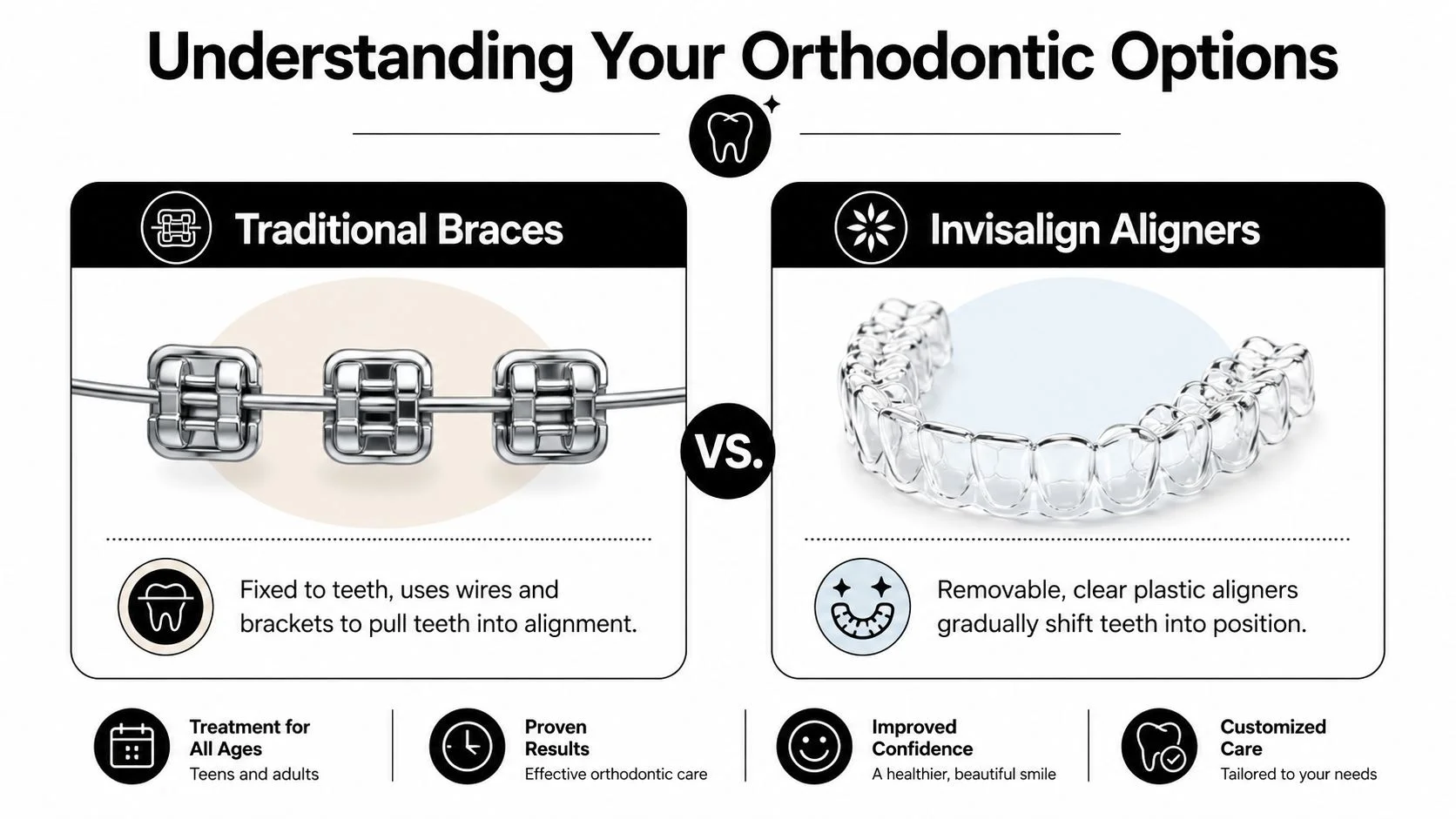
Both systems move teeth with gentle pressure. The difference is how that pressure is delivered and how much of the process depends on the patient.
How traditional braces work
Traditional braces use bonded brackets and archwires. Once attached, they apply continuous force to guide teeth into better positions over time. Because braces stay on the teeth, they keep working whether you're busy, distracted, or not thinking about treatment at all.
That fixed design gives the dentist more control over difficult movements. If teeth need major rotation, significant alignment changes, or more involved bite correction, braces often provide a more direct mechanical advantage.
Think of braces as steady hands on the steering wheel. The system stays engaged all day and all night.
How Invisalign works
Invisalign uses a series of custom clear aligners. Each set is shaped to move teeth in planned increments, and you switch to the next set as treatment progresses. Instead of wires being adjusted on the teeth, the treatment follows a sequence of trays designed to keep movement advancing.
That removability is also where the tradeoff begins. Clear aligners are convenient and nearly invisible, but they rely on compliance. The main technical difference is well summarized by this explanation of control versus convenience in clear aligners and braces, which notes that aligners typically need to be worn 20 to 22 hours per day while braces deliver force without depending on patient removal habits.
Why the mechanics matter in real life
A removable system gives you freedom. You can take aligners out for meals, photos, presentations, and brushing. A fixed system gives you consistency. You don't have to remember to put it back in.
Braces keep moving teeth when life gets busy. Invisalign works beautifully when the patient does their part every day.
This is why two people with similar crowding might receive different recommendations. One may value flexibility and have the discipline to wear trays exactly as directed. Another may need a system that doesn't leave progress up to memory or routine.
For patients searching for a dentist near me because they want a straighter smile without confusion, this is usually the first major distinction to understand. Invisalign follows a planned route. Braces allow more continuous guidance and adjustment along the way.
A Detailed Comparison for Your Treatment Journey
Once patients understand how each system works, the next question is simpler. What will everyday treatment feel like?
Appearance and discretion
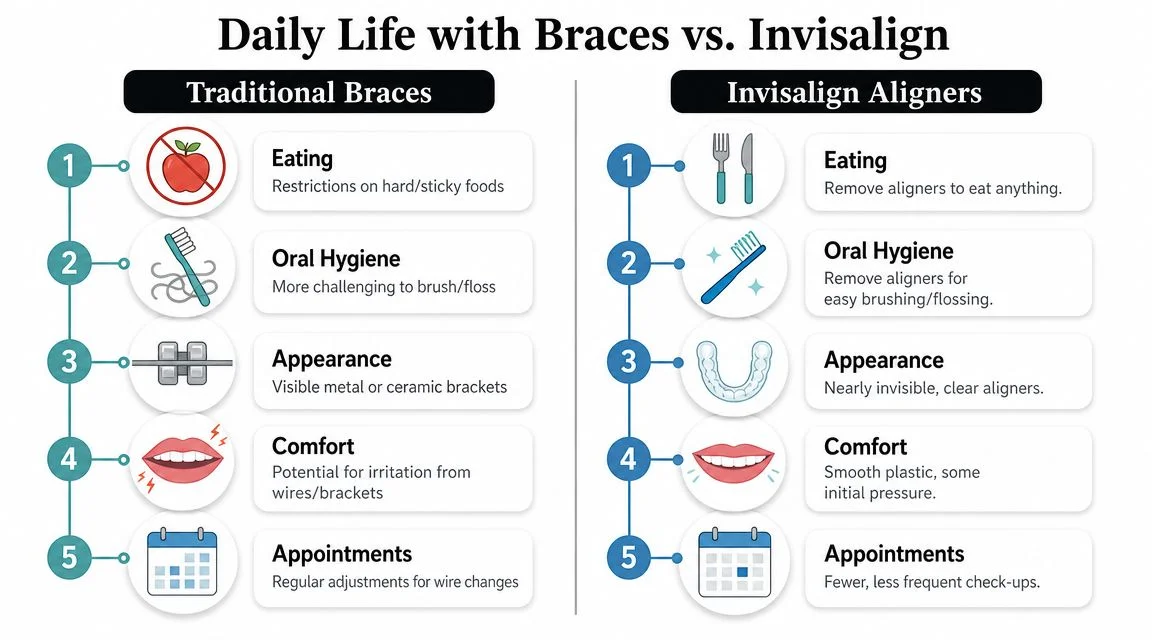
Invisalign often distinguishes itself early on. The aligners are clear, so many adults prefer them when they want orthodontic treatment to stay low-profile at work or in social settings. If you're speaking with clients, attending events, or do not want metal to show in photos, that matters.
Traditional braces are more visible. Some patients don't mind that at all. Others prefer ceramic or metal brackets because they care more about treatment control than appearance during treatment.
Comfort and adjustments
Both options can create pressure. That's normal. Tooth movement requires force.
Patients often describe the experience differently, though. With braces, irritation may come from brackets and wires rubbing the lips or cheeks, especially early on or after adjustments. Invisalign doesn't have metal hardware, so the feel is smoother against the soft tissue, but each new tray can create tightness as teeth begin the next stage of movement.
Neither option is completely sensation-free. The better question is what type of sensation you're more likely to tolerate well.
Eating and oral hygiene
This category changes daily life more than many patients expect.
With Invisalign, you remove the trays before meals and snacks. That means you can generally eat what you want, but you also need to brush before putting the aligners back in. Patients who already keep a structured routine often do well with that.
With braces, there is no need to remove anything before eating, but food choices matter more. Hard, sticky, and crunchy items can create problems for brackets and wires. Cleaning also takes more effort because brushing and flossing must work around the hardware.
Timing and efficiency
The treatment timeline depends on the case, not just the product name. Even so, one comparative analysis found a mean treatment time of 18 months for Invisalign versus 24 months for braces, with high success rates for both approaches and no significant difference in relapse in that analysis. You can review that comparison in the PMC study on Invisalign and conventional braces treatment outcomes.
For some patients, that shorter average treatment window is appealing. But average numbers don't replace diagnosis. A mild alignment case and a complex bite correction are not the same treatment challenge.
If you want a closer look at timing questions, this page on how long Invisalign takes is a helpful next read.
Office visits and monitoring
Braces and Invisalign also create different kinds of appointments.
Braces often require visits focused on wire changes, adjustments, and close tracking of movement. Invisalign visits are commonly built around progress checks and receiving the next set of aligners or updating the plan when needed. Both require follow-through. The difference is what the dentist is managing at each step.
For busy Walnut Creek patients, that's often part of the decision. Some people want fewer disruptions and prefer removable trays. Others want the reassurance of a fixed appliance that keeps working without daily choices.
Here is the practical summary:
- Choose Invisalign if discretion, removability, and easier brushing matter most, and you're confident you'll wear trays as directed.
- Choose braces if you want a system that stays on full time and gives stronger control for more difficult tooth movement.
- Ask about timing carefully because averages can be useful, but your bite and alignment pattern determine your actual schedule.
Lifestyle Fit and the Daily Patient Experience
The day-to-day difference between Invisalign and braces is often what decides the case.
Living with Invisalign
Invisalign tends to fit adults especially well when they want treatment to stay subtle and they don't mind structure. The aligners come out for meals, coffee breaks, and brushing, but that freedom only works if the trays go right back in.
A common problem isn't that the aligners fail. It's that real life chips away at wear time. A long lunch, frequent snacking, social events, and travel can gradually reduce the hours enough to slow progress. Invisalign works best for patients who don't mind discipline.
Recent patient-focused reporting summarized in this Invisalign and braces overview notes that around 95% of Invisalign users experienced less pain and discomfort than with traditional braces, about 96% reported overall satisfaction, and aligners generally need to be worn 20 to 22 hours per day.
Daily reality: If you're the kind of person who loses sunglasses, skips routines, or forgets small tasks, removable orthodontics may feel harder than it sounds.
For some patients exploring a more cosmetic route, Six Month Smile braces can also come up in conversation as another tooth-straightening option, depending on the case and goals.
A quick visual overview can help if you're comparing the routines side by side:
Living with braces
Braces ask less of your memory and more of your adaptation. You don't remove them, so the treatment keeps moving. That can be a relief for patients who don't want one more daily responsibility.
The tradeoff is practical. Certain foods are more troublesome. Cleaning takes longer. The first stretch with brackets and wires can feel awkward until your cheeks, tongue, and brushing routine adjust. Still, many patients prefer that kind of challenge over the responsibility of a removable appliance.
Which daily pattern sounds more like you
Some patients do best with freedom. Others do best with structure built in.
- You may prefer Invisalign if you're organized, motivated by appearance, and comfortable removing trays every time you eat or drink anything besides water.
- You may prefer braces if you'd rather not think about compliance all day and want treatment to keep working in the background.
- You should pause and reconsider aligners if you know your schedule is unpredictable or you already struggle with consistent habits.
Which Option Is Right for Your Specific Smile Goals
A patient in Walnut Creek might come in asking for the least noticeable option, then learn the key question is how much tooth movement the case requires and how predictable that movement needs to be. Smile goals matter, but the bite, spacing, crowding, and jaw relationship decide which system is likely to work best.
When Invisalign is often a strong fit
Invisalign is often a good choice for mild to moderate alignment problems, especially spacing, minor crowding, or teeth that have shifted after past orthodontic treatment. Many adults prefer it because the trays are less visible and can be removed for meals, brushing, and flossing.
At William M. Schneider, DDS, Invisalign is one option I consider when it fits both the cosmetic goal and the mechanics of the case. If a patient wants a discreet treatment and the tooth movements are realistic for aligners, it can be a very practical solution.
When braces often make more sense
Traditional braces still have an advantage in cases that need stronger control. That includes severe crowding, difficult rotations, larger bite corrections, and situations where I want consistent force on the teeth without relying on daily wear habits.
Some smiles respond better to a fixed system. In those cases, braces are not the "old-fashioned" choice. They are the more dependable one.
Why diagnosis matters more than preference
Research published in a PMC report on clear aligners and fixed appliances in simple Class I cases found that Invisalign patients required 4.8 more months than comparable braces patients, which is a useful reminder that aligners depend heavily on wearing them 20 to 22 hours per day.
That point matters in real life. Two Walnut Creek patients may want the same cleaner look during treatment, but one has the kind of bite that aligners can handle well, while the other needs the control of brackets and wires. The better option is the one that matches both the teeth and the person's habits.
Orthodontic treatment also affects the bigger picture for your smile. If you are planning whitening, restorative work, or longer-term cosmetic changes, the way teeth are aligned now can make later treatment simpler and more predictable.
Schedule Your Consultation with Your Walnut Creek Dentist
Once you've compared Invisalign vs. traditional braces, the next step is to narrow the decision to your own priorities.
Questions worth bringing to your visit
A good consultation usually becomes much easier when patients already know what matters most to them.
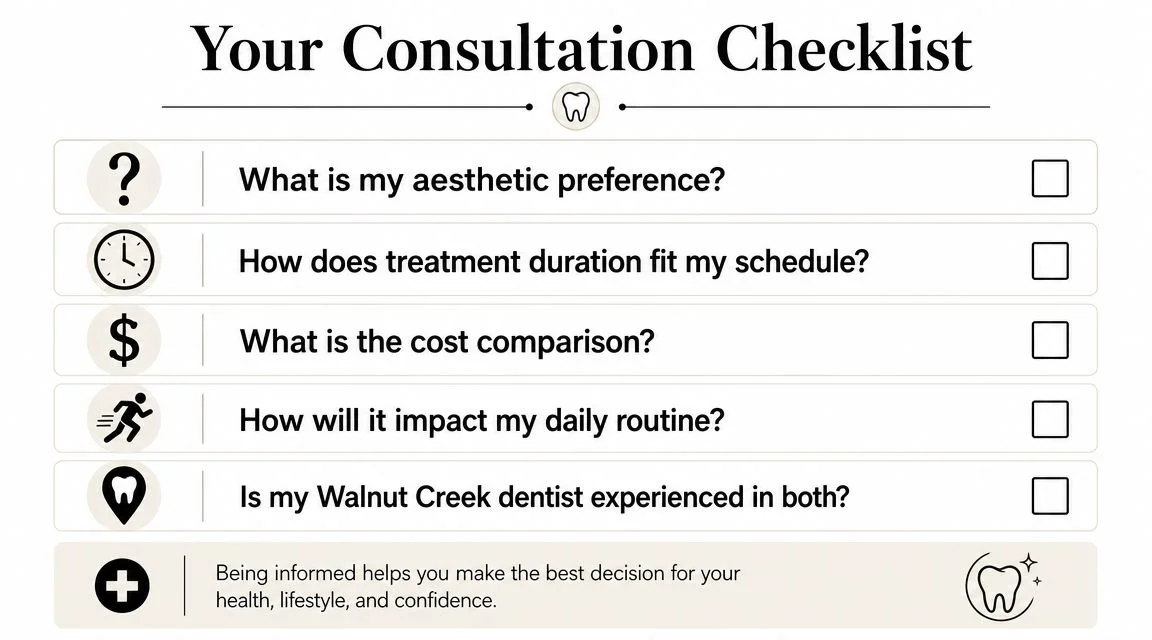
- Appearance concerns. Do you strongly prefer a treatment option that's less noticeable in meetings, photos, or social settings?
- Routine and discipline. Are you realistically going to wear a removable appliance exactly as instructed every day?
- Complexity of movement. Are you trying to fix minor crowding, or is the issue more about bite, rotation, or heavier alignment changes?
- Oral hygiene habits. Would you do better removing trays to brush and floss, or would a fixed system be easier because you can't forget it?
- Long-term planning. Will your orthodontic treatment connect with other care such as cleanings and exams, cosmetic dentistry, crowns, or even future restorative work?
What to expect from a local dental consultation
An orthodontic evaluation should look at more than whether teeth appear crooked. It should consider bite function, crowding pattern, spacing, gum health, existing dental work, and whether your treatment choice fits your lifestyle. That matters just as much as the appliance itself.
If you're also looking for a long-term dentist in Walnut Creek, CA, this kind of visit can tie orthodontic planning into overall oral health. That may include preventive care, dental x-rays, new patient exams, cosmetic planning, or restorative needs that should be considered before or after tooth movement. If you have urgent discomfort, broken dental work, or swelling, those concerns may need to be addressed first, just as they would with emergency dentist care or a needed tooth extraction. And if your long-term plan includes missing teeth, dental implants near me may become part of the discussion after alignment is complete.
The right treatment usually becomes clearer once your teeth are examined in person. Not online. Not from a photo. Not from a general rule.
If you're ready to get a clear answer for your smile, schedule a consultation with William M. Schneider, DDS. Dr. Schneider and his team provide personalized dental care in Walnut Creek with a practical, patient-focused approach, so you can understand your options and move forward with confidence.