A cracked tooth often announces itself at the worst time. You bite into lunch in Walnut Creek, feel a sharp edge, and suddenly you're searching for answers fast. Other people notice a dark spot on a molar, lose a filling, or get tired of chewing on one side because a missing tooth has changed the way their bite feels.
That's usually what starts the search for a dentist near me, an emergency dentist, or a dentist in Walnut Creek, CA. Most patients aren't just looking for a nearby office. They're trying to figure out whether they need same-day relief, a careful long-term repair, or both.
Your Guide to Restorative Dentistry in Walnut Creek
Dealing with pain, a broken tooth, an old crown that no longer feels right, or a gap in your smile that's starting to affect eating and confidence can prompt a need for restorative dentistry near me. Those problems can feel urgent, even when the solution requires more than one visit.
A common question is whether restorative care means emergency treatment or a complete plan. That uncertainty is understandable. Untreated dental caries in permanent teeth affect about 2.0 billion people worldwide, which helps explain why so many people looking for local care are trying to understand what needs immediate attention and what can safely wait, as noted by Nordhus Dentistry's discussion of restorative dentistry triage.
In practical terms, the first step is usually triage. A cracked tooth with severe pain may need stabilization right away. A missing tooth that has been there for months may not be an emergency, but it still deserves a plan before neighboring teeth start shifting or your bite changes further.
What patients usually want to know first
Most new patients ask some version of the same questions:
- Is this urgent: Do I need to be seen quickly for pain, swelling, or a broken tooth?
- Can this tooth be saved: Or am I looking at extraction and replacement?
- What will it take: A simple filling, a crown, a root canal, or something more involved?
- Will it look natural: Especially if the tooth shows when I smile.
A good restorative visit starts by solving the immediate problem first, then deciding what gives the tooth or replacement the best chance to last.
In Walnut Creek, that kind of clarity matters. People want treatment that fits real life. They want to get out of pain, keep their smile looking natural, and avoid repeating the same repair again and again. Restorative dentistry is how that happens when decay, fractures, infection, or tooth loss begin to interfere with daily comfort.
Understanding What Restorative Dentistry Covers
Restorative dentistry is the part of dental care focused on rebuilding teeth that have been weakened, damaged, infected, or lost. Think of it like repairing a home's structure, not just repainting the walls. The goal is to restore strength, function, comfort, and appearance in a way that holds up over time.
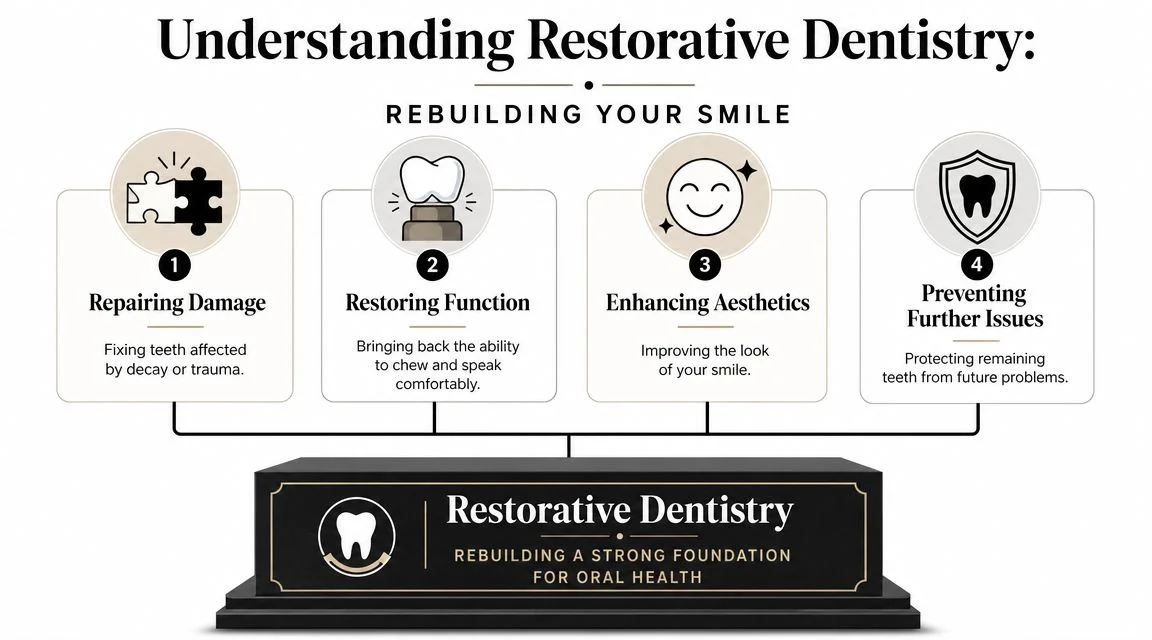
That can include a small filling for early decay, a crown for a cracked tooth, a bridge to replace a missing tooth, or implant treatment when a tooth can't be saved. It also includes the decision-making that happens before treatment starts. Not every damaged tooth needs the same fix, and the fastest repair isn't always the smartest one.
How dentists decide what makes sense
Restorative care is commonly guided by a three-part triage. The clinician asks whether the tooth is strategically important, whether it is restorable, and whether the treatment is complex enough to need referral, as described in the clinical review on contemporary restorative decision-making.
That sounds technical, but the patient version is simple. Three questions drive the recommendation:
| Question | Why it matters |
|---|---|
| Does this tooth play an important role? | Back teeth carry chewing force. Front teeth affect smile appearance and speech. |
| Can it be restored predictably? | Some teeth have enough healthy structure left. Others are too compromised. |
| Is the case straightforward or complex? | Some cases are handled in a general practice. Others need coordinated specialty care. |
Restoring more than just the tooth
A good plan doesn't look only at the hole, crack, or missing space. It also looks at how you chew, how the restoration will feel, what you can keep clean, and how long the result is likely to last.
- Function comes first: If you can't chew comfortably, the restoration hasn't fully solved the problem.
- Appearance still matters: Even back teeth should look natural and fit your bite properly.
- Longevity shapes the decision: A repair should protect the tooth, not just patch the visible damage.
- Prevention is part of treatment: The best restoration also lowers the chance of another breakdown nearby.
Practical rule: The right restoration is the one that fits the tooth's condition, your bite, and your long-term goals, not just the one that can be done fastest.
That's why restorative dentistry overlaps with preventive care, cosmetic dentistry, and sometimes tooth extraction planning. In many cases, saving a tooth is ideal. In others, replacing it well may offer the more predictable path forward.
Common Restorative Treatments to Restore Your Smile
When patients look for restorative dentistry in Walnut Creek, they're usually trying to match a problem to a solution. The most useful way to think about treatment is by asking what the tooth needs now, and what will keep it stable later.
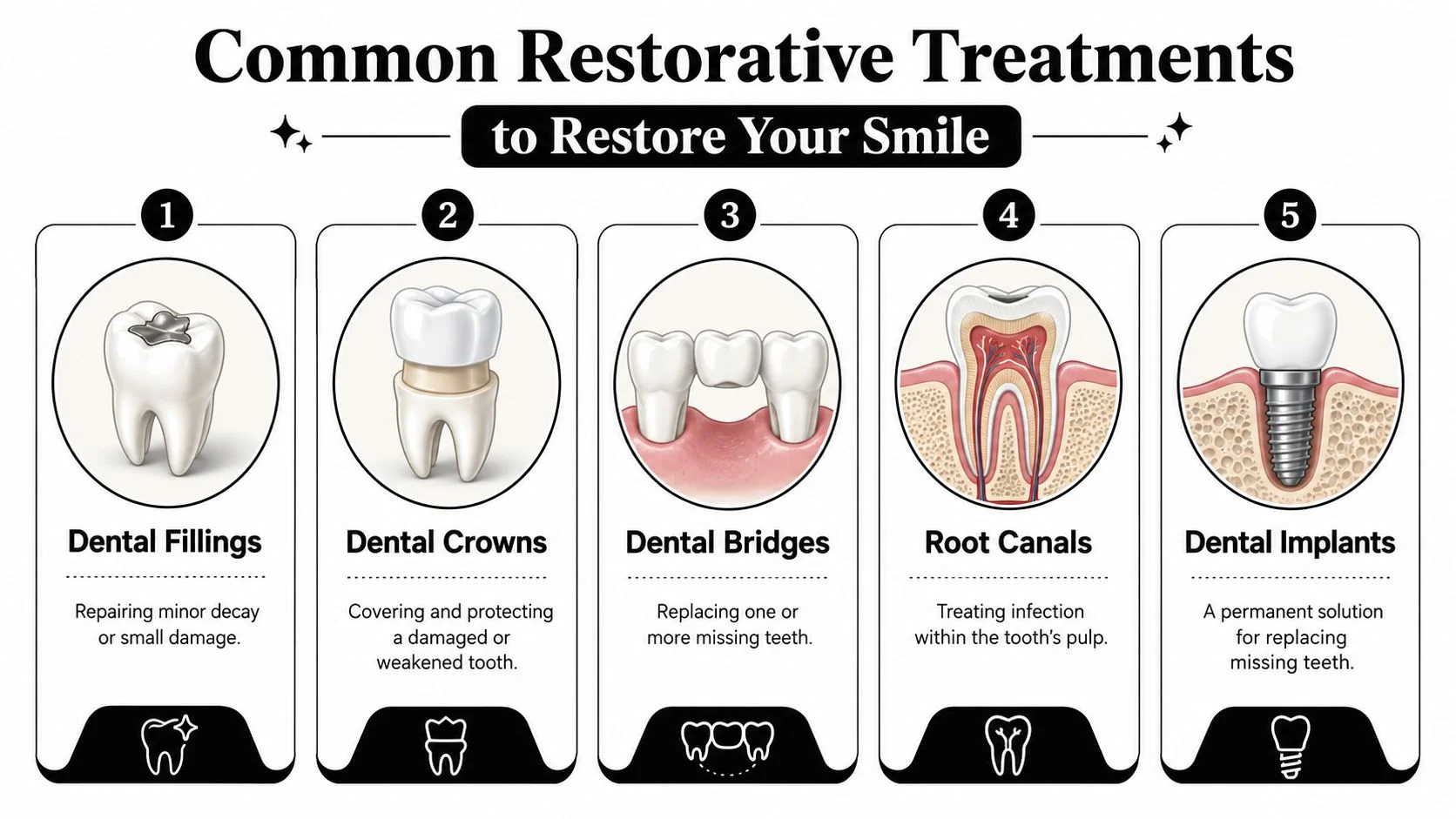
For small to moderate damage
A dental filling is often the right choice when decay is limited or a tooth has minor wear or a small chip. It restores lost structure without covering the whole tooth. If the damage is caught early, this is usually the most conservative option.
A dental crown becomes more useful when a tooth is cracked, heavily filled, worn down, or weakened after deeper decay. Instead of repairing one spot, the crown covers and protects the visible part of the tooth. Crowns are often a better fit when the tooth can still be saved but needs broader support.
When pain points to deeper trouble
A root canal is used when infection or inflammation reaches the pulp inside the tooth. Patients often associate this with severe sensitivity, lingering pain, or swelling, though some infected teeth are quieter than expected. The goal is to remove the damaged tissue inside the tooth and keep the outer tooth in place when that remains a sound option.
In many situations, a root canal and crown go together. The root canal treats the inside. The crown protects the remaining outer structure from fracture.
If a tooth hurts when you bite, reacts strongly to temperature, or has a visible crack, don't assume it only needs a filling. The outside story and the inside story can be different.
Replacing a missing tooth
When a tooth is missing, the main restorative options are usually a bridge or a dental implant.
A bridge fills the gap by anchoring to neighboring teeth. It can be a practical choice in the right situation, especially when the adjacent teeth already need restorations. An implant replaces the missing tooth in a different way. It places support in the jaw and restores the tooth without relying on neighboring teeth for that support.
Modern implant dentistry grew from the discovery of osseointegration in 1952, and by 1982 implant treatment had been clinically validated as a predictable restoration method, according to this overview of restorative dentistry and implant history. For patients comparing options today, that history matters because implants are no longer an experimental idea. They are a well-established part of mainstream restorative care.
For patients exploring dental implants near me, dental implants in Walnut Creek are typically considered when a single tooth is missing, when preserving adjacent teeth matters, or when a long-term replacement is the goal.
A quick way to compare options
| Treatment | Best for | Main trade-off |
|---|---|---|
| Filling | Small decay or minor damage | Not enough for larger cracks or weakened teeth |
| Crown | Significant damage or protection | Requires more tooth coverage than a filling |
| Root canal | Infection inside the tooth | Usually needs follow-up restoration for strength |
| Bridge | Replacing a missing tooth with support from adjacent teeth | Uses neighboring teeth for support |
| Implant | Replacing a missing tooth without depending on adjacent teeth | Often involves a longer treatment sequence |
Restorative care often overlaps with cosmetic concerns too. A front-tooth crown, implant, or bonded repair has to feel strong and look right. That's why patients who begin by searching for a cosmetic dentist near me sometimes discover that the actual need is both cosmetic and restorative at the same time.
Your Treatment Journey With Dr Schneider
Most patients feel better once they know what the process will look like. Uncertainty creates more anxiety than dentistry itself. A clear sequence, with explanations along the way, makes treatment easier to commit to and easier to complete.
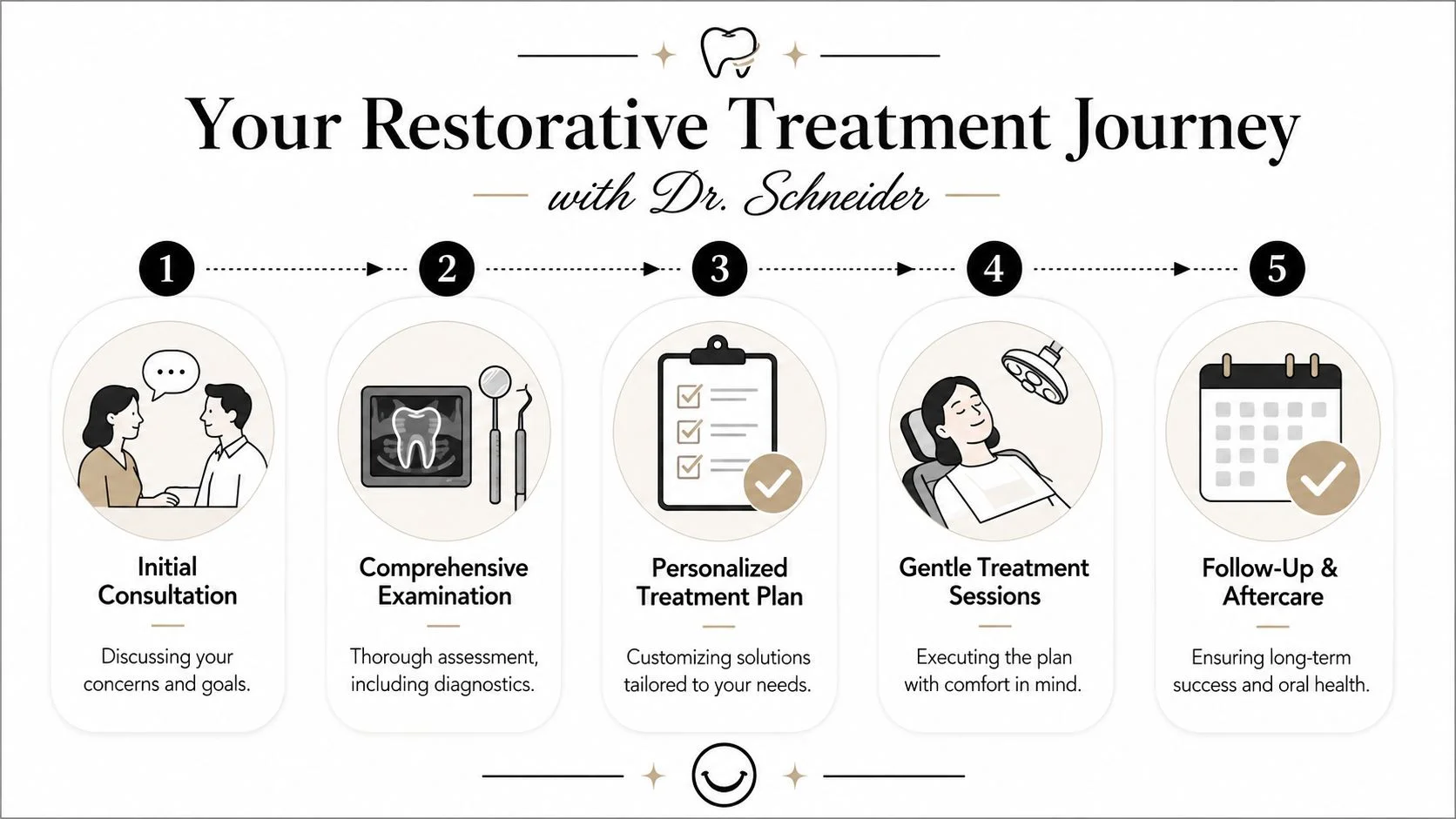
At William M. Schneider, DDS, the restorative process typically begins with a conversation about what changed. Maybe you broke a tooth, lost a crown, noticed pain when chewing, or have been putting off replacing a missing tooth. That history matters because it often points to whether the problem is sudden, progressive, or part of a larger bite issue.
The first visit and diagnostic phase
A thorough exam does more than locate the damaged tooth. Modern restorative workflows use tools such as clinical diagnosis, full-mouth radiographs, intraoral photography, and intraoral scanning before final treatment is designed. When surgery is anticipated, CBCT imaging may also be part of planning, as outlined in Decision in Dentistry's article on digital restorative workflows.
That matters because a restoration has to match both the clinical reality and the patient's goals. If someone says, “I just want the pain gone,” the plan may start with stabilization. If they also want to improve smile appearance, bite comfort, and long-term durability, the plan should reflect that from the beginning.
From planning to treatment
After diagnostics, the next step is choosing the sequence. Some patients need one visit. Others need staged care. A common order looks like this:
- Stabilize the urgent issue: Address pain, fracture, infection, or a failed restoration.
- Confirm the long-term plan: Decide whether the tooth is being repaired, protected, or replaced.
- Complete the definitive restoration: Place the filling, crown, bridge, implant restoration, or related treatment.
- Check function and maintenance: Make sure the bite feels right and the restoration can be kept clean.
Good treatment planning reduces surprises. It also helps patients understand why a temporary fix and a final fix aren't always the same thing.
Why digital planning improves predictability
Digital photography and scanning are valuable because they let the office evaluate shape, spacing, bite, and visible symmetry before the final design is made. In complex cases, scanning techniques can be segmented and stitched in software to preserve fit and reduce distortion during larger restorative work, as described in the same clinical workflow reference above.
For patients, the takeaway is simple. Better records usually lead to better-fitting restorations, clearer communication, and fewer mismatches between what was expected and what gets delivered.
Ensuring Your Comfort With Gentle and Sedation Dentistry
For many people, the hardest part of restorative care isn't choosing between a crown and an implant. It's making the appointment in the first place. Fear of pain, bad past experiences, sensitivity to sounds or injections, and embarrassment about how long the problem has been there can all delay treatment.

Comfort-focused care starts with communication. Patients do better when they know what's happening, what they may feel, and what the next step is before treatment begins. A calm pace, clear explanations, and a team that pays attention to your stress level can change the whole experience.
What gentle dentistry usually looks like
A gentler visit often comes down to small choices that add up:
- Slow, careful numbing: Many anxious patients fear the injection more than the procedure. Technique matters.
- Check-ins during treatment: A patient who can pause and communicate tends to feel more in control.
- Clear expectations: Knowing whether a tooth will feel pressure, vibration, or temporary soreness reduces fear of the unknown.
- A calmer environment: Simple reassurance and steady pacing can lower tension before treatment even starts.
Some patients need more support than reassurance alone. That's where sedation can help. If you've avoided treatment because you're nervous, have a strong gag reflex, or need longer restorative visits, it helps to review how dental sedation works before your appointment.
When extra support makes sense
Sedation dentistry isn't only for major procedures. It can also help patients who become tense during routine restorative care, especially when there's already pain or dental anxiety involved. The purpose is to make treatment feel manageable, not overwhelming.
This short video offers a helpful overview for patients who want a calmer experience during dental care:
Many people who say they hate the dentist don't hate dentistry itself. They hate feeling rushed, tense, or unsure of what will happen next.
That distinction matters. Once patients feel heard and physically comfortable, they're much more likely to complete the care that protects their teeth and relieves pain.
Navigating Insurance and Financing for Your Care
Cost is one of the first things patients think about, especially when treatment wasn't planned. A chipped tooth before a work event, a broken crown, or the need to replace a missing tooth can quickly turn into questions about insurance, timing, and payment options.
The most useful approach is to separate immediate need from final investment. If a tooth is painful or unstable, the first goal is to stop the problem from getting worse. After that, the office can help you understand what your insurance may cover, where out-of-pocket costs may apply, and whether staged treatment makes sense.
Looking beyond the upfront fee
The least expensive option today isn't always the lowest-cost option over time. Longevity matters, especially when you're comparing treatments for tooth replacement. As Scheer Dentistry's overview of restorative options notes, 10-year survival rates for single dental implants are commonly above 90%, which is one reason many patients see implants as a durable long-term investment.
That doesn't mean every patient should choose an implant. It means cost should be weighed alongside maintenance, retreatment risk, and how the restoration affects nearby teeth.
Practical questions to ask before you start
These questions help clarify the financial side without losing sight of health needs:
- What part is urgent: Ask what needs to happen now and what can be phased.
- How does insurance apply: Find out which parts may be covered and which may not.
- What are the alternatives: Compare the trade-offs, not just the price tags.
- Can treatment be staged: Some plans can be completed in steps to make timing easier.
A good financial conversation should leave you feeling informed, not pressured. Restorative treatment works best when the clinical plan and the payment plan are both realistic.
Why Walnut Creek Chooses Dr William M Schneider
Choosing a restorative dentist is about more than finding someone who offers crowns, root canals, or dental implants. Patients want a dental home where the diagnosis is careful, the recommendations are understandable, and the treatment feels manageable from start to finish.
In Walnut Creek, that usually means looking for a practice that can handle routine care, emergency concerns, and longer-term smile repair without making the process feel fragmented. It also means finding a team that respects the patient experience. People remember whether they felt listened to, whether injections were gentle, and whether the plan made sense.
What matters when you're deciding
Several factors tend to shape that decision:
- Experience with a wide range of care: Restorative cases often overlap with preventive, cosmetic, and bite-related needs.
- Modern diagnostic tools: Better imaging and digital planning support more precise treatment.
- A comfort-minded approach: Anxiety can derail good care if the environment doesn't feel supportive.
- Clear communication: Patients need honest guidance on what can be repaired, what should be replaced, and why.
Restorative dentistry is also a major part of modern dental care overall. The global dental services market was valued at about $428.5 billion in 2024 and is projected to reach roughly $673.4 billion by 2032, with a 5.8% CAGR, according to North Grove Dental's restorative dentistry market overview. For patients, the practical takeaway is that restorative treatment is not niche or experimental. It includes standard, widely used procedures such as fillings, crowns, bridges, and implants.
Local care that fits real life
For families and professionals in Walnut Creek, convenience matters, but trust matters more. You want to know who to call when a tooth breaks, when pain starts, or when an old dental problem can't be postponed any longer. You also want a plan that protects long-term oral health instead of chasing one short-term fix after another.
That combination of judgment, comfort, and follow-through is what people are really looking for when they search for restorative dentistry near home.
If you're ready to repair a damaged tooth, replace a missing tooth, or get clear answers about pain, bite changes, or emergency concerns, William M. Schneider, DDS welcomes patients in Walnut Creek and the East Bay at 1855 San Miguel Dr., Suite 31. Call the office to schedule an appointment or consultation and take the next step toward a healthier, more comfortable smile.