If you've recently had a molar removed, you may already be noticing the space with your tongue every time you eat or talk. A lot of patients in Walnut Creek ask the same question at this point: Will the other teeth move now that the molar is gone?
The short answer is yes, they can. That doesn't mean panic is necessary, but it does mean the empty space deserves a plan. Teeth don't stay frozen in place just because the extraction is over. Your bite is a system, and when one of the larger back teeth is missing, the rest of that system starts adapting.
That's where good post-extraction dental care matters. The right next step can help protect your comfort, chewing function, and long-term smile. For patients looking for a dentist in Walnut Creek, CA, this is one of the most common restorative conversations we have after a tooth extraction.
Your Local Guide to Post-Extraction Dental Care in Walnut Creek
A familiar situation goes like this. A patient has a painful molar removed, feels relieved that the infection or pressure is gone, then a few days later a new worry sets in. The soreness fades, but the empty space doesn't. Meals feel a little different. Food catches more easily. The patient starts wondering whether waiting is harmless or whether that gap will create bigger problems.
That concern is valid. Teeth shifting after molar extraction is a real issue, and it's one that's easier to manage early than later. In a busy community like Walnut Creek, people often put off follow-up treatment because work, commuting, family schedules, and everyday life get in the way. The problem is that your mouth keeps adapting even while you're busy.
What patients usually want to know first
Individuals aren't asking for a technical explanation. They want practical answers:
- Will the nearby teeth drift? Yes, they can.
- Is this only cosmetic? No. It can affect your bite and how you chew.
- Do I have to replace a missing molar? In many cases, replacing it is the most reliable way to protect the rest of the arch.
- Can I wait a little while? Sometimes, but waiting should be intentional and monitored, not indefinite.
Practical rule: After a molar extraction, don't assume “it feels fine” means “nothing is changing.”
If you're still healing, proper aftercare comes first. If you need guidance on that stage, this tooth extraction recovery guide is a helpful place to start. Once the site is healing well, the next question becomes how to keep the rest of your teeth from responding to that open space.
Why local follow-up matters
This isn't just about replacing one tooth. It's about protecting the whole bite. When patients have a nearby dental home in Walnut Creek, it's easier to get the follow-up exam, digital X-rays, and restorative planning done before small changes turn into more complicated treatment.
Why Teeth Shift After a Molar is Removed
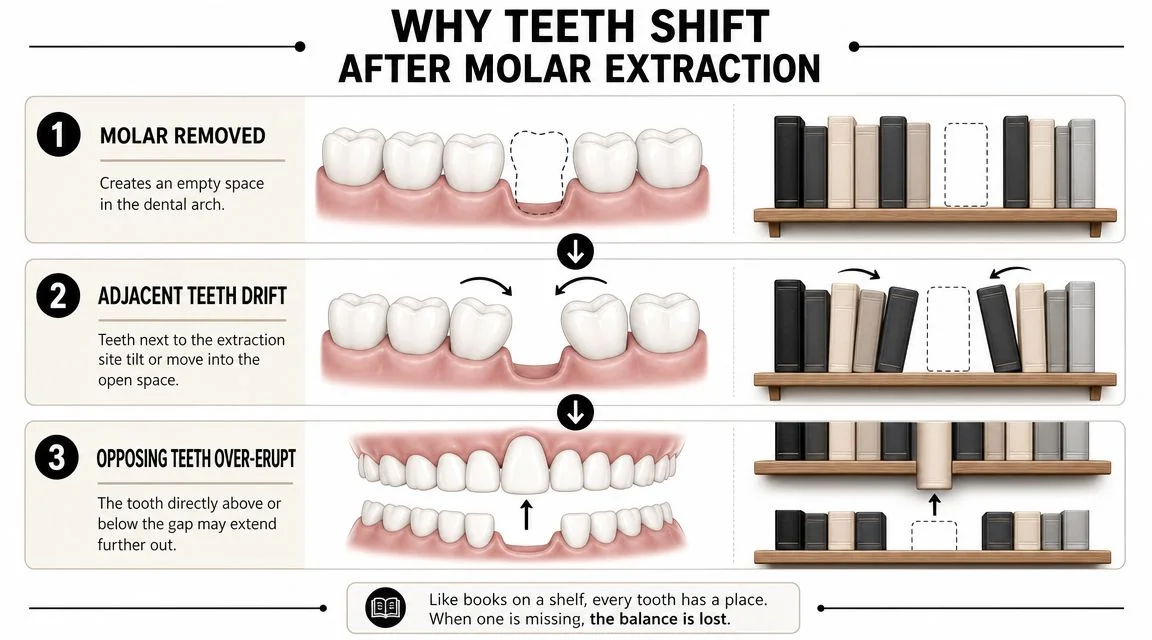
Think of your teeth like books standing upright on a shelf. Remove one large book from the row, and the books beside it no longer have the same support. They start leaning into the open space. Your teeth behave in a similar way.
A molar plays a big structural role because it's a wide chewing tooth. Once it's removed, the neighboring teeth may start drifting, tilting, or rotating toward that gap. Independent dental guidance notes that this risk is especially relevant after molar extraction because molars leave a wider space, and some shifting can appear within a few weeks with more noticeable changes over several months, as explained in this guidance on shifting teeth after extraction.
What changes inside the mouth
When a tooth is removed, the balance changes in two directions.
First, the adjacent teeth can begin to lean into the opening. Because those teeth are no longer touching the missing molar, they lose part of the contact pattern that helped keep them aligned.
Second, the opposing tooth in the other arch may start moving into the space because it no longer bites against its partner. Patients sometimes notice this later as a change in how their teeth meet when they close.
Why molars matter more than many patients expect
Front-tooth gaps get attention because they're visible. Missing molars can seem less urgent because they're farther back. But chewing forces are concentrated in the posterior part of the mouth, and molars do a lot of the heavy work.
That's why a missing back tooth often creates practical problems before it creates obvious cosmetic ones. You may chew on one side, avoid certain foods, or notice food packing into the area. Over time, those daily habits can reinforce an uneven bite.
A missing molar rarely stays an isolated issue. The neighboring teeth and the opposing tooth often respond to it.
What doesn't work
Patients sometimes hope the space will automatically “stay open” on its own until they get around to treatment. Usually, that's not a reliable plan. The mouth is always under pressure from chewing, clenching, swallowing, and natural tooth movement.
Here's the simple distinction:
| Situation | Likely result |
|---|---|
| Leaving the space alone | The surrounding teeth may begin adapting to the gap |
| Monitoring with a replacement plan | The bite has a much better chance of staying stable |
| Replacing the missing molar in a timely way | The arch is more likely to keep its shape and function |
Timeline Symptoms and Risks of Tooth Shifting
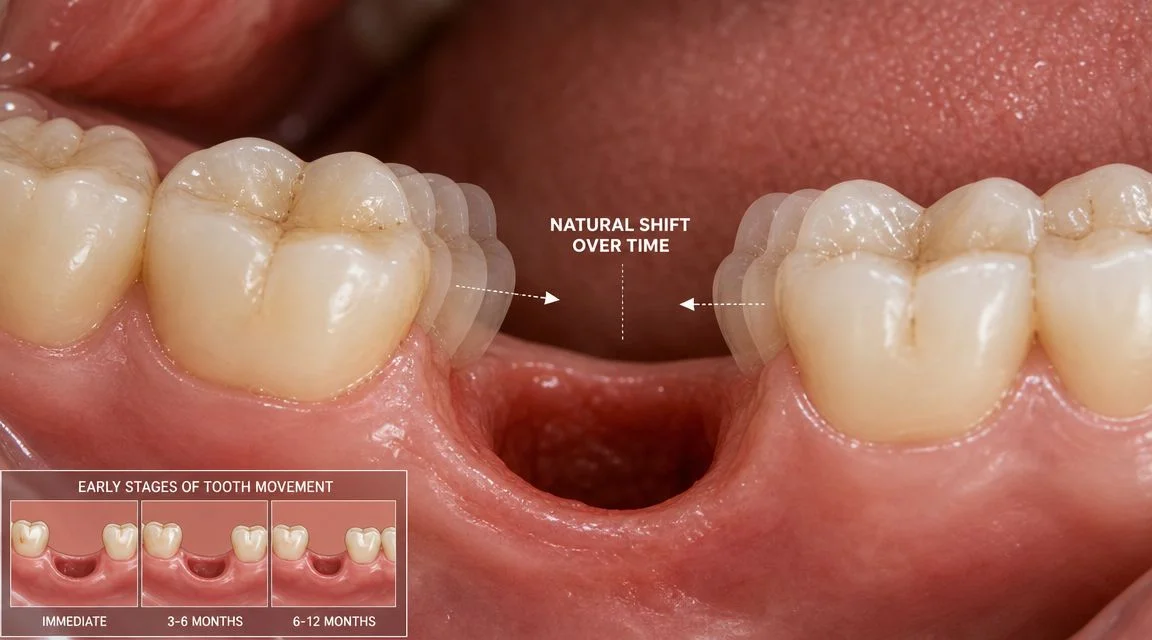
The part that surprises many patients is the timing. Teeth shifting after molar extraction doesn't always take years to show up. Some movement can begin early, even if you don't see it right away in the mirror.
In a 3D analysis of physiologic drift after extraction, researchers observed that extraction spaces decreased by approximately 1.6 mm in women and 3.23 mm in men during the first 6 months, and all measured teeth showed tipping toward the extraction space, according to this 3D study on post-extraction drift. That's a useful reminder that the process is measurable, not theoretical.
What you might notice first
Patients usually don't describe this as “my teeth are drifting.” They describe the effects:
- Food trapping more often in the extraction area or between nearby teeth
- A bite that feels off when closing the jaw
- A change in chewing habits, often favoring the other side
- Teeth that feel harder to floss around because the angles have changed
- Visible tilting or spacing changes over time
Some people also notice tenderness in certain spots when chewing because forces aren't being distributed as evenly.
Why waiting can create bigger treatment needs
A tilted tooth is harder to clean well. When plaque collects in difficult-to-reach areas, the risk of decay and gum irritation goes up. If the bite changes enough, some patients also begin clenching differently or putting extra pressure on teeth that weren't meant to handle that load.
That's when a straightforward missing-tooth problem can turn into a larger restorative issue.
Small shifts can lead to big nuisances. The issue often starts with chewing and cleaning, then affects comfort and treatment choices.
Risks that often build quietly
A missing molar can contribute to several downstream problems:
- Hygiene trouble because tilted teeth create awkward brushing and flossing angles
- Bite imbalance that changes how pressure travels across the mouth
- Wear on other teeth when one side does more of the chewing
- Restorative complexity if the space narrows before an implant or bridge is planned
- Jaw discomfort in patients whose bite becomes uneven over time
The main point isn't fear. It's prevention. The sooner a dentist evaluates the space, the more options you usually keep.
How to Prevent Teeth From Shifting After an Extraction
Prevention is almost always easier than correction. Once teeth begin drifting, treatment may involve moving them back before the missing tooth can be restored. If the goal is to protect the bite, the smartest move is to plan for the gap early.
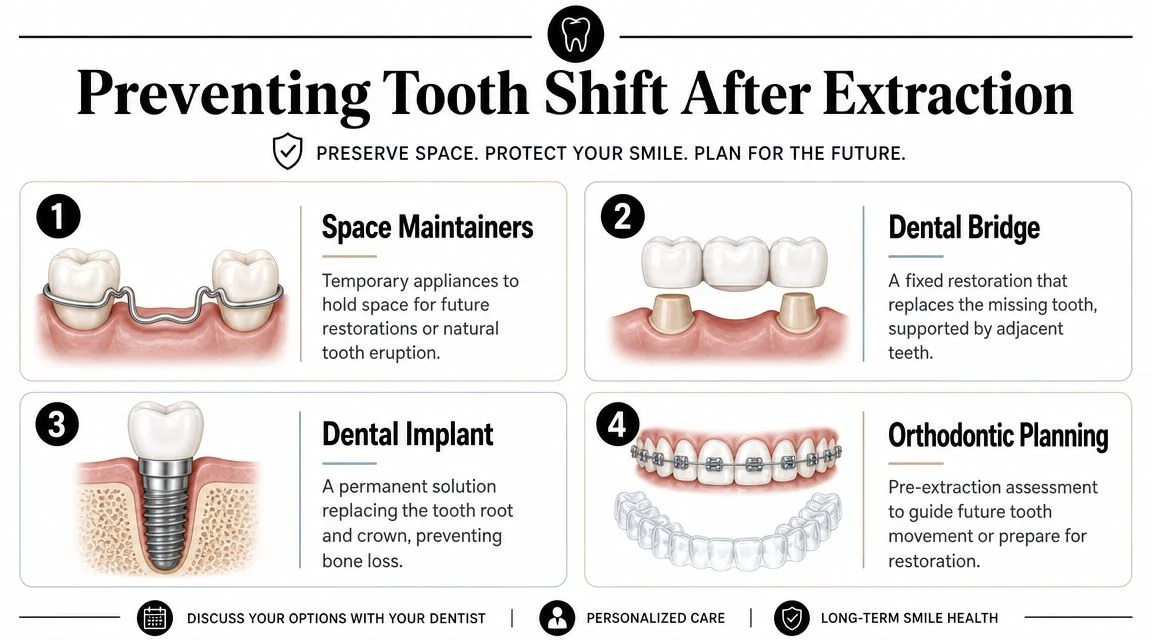
Expert summaries note that after an extraction, surrounding teeth may shift to fill the space, and preserving arch stability usually requires either maintaining the space or replacing the missing molar with a restoration such as an implant or bridge, because leaving the area unrestored allows the dentition to reorganize around the new space, as outlined in this overview of teeth shifting after extraction.
The main ways to hold the space
Not every patient needs the same solution. The right choice depends on the extracted tooth, the condition of the neighboring teeth, healing, gum health, and long-term goals.
Dental implant
This is often the most natural way to replace a missing molar because it restores the space with a stand-alone tooth replacement. It doesn't rely on the adjacent teeth for support. For patients searching for dental implants near me in Walnut Creek, this is often the option that offers the most stable long-term function when conditions are right.Dental bridge
A bridge can be a good fit when the teeth next to the gap already need crowns or when an implant isn't the preferred route. It fills the space and helps restore chewing, but it does rely on neighboring teeth as anchors.Space maintenance
In some situations, a temporary appliance may be used to help preserve room while healing or planning continues. This is more of a holding strategy than a final solution.
What tends to work best
The key is timing. A good plan starts before the space has changed too much. That doesn't always mean treatment has to happen immediately, but it does mean the decision should be intentional.
Here's a practical comparison:
| Option | What it helps with | Trade-off to consider |
|---|---|---|
| Implant | Replaces the missing tooth without depending on neighboring teeth | Requires healing evaluation and candidacy assessment |
| Bridge | Restores the gap with a fixed option | Involves the teeth beside the space |
| Temporary space holding | Helps preserve room during planning | Usually not the final answer |
What patients often regret
Most patients don't regret replacing a missing molar. They regret waiting until the space has changed and the treatment gets more involved.
For patients in Walnut Creek who want to avoid that sequence, William M. Schneider, DDS provides restorative planning that may include implants, bridges, and related follow-up care after tooth extraction. The right choice depends on your bite, the condition of nearby teeth, and how quickly the space is addressed.
If you know a molar won't be replaced right away, at least get the space evaluated. Monitoring is far better than guessing.
Correcting Shifted Teeth with Your Walnut Creek Dentist
Sometimes the teeth have already started moving by the time a patient comes in. That doesn't mean the situation is hopeless. It means the treatment plan needs to do two jobs. First, correct the position of the teeth enough to rebuild a healthy bite. Second, replace the missing tooth so the problem doesn't keep repeating.
When the space has narrowed
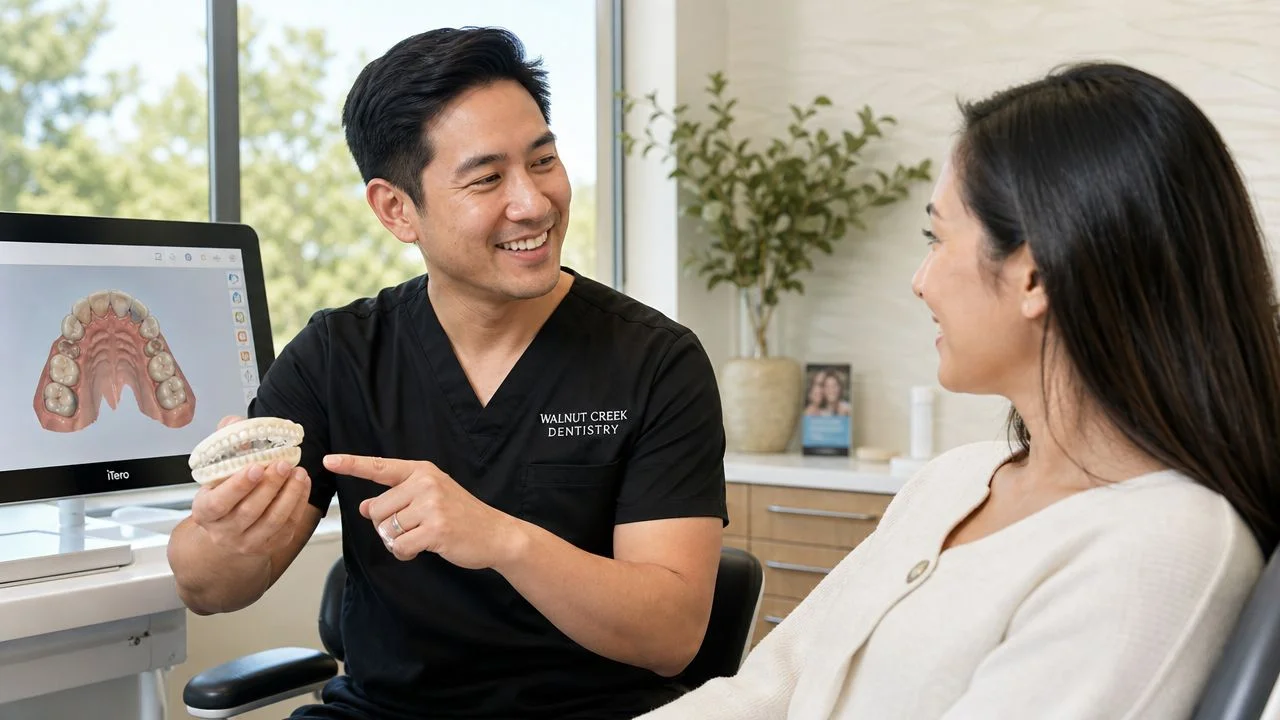
If a nearby tooth has tipped into the gap, placing a restoration may not be possible right away. The position of the tooth may need to be corrected first so there's enough room for a predictable result.
That's where orthodontic planning can help. In some cases, clear aligner treatment can gently upright or reposition teeth before the final restorative phase. For patients interested in discreet alignment correction, invisible clear aligners for adults can be part of a larger plan to prepare the bite for a bridge or implant.
A practical sequence for treatment
Correcting a shifted bite usually follows a logical order:
- Evaluate the space and bite with an exam and dental X-rays.
- Decide whether teeth need to be moved to reopen or improve the space.
- Stabilize the alignment so the final restoration has a proper foundation.
- Replace the missing molar with the restoration that fits your needs.
Some patients need only restorative care. Others need a staged plan. The important part is not forcing the wrong shortcut.
Replacing a missing tooth without addressing a tilted neighbor can leave the bite compromised. Good dentistry starts with the right foundation.
A short visual overview can help if you're comparing treatment paths:
What successful correction looks like
The goal isn't only to close a gap. It's to restore function in a way that feels comfortable and is easier to maintain.
Patients usually care about a few practical outcomes:
- Chewing more evenly
- Reducing food traps
- Making the bite feel stable again
- Replacing the missing tooth with a solution that fits long-term goals
- Improving appearance without making appearance the only priority
If you've been searching for an emergency dentist, a tooth extraction provider, or a dentist near me because a painful molar had to come out, this next stage matters just as much as the extraction itself. Removing the tooth solves the immediate problem. Restoring the bite protects what comes next.
What to Expect During Your Consultation with Dr. Schneider
Many patients put off this visit because they assume it will be complicated or uncomfortable. In reality, a consultation is usually straightforward. The purpose is to understand what has changed, what hasn't, and which options still make sense for your mouth.
At the Walnut Creek office on San Miguel Drive, the visit starts with conversation. Patients talk about when the extraction happened, whether chewing feels different, whether food is collecting in the area, and whether the bite seems uneven. That history matters because symptoms often reveal as much as the space itself.
What the exam usually includes
A consultation for a missing molar or shifting teeth commonly involves:
- A clinical exam to check the space, nearby teeth, gum health, and bite
- Digital X-rays to look at the bone and tooth positions more clearly
- A discussion of replacement options such as an implant or bridge
- Planning for alignment correction if drifting has already changed the space
- Review of comfort needs, including sedation options when appropriate
Patients who are anxious often relax once they understand that the first appointment is about answers, not pressure.
How treatment decisions are made
A good plan should fit your mouth and your life. Some patients want the most direct route to replacing the tooth. Others need phased treatment because of timing, healing, or budget considerations. The point of the consultation is to sort through those trade-offs.
For example, if the neighboring teeth are healthy and well-positioned, one option may make more sense. If those teeth already need restorative work, another option may be more practical. If the bite has changed, correcting alignment first may protect the final result.
The right plan is the one that restores function, respects your comfort, and gives you a result you can maintain.
A calmer experience for nervous patients
Dental anxiety is common, especially after an extraction or a painful dental problem. That's why comfort matters. Clear explanations, gentle injections, modern imaging, and sedation when appropriate can make the process much easier than patients expect.
Whether you're new to the area, looking for a dentist near me, or trying to find a long-term dentist in Walnut Creek, CA, this kind of visit should leave you with clarity. You should know what's happening, what can be done, and what the next step would be if you choose to move forward.
If you're concerned about teeth shifting after a molar extraction, William M. Schneider, DDS can help you evaluate the space, understand your options, and create a practical plan to protect your bite and smile in Walnut Creek.