If you're looking in the mirror before work, angling your smile a little so the overlap in the front doesn't show as much, you're not alone. Many adults in Walnut Creek feel bothered by crowded teeth for years before they finally ask whether there's a cleaner, more discreet option than metal braces.
Some people are mostly focused on appearance. Others are tired of floss catching, toothbrush bristles missing tight areas, or the way one tooth seems to sit in front of another in every photo. Most are balancing that concern with real life. Meetings, social events, parenting, travel, and the simple fact that they don't want orthodontic treatment to take over their day.
Invisalign for crowded teeth can be a very good option when the case is planned carefully and the patient is ready to wear the aligners consistently. For those seeking a dentist in Walnut Creek, CA who offers cosmetic dentistry with a practical, health-first approach, it helps to understand what the process feels like from the first consultation through the final retainer.
A Straighter Smile is Closer Than You Think in Walnut Creek
A common first visit goes something like this. A patient comes in for a cleaning and exam, then mentions one front tooth that has shifted over time. They aren't in pain. They just smile less freely than they used to. Often, they assumed crowded teeth were something to live with unless they were willing to wear braces.
That assumption keeps people stuck longer than they need to be.
For many adults, Invisalign feels manageable because it fits into normal life better than they expected. The aligners are clear, removable, and designed around gradual tooth movement instead of brackets and wires. That matters if you work in a client-facing role, spend a lot of time on video calls, or want treatment to stay low-profile.
What patients usually want
People who ask about Invisalign for crowded teeth aren't chasing a perfect Hollywood smile. They want practical improvements:
- More confidence in photos
- Teeth that are easier to brush and floss
- A smile that looks more even without looking artificial
- A treatment option that works with adult routines
In Walnut Creek, those concerns are especially common among busy professionals and families who want care that feels efficient, clear, and respectful of their schedule.
Sometimes the biggest hurdle isn't the crowding itself. It's the assumption that treatment will be more awkward, visible, or disruptive than it really is.
Cosmetic dentistry isn't only about appearance. When teeth line up more cleanly, daily home care usually becomes easier too. That's one reason many people who start by asking about looks end up appreciating the health side of treatment just as much.
Understanding the Causes and Risks of Crowded Teeth
Crowded teeth happen when there isn't enough room for all of the teeth to sit in a healthy position. Invisalign describes this as a form of malocclusion caused by a mismatch between jaw size and tooth size, such as a jaw that's too small or narrow for the available teeth, or teeth that are too large for the space available, as noted on Invisalign's crowded teeth overview.
Crowding is also common. Adult prevalence is listed there as around 24% of women and 14% of men, which helps explain why clear aligners are used for this problem so often, not just in unusual cases.
Why teeth become crowded
Some patients have crowding from early on. Others notice it gradually as they age and teeth shift. In day-to-day terms, the problem usually looks like one or more of these patterns:
- Overlapping front teeth that are hard to clean well
- Rotated teeth that sit at an angle
- Teeth pushed forward or backward out of the arch
- A narrow-looking smile where everything feels compressed
The cause may be inherited, developmental, or a mix of both. What matters most during diagnosis is not just that teeth are crowded, but how the crowding is distributed and whether enough space can be created safely.
Why this matters beyond appearance
Crowded teeth are often discussed like a cosmetic concern only. In practice, they can affect everyday oral health. Tight overlaps and rotations create more difficult cleaning zones. If a toothbrush or floss can't reach areas easily, plaque tends to linger.
That can make routine care more frustrating and less reliable. Patients often tell me they brush carefully and still feel like certain spots never get fully clean.
Practical rule: If you're repeatedly fighting the same hard-to-clean area, alignment may be part of the problem, not just brushing technique.
Crowding can also influence wear patterns and how comfortably teeth meet. That's why the right treatment plan starts with a full dental evaluation, not a quick look at the front teeth alone. In some cases, crowding is mild and straightforward. In others, it signals a more involved space problem that needs a more deliberate approach.
How Invisalign Makes Space to Straighten Your Smile
Invisalign doesn't "fix" crowding by forcing teeth into line all at once. It works through a planned sequence of small movements. Each aligner is shaped to place pressure in specific areas, and over time those controlled movements guide teeth toward better positions.
A strong treatment plan matters because not every movement is equally predictable. A peer-reviewed study found that crowding resolution with clear aligner treatment was 87% in the upper arch and 81% in the lower arch, while some space-creation methods were less predictable, according to this peer-reviewed review of clear aligner predictability. That's one reason careful case selection and planning make such a difference.
Where the space comes from
This is the question patients ask most often. If the teeth are already packed together, where does room for movement come from?
The answer depends on the case. Common options include:
Repositioning within the arch
Sometimes the existing space is being used inefficiently because teeth are rotated or tipped. Straightening those positions can improve alignment without major additional space.Arch development
In selected cases, the dental arch can be broadened somewhat. This has limits, and it's one reason treatment needs realistic planning.Interproximal reduction
This is often called IPR. It involves polishing very small amounts of enamel between certain teeth to create room. Patients are often relieved to learn this is controlled and conservative when appropriate.Extractions or other space-creating treatment
Invisalign notes that severe crowding may require palatal expansion or tooth extraction before or during treatment. Those are not needed in every case, but they are part of honest treatment planning for more advanced crowding.
What attachments actually do
Some Invisalign cases also use small tooth-colored shapes bonded temporarily to the teeth. These are called attachments. They give the aligners more grip and control.
Attachments can help with movements that are harder to achieve with a smooth tray alone, especially when a tooth is rotated or needs more precise guidance. Patients usually notice them most in the first few days, then they become routine.
What treatment feels like
Most adults describe Invisalign as pressure rather than pain. A new set of aligners often feels snug at first. That's usually a sign the tray is actively moving the teeth.
The first days of treatment often bring a short adjustment period:
- Speech feels slightly different for some patients, then normalizes
- The trays feel tight when first inserted
- Taking aligners out is awkward at first, then becomes easy
- Meals require more planning because trays need to come out
The process is gentler than many people expect, but it isn't passive. Good results come from wearing the aligners as directed and following through on the details.
The best Invisalign plan is the one that matches both your teeth and your habits. Biology matters, but routine matters too.
Are You a Good Candidate for Invisalign Treatment
Not every crowded smile should be treated the same way. Candidacy depends less on how bothered you are by the crowding and more on whether the teeth can be moved predictably, safely, and efficiently with aligners.
Mild and moderate cases
Many adults with mild or moderate crowding are reasonable candidates for Invisalign. These are often the patients who notice overlap in the front teeth, minor rotations, or gradual shifting that has made the smile look less even over time.
A digital scan is especially useful here because it lets the provider look beyond the obvious front view. Sometimes a case that appears simple has bite details that change the plan. Other times a patient who assumes they need braces turns out to be a good fit for aligners.
A consultation also helps identify whether other needs should be handled first, such as a new patient exam, dental x-rays, or restorative work. If a tooth is compromised, treatment planning should account for that before cosmetic movement begins.
Severe crowding and borderline cases
Severe crowding deserves a more cautious conversation. If there isn't enough space, aligners alone may not be the whole answer. A patient may still be treated with Invisalign, but the plan could involve space-creating steps rather than trays alone.
Here is a simple way to think about it:
| Situation | What it often means |
|---|---|
| Mild overlap | Often manageable with aligners alone |
| Moderate crowding with rotations | May need attachments and detailed staging |
| Severe space shortage | May require extractions, expansion, or a different orthodontic approach |
This isn't something to self-diagnose in the mirror. The question isn't "Do my teeth look crowded?" It's "Can these teeth be moved into stable positions with the space and control available?"
What a real consultation should answer
A useful Invisalign consultation should give you more than yes or no. It should clarify:
- How severe the crowding is
- Whether enough space can be created conservatively
- Which teeth will be hardest to move
- What trade-offs come with the chosen plan
If you're considering care through William M. Schneider, DDS, the practical value is in the diagnostic process and custom planning, not just access to aligners as a product.
Invisalign vs Traditional Braces for Crowding
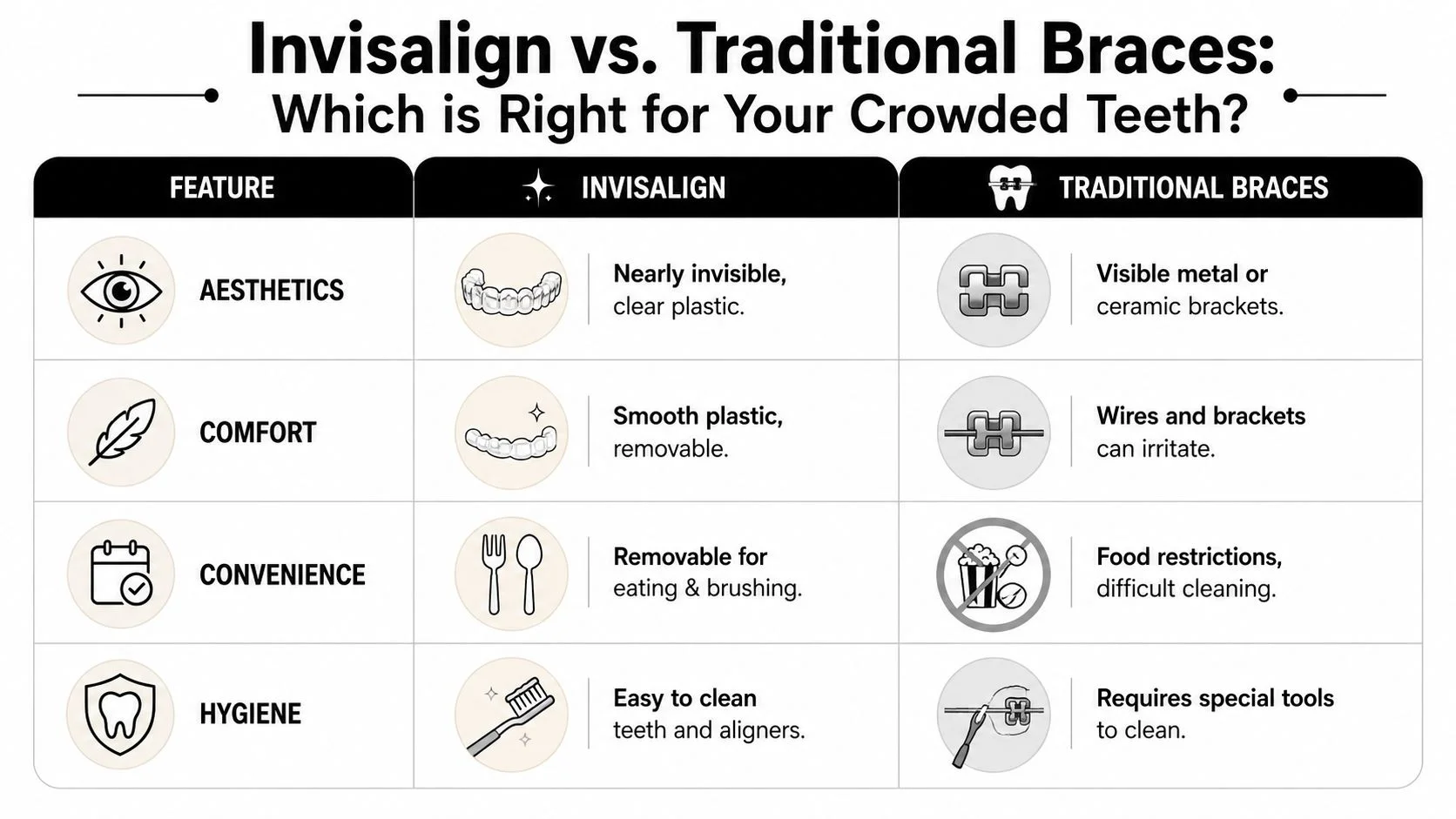
Adults usually compare Invisalign and braces on four issues. How they look, how they feel, how much they interrupt daily life, and how much responsibility falls on the patient.
Where Invisalign tends to win
For many working adults, the biggest advantage is visibility. Clear aligners are far less noticeable than brackets and wires. They also come out for meals and brushing, which makes normal eating and hygiene simpler.
That removability can be a major quality-of-life benefit. You can brush, floss, and clean around every tooth without working around hardware.
Where braces still have an edge
Braces are fixed to the teeth. That means they keep working whether the patient is motivated that day or not. Invisalign only works when it's worn.
Consumer guidance on crowded teeth commonly recommends about 20 to 22 hours per day of wear, as explained in this patient guidance on Invisalign wear time for crowding. That's the trade-off many people underestimate. Convenience helps, but compliance drives results.
If you like the idea of removable aligners but know you'll leave them out for long stretches, braces may be the more reliable choice.
A simple side-by-side view
Appearance
Invisalign is discreet. Braces are more visible.Comfort
Invisalign uses smooth plastic. Braces can rub cheeks and lips.Cleaning
Invisalign lets you remove trays to brush and floss normally. Braces require more technique and patience.Discipline
Invisalign asks more of the patient. Braces ask more of the hardware.
If you're weighing both options, this page on Invisalign vs traditional braces is a useful next read. The right choice depends on the complexity of the case and how you realistically live day to day.
Your Invisalign Journey at Our Walnut Creek Office
Most patients feel better once they know what the process looks like. The unknown is often more stressful than the treatment itself.
The first visit
The first appointment is a conversation before it's a commitment. You'll talk about what bothers you, what you've noticed changing, and what outcome matters most to you. Some patients care most about one crowded front tooth. Others want a broader cosmetic refresh that may eventually include teeth whitening or other cosmetic dentistry after alignment is complete.
A proper evaluation also looks at the health side. Teeth, gums, bite, and any existing restorations all matter. If you came in searching for a cosmetic dentist near me, cosmetic goals and long-term function must be aligned.
The digital scan and custom planning
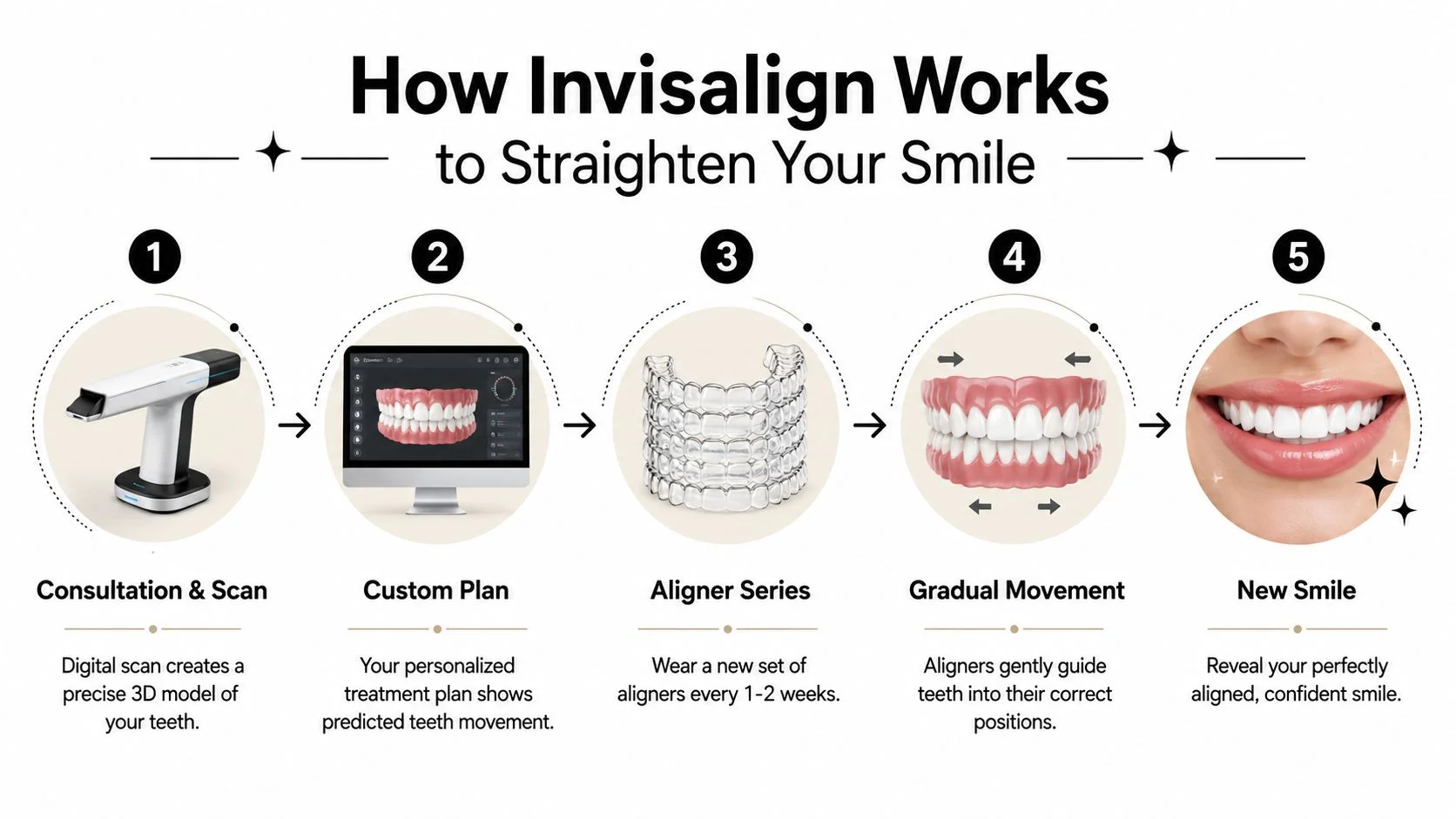
One of the best parts of modern Invisalign treatment is that there usually isn't a need for messy traditional impressions. A digital scan creates a 3D model of the teeth, which makes planning more precise and far easier for patients to understand.
That scan supports a custom treatment plan showing how the teeth are expected to move. It also helps identify whether attachments, IPR, or other adjustments may be needed.
Patients are often most relieved when they can finally see a plan instead of guessing what orthodontic treatment might involve.
Living with aligners week to week
Once treatment begins, life settles into a rhythm. You wear the trays through most of the day, remove them for meals, brush before putting them back in, and change aligners on schedule.
Regular check-ins are part of the process, but they are usually straightforward. The goal is to confirm that the teeth are tracking properly and make adjustments if needed. Daily tray care matters too, and these tips for taking care of your Invisalign trays can help keep the aligners clear and comfortable.
A quick visual overview can help if you're still trying to picture the flow of treatment.
The final phase
When active movement is complete, patients often expect the journey to be over. In reality, retention is what protects the result. Teeth have a memory for where they used to sit, and retainers help hold the new alignment while things stabilize.
That final stage is less dramatic than the first trays, but it's just as important. If you've invested time in straightening crowded teeth, keeping them there matters.
Invisalign FAQs and Your Next Step to a Confident Smile
A few questions come up in nearly every consultation, especially from adults who are interested but still unsure whether treatment will fit their life.
Does Invisalign hurt
Most patients feel pressure more than pain. New aligners can feel tight for a short time, especially when you switch trays. That sensation usually means the aligner is active and fitting correctly.
How do I clean the aligners
Keep it simple and consistent. Rinse them when you remove them, clean them gently as instructed, and don't let them sit unprotected in a napkin or pocket. Patients lose more trays that way than you'd think.
Will my teeth move back after treatment
They can if you don't wear your retainer as directed. Straightening teeth is one phase. Holding them in their new position is the phase that protects the result.
What if I also need other dental care
That's common. Some patients start Invisalign after cleanings and exams show their teeth and gums are ready. Others need restorative care first. In some cases, alignment is part of a bigger plan that may later include cosmetic work or restorative dentistry.
For patients in Walnut Creek, the main decision isn't whether clear aligners are trendy or convenient. It's whether the treatment is appropriate for your crowding, your bite, and your routine. When those pieces match, Invisalign can be a very satisfying way to improve both the look and maintainability of your smile.
If you've been putting this off because braces felt too visible, too inconvenient, or too late in life, it may be worth getting real answers instead of guessing.
If you're ready to talk through Invisalign for crowded teeth with a local provider, schedule a consultation with William M. Schneider, DDS. The office serves Walnut Creek and nearby East Bay communities with dental care, including cosmetic dentistry, cleaning and exams, restorative dentistry, and Invisalign treatment planned around your goals, comfort, and long-term oral health.