A lot of people start asking whether dental implants are worth it after months or years of making do. You may be chewing on one side because a back tooth is gone. You may have a bridge that's starting to fail, or a denture that shifts when you talk. You may be tired of seeing a space in your smile every morning and wondering if it's time to fix it properly.
In a Walnut Creek office like mine, this conversation usually isn't just about one tooth. It's about confidence at work, comfort at dinner, and whether the next treatment you choose will still make sense years from now. That's why the right question isn't only “What does an implant cost?” It's “What do I get in return, and is it the best fit for my life, health, and budget?”
Your Guide to Dental Implants in Walnut Creek
A missing tooth changes more than appearance. People often notice the daily annoyances first. Food catches in the space. Smiling feels less natural. A removable option may work, but it can also feel bulky, unstable, or high-maintenance.
Those frustrations are real, and they're often what lead people searching for a dentist in Walnut Creek, CA or dental implants near me. Some want the most durable replacement possible. Others want to know if there's a simpler option that makes more sense. Both are reasonable.
When the Question Becomes Worth It
Most patients aren't asking for a sales pitch. They want an honest answer about trade-offs.
An implant can be an excellent solution when you want a tooth replacement that feels fixed, protects function, and supports long-term oral health. It may be less appealing when the treatment requires extra procedures, a long healing period, or more investment than you're ready for. The answer depends on the whole picture.
Practical rule: If you're only comparing the initial fee, implants can look expensive. If you're comparing stability, maintenance, and how long a solution may serve you, the conversation changes.
What Patients Around Walnut Creek Usually Want to Know
The biggest concerns tend to be practical:
- Will it feel like a real tooth? Security when chewing and speaking is a key concern.
- How long will the process take? Healing matters, especially for busy adults balancing work and family.
- Will I need extra treatment first? Bone grafting, tooth extraction, and temporary teeth can affect the experience.
- Is there a better alternative for my situation? Sometimes a bridge or denture is the smarter choice.
If you're weighing implants against other restorative dentistry options, the goal is clarity. The best treatment isn't always the most advanced one. It's the one that fits your mouth, your health, and your priorities.
Understanding the Foundation of a Lasting Smile
A dental implant works like a foundation for a house. The visible tooth matters, of course, but what makes the result stable is what sits underneath it.

Consider it an anchor holding something firmly in place. A removable appliance rests on the gums. A bridge spans a space by attaching to nearby teeth. An implant is different because it's placed in the jawbone, where it becomes the support for the replacement tooth.
The Three Parts of an Implant
A complete implant restoration has three main parts:
- The implant post. This is usually made of titanium and placed in the jawbone.
- The abutment. This small connector joins the implant to the final tooth.
- The crown. This is the visible part that looks like a natural tooth.
Each part has a job. The post provides support, the abutment links the parts together, and the crown restores the look and function of the missing tooth.
Why Osseointegration Matters
The key reason implants can feel so secure is osseointegration. That means the implant fuses with the jawbone over time, creating a fixed foundation. This helps restore chewing forces, cosmetic appearance, and jawbone stability. In healthy patients, reported 10-year success rates are often above 90%–95%, according to this review of implant function and osseointegration.
That fusion is what makes an implant different from filling a gap with something removable.
A crown is the part you see. The value of an implant comes from the support you don't see.
Why This Feels More Natural
When the support is built into the bone, the replacement tooth tends to feel more stable during normal activities like chewing, speaking, and smiling. It also allows treatment to be more targeted. If one tooth is missing, one implant can often replace that one tooth without relying on neighboring teeth for support.
For patients who want restorative dentistry that's designed around long-term function, that foundation is often the deciding factor.
Comparing Your Tooth Replacement Options
A patient in my Walnut Creek office might be choosing between three very different paths after losing a tooth. One option replaces the root and the visible tooth. One bridges the space by using the teeth next to it. One fills the gap with something removable. The best choice depends on more than price alone.
I encourage patients to compare these options based on what daily life will look like a year from now, five years from now, and after the initial treatment is behind them.
Dental Implants vs. Bridges vs. Dentures
| Feature | Dental Implant | Dental Bridge | Removable Denture |
|---|---|---|---|
| Support | Anchored in the jawbone | Supported by adjacent teeth | Rests on gums |
| Effect on nearby teeth | Usually preserves adjacent teeth | Usually requires shaping neighboring teeth | Doesn't require attachment to adjacent teeth |
| Bone support | Helps maintain stimulation in the jawbone | Doesn't replace the tooth root | Doesn't replace the tooth root |
| Feel in daily life | Fixed and secure | Fixed and secure | Can shift or feel bulky |
| Cleaning | Similar to caring for a natural tooth, plus regular professional monitoring | Requires careful cleaning around the bridge | Must be removed and cleaned |
| Expected service life | Often the longest-lasting option with good maintenance | Usually needs replacement sooner than an implant | Often needs periodic adjustments, relines, or replacement |
| Upfront investment | Usually higher | Often moderate | Often lower |
| Long-term value | Often strongest for suitable candidates | Depends on the health of supporting teeth | May involve relines, remakes, and fit changes over time |
The short version is simple. Implants usually cost more at the start, but they often ask less of the neighboring teeth and tend to hold their value over time. If you want a clearer sense of lifespan, this guide on how long dental implants can last with proper care helps frame that part of the decision.
Where Bridges Work Well
A bridge can be a very reasonable choice. If the teeth on either side already need crowns, a bridge may solve two problems at once. It also avoids surgery, which matters for some patients.
The trade-off is structural. A traditional bridge usually requires reducing healthy neighboring teeth to support the replacement tooth. If those teeth are strong and untouched, that matters.
Where Dentures Make Sense
Dentures still have a clear place in treatment. They can be the most practical option when several teeth are missing, when a patient wants to avoid surgery, or when budget needs to stay as low as possible at the start.
They also come with more day-to-day compromise. Patients often need time to adjust to bulk, movement, sore spots, or changes in fit as the gums and bone change over time.
Where Implants Change the Equation
Implants often stand out because they treat the gap more independently. The neighboring teeth usually do not need to be cut down, and the replacement stays fixed in place rather than sitting on the gums.
That said, a fair comparison has to include the parts many online guides skip. Some patients need a bone graft before implant placement. Some need more healing time than they expected. Some are better served by a bridge now and may revisit implants later. Those details affect the actual value of treatment, especially if you are balancing health, timing, and budget.
In my experience, patients are happiest with their decision when they compare the full picture. Surgery, recovery, maintenance, future replacements, comfort, and the condition of the surrounding teeth all belong in the conversation.
The Long-Term Value and Benefits of Dental Implants
When patients ask me if implants are worth it, the answer often comes down to daily life. Can you chew comfortably? Can you smile without thinking about the gap? Can you trust the tooth replacement to stay put?
For many people, that's where implants earn their value.
What Patients Notice First
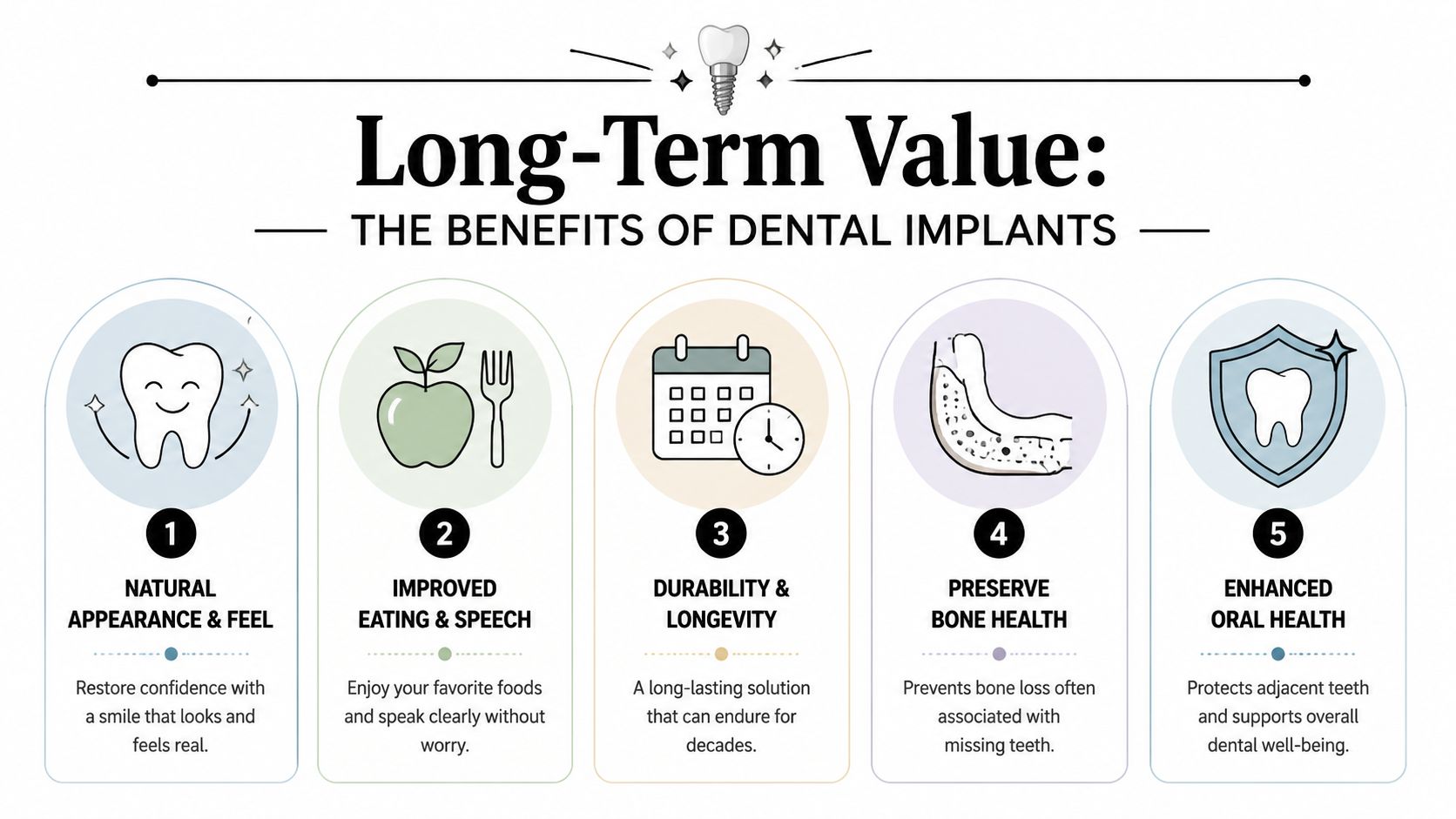
The first benefit is usually confidence. A well-designed implant restoration blends into the smile and doesn't come out at night. That matters more than many people expect.
The second is function. Food choices often expand again when a tooth replacement feels steady. Speaking can feel easier too, especially for patients who've struggled with movement from a removable appliance.
- Natural appearance and feel helps many patients stop thinking about the missing tooth.
- Improved eating and speech makes everyday routines feel normal again.
- Bone support matters because the jaw is no longer missing the root-level stimulation in that area.
Why Durability Changes the Conversation
The strongest long-term argument for implants is durability. Large clinical studies report about a 92% survival rate after 20 years, and other reviews place long-term functional survival in the 86%–92% range after two decades, according to this summary of long-term implant data and growth trends. The same source notes that implant use among U.S. adults with missing teeth rose by an average of 14% per year from 1999–2000 to 2015–2016.
That doesn't mean every implant lasts forever without maintenance. It does mean implants have moved well beyond a niche treatment and into mainstream restorative dentistry because they perform well over time.
If you want a closer look at the durability side of the decision, this page on how long dental implants last is helpful.
A short visual overview can help make the benefits easier to picture:
The Benefit Beyond the Tooth
Replacing a missing tooth isn't only cosmetic. It can support the way your bite functions, help maintain facial structure, and reduce the sense that your mouth is slowly changing around the empty space.
The best implant cases don't just fill a gap. They restore ease.
That's the reason many patients decide the investment is worthwhile.
Your Dental Implant Journey with Dr Schneider
A patient comes into my Walnut Creek office missing a back tooth and asks the question I hear all the time: "How long is this really going to take?" That question matters, because the value of an implant is not only about the final result. It is also about whether the process fits your health, schedule, and budget.
Step One and Step Two
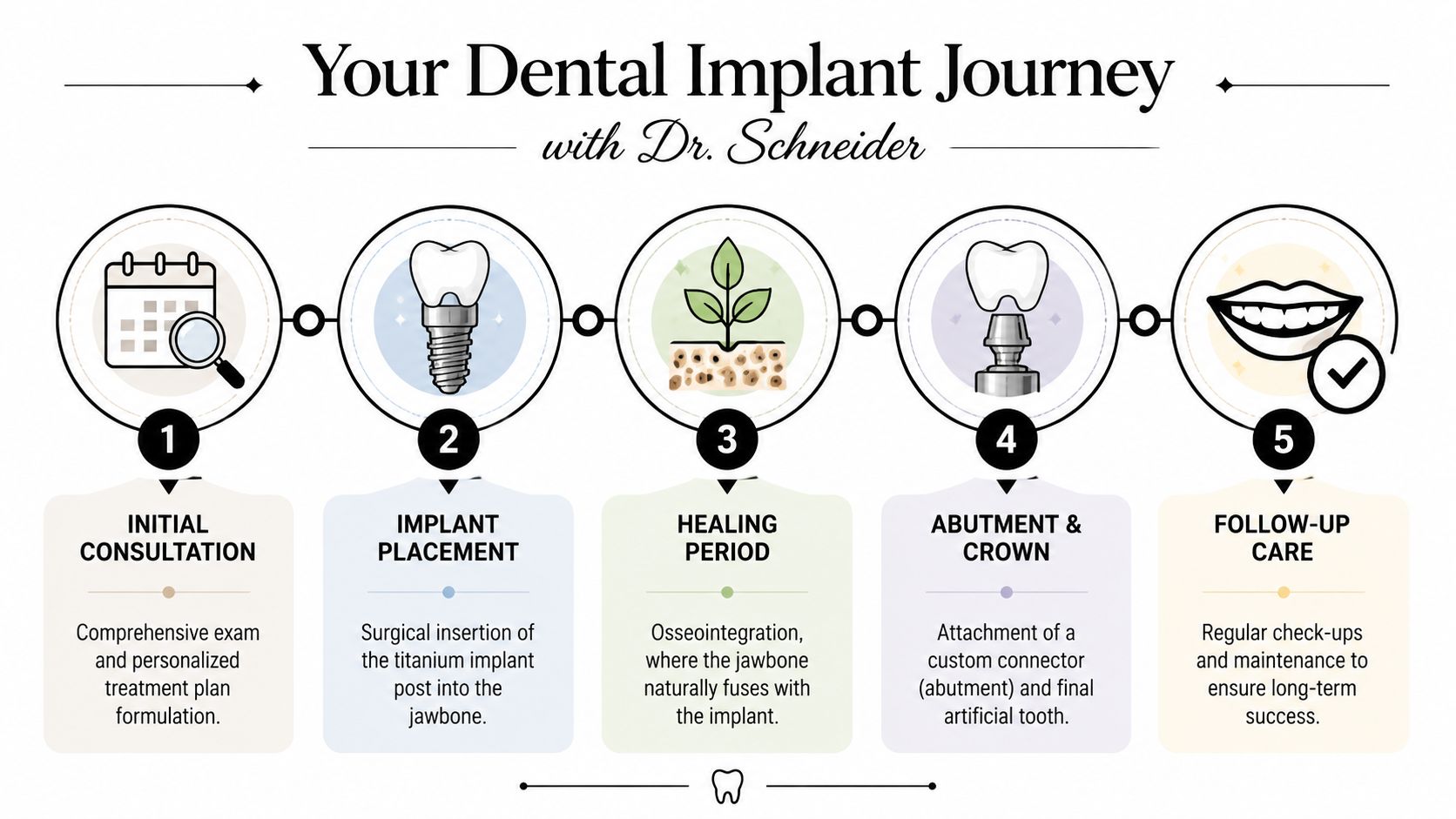
The first visit is planning, not sales. I evaluate the gums, bone support, bite, and the condition of the nearby teeth so we can decide whether an implant is the right solution or whether another option makes more sense.
Digital imaging helps us see what the site can support now and what may need to happen first. Some patients are ready for implant placement soon after the consultation. Others need an extraction site to heal, treatment for gum inflammation, or added bone in the area before placement will be predictable.
That preparation is one of the details many online guides skip. It also affects the timeline and the full fee. If you want a clearer picture of those added steps, this breakdown of what dental implants can cost with related procedures is a good place to start.
Step Three Through Step Five
After the implant is placed, the next phase is healing. This is where patience matters. The bone needs time to bond to the implant, and that part cannot be rushed without increasing risk.
Once the implant is stable, the connector piece and final crown are placed. The crown is designed to fit your bite and match the surrounding teeth, so the goal is not just to fill a space. The goal is to restore comfort when you chew, speak, and smile.
Then the work shifts to maintenance. An implant does not get cavities, but the gum and bone around it still need care.
What the Experience Usually Feels Like
Many patients expect the procedure itself to be the hardest part. In practice, the bigger challenge is usually the staged nature of treatment. There are appointments, healing periods, and moments when waiting is the right call.
A typical journey includes:
- Consultation and planning with a review of your goals, exam findings, and imaging.
- Site preparation when needed, which may include healing after an extraction or building support in the area.
- Implant placement once the foundation is ready.
- Healing and integration before the tooth is attached.
- Final restoration and follow-up care to protect the result over time.
What Helps the Process Go Smoothly
Good implant cases are built on a few practical habits and decisions:
- Healthy gums reduce the chance of complications during healing.
- Consistent home care keeps plaque and inflammation under control around the implant.
- Routine follow-up visits let us catch bite issues, gum changes, or wear before they turn into larger problems.
- Realistic expectations make the experience easier, especially if grafting or extra healing time is part of the plan.
Patients often feel more at ease once they understand that implant treatment follows a clear sequence. Each step has a purpose, and each decision affects the long-term value of the result.
Determining Candidacy and The Total Investment
Not every patient is an ideal implant candidate on day one. That's normal. The better question is whether the mouth can be made ready for an implant, and whether doing so is the smartest use of time, money, and effort.
Who Tends to Be a Good Candidate
Implants are often most successful in patients with healthy gums, adequate bone volume, and good oral hygiene habits. Smoking, uncontrolled periodontal disease, and certain medical conditions can complicate healing or reduce predictability. Age alone isn't the main issue. Overall health, healing ability, and treatment goals matter more.
The FDA emphasizes that implants are surgical devices, can improve quality of life, and require individualized assessment because complications can occur. That guidance is summarized in this FDA patient overview of dental implants and treatment decisions.
Sometimes the right answer is an implant. Sometimes the right answer is a bridge, a removable option, or no treatment at all right now.
What Affects the Real Cost
Many online guides fall short by talking about the implant itself as if that's the whole fee. Often it isn't.
The true value of an implant can be influenced by necessary add-ons. Many articles under-explain how bone grafting, sinus lifts, and extractions can change the total price and timeline, as discussed in this patient guide to the hidden factors behind implant value.
Your complete treatment plan may involve:
- Tooth extraction if the failing tooth is still present
- Bone grafting if the site needs more support
- Temporary tooth replacement during healing
- Multiple appointments for surgery, checks, and the final restoration
- Future maintenance or repairs to the visible restoration over time
If you're trying to understand the financial side more clearly, this page on how much dental implants cost is a useful next step.
When Implants May Not Be the Best Value
An implant isn't automatically worth it just because it's advanced. In some cases, the total burden outweighs the likely benefit.
That may happen when a patient has significant medical complexity, very limited tolerance for surgery, a short time horizon for the expected benefit, or a site that requires several additional procedures to become workable. In those situations, a simpler restoration can be the better value.
The right decision comes from a transparent conversation, not a one-size-fits-all recommendation.
Schedule Your Personalized Implant Consultation
If you're still asking whether dental implants are worth it, that usually means you need answers that apply to your mouth, not somebody else's. Online research helps, but it can't tell you whether the bone is adequate, whether a bridge would serve you just as well, or whether hidden steps will change the timeline.

A personalized consultation gives you the details that matter most:
- A thorough exam to evaluate the missing tooth area, gum health, and bite
- A candid discussion about whether an implant, bridge, denture, or another restorative plan fits best
- A clear roadmap so you understand the likely steps, healing, and maintenance
- Transparent expectations about the full scope of treatment, including related procedures if needed
For Walnut Creek and East Bay patients searching for dental implants near me, cosmetic dentist near me, or a long-term dental home, the essential value of a consultation is confidence. You leave knowing what works, what doesn't, and what your next step should be.
Frequently Asked Questions About Dental Implants
Does getting a dental implant hurt
Most patients tolerate implant placement well, especially when the area is fully numb and the procedure is carefully planned. People often worry more before treatment than after it. Soreness during recovery is expected, but it's usually manageable with routine aftercare and follow-up.
How long does recovery take
There are two timelines to think about. The short-term recovery after placement is one part. The deeper healing phase, where the implant bonds with the bone, takes longer. That's why implant treatment works best when you go in expecting a process rather than a quick fix.
How do I care for a dental implant
You care for an implant much like you care for natural teeth. Daily brushing, cleaning between teeth, and regular dental visits matter. Good maintenance isn't optional. It's part of what protects the long-term value of the treatment.
Can a dental implant be rejected
The more accurate way to think about this is implant failure risk, not rejection in the casual sense. Implants have strong long-term performance in suitable patients, but success still depends on planning, healing, oral hygiene, and controlling risk factors like gum disease and smoking.
Are dental implants worth it for older adults
Sometimes yes, sometimes no. The decision depends less on age itself and more on health, healing ability, treatment burden, and how much benefit the patient is likely to get from the restoration over time. For some older adults, an implant is a great investment. For others, a bridge or removable prosthesis is the better fit.
If you're ready for clear answers about missing teeth, bridges, dentures, or dental implants in Walnut Creek, CA, schedule a consultation with William M. Schneider, DDS. The office is located at 1855 San Miguel Dr., Suite 31, Walnut Creek, CA, and patients can call to discuss treatment options or request a visit through the practice website. Whether you need restorative dentistry, a second opinion, help after a tooth extraction, or a trusted dentist near me for long-term care, you'll get a thoughtful evaluation and a treatment plan built around your health, comfort, and goals.