If you're reading this in Walnut Creek after another rough night with a CPAP mask, you're not alone. Many people start with good intentions, then find themselves fighting the tubing, waking up to air leaks, or taking the mask off sometime after midnight without even realizing it. By morning, they're still tired, still snoring, and still wondering if there's a better way to treat sleep apnea.
There often is. The key is matching the treatment to the person, not forcing every person into the same treatment. For many East Bay adults, the most practical first step is not another machine adjustment. It's a careful evaluation of whether a dental sleep appliance could work, and whether another non-CPAP path makes more sense.
A Better Night's Sleep Is Possible in Walnut Creek
A lot of people who ask about sleep apnea treatment alternatives are in the same place. They've already tried CPAP, or they were prescribed it and never got comfortable enough to use it consistently. The problem usually isn't motivation. It's that sleeping with a mask and hose every night can feel intrusive, noisy, awkward, or unsustainable.

In a consultation, the story often sounds familiar. Someone says their partner still hears snoring. Another says they travel for work and hate packing the machine. Someone else says they can tolerate CPAP for a few hours, but not for a full night. These aren't excuses. They're real barriers, and they matter because treatment only helps when you can live with it.
Why local patients often start with a dental evaluation
In Walnut Creek, many adults looking for a dentist near me or a dentist in Walnut Creek, CA aren't just thinking about cleanings and exams. They're also looking for practical care that improves daily life. Sleep apnea sits right in that category because it affects rest, energy, mood, and even how comfortable your mouth and jaw feel at night.
For people with mild to moderate obstructive sleep apnea, or for people who can't tolerate CPAP, a dentist trained in oral appliance therapy can help identify whether a custom device is a realistic option. That matters because the right oral appliance isn't an over-the-counter mouthguard. It's a medical device designed around your bite, your airway, and your comfort.
Better sleep usually starts when the treatment fits your routine well enough that you'll actually use it.
A practical path forward
The goal isn't to sell every patient the same appliance. The goal is to sort through what's likely to work, what probably won't, and what tradeoffs come with each option. Some people are better served with an oral appliance. Some need medical weight management. Some need evaluation for a procedure. Some still do best with CPAP, especially when the disease is more severe.
That kind of clarity is what people are really looking for when they search for answers. They want a straightforward roadmap, not a generic list.
Understanding Sleep Apnea and Why CPAP Is Not for Everyone
Obstructive sleep apnea happens when the airway narrows or collapses during sleep. Breathing gets interrupted, oxygen levels can drop, and sleep becomes fragmented even if you don't remember waking up. A person may snore loudly, gasp, wake with a dry mouth, feel foggy during the day, or hear from a partner that breathing repeatedly stops overnight.
The condition isn't just about snoring. Untreated sleep apnea can affect how rested you feel, how well you focus, and how your body handles chronic strain over time. That's why treatment matters.
Why CPAP helps and why people still struggle with it
CPAP works by using air pressure to help keep the airway open. It can be very effective, especially in more severe cases. But there's a difference between a treatment working in theory and working in real life for a specific person.
Common reasons patients look for sleep apnea treatment alternatives include:
- Mask discomfort that irritates the skin or leaves marks
- Claustrophobic feelings when wearing the mask
- Noise and sleep disruption from the machine or air leaks
- Dry mouth or nasal irritation during use
- Travel inconvenience when carrying equipment
- Poor tolerance through the full night, even when they want treatment to succeed
If you dread putting a treatment on every night, long-term success gets much harder.
Why this matters in treatment planning
Some patients assume that if CPAP didn't work for them, they failed treatment. That's not the right way to look at it. More often, the treatment and the patient weren't a good match.
That's where careful screening becomes useful. A person might need a custom oral appliance, a discussion about body weight and airway anatomy, a medical referral for additional options, or a coordinated plan that combines approaches. The point is to keep moving toward effective treatment rather than giving up because the first option was hard to tolerate.
How Your Dentist Can Be Your Greatest Ally Against Sleep Apnea
For many adults with mild to moderate obstructive sleep apnea, the most established non-CPAP option is a custom mandibular advancement device, often called a MAD. A major review notes that these devices are widely used in this severity range, and the American Academy of Sleep Medicine recommends oral appliance therapy for adults who are CPAP-intolerant or prefer an alternative in its guidance on oral appliance therapy for obstructive sleep apnea.
How a mandibular advancement device works
A MAD is worn during sleep. It gently moves the lower jaw forward to help maintain airway space and reduce collapse. The concept is simple, but the execution has to be precise. The fit, jaw position, comfort, and follow-up adjustments all influence whether the appliance will be effective and wearable night after night.
Dentistry plays a central role. A qualified dentist evaluates tooth support, jaw health, bite relationships, restorations, and oral anatomy before recommending treatment. That's important because a poorly chosen or poorly fitted device can create discomfort without adequately helping the airway.
Why custom care matters more than brand names
Patients often ask which appliance brand is “best.” In practice, candidacy and titration matter more. A custom appliance must fit the patient's mouth accurately and be adjusted carefully over time. That's one reason a dental consultation is often the smartest first move for someone exploring non-mask treatment.
At William M. Schneider, DDS, the dental side of sleep apnea care includes examining whether your teeth, gums, jaw joints, and bite can support oral appliance therapy comfortably. That same appointment can also identify oral health issues that should be addressed first, whether that's routine dental care, restorative dentistry, or stabilizing existing dental work.
Clinical reality: The appliance has to fit your airway goals and your mouth at the same time.
Who tends to do well with this option
Oral appliance therapy is often a strong fit for people who:
- Can't tolerate CPAP despite trying to make it work
- Prefer a lower-burden treatment that doesn't involve a mask
- Have mild to moderate obstructive sleep apnea
- Travel often and want a portable option
- Need a treatment that feels easier to incorporate into normal life
It isn't ideal for every case, and it doesn't replace a full sleep apnea workup when more advanced treatment is needed. But in the right patient, it can be a practical and evidence-based answer.
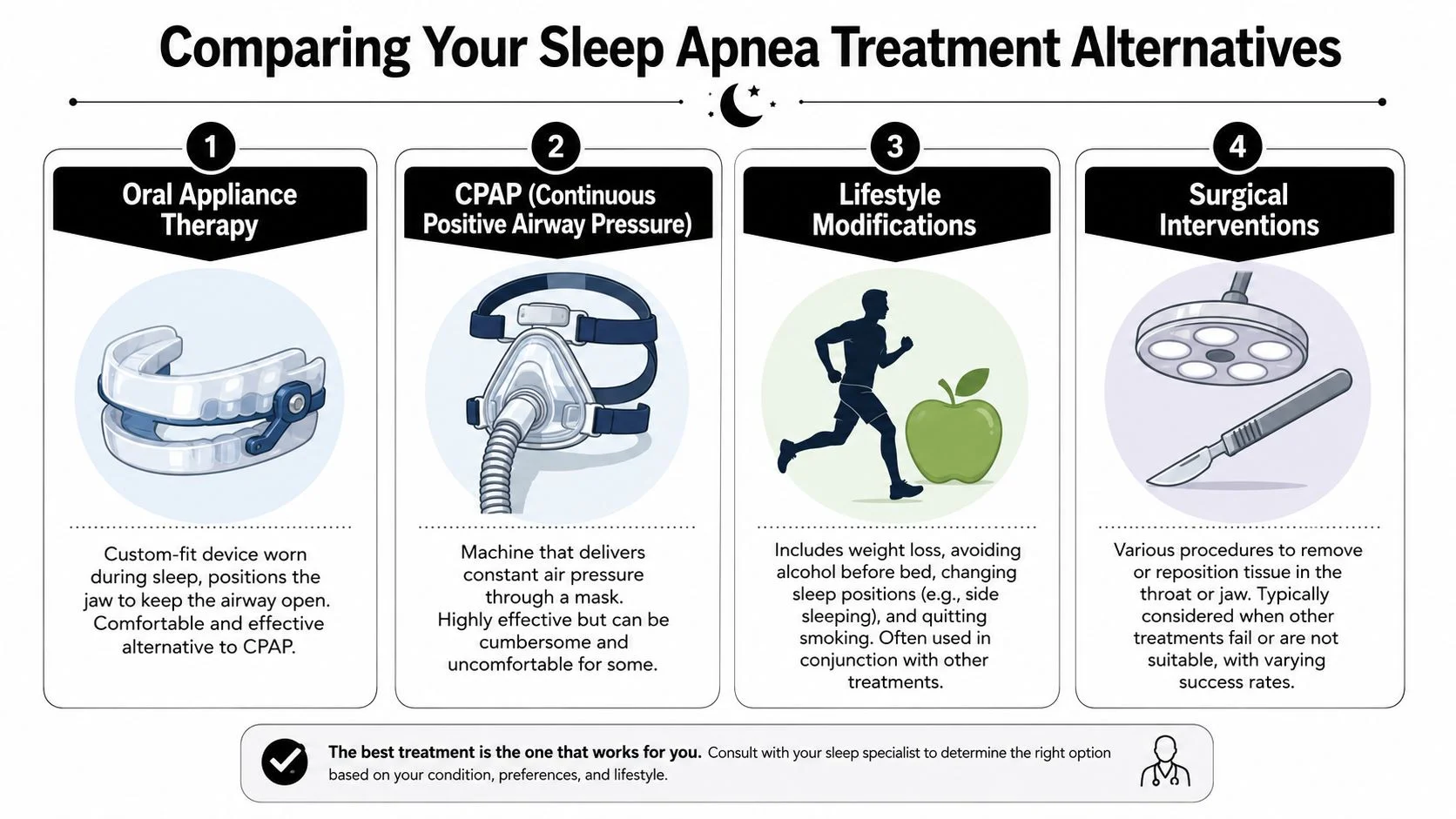
Comparing Your Sleep Apnea Treatment Alternatives
A Walnut Creek patient may come in saying the same thing I hear every week. “I know I need treatment. I just need something I can live with.” That is the right question to ask.
Sleep apnea treatment is not a one-size-fits-all decision. The best option depends on how severe the apnea is, what your airway and jaw anatomy look like, whether weight is a major driver, how you sleep, what medical conditions are in the background, and how likely you are to keep using the treatment six months from now. A treatment only works if it fits real life.
Here is a practical side-by-side comparison.
| Treatment | How It Works | Best For Patients Who… | Key Considerations |
|---|---|---|---|
| Oral appliance therapy | Repositions the lower jaw during sleep to help keep the airway open | Have mild to moderate OSA, can't tolerate CPAP, or prefer a dental alternative | Requires dental evaluation, custom fitting, and follow-up adjustment |
| Positional therapy | Reduces sleeping on the back when apnea is position-related | Notice symptoms are worse when sleeping supine | May help some patients, but often needs to be paired with other treatment |
| Weight management and pharmacotherapy | Targets obesity-related airway collapse by reducing body weight | Have OSA with obesity and need a disease-modifying approach | Medical supervision is needed, and candidacy is individualized |
| Hypoglossal nerve stimulation | Stimulates the hypoglossal nerve during sleep after surgical implantation | Have moderate to severe OSA, can't tolerate CPAP, and meet selection criteria | Implant procedure, anatomy requirements, and insurance questions matter |
| Surgery | Removes or repositions tissue or skeletal structures affecting the airway | Have anatomy that may respond to structural correction | Recovery, candidacy, and the possibility of needing additional treatment remain important |
| Oral negative pressure device | Uses negative pressure to influence airway behavior during sleep | Need another non-mask discussion point beyond standard options | Suitability varies, and real-world fit still needs review |
Oral appliance therapy
For many people in Walnut Creek who want a non-CPAP option, oral appliance therapy is the most realistic place to begin. It is especially useful when sleep apnea falls in the mild to moderate range, or when CPAP was prescribed but never became a treatment the patient could use consistently.
The trade-off is straightforward. Oral appliances are less cumbersome than a mask and machine, but they need proper case selection, a precise fit, and careful adjustment over time. A qualified dentist can evaluate whether your teeth, bite, jaw joints, and existing dental work can support treatment comfortably. That first dental evaluation often saves patients time because it quickly shows whether this path makes sense or whether another route should take priority.
Weight management and medication-based treatment
Weight loss can meaningfully improve sleep apnea in patients whose airway collapse is tied to obesity. For some people, that means nutrition changes, exercise, and physician-guided medical care. For others, medication may become part of the plan.
This approach can address a root contributor instead of only controlling symptoms during sleep. It also takes time, close follow-up, and realistic expectations. Even when weight management helps significantly, some patients still need an appliance, CPAP, or another therapy while those changes are underway.
Hypoglossal nerve stimulation
Hypoglossal nerve stimulation is an implanted treatment used for selected adults with obstructive sleep apnea who have not done well with CPAP. It works by stimulating the nerve that helps control tongue position during sleep, which can reduce airway blockage in the right candidate.
This option has a narrower entry point than many patients expect. It involves surgery, formal screening, anatomy-based eligibility, and cost considerations. For the right patient, it can be a strong option. For many others, it is more invasive and more expensive than they want as a first step.
A treatment can sound appealing online and still be wrong for your anatomy, your severity level, or your budget.
Surgery and other less common alternatives
Surgery covers a range of procedures, not a single fix. Some operations target soft tissue. Others reposition the jaws to create more airway space. The right surgical discussion depends on where the obstruction is happening and whether a structural correction is likely to change the problem enough to justify recovery and cost.
Other device-based options may come up during research, including oral negative pressure systems and newer daytime or nighttime devices. Some patients are curious about them because they want something different from both CPAP and an oral appliance. In practice, these options usually make sense only after a careful review of the sleep study, airway pattern, and daily tolerance factors.
Cost matters too. If you're comparing what these choices look like in real life, this guide to sleep apnea treatment costs in Walnut Creek can help you weigh the financial side along with comfort, convenience, and long-term follow-through.
The Life-Changing Benefits of Effective Sleep Apnea Treatment
A Walnut Creek patient starts treatment and notices the change before anyone mentions numbers or sleep studies. They wake up clearer, need less effort to get through the afternoon, and stop dreading the next morning.
That early shift often shows up as less daytime fatigue, fewer dry-mouth mornings, better concentration at work, and less strain on a bed partner whose sleep was disrupted by snoring. These are everyday improvements, but they change daily life in a real way. Patients often tell me they feel more patient, more present, and more capable of keeping up with work, family, and errands without running on empty.
The health impact goes beyond the bedroom
Effective treatment reduces the repeated stress that interrupted breathing places on the body night after night. The goal is steadier oxygen flow, fewer sleep disruptions, and better-quality rest that the body can use.
That can create momentum in other areas of health. People who finally sleep well are often more consistent with exercise, meals, medications, and follow-up care because they have the energy to do it. Weight management may also become more realistic once exhaustion is no longer driving the day, and as noted earlier, that can be part of the bigger treatment picture for some patients.
Why it also matters for dental health
There is also a practical oral health benefit. Better sleep supports the steady self-care that helps people maintain their teeth and gums over time, whether that means keeping up with preventive visits or protecting cosmetic and restorative dental work they have already invested in.
Dry mouth, clenching, inconsistent home care, and missed appointments often travel together with poor sleep and chronic fatigue. When treatment works and a patient can stick with it, those patterns often improve. That matters because long-term dental health depends on consistency much more than quick fixes.
The goal is better sleep, better function, and a treatment you can realistically live with.
For many patients in Walnut Creek and across the East Bay, that is a significant turning point. They are not just treating a diagnosis. They are getting back a more stable, workable version of daily life.
What to Expect at Your Sleep Apnea Consultation in Walnut Creek
A lot of Walnut Creek patients come in after the same kind of night. They slept for hours, but woke up tired, dry-mouthed, and already dreading the day. Some have tried CPAP and could not get comfortable with it. Others are just starting to look for a realistic alternative.
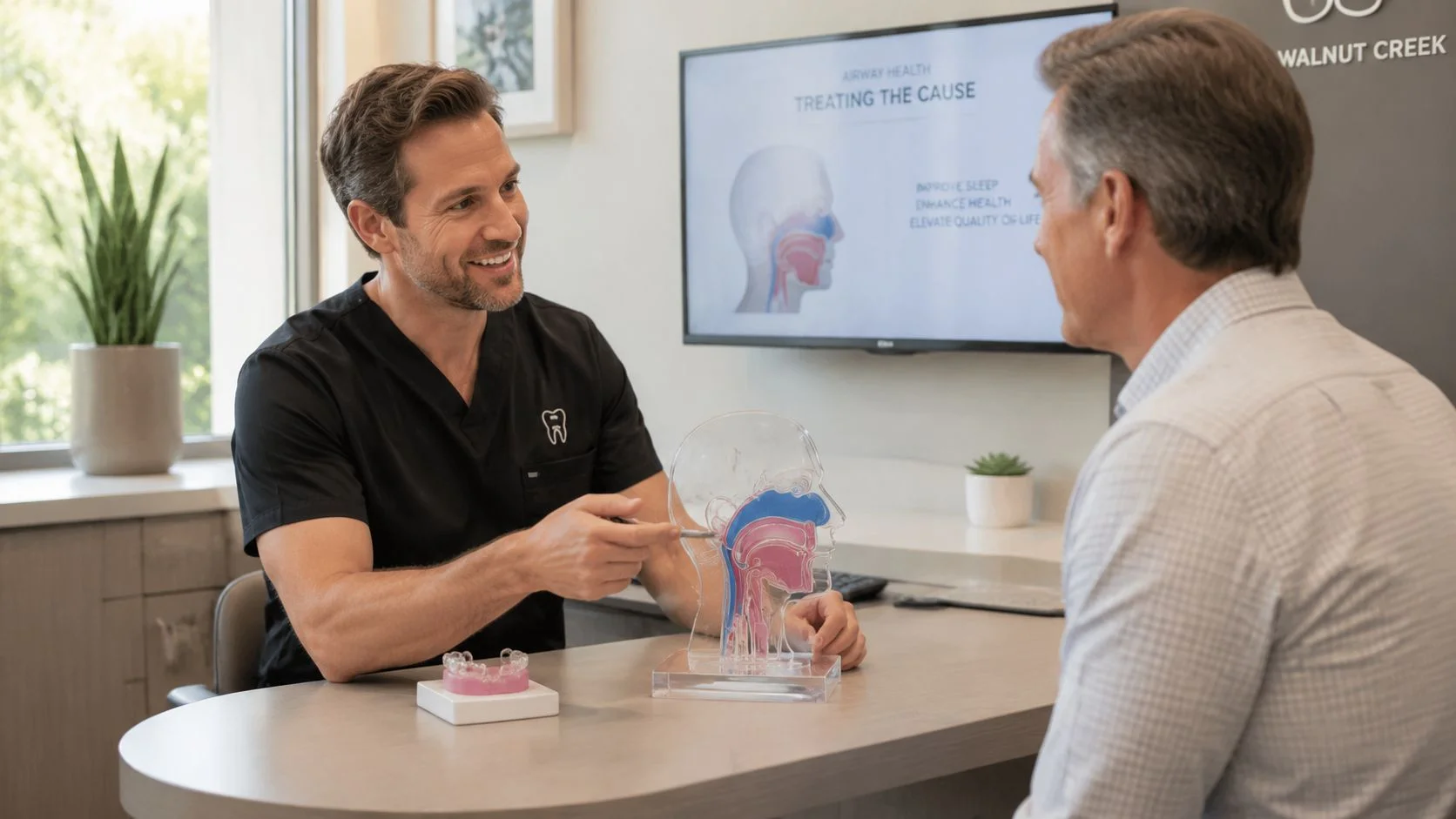
The first consultation is designed to answer one practical question. Is oral appliance therapy a good fit for your mouth, your airway, and your daily life?
What the evaluation includes
The visit usually starts with a careful conversation. We review your diagnosis, symptoms, sleep quality, snoring, daytime fatigue, and any previous CPAP experience. That history matters because comfort problems, travel demands, and nightly routines often shape which treatment a patient will use.
The exam focuses on whether your teeth, gums, bite, jaw joints, and oral anatomy can support a custom appliance safely and predictably. Records or imaging may be needed in some cases, but only if they help clarify fit, stability, or other dental concerns that should be addressed first.
That distinction matters. A consultation is not just a confirmation that sleep apnea exists. It is a planning visit to see whether a dentist trained in sleep apnea treatment, such as Dr. Schneider, can move you toward an oral appliance with a reasonable expectation of comfort and long-term success.
How the appliance process works
If you are a good candidate, the next step is usually digital scans or impressions for a custom device. The appliance is made to fit your teeth and guide the lower jaw forward in a controlled way. Small changes in position can make a meaningful difference, so treatment does not stop the day the appliance is delivered.
Adjustment is part of the process. In practice, that is often what separates a device that sits in a drawer from one a patient wears consistently.
As noted earlier, oral appliances can work very well for the right patient, especially when the fit is precise and follow-up is handled carefully. They are not identical to CPAP, and they are not the best answer for every case. The consultation helps sort that out before you spend time and money on the wrong option.
What follow-up feels like
Follow-up visits are usually straightforward. We check comfort, bite changes, jaw symptoms, and whether the appliance is being worn enough to help. If something feels off, the device can often be adjusted rather than abandoned.
That same appointment can also be a sensible time to stay current with the rest of your dental care. Some patients are due for preventive treatment. Others need restorative work or have a separate issue, such as a broken tooth or another urgent problem, that should be addressed so the mouth stays healthy enough to support appliance therapy.
For patients here in Walnut Creek, that local continuity is one of the advantages of starting with a qualified dentist. You are not just getting a device. You are getting a treatment plan, ongoing monitoring, and a clear place to turn if something needs attention.
Schedule Your Consultation for Sleep Apnea Relief Today
You may be here after another rough night. The snoring is still disrupting the house, you are tired of waking up unrefreshed, and CPAP never became part of real life. That is a common starting point in my office, and it is often the moment patients realize they need a plan built around how they sleep.
A consultation in Walnut Creek can answer the question that matters first. Is a custom oral appliance a sensible next step for your airway, your symptoms, and your medical history? For many local patients, starting with a qualified dentist helps narrow the field quickly and keeps them from spending more time on options that are unlikely to fit.
Trade-offs matter. Some patients do well with oral appliance therapy. Others need to keep CPAP in the conversation, and some surgical options bring higher cost, more recovery, or stricter candidacy requirements. The right decision is usually the one you can tolerate, use consistently, and follow through on.
For those seeking a dentist near me, a cosmetic dentist near me, or a trusted dentist in Walnut Creek, CA who also understands oral appliance therapy, the next step is simple. Book a consultation and get a clear recommendation based on your case, not a generic list of treatments.
You can schedule an appointment at the office located at 1855 San Miguel Dr., Suite 31, Walnut Creek, CA. Call the practice directly or request a visit through the online scheduling tools on the website.
To request your consultation in Walnut Creek, contact William M. Schneider, DDS.