If you've recently been told you may need a root canal, you're probably weighing two thoughts at once. You want the pain gone, and you want to know whether there's another way to handle the tooth.
That's a fair question. Patients looking for a dentist in Walnut Creek, CA, an emergency dentist, or help with a painful cracked or infected tooth often aren't just asking, “Do I need a root canal?” They're asking, “Can this tooth still be saved, and if not, what comes next?”
Modern dentistry does offer root canal alternative treatments, but they are not all the same. Some treatments aim to keep the natural tooth alive. Others remove the tooth and replace it. That difference matters more than most online guides make clear.
Considering Your Options for a Damaged Tooth
A common scenario goes like this. A patient feels a sharp jolt when biting, or a lingering ache after something hot or cold. They search for a dentist near me, come in worried, and hear that the tooth may need endodontic treatment. The first reaction is often anxiety. The second is usually, “Are there alternatives?”
There are. But the right answer depends on how far the problem has progressed inside the tooth.
A major global review found that root canal treatment is already a familiar part of dental care for many adults. It reported that 8.2% of teeth studied had received root canal treatment, and 55.7% of adults worldwide had at least one root canal treated tooth, according to the 2025 systematic review on root canal treated teeth prevalence. That tells us two things. First, this situation is common. Second, patients are right to ask careful questions before choosing treatment.
The first question to ask
Before talking about alternatives, ask this:
| What you want to know | Why it matters |
|---|---|
| Can the tooth still be saved? | This determines whether conservative treatment is realistic. |
| Is the pulp irritated, inflamed, or infected beyond repair? | Mild irritation can sometimes be treated differently from established infection. |
| Is the tooth structurally restorable? | Even if infection can be addressed, the remaining tooth has to be strong enough to function. |
| If the tooth can't be saved, what replaces it? | Extraction is not the end of treatment. It starts a replacement decision. |
Practical rule: The best alternative isn't the one that sounds most appealing online. It's the one that matches the actual condition of the tooth.
Why local evaluation matters
A careful exam changes everything. In a Walnut Creek office setting, that usually means listening to your symptoms, checking for swelling or cracks, testing how the tooth responds, and reviewing dental x-rays. The goal isn't to push one procedure. The goal is to sort the tooth into the correct category.
That category usually falls into one of two paths:
- Tooth-saving care when the pulp may still be protected or partially preserved
- Tooth-replacement care when the damage is too advanced and extraction is the only predictable option
Patients who need urgent pain relief often also need clarity. A calm exam and a straightforward explanation usually reduce anxiety more than anything else. Once you know whether the tooth is still a candidate for conservative care, the decision becomes much easier.
Understanding Why Your Tooth Is in Trouble
A tooth looks solid from the outside, but it has a living center. Inside is the pulp, which contains nerves, blood vessels, and soft tissue. If you think of the tooth like a house, enamel is the roof and siding, dentin is the framing, and pulp is the wiring and plumbing in the middle.
When bacteria reach that inner space, the tooth doesn't just get “sensitive.” It can become inflamed, infected, and increasingly painful.
How the problem starts
Several issues can open the door for bacteria:
- Deep decay that moves close to or into the pulp
- A crack or fracture that lets bacteria travel inward
- A leaking or very large filling that no longer seals the tooth well
- Repeated dental work on the same tooth, which can stress the pulp over time
At first, the pulp may only be irritated. In that stage, a more conservative treatment may still be possible. But when infection becomes established, the tooth often needs root canal treatment or, if it's too damaged, extraction.
Why waiting can make the choice narrower
A lot of patients hope the pain will settle down on its own. Sometimes pain does fade, but that doesn't mean the tooth has healed. It can mean the nerve tissue is no longer responding normally.
Once infection advances, the range of root canal alternative treatments gets smaller. A tooth that might have qualified for a protective procedure earlier may later need full endodontic treatment or removal.
A root canal is recommended for a reason. It's meant to remove damaged or infected pulp, disinfect the inner space, and seal the tooth so the surrounding bone and gums stay healthy.
What a dentist is looking for
During a new patient exam or emergency visit, the main questions are practical:
- Is the pulp still healthy enough to protect?
- Is the inflammation reversible, or has it crossed into deeper infection?
- Is there enough remaining tooth to restore with a filling or crown?
- Is there any sign that the tooth has already become non-restorable?
Those answers often come from symptoms, testing, and dental x-rays together. In many cases, the treatment decision is less about preference and more about timing. Early treatment tends to preserve more options. Delayed treatment often turns a tooth-saving situation into a replacement situation.
Tooth-Saving Alternatives A Comparison
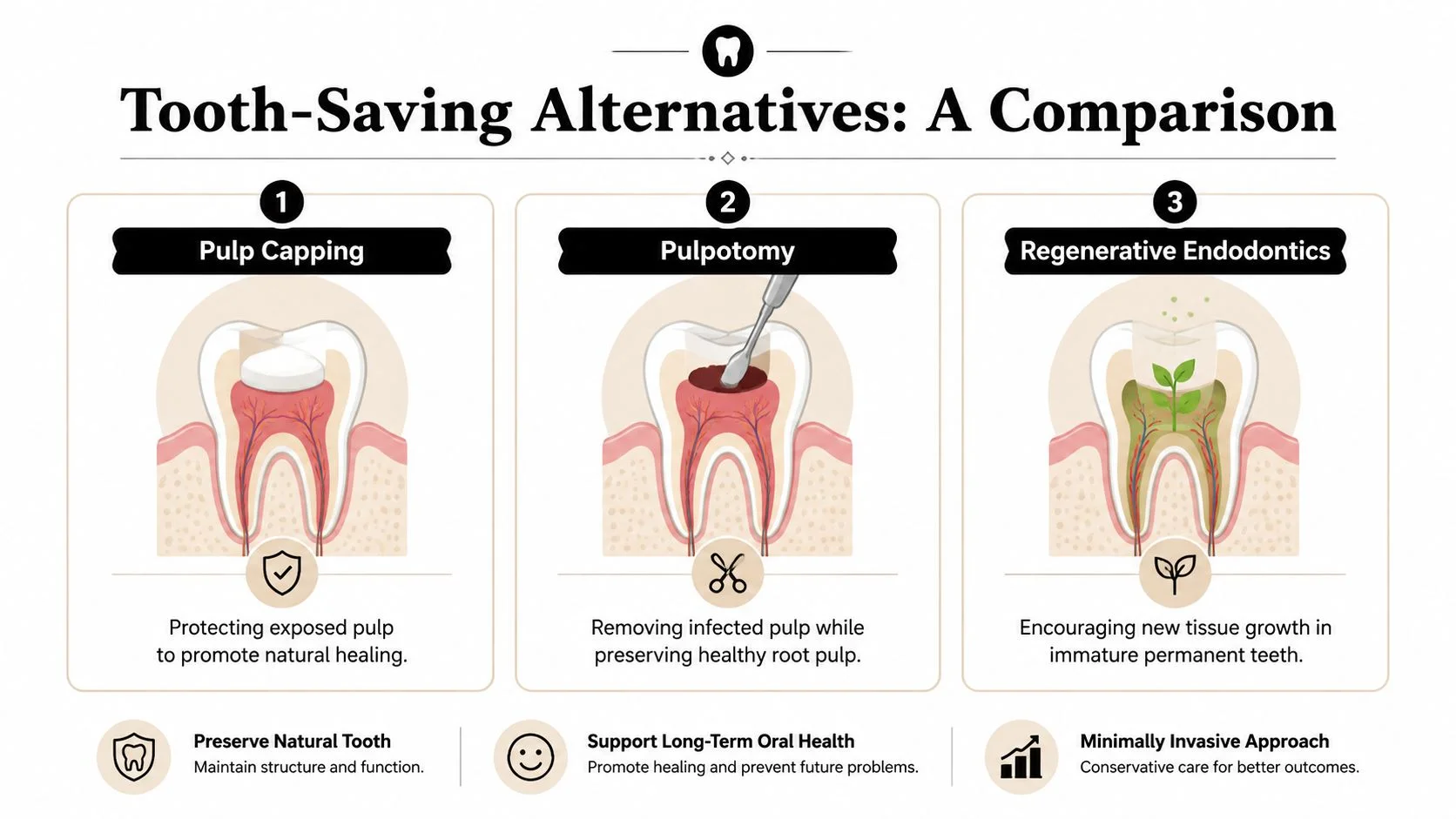
Root canal alternative treatments often appear as a mixed list of procedures that sound interchangeable. They aren't. Some options only work when the pulp is still partly healthy and the exposure is limited.
That's the important benchmark. Traditional root canal therapy sets a high bar for long-term tooth retention. Population studies reported an approximate 10-year tooth survival rate of 83.8% after root canal therapy, and survival can rise to over 95% at 7.5 years when the tooth is properly restored with a crown, as summarized in this review of root canal success and tooth preservation data. Any tooth-saving alternative has to be judged against that standard.
Side-by-side comparison
| Treatment | Best fit | What it does | Main limitation |
|---|---|---|---|
| Indirect pulp capping | Deep decay that is close to the pulp but has not fully exposed it | Places a protective material over a thin remaining layer of dentin to help the pulp stay calm and healthy | Not appropriate if infection has clearly reached the pulp |
| Direct pulp capping | Small pulp exposure with limited contamination | Covers the exposed pulp with a protective material to encourage healing | Works only in selected cases with controlled exposure and healthy surrounding tissue |
| Pulpotomy | Inflamed tissue in the crown portion of the pulp, often used in younger teeth and select cases | Removes the affected pulp from the crown while preserving healthy tissue in the roots | Not a solution for widespread infection extending through the canal system |
| Regenerative endodontics | Immature permanent teeth with open apices and necrotic pulp | Encourages continued development of the root and pulp-dentin complex | Not a routine substitute for every adult infected tooth |
What each option looks like in real life
Indirect pulp capping is the most conservative of the group. If decay is very deep but the pulp has not been openly exposed, the dentist can remove compromised tooth structure, place a protective material, and seal the tooth. In the right case, that gives the pulp a chance to recover.
Direct pulp capping is more selective. A tiny exposure from decay removal or trauma may still be manageable if the pulp tissue looks healthy enough and contamination is limited.
Pulpotomy removes only the diseased portion of the pulp in the crown and leaves healthier tissue in the roots. It is often associated with baby teeth, but it may also play a role in carefully chosen permanent teeth.
Regenerative endodontics is the most specialized option in this group. Verified clinical data report 85% to 90% success in revascularizing immature teeth with necrotic pulp, with 95% survival at 3 years, and continued increases in root wall thickness and root length in the right cases. This approach is especially relevant in younger patients whose permanent teeth are still developing.
For patients who are also considering conservative restorative care, a well-sealed restoration matters just as much as the pulp procedure itself. This is one reason tooth-colored fillings can be vital to your oral health.
Conservative care works best when the diagnosis is early and the seal is excellent. Once bacteria have deeply colonized the canal system, these options usually stop being predictable.
When Replacement Is the Alternative Extraction and Implants
Many websites present extraction as if it's just another version of a root canal alternative. It isn't. It's a different category of care.
A tooth-saving treatment aims to keep your natural tooth in place. A tooth-replacement treatment starts after that tooth is removed.
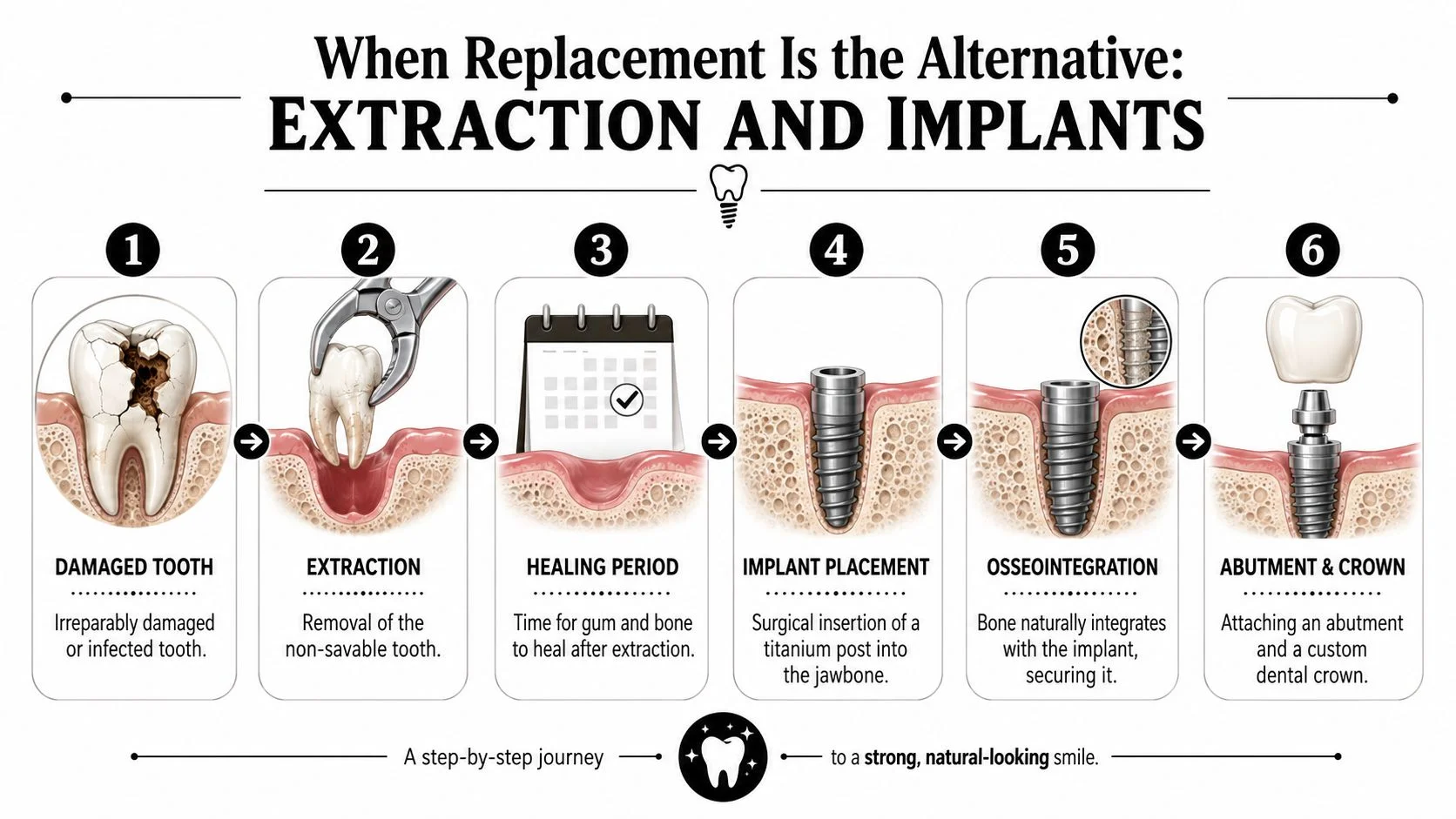
Clinical guidance makes this distinction clear. Options such as pulp capping are used only when decay or exposure is limited, while extraction becomes the realistic alternative when damage or infection is too advanced, as explained in this clinical overview of root canal alternatives and extraction decisions.
When extraction is the right call
Extraction may be necessary when:
- The tooth is too broken down to restore predictably
- A crack extends too far for the tooth to function long term
- Infection or damage is too advanced for conservative treatment
- Previous treatment options have been exhausted and the remaining structure is poor
Removing the tooth can stop pain and clear infection. But it also creates a new problem. Teeth next to the space can shift, chewing can change, and the area may become harder to restore later if the space is ignored.
What replaces the tooth
The most common replacement options are:
- Dental implant for a stand-alone replacement anchored in bone
- Dental bridge for replacing a missing tooth by connecting to neighboring teeth
- Partial denture when a removable option is more appropriate
Patients searching for dental implants near me are often already on this second path. They're no longer comparing one way to save the tooth versus another. They're comparing one way to replace the tooth versus another.
This video gives a helpful visual overview of the implant path:
For patients weighing fixed replacement choices, this guide on bridge vs implant and which is right for you can help clarify the practical differences.
Extraction can be the correct treatment. But it should be understood honestly. It does not preserve the natural tooth. It begins a restoration plan to replace what was lost.
That distinction helps patients make better decisions, especially during an emergency dental visit when pain can make every option sound the same.
Advanced Options for Previously Treated Teeth
Sometimes the question isn't whether to avoid a first root canal. Sometimes the tooth already had one, but symptoms returned. That situation calls for a different conversation.
The two main options are endodontic retreatment and apicoectomy. These are not first-line alternatives for a newly diagnosed tooth. They are problem-solving procedures for a tooth that was already treated and still has persistent infection, unresolved symptoms, or a new issue around the root.
Retreatment
Retreatment is the inside-the-tooth approach. The dentist reopens the tooth, removes prior filling material from the canals, cleans the spaces again, and reseals them. This may be considered when the original treatment has broken down, missed anatomy is suspected, or new contamination has reached the canal system.
The point is to keep the natural tooth if it still has sound structure and a realistic prognosis.
Apicoectomy
An apicoectomy is the root-end approach. Instead of redoing the entire treatment through the top of the tooth, the dentist accesses the tip of the root through the gum area, removes the infected tissue at the end of the root, and seals that root tip directly.
This option is usually considered when the problem is localized near the root end or when conventional retreatment is less practical.
Which one makes sense
A simple way to think about it is this:
| Situation | More likely direction |
|---|---|
| The tooth can be reopened and cleaned from inside | Retreatment |
| The issue is concentrated at the root tip and surgical access is more practical | Apicoectomy |
A tooth that has already had a root canal still may be worth saving. The decision depends on remaining tooth structure, restorability, and where the new problem is located.
For many patients, this is good news. A previously treated tooth doesn't automatically need extraction. But it does need a careful diagnosis, because retreatment only makes sense when the tooth still has a strong enough long-term future.
Making the Right Choice for Your Health in Walnut Creek
The right decision usually becomes clearer when you stop asking, “What's the easiest way to avoid a root canal?” and start asking, “Which treatment gives this tooth the best chance based on its actual condition?”
That shift matters. Some online discussions lump together pulp capping, extraction, laser therapy, ozone, and home remedies as if they belong in one basket. They don't.
The decision framework that matters
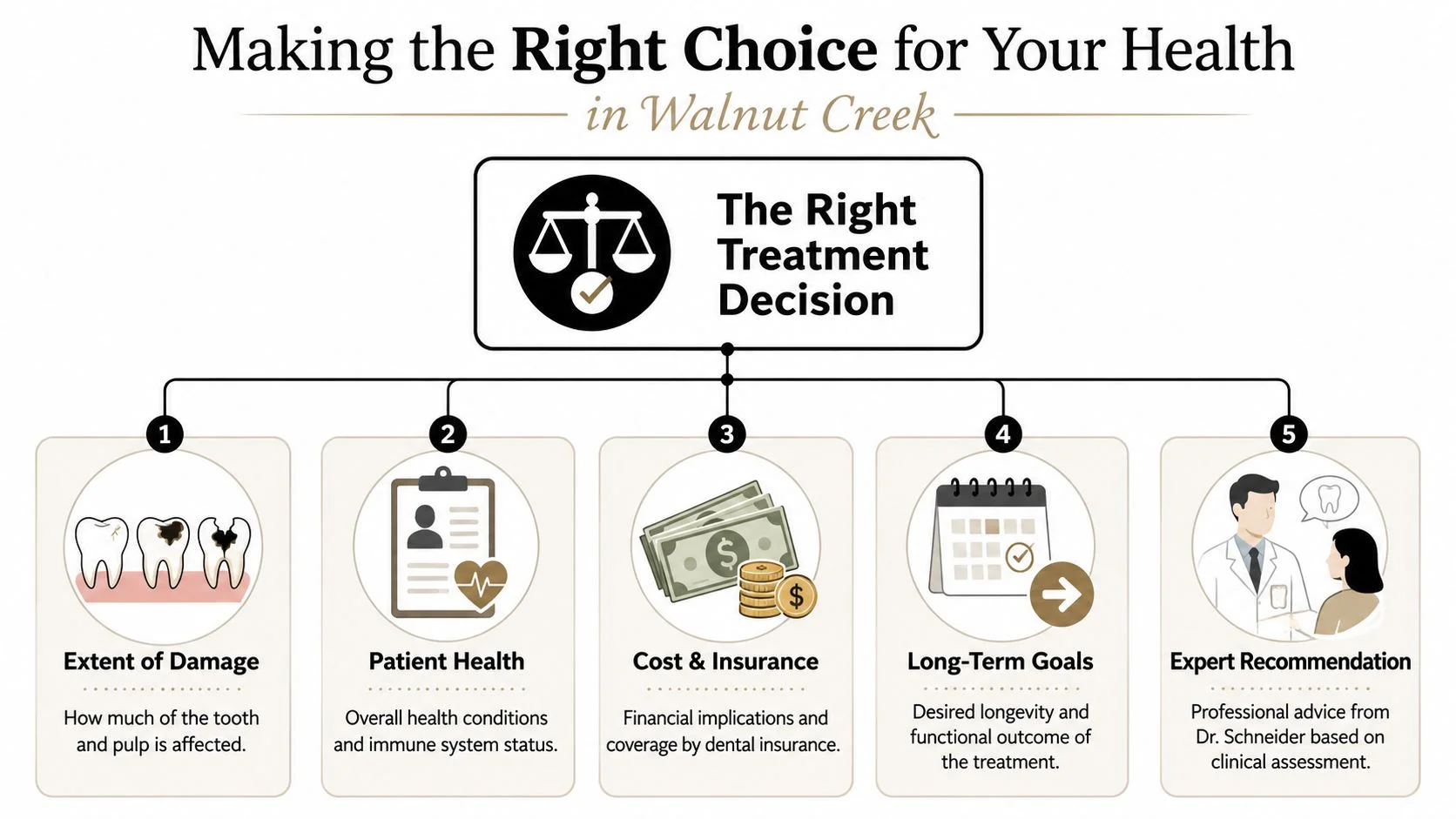
A sound treatment choice usually turns on five factors:
- Extent of damage. A small area of irritation is different from widespread infection or a deep fracture.
- Patient health. Healing, immune status, and general health can affect treatment planning.
- Cost and insurance. Financial reality matters, but it shouldn't blur the difference between temporary relief and durable treatment.
- Long-term goals. Some patients want the most conservative path possible. Others want the most predictable long-term function.
- Clinical recommendation. A diagnosis based on exam findings and x-rays matters more than marketing language.
Natural and minimally invasive claims
Patients often ask whether they can skip standard treatment and choose something more natural. That question deserves a straight answer.
Current guidance notes that approaches such as ozone or laser therapy may be used as adjuncts in selected situations, but evidence is limited for them as stand-alone replacements for reversing established pulp infection, as described in this discussion of natural and minimally invasive root canal alternatives.
That doesn't mean these tools are useless. It means they should be understood in the right role. They may support care in early or selective cases. They do not reliably substitute for definitive treatment when the pulp is already infected.
Marketing language can make every option sound gentle and advanced. Diagnosis decides whether it will actually work.
A practical way to think about it
If the tooth is still vital enough for conservative treatment, preserving it is often the best first goal. If it has crossed into deeper infection but remains restorable, root canal therapy may still be the most predictable way to keep it functional. If the tooth cannot be saved, extraction and replacement planning become the honest path forward.
That's why patients in Walnut Creek who want clear answers benefit from a thorough exam instead of trying to self-sort from internet lists.
Schedule Your Consultation with Dr Schneider Today
If you have tooth pain, swelling, pressure when biting, or you've already been told you may need a root canal, the next step should be simple. Get the tooth evaluated before the problem becomes harder to treat.
For a new patient, that process is straightforward:
- Call or request a visit for a problem-focused exam or emergency appointment.
- Have the tooth evaluated with the appropriate exam and dental x-rays.
- Review the findings clearly so you understand whether the tooth can be protected, treated, retreated, or replaced.
- Choose a plan based on comfort, function, and long-term oral health.

Patients looking for a dentist near me, tooth extraction, restorative dentistry, or an emergency dentist in Walnut Creek often feel better once they understand the decision in plain language. The fear usually comes from uncertainty. A careful exam replaces uncertainty with a plan.
That plan may involve monitoring and protecting a tooth with limited pulp irritation. It may involve root canal treatment to save a restorable tooth. It may involve extraction and replacement with an implant or bridge if the tooth is beyond repair. What matters is knowing which path you're on.
For people with dental anxiety, a calm office environment, clear explanations, and comfort options can make a major difference. Many patients postpone care because they're worried about the appointment itself. In practice, the consultation is often the most reassuring part. You get answers first. Then you decide.
If you live in Walnut Creek, CA and want a trusted local office for dental care, cosmetic dentistry, restorative dentistry, dental implants, cleaning and exams, or urgent tooth pain, don't wait for the problem to become more complicated.
If you're ready for clear answers and compassionate care, schedule a consultation with William M. Schneider, DDS. Whether you need an emergency evaluation, a second opinion on root canal alternative treatments, tooth extraction, or long-term restorative planning, the office provides patient-focused dental care in Walnut Creek, CA designed to protect your comfort and your smile.