You catch it in the mirror while brushing. A thin dark line sits near the gumline, or maybe between two teeth, and your first thought is usually the same. Is this a cavity, tartar, or something worse?
That reaction is understandable. Black lines on teeth can look alarming because they don’t all mean the same thing. Some are harmless surface stains. Some are hardened buildup that needs a cleaning. Some point to a tooth or restoration that deserves a closer look.
If you’ve searched what are the black lines on my teeth, you probably want more than a list of possibilities. You want to know how a dentist figures it out, what can be treated gently, and what steps make sense next. That’s especially true if you’re looking for a dentist near me or a dentist in Walnut Creek, CA and want care that feels calm, clear, and practical.
Noticing Black Lines on Your Teeth? A Walnut Creek Dentist Explains
Most patients don’t notice black lines while eating lunch or talking with friends. They notice them in ordinary moments. Brushing before work. Leaning toward the bathroom mirror. Looking at a photo and zooming in on one tooth that suddenly seems different.
What makes this stressful is the uncertainty. A black line might be something simple sitting on the surface of the tooth. It might be tartar collecting where a toothbrush misses. It might be a stain around an older filling or crown. And sometimes, yes, it can be early decay.
Black lines are a visual clue, not a diagnosis.
That distinction matters. People often try to scrub the area harder at home, switch to a whitening toothpaste, or assume they need cosmetic dentistry right away. Sometimes that helps a little. Often it doesn’t. In some cases, aggressive home scrubbing can irritate the gums without fixing the actual cause.
In a dental office, the process is more deliberate. The goal isn’t to guess. The goal is to identify whether the line is on the tooth, in the tooth, or coming from something attached to the tooth.
What patients usually want to know first
A few questions come up again and again:
- Is it decay or just stain
- Can it be brushed off or does it need professional cleaning
- Will whitening fix it or make no difference
- Could it be related to an old crown or filling
- Do I need urgent treatment or just an exam and cleaning
Those are the right questions to ask. Good dental care starts by narrowing the possibilities carefully, not by jumping straight to treatment.
Common Causes of Black Lines on Teeth
The most useful way to think about black lines is to separate them into broad categories. Some are extrinsic, which means they’re on the outer surface. Others are intrinsic, which means the dark appearance is coming from within the tooth or from a structural problem.
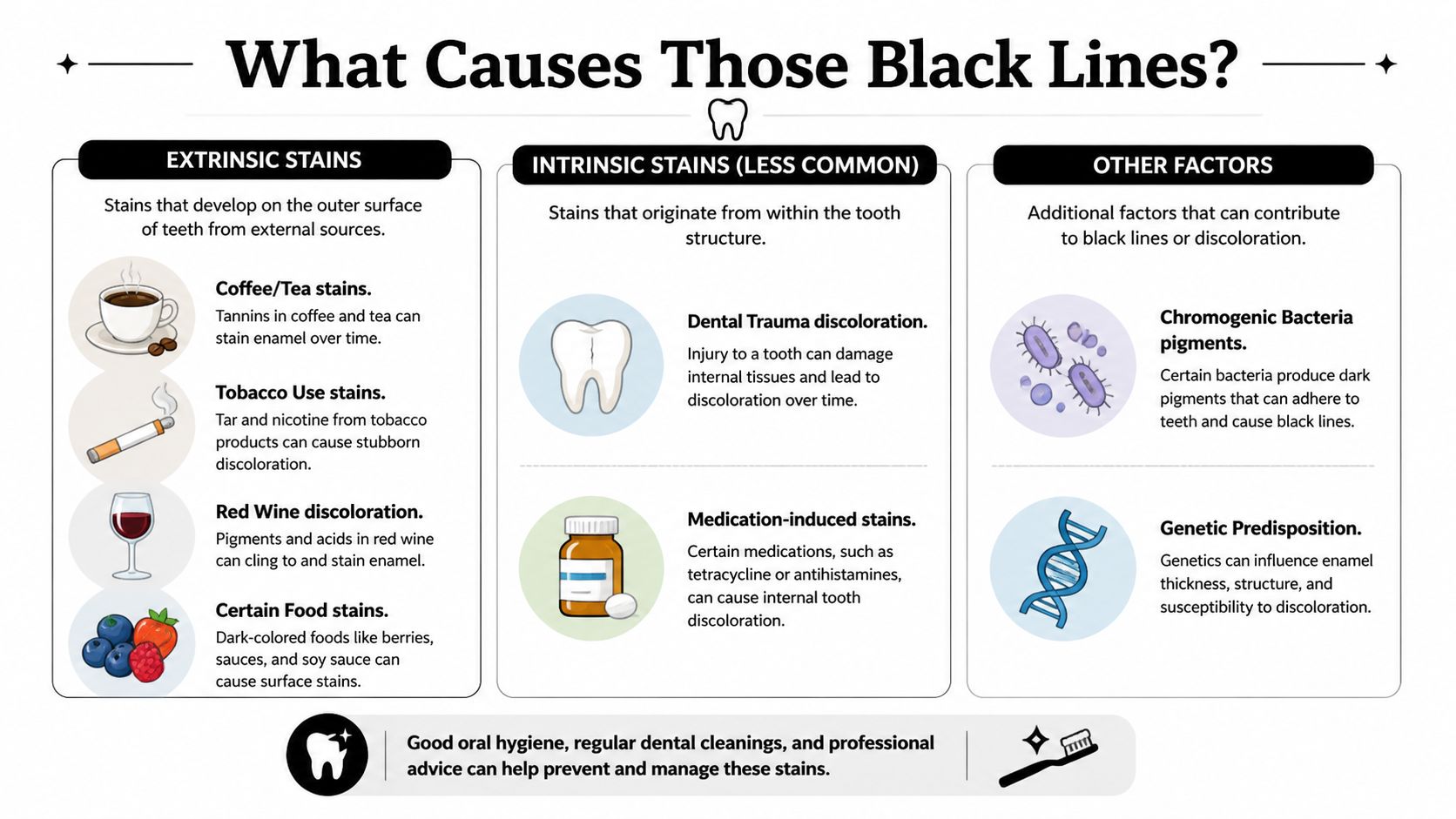
Surface stain and black stain near the gums
Some black lines are stain caught in plaque or on enamel near the gumline. Coffee, tea, red wine, tobacco, and certain foods can contribute to dark discoloration over time. This kind of stain may look dramatic, but it often sits on the surface.
A specific type of discoloration called black stain tends to appear as a line near the gums. Published studies place its prevalence at 1% to 20% globally, and one reviewed study found children with black stain had a mean DMFT index of 1.46 compared with 2.42 in those without it, according to the review of black stain in the National Library of Medicine. That doesn’t mean the stain is desirable. It means appearance and disease don’t always match in a simple way.
Tartar and calculus
Tartar is different from ordinary stain. A useful comparison is this: stain is like a coffee spill on a countertop, while tartar is like baked-on residue stuck to a pan. One wipes away. The other needs instruments.
When plaque isn’t removed well, it can harden into calculus along the gumline and between teeth. That buildup can absorb pigments and look brown, gray, or black. It often feels rough if you run your tongue over it. It also tends to collect in the places patients already struggle to clean.
When the dark line may be inside the tooth
Not every black line is something sitting on the enamel. Sometimes the tooth itself is the problem.
Common examples include:
- Early decay that darkens a groove, edge, or area near the gumline
- A crack that catches stain and creates a thin dark line
- Old metal-based dental work that shows through as a dark shadow at the edge
- A failing filling or crown where the margin begins to discolor
These don’t all feel the same. A cavity may feel soft or sensitive. A crack may bother you when you bite. A restoration margin may look darker without causing pain.
Practical rule: If the line doesn’t brush off, keeps returning, or is paired with sensitivity, don’t assume it’s cosmetic.
A quick comparison
| Cause | What it often looks like | What usually works |
|---|---|---|
| Surface stain | Thin dark discoloration on enamel | Professional polishing or cleaning |
| Black stain | Line near gumline, often persistent | Professional removal and monitoring |
| Tartar | Rough, attached buildup near gums | Scaling and home-care improvement |
| Decay or crack | Localized dark area that may feel different | Exam, X-rays, and restorative care if needed |
How We Diagnose Black Lines at Our Walnut Creek Office
Patients usually feel better once they know what the exam involves. Diagnosis isn’t dramatic. It’s methodical, gentle, and focused on ruling out the serious causes before recommending anything.

First we look at location and texture
The first clues come from where the line sits and how it behaves. A line hugging the gumline across several teeth raises different questions than a dark mark on one tooth next to an old filling. We also check whether the area looks matte or shiny, smooth or rough, isolated or widespread.
An explorer helps distinguish attached buildup from a surface stain or a suspicious softened area. That doesn’t mean “poking hard.” It means carefully checking the texture and margin of the tooth.
We also look at the surrounding gums and restorations
A black line rarely exists in isolation. The tissue around it matters. So do nearby crowns, fillings, and the way your bite loads that tooth.
Calculus formation rates can double with poor hygiene, and professional scaling matters because these deposits can contribute to pocketing that needs treatment, as noted in this discussion of calculus and black line diagnosis. That’s one reason a dark line at the gumline gets evaluated as a health issue, not just a cosmetic one.
If the discoloration is next to older dental work, we also consider whether the restoration margin is staining, leaking, or showing age. If you’re wondering whether an existing restoration may be part of the problem, this page on signs you may need to replace your crown can help you recognize common warning signs.
When dental X-rays help
Not every black line needs imaging, but dental X-rays are valuable when the dark area may reflect decay between teeth, under a restoration, or near the gumline where direct vision is limited. Digital images also help confirm that a suspicious spot is only external and not hiding deeper damage.
A new patient exam should answer two questions clearly. What is it, and what does it actually need?
That matters because treatment depends on the diagnosis. A surface stain doesn’t need a filling. A cavity won’t improve with whitening. A rough band of tartar can’t be flossed away once it has hardened.
What the visit usually feels like
For most patients, this part is easier than expected:
- You point out the area that’s bothering you.
- The tooth is dried and examined closely under good lighting.
- We check the texture and margins around the dark line.
- Digital X-rays are taken if needed to see what the eye can’t.
- You get a plain-English explanation of what’s going on and what, if anything, should be done next.
Effective Treatments for a Brighter, Healthier Smile
Once the cause is clear, the treatment path usually becomes simpler. The key is matching the solution to the problem instead of using one cosmetic fix for every dark line.

What works for surface problems
If the line is stain or tartar, treatment usually starts with a professional cleaning. Polishing can lift many external stains. Scaling removes hardened deposits that brushing and flossing can’t touch.
Black line stain is its own category. For that condition, removal requires professional instruments such as ultrasonic scalers, and professional air polishing has achieved 95% stain elimination with minimal enamel abrasion, according to this review of black line stain hygiene management. That’s why repeated home scrubbing often disappoints. The problem isn’t effort. It’s the wrong tool.
Whitening can help when discoloration is broadly related to external staining, but it has limits. Whitening does not remove calculus. It also won’t repair a dark margin around a leaking filling or cover a crack line inside the tooth. If you’re exploring cosmetic improvement after the tooth surfaces are properly cleaned, Zoom whitening in office is the type of treatment people often ask about.
What works for structural or restorative issues
When the line reflects a damaged tooth, old restoration, or active decay, the goal shifts from polishing to repair.
That may include:
- Tooth-colored fillings for small areas of decay
- Crown replacement if an existing crown margin is failing or staining
- Bonding in selected cosmetic situations
- Protective restoration when a crack line is compromising the tooth
The benefit isn’t just appearance. Treating the actual cause protects the tooth from further breakdown and often improves comfort at the same time.
A short visual explanation can help if you want to see how professional dental care addresses concerns like this:
What doesn’t work well
Patients deserve straight answers about the trade-offs.
| Approach | When it falls short |
|---|---|
| Whitening toothpaste | Won’t remove hardened tartar or fix decay |
| Home scraping tools | Can damage enamel or irritate gums |
| Whitening alone | Doesn’t correct internal darkening or faulty restorations |
| Waiting to “watch it” | Risky if the line is actually decay or a cracked margin |
The right treatment should make the tooth cleaner, healthier, and easier to maintain. Not just lighter for a week.
How to Prevent Black Lines on Your Teeth
Prevention depends on interrupting the cycle before plaque hardens or pigments settle into rough areas. The most effective habits aren’t complicated, but they do need to be consistent.
Focus on the gumline every day
The gumline is where many dark lines begin. That’s also the area people often miss when they brush quickly.
Plaque can mineralize into tartar within days, and improved daily hygiene can cut tartar recurrence by 50% to 70%, according to this clinical overview of black lines and tartar prevention. That’s why twice-daily brushing and daily flossing are not optional if you’re prone to buildup.
Small habits that make a real difference
Some prevention is about technique. Some is about timing.
- Brush where the tooth meets the gum instead of polishing only the front surfaces.
- Floss daily because floss disrupts plaque between teeth before it hardens.
- Rinse with water after coffee, tea, or red wine to reduce how long pigments sit on the enamel.
- Don’t rely on whitening products as maintenance if the underlying issue is buildup.
A power toothbrush can help some patients clean more consistently along the gumline, especially if hand brushing tends to miss the same spots over and over.
Keep routine cleanings on schedule
Even careful patients can build tartar in hard-to-reach places. Professional cleanings remove what home care can’t and give your dentist a chance to spot a harmless stain before it becomes a larger issue, or catch a structural problem while it’s still small.
Prevention works best when home care and professional care support each other.
For patients with frequent staining, closely spaced teeth, older crowns, or a history of fast tartar buildup, recall visits become especially valuable. The goal isn’t just a cleaner smile. It’s fewer surprises.
Schedule Your Visit with a Trusted Walnut Creek Dentist Today
When someone notices a black line on a tooth, the hardest part is usually not the treatment. It’s the uncertainty before the visit. Patients often arrive expecting bad news and leave relieved because they finally know whether the issue is simple stain, tartar, a restoration problem, or something that needs restorative care.
A good first visit should feel organized and unhurried. You check in, settle into a comfortable setting, and talk through what you’ve noticed. During new patient exams, the concern gets looked at directly instead of being folded into a vague “we’ll keep an eye on it.” If needed, dental X-rays help clarify what the surface can’t show.

Some dark lines turn out to be related to enamel changes rather than ordinary stain. A forward-looking dental practice also watches for intrinsic darkening linked to demineralization and dry mouth, where remineralization therapies may help more than whitening, as discussed in this overview of enamel demineralization and black lines. That’s another reason a real diagnosis matters.
Whether you’re searching for a dentist in Walnut Creek, CA, an emergency dentist, a home for cleaning and exams, or long-term help with cosmetic dentistry, restorative dentistry, tooth extraction, or even dental implants near me, the first step is the same. Get the area evaluated before guessing.
If the black line is harmless, you’ll know. If it needs treatment, you can address it early and conservatively. Either way, certainty is better than worry.
If you’ve noticed a dark line on a tooth and want a clear answer, William M. Schneider, DDS offers thoughtful, gentle dental care for Walnut Creek and the East Bay. Whether you need a routine exam, a professional cleaning, cosmetic guidance, or restorative treatment, scheduling a visit is the best way to find out what’s causing the change and what will help.