If you're reading about the dental implant healing timeline, there's a good chance you're in one of a few familiar situations. Maybe you recently had a tooth extraction and want to know what comes next. Maybe you've been living with a gap in your smile and you're finally ready to fix it, but you're worried about how long recovery will take. Or maybe you've searched for a “dentist near me” or “dental implants near me” in Walnut Creek, CA because you want answers from a local office you can call.
Those questions are reasonable. Patients often don't feel anxious about the implant itself as much as they feel uncertain about the waiting. They want to know when they'll feel normal, when they can chew comfortably, and when the final tooth will be in place.
At our Walnut Creek dental office, I believe patients do better when they understand the process clearly. A dental implant isn't a quick patch. It's a carefully planned form of restorative dentistry that replaces a missing tooth from the root up. When done thoughtfully, it can restore comfort, function, and confidence in a very natural way.
Dental Implants in Walnut Creek Your Path to a Restored Smile
A missing tooth affects more than appearance. It can change the way you chew, the way you speak, and even how confident you feel when you smile. Many patients come in after a tooth extraction, while others have been putting off treatment for years because they weren't sure what the implant process would involve.
That hesitation makes sense. If you've never had an implant before, the healing phase can sound mysterious. People often ask whether they'll be out of work, whether the area will hurt for months, or whether healing means they have to put life on hold. In most cases, the answer is more reassuring than people expect. Recovery has stages, and each stage has a purpose.

Why patients in Walnut Creek ask about timing first
When someone searches for a dentist in Walnut Creek, CA, an emergency dentist, or even a cosmetic dentist near me, they're often trying to solve two problems at once. They want relief, and they want a plan. With implants, the plan matters because the final result depends on healing beneath the surface, not just what the gums look like from the outside.
A dental implant replaces the root of a missing tooth with a small post placed in the jawbone. After that, the body needs time to build a secure bond around it. That's why the timeline is measured carefully and why follow-up visits matter.
A healthy implant result isn't about rushing to the crown. It's about letting the foundation become strong enough to handle everyday chewing.
What this means for you as a local patient
If you're in Walnut Creek or the surrounding East Bay and looking for restorative dentistry, you deserve guidance that's practical, calm, and specific to your situation. Some patients need implant treatment after tooth extraction. Others may also be comparing options like crowns, bridges, cosmetic dentistry, or even teeth whitening after they restore the missing tooth and want the whole smile to match.
What matters first is understanding the road ahead. Once you know what healing looks like, the process feels much less intimidating.
Why Dental Implant Healing Is a Unique Process
You may feel surprisingly normal a week or two after implant surgery. The gum can look calmer. Chewing on the other side may feel easy again. Then it is natural to ask, "If it feels better, why am I still waiting?"
The answer is that implant healing happens in two places at once. The gum heals on the surface, and the jawbone heals deeper down around the implant. Those two timelines do not always match.
A filling rests in a tooth. A crown covers a prepared tooth. A dental implant is placed into bone, so your body has to do more than recover from a procedure. It has to grow a firm attachment between living bone and the implant surface. Dentists call that osseointegration.
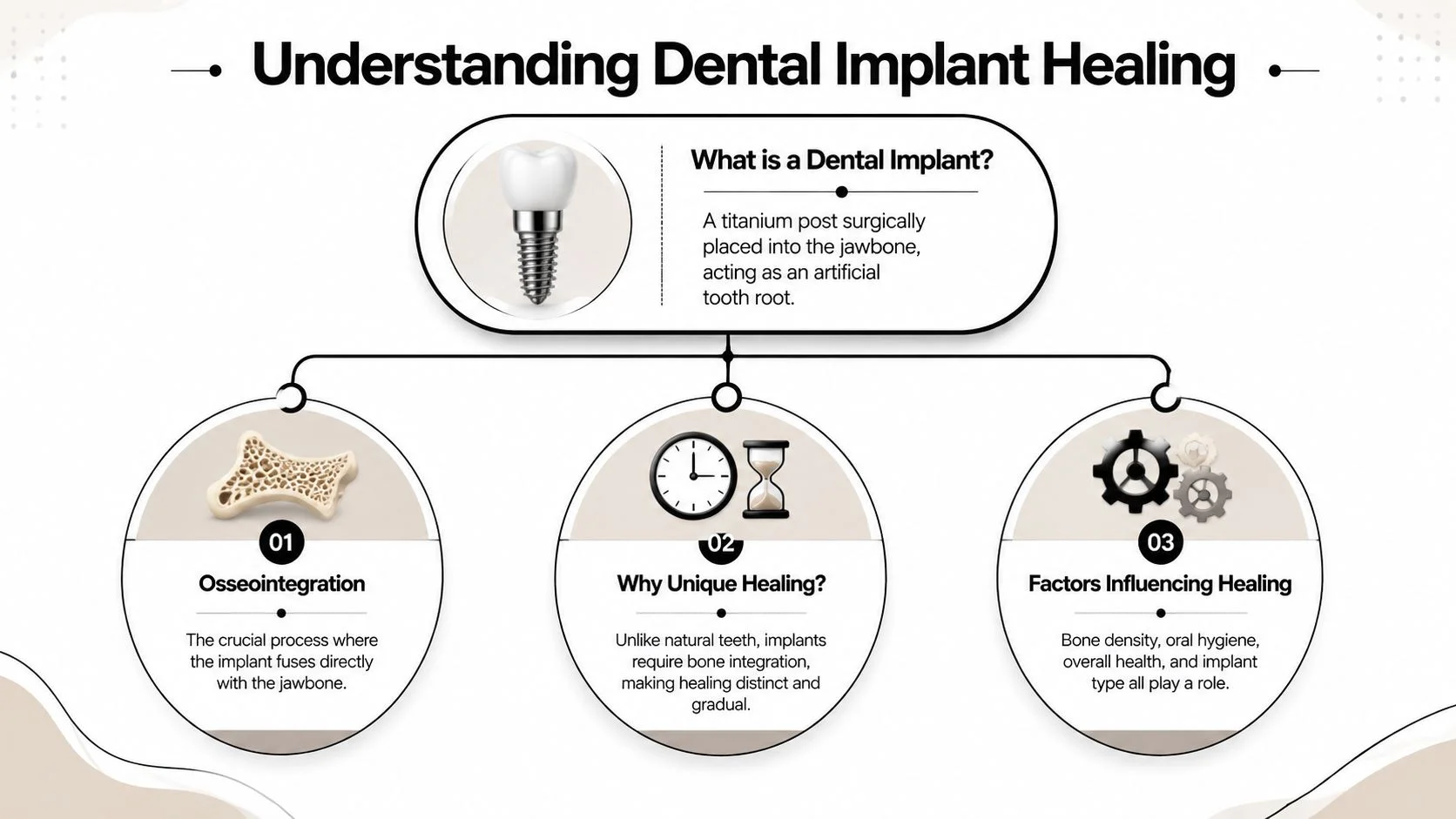
A clear way to understand osseointegration
An implant works a lot like a post that needs the surrounding ground to become firm before it can carry weight well. At first, the implant is in position, but long-term strength comes from the healing bond your body builds around it. That is why an area can look good in the mirror and still need more time before it is ready for full biting pressure.
This point causes a lot of confusion for new patients. Comfort is encouraging, but comfort is not the same thing as full stability. In our Walnut Creek office, Dr. Schneider spends time explaining this early so patients do not mistake "it feels fine" for "it is finished healing."
Why the process takes longer than many patients expect
Implant healing is usually measured in phases, not in one single finish line. The soft tissue may settle first. Bone remodeling and integration continue unseen underneath the gums after that. You will not see that deeper part happening, but it is the part that helps the implant support a crown or bridge with confidence over time.
For you as our patient in Walnut Creek, this is why follow-up visits matter. We are not merely waiting for time to pass. We are checking that the site is staying clean, the gums are responding well, and the implant is healing on schedule before the next step is approved. If you want to learn more about the treatment options we provide, our Walnut Creek dental implant care page gives a helpful overview.
Why this matters for long-term success
Good implant treatment is built on patience and planning. Rushing to place the final tooth before the foundation is ready can put unnecessary stress on the implant.
Patients in Walnut Creek often feel more at ease once they understand that the quiet middle part of healing is still active treatment. Your body is doing the hard work. Our job is to monitor it carefully, guide you through each stage, and make sure the final result is strong, comfortable, and made to last.
The Dental Implant Healing Timeline Week by Week
Most patients want a clear answer to one question. How long will this take from surgery to the final tooth? The most useful answer is that healing happens in layers.
A general estimate from dental practices puts full healing at about 6 months, with many patients healing in 3 to 4 months. The initial soft-tissue healing completes within 1 to 2 weeks, but the bone fusion generally takes 3 to 6 months before the permanent tooth can be placed, according to this overview of typical implant healing time.
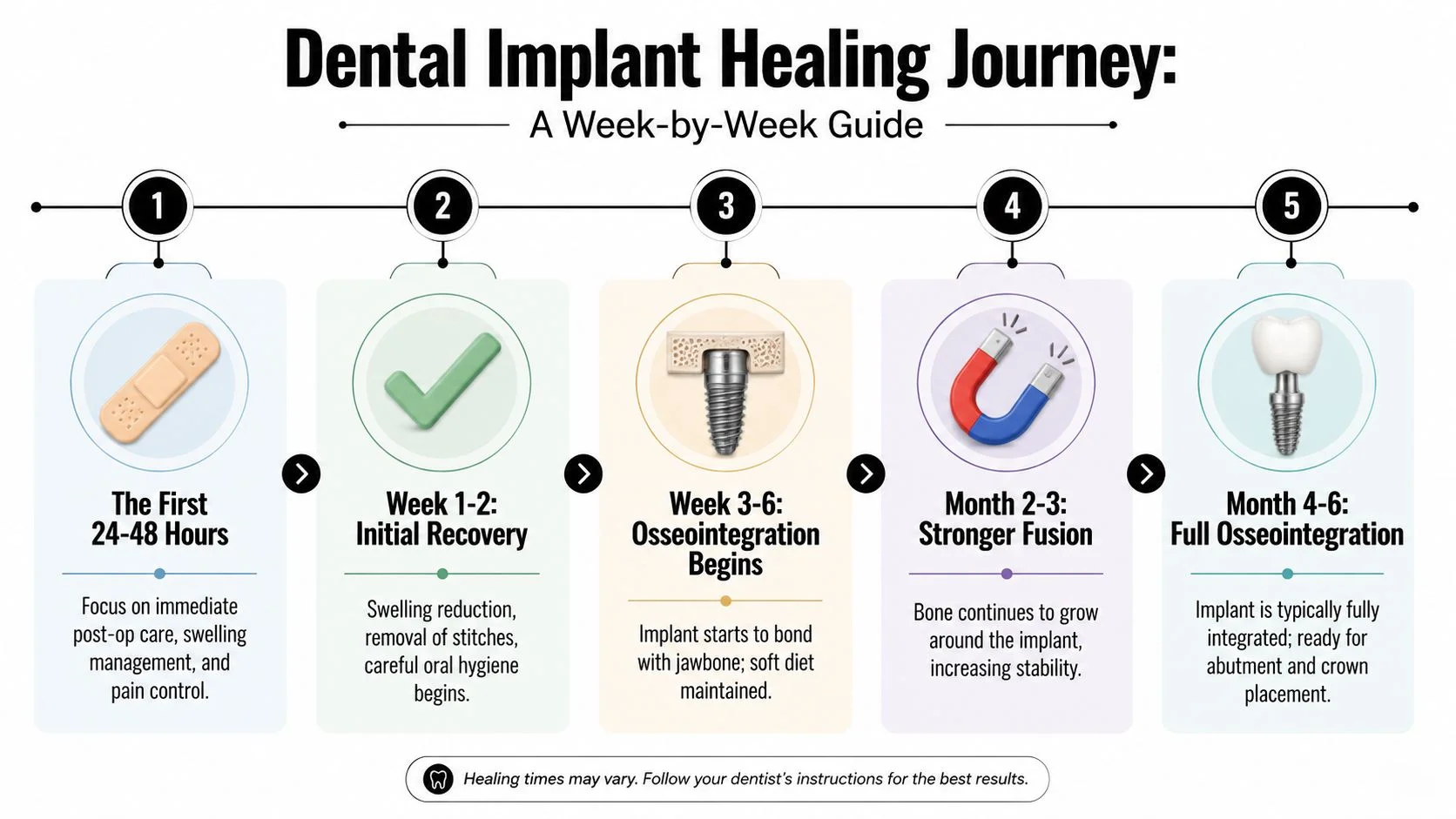
The first 24 to 48 hours
This is the immediate recovery window. The tissues are reacting to the procedure, so some soreness, swelling, and light bleeding or oozing can happen. Rest, a soft-food routine, and careful attention to post-op instructions are typically beneficial.
Your job during this phase is simple. Protect the area and don't disturb the site. Avoid chewing directly on it unless you've been told otherwise. Keep foods easy, soft, and not overly hot.
A few examples that usually work well:
- Breakfast options: yogurt, scrambled eggs, oatmeal, or smoothies eaten carefully
- Lunch and dinner ideas: soup that isn't too hot, mashed potatoes, soft pasta, or tender fish
- What to avoid: crunchy foods, very chewy foods, and anything that pokes the surgical site
The first 2 weeks
This is when the gums usually start looking calmer. The area often becomes easier to manage day by day. Patients are sometimes surprised by this part because they expected a longer period of visible recovery.
That doesn't mean the implant is done healing. It means the soft tissue is closing and organizing well. This is a good phase for gentle oral hygiene and follow-up with your dentist if a review visit is planned.
Most of the healing you can see happens early. Most of the healing that determines implant strength happens later.
If you're comparing providers for dental implants near me or a dentist near me, this part of the process is one reason careful follow-up matters. A team that explains what you're feeling and what you're not supposed to test with your tongue or bite can make recovery much less stressful.
Weeks 2 through 12
This is the quiet middle of the timeline. Patients often feel fairly normal, but the bone is still adapting around the implant. In everyday language, the body starts turning a placed implant into a functional anchor.
You may be eating more comfortably, returning to routine, and noticing less daily awareness of the area. That's good progress. It still isn't the stage to challenge the implant with hard chewing unless your dentist has said it's appropriate.
For patients who want more background on implant care and restoration options, our dental implant articles and updates explain related topics in more detail.
Here's a simple way to think about this middle stretch:
| Healing period | What you may notice | What's happening |
|---|---|---|
| Days 1 to 2 | Tenderness, swelling, careful eating | Early tissue recovery |
| Week 1 to 2 | Gums look better, discomfort eases | Soft-tissue healing progresses |
| Weeks 2 to 12 | Daily comfort improves | Bone support develops around the implant |
| Months 3 to 6 | Little visible change, more internal stability | Implant integration matures |
A short video can also help make the sequence easier to picture.
Months 3 to 6
This is the phase patients are usually waiting for. If healing is progressing as planned, the implant may be ready for the next restorative step. That can involve the abutment and final crown, depending on your treatment plan.
This period is less dramatic than the first week, but it's the most important for long-term function. The reason many implant timelines are discussed in months is that this deeper stability takes time.
If you're also considering broader smile improvements, this is often when patients begin asking how the implant will match nearby teeth and whether additional restorative dentistry or cosmetic dentistry might help create a balanced final result.
Normal Recovery Symptoms vs Warning Signs of Complications
A question we hear often in our Walnut Creek office is simple: “How do I know if I'm healing normally?” That question matters because implant recovery can feel unfamiliar. The site may look different day to day, and small changes can be hard to interpret if you have never been through this before.
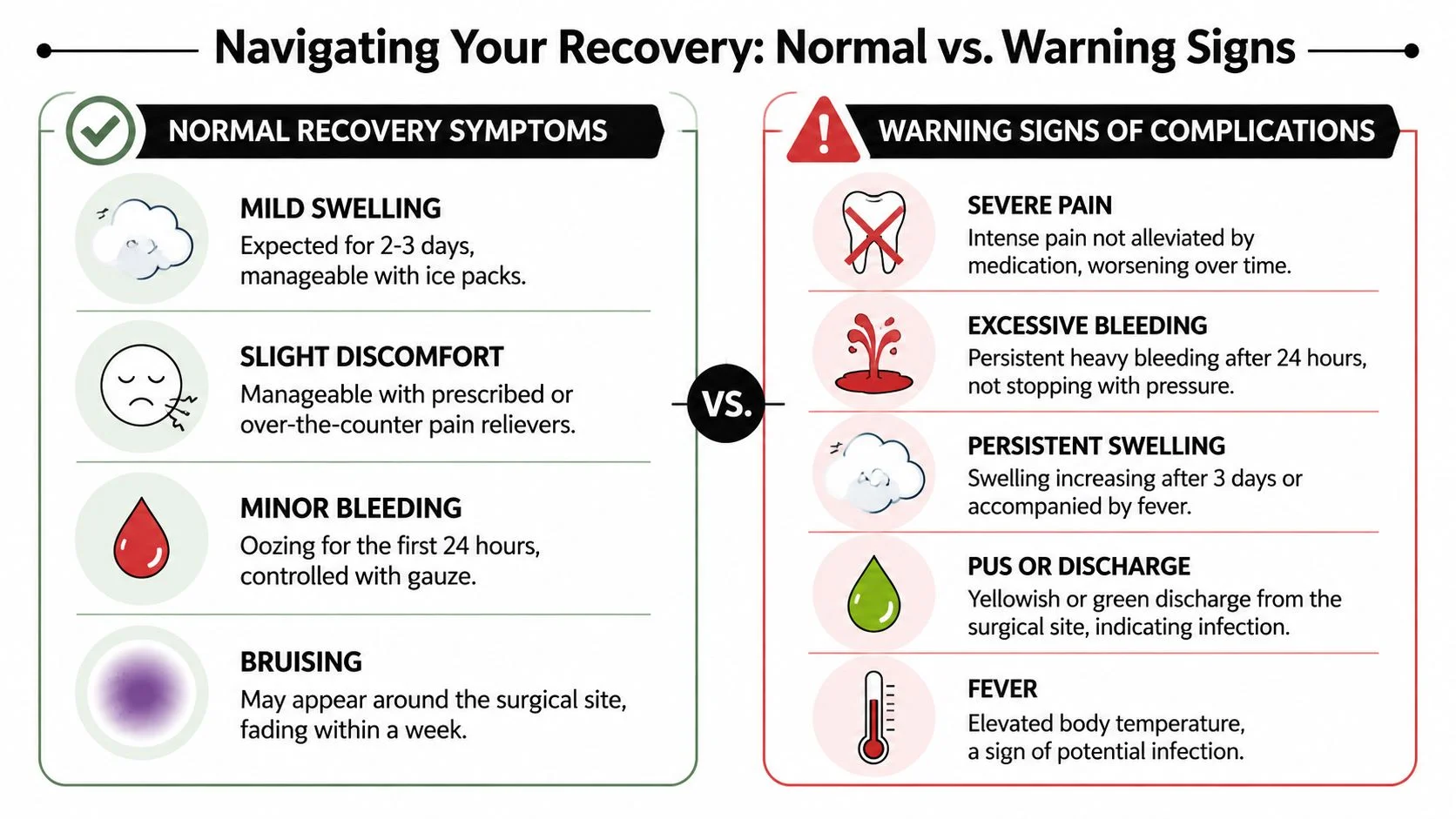
A helpful way to judge healing is to watch the direction. Normal recovery usually moves in one direction: less swelling, less tenderness, and easier function as the days pass. A problem often moves the other way. Symptoms become stronger, spread, or appear after you were already starting to feel better.
What usually falls into the normal range
Early healing often includes a few signs that can look concerning but are commonly part of recovery:
- Mild swelling: Puffiness near the implant site or along the cheek is common at first and should gradually go down.
- Soreness that responds to care: Tenderness during eating, brushing nearby, or opening wide can happen early on.
- Light bleeding or oozing: A small amount soon after surgery can be expected.
- Minor bruising or tightness: Some patients notice discoloration or a stretched feeling in the gums or cheek.
This part is a lot like watching a scraped knee close up. It may look a little irritated before it looks fully normal, but the pattern should still be steady improvement.
Signs that deserve prompt attention
The symptoms below are less about how dramatic they look and more about the pattern they follow.
| Normal recovery | Warning sign |
|---|---|
| Symptoms ease gradually | Pain becomes stronger over time |
| Swelling settles | Swelling keeps increasing or feels excessive |
| Light early bleeding | Bleeding continues heavily or won't stop |
| Area feels stable | Implant feels loose or shifts |
| Clean healing | Pus, unusual discharge, or a bad taste appears |
If something feels worse instead of better, call your dentist. You do not need to figure out the cause before reaching out.
When to call, even if you're unsure
Sometimes the symptom itself is not the biggest concern. Uncertainty is. You may not have severe pain, but you may notice that something feels off, looks unusual, or is not improving the way you expected.
That is enough reason to contact us.
At our Walnut Creek office, we always tell patients that a call to check in is never a bother. We would rather answer a small question early than have you sit at home worrying about whether you should have called sooner. That patient-first approach is part of how Dr. Schneider and our team help make implant care feel safer, clearer, and more personal.
Factors That Can Affect Your Implant Healing
No two mouths heal in exactly the same way. That's one reason the dental implant healing timeline is usually described as a range instead of a single date circled on the calendar.
Some patients move through healing smoothly and quickly. Others need more time because the biology at the implant site is more demanding. That isn't failure. It's the body following its own pace.
What can speed healing up or slow it down
A few factors often shape the timeline:
- Bone quality: Stronger, healthier bone can support more efficient integration.
- Oral hygiene: Clean conditions help the tissues recover without added irritation.
- Overall health: Medical conditions can influence how the body repairs tissue and bone.
- Smoking or tobacco use: Reduced blood flow can make healing less predictable.
- Whether grafting was needed: If the site needed extra preparation, the process may take longer.
These aren't just technical details. They're the reasons one patient may be ready for the next step sooner while another needs more observation before a final crown is placed.
What implant design and surface treatment can change
Surface treatment also matters. In a PubMed-indexed study on implant loading and photofunctionalization, the healing time before functional loading was 3.2 months for photofunctionalized implants versus 6.5 months for untreated implants. The same study reported a 97.6% success rate for photofunctionalized implants and 96.3% for untreated implants, and found faster monthly increases in implant stability quotient for photofunctionalized implants at 2.0 to 8.7 per month, compared with published untreated ranges of -1.8 to 2.8.
For patients, the takeaway is straightforward. The implant timeline isn't random, and it isn't identical for everyone. Biology, bone response, and treatment details all play a role.
Healing time is personal. Two patients can have the same procedure and reach the finish line on different schedules for completely reasonable clinical reasons.
Why the consultation matters so much
This is why a proper exam is more than a formality. Your dentist isn't just deciding whether you want an implant. They're evaluating what kind of healing environment the implant will have.
For someone who has also been thinking about cleaning and exams, dental x-rays, new patient exams, or restorative dentistry after tooth extraction, this planning stage often brings everything together. The implant itself is one part of a broader oral health picture.
Your Implant Journey at Our Walnut Creek Dental Office
You leave your consultation knowing what happens first, what can wait, and what signs tell us healing is on track. That kind of clarity matters. For many patients in Walnut Creek, the stress is not only about the implant itself. It is about not knowing how the process will fit into daily life.
At our office, the journey starts with a conversation. Dr. Schneider reviews your health history, examines the area, and takes the imaging needed to plan the implant with care. We also study the nearby teeth, your bite, and your gum condition, because an implant works best when the whole mouth is working together.
Some patients come in focused on one missing tooth. Others are also dealing with a recent extraction, an older crown that is failing, or wear that affects how the final tooth should be designed. In those cases, the treatment plan needs the right order. Building an implant is a little like building on a foundation. We want the base, the support around it, and the final fit to make sense together.
What patients can expect from the experience
Dr. Schneider explains each step in plain language. You should know what we are doing, why it matters, and what the next checkpoint will be. We also give practical instructions for eating, brushing, activity, and follow-up visits, so the plan feels manageable at home, not only understandable in the chair.
Patients who feel anxious are common in every dental office, and we take that seriously. Some are worried about injections. Some remember a difficult dental visit from years ago. Some are more comfortable when they know the sequence ahead of time. A calm setting, clear instructions, and steady follow-up often lower that stress because uncertainty is no longer running the show.
If you want to see how an implant fits into your broader restorative dentistry options in Walnut Creek, that page gives helpful context for implants, crowns, bridges, and long-term tooth replacement planning.
How we monitor healing
In our office, we treat implant healing as a process with checkpoints, not a race with fixed dates. The gums usually settle first. The deeper bond between the implant and bone takes longer. What this means for you as our patient in Walnut Creek is simple. We do not move to the next stage because the calendar says we should. We move forward when your mouth is ready.
That approach helps protect the long-term result. A site can look calm on the surface while deeper healing is still underway, much like fresh grass can cover soil before the ground underneath is fully packed and stable. Follow-up visits let us confirm that recovery is progressing the way it should and answer questions before small concerns become bigger ones.
William M. Schneider, DDS provides general, cosmetic, and restorative dental care in Walnut Creek, including implant treatment planning, follow-up care, and long-term maintenance for patients who want one dental home for routine care and more advanced treatment.
Take the Next Step Toward a Healthy Smile in Walnut Creek
A dental implant doesn't heal all at once. It heals in stages, and each stage has a purpose. The early days are about comfort and soft-tissue recovery. The months that follow are about building the stable bond that makes the final tooth feel secure and functional.
That's why patience matters. A successful implant isn't just about placing a post in the bone. It's a partnership between an informed patient and a careful dental team that monitors healing, answers questions, and moves to the next step only when the foundation is ready.
If you're in Walnut Creek or nearby and you're looking for dental implants near me, a trusted dentist near me, or guidance after tooth extraction, the next step is a consultation. That's the best way to get answers based on your mouth, your health, and your goals.
If you're ready to talk about missing teeth, implant timing, or your options for restorative care, schedule a consultation with William M. Schneider, DDS. Our Walnut Creek office can help you understand your treatment plan, review healing expectations, and decide whether dental implants are the right fit for your smile.