A missing tooth usually becomes a bigger issue the moment everyday life makes it obvious. You notice it when you chew on one side, when cold air hits the space, or when you smile in the mirror and your eye goes straight to the gap. Those in Walnut Creek searching for a dentist near me or dental implants near me aren't just curious. They want a clear answer on what will work, what will last, and what will feel manageable.
The two options patients ask about most often are dental implants and dental bridges. Both can restore a smile. Both can improve function. But they don't work the same way, and the long-term experience is very different. That's why the difference between dental implants and bridges isn't just a technical detail. It affects your comfort, your maintenance routine, your future dental work, and often your total cost over time.
Restoring Your Smile in Walnut Creek After Tooth Loss
A common situation looks like this. Someone loses a back tooth after a crack, a failed root canal, or an extraction. At first, they tell themselves they can live with it because no one sees that area anyway. Then chewing gets awkward, food collects in the space, and they start wondering whether the nearby teeth will shift.
For a front tooth, the stress is usually more immediate. Patients often feel self-conscious in conversations, on video calls, or at family events. Even when the missing tooth isn't painful, the uncertainty is draining. Should you choose the faster option? The one with less treatment? The one that protects your mouth best over time?

What patients usually want to know first
Readers aren't asking for a lecture on restorative dentistry. They want practical answers:
- Will it look natural
- Will I be able to chew normally
- How long will it last
- Will treatment hurt
- What happens to the teeth next to the gap
- What will this really cost over the years
Those are the right questions.
A missing tooth isn't only a cosmetic problem. It changes how forces move through your bite and how you care for the area every day.
Patients looking for a dentist in Walnut Creek, CA also tend to want a long-term dental home, not a rushed recommendation. That matters because the best choice depends on more than the empty space itself. The condition of the neighboring teeth, the health of the bone, your comfort with procedures, and your budget all shape the decision.
Why this choice deserves careful planning
Tooth replacement isn't one-size-fits-all. A bridge can be a smart solution in the right situation. An implant can be the strongest long-term choice in many others. The right recommendation comes from matching the treatment to the person, not forcing every patient into the same plan.
If you're weighing cosmetic concerns, function, comfort, or long-term oral health, this guide will help you understand the key difference between dental implants and bridges in plain English.
Understanding Your Two Main Tooth Replacement Options
Before comparing them, it helps to picture how each restoration works inside your mouth.
How a dental bridge works
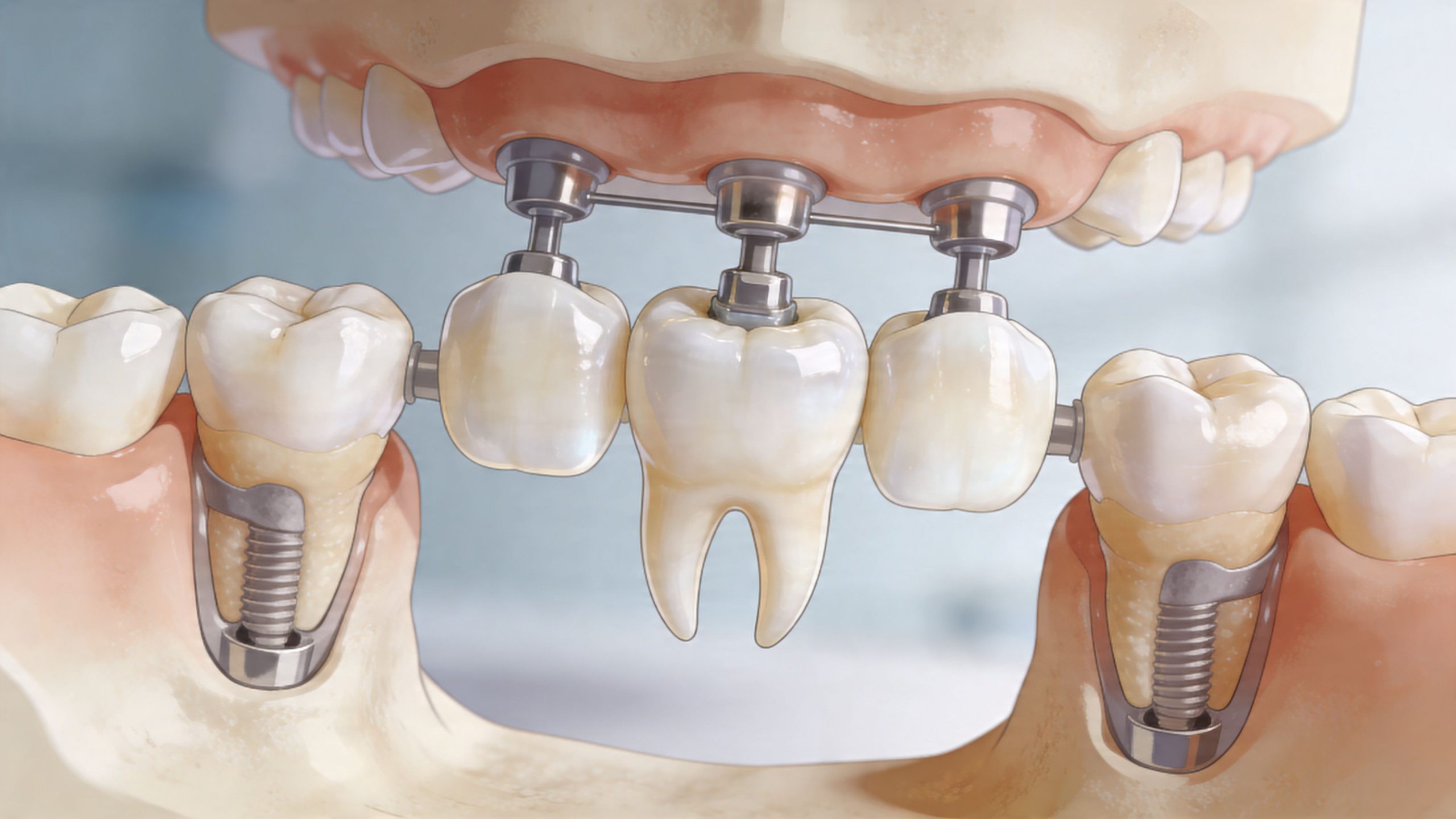
A dental bridge fills the space left by a missing tooth by attaching a replacement tooth to support teeth on either side. It resembles a short span across a gap. The replacement tooth in the middle depends on neighboring teeth to hold it in place.
In a traditional bridge, those adjacent teeth are reshaped so crowns can fit over them. Those crowns act as anchors. The false tooth between them restores appearance and some chewing function.
For patients who want a simple visual explanation, this overview of dental bridges gives a helpful outside reference, and this page on replacement teeth options shows how bridge treatment fits into restorative care.
A bridge can be appealing when you want a non-surgical solution and the neighboring teeth already need crowns. In that situation, the treatment can solve more than one problem at once.
How a dental implant works
A dental implant replaces the tooth from the root up. Instead of leaning on nearby teeth, it stands on its own.
It has three basic parts:
- The implant post goes into the jawbone and acts like a new root.
- The abutment connects the post to the visible restoration.
- The crown is the part that looks like a tooth above the gumline.
That design changes how the restoration behaves. Because the implant is anchored in bone, it functions more like a natural tooth than a bridge does. It doesn't require support from the teeth next to it.
Many patients find the process easier to understand when they see it explained visually:
Why the mechanics matter
The structure determines the trade-offs. A bridge is usually quicker and avoids implant surgery. An implant is more involved on the front end, but it replaces the missing root as well as the visible tooth.
If you remember one basic distinction, remember this. A bridge connects across a gap. An implant replaces the missing tooth as its own unit.
That single difference affects bone health, the neighboring teeth, cleaning, and long-term durability. Those are the issues that matter most when you're choosing between the two.
A Detailed Comparison Dental Implants vs Dental Bridges
Here is the side-by-side view many patients wish they had at the beginning.
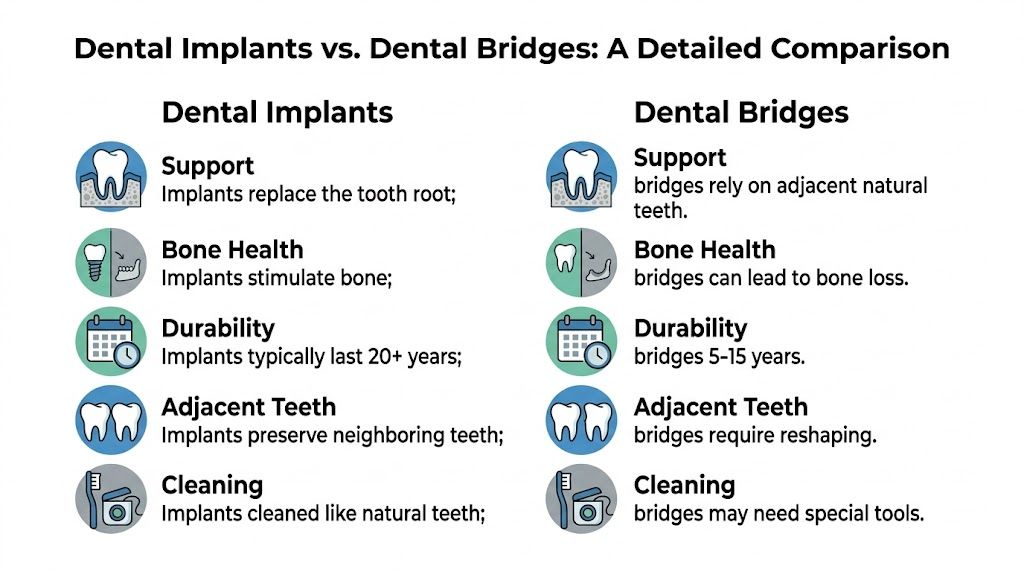
| Factor | Dental Implant | Dental Bridge |
|---|---|---|
| How it stays in place | Anchored in the jawbone | Supported by neighboring teeth |
| Effect on nearby teeth | Usually preserves adjacent teeth | Usually requires reshaping adjacent teeth |
| Jawbone response | Replaces the root and stimulates bone | Doesn't replace the root |
| Cleaning | Similar to caring for a natural tooth | Often needs extra cleaning under the bridge |
| Treatment style | Surgical placement followed by restoration | Non-surgical restoration in many cases |
| Typical long-term pattern | Designed as a standalone replacement | May need replacement over time |
Adjacent teeth and structural support
This is often the first major clinical dividing line.
With a bridge, the supporting teeth do extra work. To hold the bridge, those teeth are commonly prepared for crowns. If those teeth already have large fillings, fractures, or existing crowns, that may be acceptable and even practical. But if they're healthy and untouched, removing tooth structure is a real trade-off.
An implant doesn't ask neighboring teeth to carry the load. It restores the missing tooth independently.
Clinical takeaway: If the teeth beside the gap are healthy, preserving them is often a strong reason to consider an implant.
For readers who want another plain-language explanation of how dental implants function as independent replacements, that resource gives a useful visual summary.
Jawbone health and facial support
When you lose a tooth, you don't just lose the crown you can see. You also lose the root's role in stimulating the jawbone. That stimulation matters because bone responds to use.
An implant replaces the root and bonds with bone through osseointegration. That helps preserve the jaw in a way a bridge cannot. A bridge fills the visible space, but it doesn't create root-level stimulation under the missing tooth site.
This matters more than most patients realize. Bone support influences stability, gum contours, and the long-term shape of the area.
Longevity and replacement cycle
Longevity is where the difference between dental implants and bridges becomes especially important.
Modern studies report 98.6% success at 5 years post-loading and 90% to 95% survival at 10 years for implants, and implants often last 30 years or more. By comparison, bridges show 79% to 94% survival at 10 years and typically require replacement every 7 to 15 years, according to this review of long-term outcomes and cost factors from Gold Coast Dental's implant and bridge comparison.
That doesn't mean every bridge fails early or every implant lasts forever. It means the long-term pattern favors implants, especially for single-tooth replacement.
Daily function and feel
Most patients want their replacement tooth to disappear into normal life. They don't want to think about it every meal.
An implant often feels more like having your own tooth back because it stands independently. A bridge can also restore appearance and function well, but patients sometimes notice the difference in how they clean around it and how it interacts with the supporting teeth.
Cleaning also differs:
- Implants are generally brushed and flossed much like natural teeth.
- Bridges often require threading floss or using special cleaning tools under the false tooth.
- Food trapping may be more noticeable with a bridge if home care isn't precise.
Treatment process and timing
This category matters a lot to busy adults and anxious patients.
A bridge is often the faster route. There's no implant post placed in bone, and treatment can move ahead once the supporting teeth are prepared and the restoration is made.
An implant usually takes longer because it involves placement and healing before the final crown is attached in many cases. Some patients are comfortable with that timeline because they're thinking about long-term preservation. Others need a solution with fewer steps.
A bridge often wins on speed. An implant often wins on preserving the rest of the mouth.
Which one usually makes more sense
A bridge may make more sense when adjacent teeth already need crowns, when surgery isn't the right fit, or when a faster non-surgical option fits the patient's priorities.
An implant often makes more sense when the neighboring teeth are healthy, the goal is to preserve bone and surrounding structures, and the patient wants the most self-contained replacement possible.
Neither option is universally right. But if your goal is long-term stability with the least impact on nearby teeth, implants usually have the edge.
Analyzing the Lifetime Cost and Insurance Factors
A lot of patients start with one question. Which one costs less?
The honest answer is that a bridge usually looks less expensive at the beginning. Insurance is also more likely to contribute toward a bridge in many plans. That makes bridges attractive when you're making a decision based on today's out-of-pocket number.
Upfront price versus total ownership
The problem is that upfront cost and long-term cost aren't the same thing.
According to Cleveland Clinic's discussion of bridge versus implant costs and lifespan, bridges often have a lower initial cost and are more likely to be covered by insurance, but their average 10-year lifespan means replacement is often part of the long-term picture. That same source notes lifetime costs can rise to 2 to 3 times those of a dental implant, while implants have a 97% success rate and often last a lifetime.
That shift happens for practical reasons, not abstract ones. A bridge may need to be remade. The supporting teeth may need additional work. If one of those anchor teeth develops a problem, the entire restoration plan can change.
Why Walnut Creek patients should ask better money questions
Instead of asking only, "What's the fee today?" ask questions like these:
- What maintenance is likely over the life of this restoration
- If this bridge fails, what happens to the teeth supporting it
- What does my insurance cover now, and what might I pay again later
- If I choose the lower-cost option first, will it still be the lower-cost option years from now
For people comparing treatment through the lens of family budgets, that's the more useful framework.
A detailed cost breakdown can also help you think through the decision more clearly. If you're reviewing options for this kind of restorative care, this page on the cost of dental implants is a useful starting point for understanding the financial side.
Insurance rarely tells the whole story
Insurance doesn't always reward the treatment with the best long-term value. Many plans are built around benefit categories and annual limits, not around what's most conservative for the rest of your mouth over decades.
That means a bridge can look favored on paper even when an implant may protect healthy adjacent teeth and reduce future replacement needs. Patients often feel frustrated by that because the benefit summary seems simpler than the actual decision.
Practical rule: Don't let insurance alone make the clinical decision. Let it inform the budget discussion after you've identified the best treatment for your mouth.
A better way to think about value
For many adults in Walnut Creek, especially those planning around work, family obligations, and long-term dental health, the right question isn't "Which is cheaper?" It's "Which gives me the best result with the fewest future surprises?"
Sometimes that answer is still a bridge. Sometimes it clearly points toward an implant. The key is to compare full ownership, not just the first bill.
Are You a Good Candidate for Implants or Bridges?
The best treatment isn't chosen by preference alone. It depends on what your mouth can support, what your neighboring teeth need, and what kind of treatment experience feels realistic for you.
When an implant is often the ideal choice
An implant is often a strong choice when the teeth beside the missing area are healthy and you want to keep them untouched. It's also a good fit when you want a replacement that functions independently and supports the area beneath the missing tooth.
Good implant planning usually depends on:
- Adequate bone support so the implant can be placed securely
- Healthy gums because gum health affects long-term stability
- A commitment to maintenance since implants still need excellent home care and regular exams
- A long-term mindset because the treatment process can take more time than a bridge
Some patients assume they aren't candidates because they feel nervous about oral surgery. That's understandable, but fear alone shouldn't eliminate the option.
According to The Teeth Doctors' overview of implants and bridges, traditional implants often involve a 2 to 6 month healing period, and sedation-supported care can make implant treatment more comfortable for patients with dental anxiety while helping them avoid grinding down healthy neighboring teeth for a bridge.
If dental anxiety is the biggest obstacle
This comes up more often than people admit. Many patients aren't deciding between two restorations. They're deciding between a restoration and their own fear.
That doesn't make them difficult patients. It means the experience has to be planned with comfort in mind. Local patients searching for a cosmetic dentist near me, dentist near me, or even an emergency dentist after losing a tooth may already feel behind and overwhelmed. For those patients, support matters as much as technical skill.
The right treatment plan has to work clinically and emotionally. If a patient can't get through the process comfortably, the best treatment on paper won't help.
For anxious patients, the practical conversation usually includes pacing, numbness, sedation options when appropriate, and clear explanation of each step before anything begins.
When a bridge might be recommended instead
A bridge can be the better recommendation when the surrounding teeth already need crowns. In that case, the preparation required for a bridge may align with work those teeth need anyway.
A bridge may also be preferred when:
- You want to avoid surgery. Some patients prefer a non-surgical path.
- You need a quicker restoration. A bridge is often the faster route to a finished tooth.
- Bone conditions complicate implant placement. If the site needs additional preparation, some patients choose the more direct bridge option instead.
A bridge isn't a compromise in every case. It can be a thoughtful, effective treatment when the supporting teeth and the overall bite make it sensible.
The real answer comes from the full exam
Candidacy cannot be determined from a mirror at home. The quality of the bone, the condition of the adjacent teeth, the bite pattern, and the health of the gums all matter. A proper exam, dental x-rays, and discussion of your priorities are what turn a general comparison into a real recommendation.
Your Tooth Replacement Journey with Dr Schneider in Walnut Creek
Choosing between a bridge and an implant feels easier when you know what the process looks like. Patients are often less anxious once the unknowns are removed and each step has a purpose.
The consultation and diagnostic phase
The first visit usually focuses on the whole picture, not just the gap. That includes your medical and dental history, a close look at the missing tooth site, the neighboring teeth, your gums, and your bite. Digital imaging and dental x-rays help identify whether the area is better suited for a bridge or an implant and whether any other issues need attention first.
This is also the time to talk about your goals. Some patients care most about preserving healthy teeth. Others need the least invasive route that still gives them dependable function. Some want cosmetic improvement because the missing tooth shows when they smile.
Planning treatment around comfort
Patients with dental anxiety often do best when the plan is broken into simple, predictable steps. Clear explanations matter. So do gentle injections, realistic timelines, and options that help the appointment feel manageable.
With more than 25 years of experience, Dr. Schneider's practice is built around comfortable, high-quality care for Walnut Creek and the East Bay. That includes preventive dentistry, restorative dentistry, cosmetic services, and support for patients who need a calmer environment to move forward with treatment.
A typical planning discussion may include:
- Restorative goals such as replacing one tooth, rebuilding chewing function, or improving smile appearance
- Related needs like crowns, tooth extraction, or gum treatment before final restoration
- Comfort options for patients who feel nervous about treatment
- Maintenance expectations so the result lasts as well as possible
Completing the restoration
If a bridge is selected, treatment typically centers on preparing the support teeth, taking records, and placing the final bridge so the bite feels balanced and natural.
If an implant is selected, treatment includes placement of the implant, healing, and then the final crown. The timing depends on how the site heals and whether any preliminary care is needed. The final goal is the same in both cases. A tooth that looks natural, feels stable, and fits the bite correctly.
Good restorative care doesn't stop at placing the tooth. The bite, the gum contour, and the cleaning plan all need to make sense for the long run.
Follow-up and long-term care
The final step is ongoing care. Restorations last longer when patients return for cleanings and exams, keep inflammation under control, and report any changes early. That's true whether you have an implant, a bridge, a crown, or a full restorative treatment plan.
For many people seeking a dentist in Walnut Creek, CA, that continuity is what matters most. They don't just want the tooth replaced. They want a practice that will help them protect the result.
Frequently Asked Questions About Implants and Bridges
How do I clean and maintain a dental implant versus a bridge
An implant is usually cleaned much like a natural tooth. Brush carefully along the gumline, floss daily, and keep regular cleaning and exam appointments. The goal is to keep the surrounding gum tissue healthy.
A bridge often needs more specific cleaning underneath the replacement tooth. Many patients use floss threaders, special bridge floss, or other tools that help clean under the span where a regular flossing motion won't work as easily. If that area isn't cleaned well, plaque and inflammation can build around the supporting teeth.
Can a dental bridge be replaced with an implant later
Yes, in many cases it can. Whether it's straightforward depends on the condition of the site, the neighboring teeth, and the amount of bone present where the tooth has been missing.
If the area has been without a root replacement for a long time, additional preparation may be needed before implant treatment. That's one reason early evaluation is helpful. Even if you choose a bridge now, it's smart to understand what future implant treatment might involve.
What are the risks of not replacing a missing tooth at all
Leaving the space open can create more problems than people expect. Nearby teeth may drift. The opposing tooth can move out of position. Chewing forces can become uneven, and cleaning the area may get harder.
Missing a tooth can also affect appearance and comfort over time, especially if the space is visible or if bone support in the area changes. In short, "doing nothing" is still a decision, and it often leads to more complicated treatment later.
If you're unsure whether to act now, get the area evaluated. A short consultation is often what prevents a much larger repair later.
Schedule Your Tooth Replacement Consultation in Walnut Creek
If you're weighing the difference between dental implants and bridges, the best next step is a personalized evaluation. What works beautifully for one patient may not be the best fit for another, especially when you factor in adjacent teeth, jawbone support, treatment comfort, and long-term cost.
Patients in Walnut Creek and nearby East Bay communities often start with the same goal. They want clear guidance, practical recommendations, and a restoration that feels worth the investment. Whether you need restorative dentistry after tooth loss, want to explore dental implants near me, or need a trusted dentist near me for a second opinion, a consultation can give you a confident plan.
If you're ready to replace a missing tooth with thoughtful, experienced care, schedule a consultation with William M. Schneider, DDS. The practice welcomes patients in Walnut Creek, CA who want comfortable treatment, honest guidance, and long-term solutions for healthy, confident smiles.