A sharp ache in your front tooth can make the whole day feel off. You try to drink coffee on the other side, avoid biting into anything firm, and keep searching phrases like emergency dentist, dentist near me, or dentist in Walnut Creek, CA because you want one clear answer. Can this tooth be saved, and will treatment hurt?
That worry gets even stronger when the sore tooth is your eye tooth, also called a canine. It's one of the most noticeable teeth in your smile, and it plays an important role when you bite and guide your jaw. If someone has told you that you may need an Eye Tooth Root Canal, it's normal to feel uneasy.
The good news is that root canal treatment is routine and well established. Modern sources report that about 25 million root canals are performed annually in the United States, and the American Association of Endodontists states that there is no valid scientific evidence linking root canal treatment to systemic disease, as noted in this discussion of common root canal myths. For many patients in Walnut Creek, the primary goal is simple. Get out of pain, stop the infection, and keep the natural tooth.
Dealing With Tooth Pain? A Walnut Creek Dentist Can Help
A lot of people wait longer than they should. The pain starts as a quick zing when something cold touches the tooth. Then it becomes throbbing at night, tenderness when chewing, or a strange pressure high in the gum near the canine. By that point, most patients aren't thinking about dental terminology. They just want relief.
That's often when local searches begin. You may be looking for an emergency dentist in Walnut Creek, a family office for ongoing dental care, or a new provider who can explain what's happening without making you feel rushed. Fear usually comes from not knowing what the treatment will feel like or whether the tooth can still be saved.
A root canal doesn't remove your tooth. It removes the infected tissue inside the tooth so the outer tooth can stay in place and keep working.
That distinction matters, especially for a canine tooth. Your eye tooth helps tear food, supports the shape of your smile, and contributes to the way your bite comes together. Saving it is usually preferable when the tooth is restorable.
When pain needs prompt attention
Call promptly if the tooth is waking you up, feels painful to bite on, or the gum looks swollen. Those signs don't always mean you need a root canal, but they do mean you need an exam, dental X-rays, and a clear diagnosis.
A local office in Walnut Creek can also help sort out whether the problem is coming from deep decay, trauma, a crack, or irritation inside the tooth. Sometimes the symptoms feel bigger than the tooth itself. Patients may notice discomfort that seems to travel up the face or toward the nose because the nerves in this area can be misleading.
Why anxious patients often delay
People hear the phrase “root canal” and think of discomfort. In reality, modern treatment is designed around numbness, infection control, and comfort. The purpose is pain relief.
If you've been putting this off because you're nervous, that's understandable. It also means a gentle, locally accessible office matters. In Walnut Creek, many patients want a dentist who can explain each step, offer sedation when appropriate, and give them a plan that includes both immediate relief and long-term restoration.
What Is an Eye Tooth Root Canal
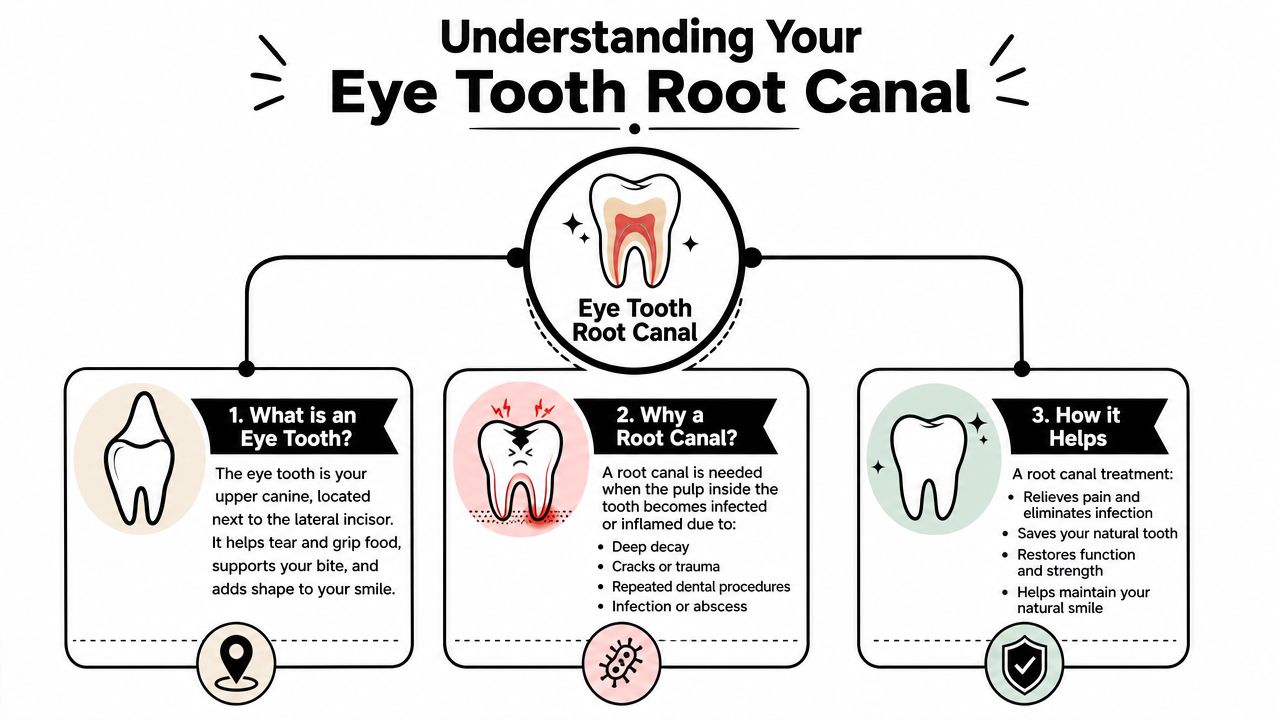
Your eye tooth is the pointed tooth between your front incisors and back premolars. Dentists call it a canine. It has a long root and a very important job. It helps tear food and helps guide side-to-side jaw movement.
Inside that tooth is a small central space containing the pulp. Think of the tooth like a house. The enamel and dentin are the walls. The pulp is the wiring and plumbing in the middle. If bacteria get into that inner space, or if the tooth has been injured, the tissue can become inflamed or infected.
Why an eye tooth may need treatment
Common reasons include:
- Deep decay that reaches the inner part of the tooth
- Trauma from a hit, fall, or old injury
- A failing restoration that allows bacteria to seep inward
- A crack that irritates or exposes the pulp
An eye tooth root canal is recommended when the problem is inside the tooth, not just on the surface. The goal is to remove unhealthy pulp, clean the inside space, and seal it so bacteria can't keep causing trouble.
What makes canine root canals different
The outside shape of a canine is easy to recognize, but the inside anatomy can still vary. A 2021 NIH review notes that root canal complexity is driven by canal anatomy, and accurate canal identification is important because missed anatomy is a major cause of persistent infection. That review also explains that treatment involves removing infected pulp, cleaning the canal space, and sealing it three-dimensionally, as detailed in the NIH review on root and canal morphology.
For patients, the takeaway is simple. A canine often has a more straightforward canal system than a molar, but success still depends on careful cleaning and complete sealing.
Practical rule: If the pain is coming from the inside of the tooth, a filling alone usually won't solve it. The inner tissue has to be treated.
Symptoms that often confuse patients
You may not have every symptom at once. Some people feel lingering sensitivity to hot or cold. Others notice pain when biting, gum tenderness above the tooth, or a darkened appearance after trauma. Some feel pressure rather than sharp pain.
That's one reason a proper exam matters. The same symptom can come from very different problems, and the right treatment depends on the actual cause.
The Root Canal Procedure Step by Step
Most patients relax once they understand the sequence. A root canal on a canine is controlled, careful treatment. It isn't a rushed or mysterious process.
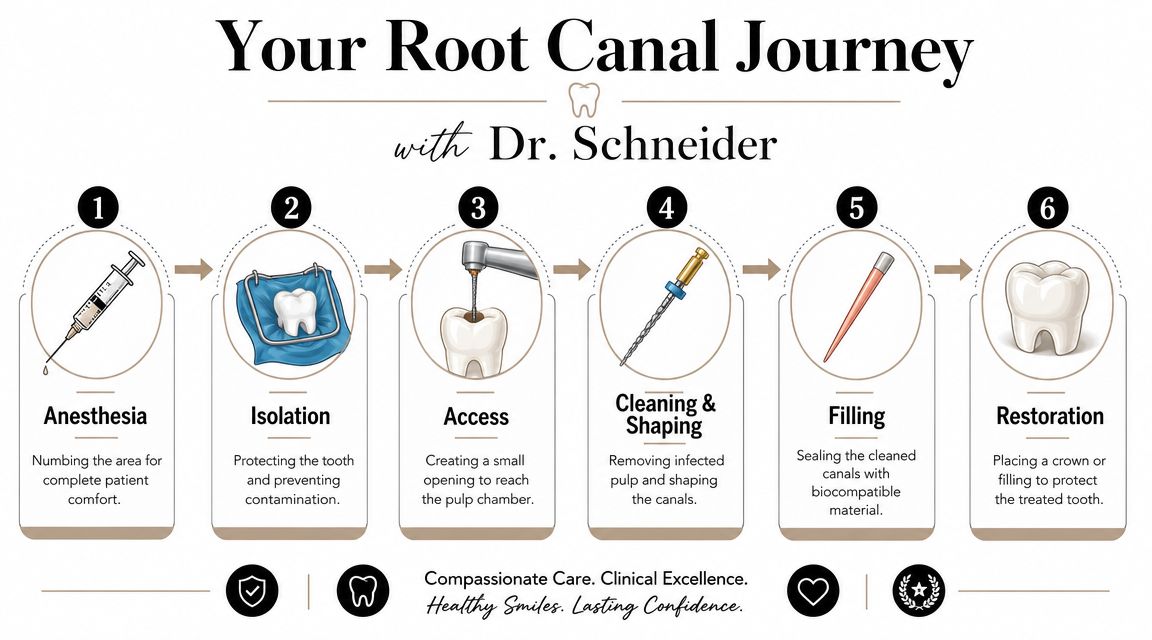
A helpful overview of the flow is below.
Step 1 to Step 3 getting comfortable and accessing the tooth
First comes the exam and imaging. Your dentist checks the tooth, reviews symptoms, and uses X-rays to see the root and surrounding bone. Then the area is thoroughly numbed with local anesthesia.
For patients with dental anxiety, comfort planning matters just as much as the technical treatment. Some offices, including William M. Schneider, DDS, also provide guidance on how to prepare for a root canal so the visit feels more predictable from the start.
After the area is numb, the tooth is isolated with a dental dam. This small protective sheet keeps the field clean and dry. Then a tiny opening is made through the top or back of the tooth to reach the pulp chamber.
Step 4 and Step 5 cleaning and sealing
Once the dentist reaches the inside of the tooth, the inflamed or infected pulp is removed. The canal space is then cleaned, shaped, and disinfected. This is the part many people imagine as the “root canal,” but in practice it's more like carefully washing and shaping a narrow inner tunnel so it can be sealed well.
Later in the visit, the cleaned space is filled with gutta-percha and sealer. That filling material closes off the canal from within.
The purpose of treatment is preservation. The dentist removes infected tissue and keeps the rest of the tooth functioning.
The American Association of Endodontists explains that root canal treatment removes inflamed or infected pulp, cleans and disinfects the canal, and fills and seals the space so the tooth can continue to function normally. The same patient guidance notes, with Mayo Clinic information referenced there, that treatment is usually completed in one or two visits and requires a final restoration such as a crown for long-term protection, as explained on the AAE root canal overview.
Here is a short video many patients find reassuring before their appointment.
Step 6 restoring the tooth
After the inside is sealed, the outside of the tooth still needs protection. Sometimes that means a bonded filling. In other cases, especially when the tooth has lost a lot of structure, a crown is recommended.
This final step is easy to underestimate, but it matters. The root canal fixes the inner infection. The restoration protects the tooth above the gumline so it can handle everyday function.
Healing and Protecting Your Restored Tooth
Patients generally experience improvement after treatment than before it. That may sound obvious, but it matters when you're anxious. The whole reason for a root canal is to remove infected tissue and calm the source of pain.
You may feel some soreness after the appointment, especially when biting, because the area around the root has been irritated by the infection and then treated. That's different from the deep, pulsing pain many patients feel before care. Recovery instructions are straightforward, and the dentist will tell you when to avoid chewing on that side and when to return for the final restoration if it isn't placed the same day.
Why the final restoration is not optional
A treated tooth still needs a good outer seal. If the top of the tooth leaks, bacteria can find their way back in. That's why the final filling or crown is such an important part of the result.
If your canine needs a crown, it helps to understand how to protect it afterward. This guide on how to care for dental crowns is useful for daily habits, cleaning, and avoiding unnecessary stress on the restored tooth.
A successful root canal is part endodontic treatment and part restoration. The inside must be sealed well, and the outside must stay protected.
Why saving the tooth is often worth it
Long-term outcomes are strong when the tooth is treated and restored appropriately. In a 21-year follow-up study of 598 teeth from 312 patients, primary root canal treatment showed an overall survival rate of 85.5% at the tooth level, with cumulative survival reaching 97% at 10 years and 81% at 20 years, as reported in this long-term follow-up study on root canal survival.
That kind of longevity helps explain why dentists try to preserve a natural tooth whenever possible. An eye tooth has a unique shape, root, and role in your bite. Keeping it can be simpler for your mouth than removing it and rebuilding later.
Daily habits that protect the result
A restored canine does best when you:
- Keep it clean with consistent brushing and flossing
- Avoid using it as a tool to tear packages or bite hard objects
- Return for follow-up care if the bite feels off or the temporary restoration loosens
- Wear protection if you grind your teeth or play contact sports
Root Canal Alternatives and Associated Costs
When a tooth hurts badly, many patients ask the same practical question. Is it better to save it or pull it? That's a fair question, especially if you're also searching for tooth extraction, dental implants near me, or other restorative options in Walnut Creek.
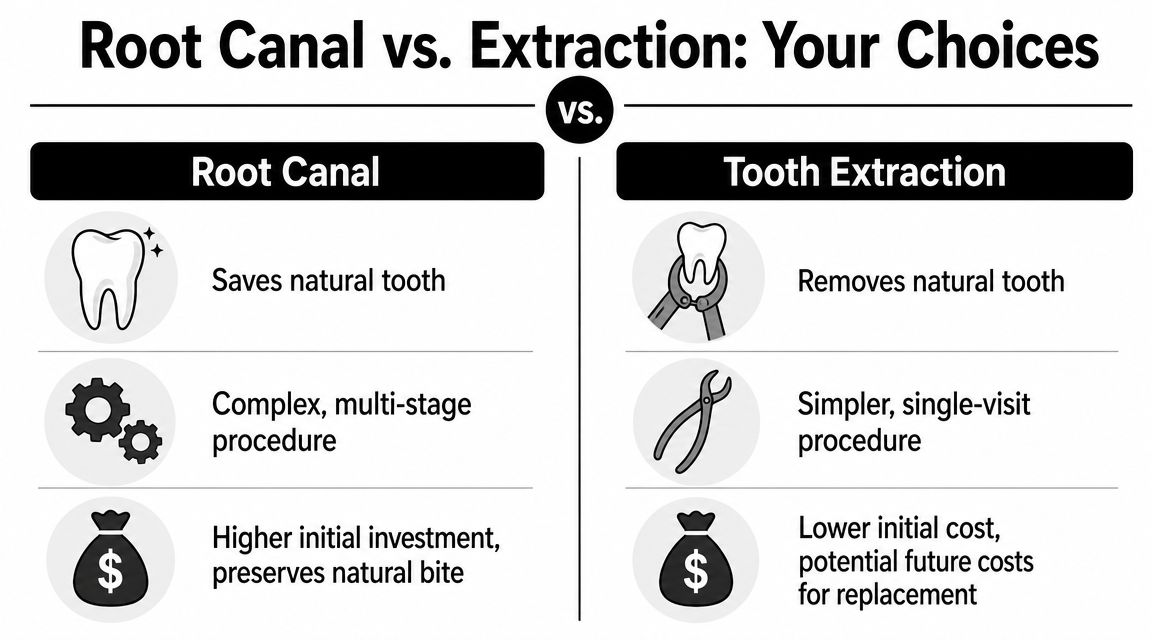
The main alternative to an eye tooth root canal is extraction. Once the tooth is removed, you then decide whether to leave the space alone or replace it with something like a bridge or implant. For a canine, replacement planning matters because this tooth is visible and functionally important.
Side by side comparison
| Option | Main advantage | Main tradeoff | Best fit |
|---|---|---|---|
| Root canal and restoration | Preserves your natural tooth | Requires the tooth to be restorable and properly rebuilt | When the root and surrounding tooth structure can still support long-term function |
| Extraction only | Removes the problem tooth quickly | Leaves a gap and may affect appearance or bite | When the tooth is too damaged to save or the patient chooses removal |
| Extraction with replacement | Rebuilds the missing tooth with a bridge or implant | Involves additional planning, healing, and cost beyond the extraction | When the natural tooth can't be kept and appearance or function needs to be restored |
The cost question patients are really asking
Patients aren't just asking for a fee. They're asking which path creates the least trouble over time.
A root canal may involve the treatment itself plus a final restoration. An extraction can look simpler at first, but if you want the missing canine replaced, that usually means additional restorative care. Depending on your needs, that may involve a bridge, an implant, or other treatment planning.
Saving a tooth and replacing a tooth are different decisions. Extraction is removal. It is not the full restoration plan.
How dentists think through the choice
Dentists usually weigh these points:
- Restorability. Is there enough healthy tooth left to rebuild it predictably?
- Function. Will the canine still support a healthy bite after treatment?
- Appearance. Will keeping the natural tooth give the better esthetic result?
- Timeline. Do you need immediate relief only, or a complete long-term solution?
- Comfort with treatment. Some patients prefer preserving what they have. Others feel more comfortable starting over with replacement options.
If the tooth can be saved, preserving it often keeps treatment more biologically natural. If it can't, extraction and replacement may be the healthier path. A good consultation should cover both, not just one.
Experience Compassionate Care with Dr Schneider
When people look for a cosmetic dentist near me or a dentist in Walnut Creek, CA, they're often looking for more than technical treatment. They want clear answers, a calm environment, and a team that takes fear seriously.
That matters even more with a procedure people already feel nervous about. Gentle injections, local anesthesia, careful communication, and sedation options when appropriate can completely change how a patient experiences root canal care.
What local care looks like in practice
At Dr. Schneider's office, patients in Walnut Creek and the East Bay can expect complete care in one dental home. That includes preventive visits such as cleaning and exams, diagnostic dental X-rays and new patient exams, plus restorative and cosmetic services when a tooth needs more than immediate pain relief. If a tooth can't be saved, the conversation can also include follow-up options such as crowns, bridges, and implant planning.
The practice is located at 1855 San Miguel Dr., Suite 31, Walnut Creek, CA, which makes ongoing care easier for local families and professionals who don't want to bounce between distant offices for every step.

Why this matters for anxious patients
An eye tooth root canal is easier to handle when you know what's happening, why it's needed, and what comes next. The treatment is about preserving function, protecting your smile, and stopping pain at its source.
For many patients in Walnut Creek, the biggest relief isn't just that the tooth can be treated. It's that they can receive that care in a familiar local office that also handles the restoration and long-term follow-up.
FAQs About Canine Root Canal Treatment
Does an eye tooth root canal hurt?
The goal of treatment is to relieve pain, not create it. During the procedure, the tooth and surrounding area are numbed with local anesthesia. If you're anxious, ask about comfort measures and sedation options available at your dental office.
How long does the appointment take?
Treatment is usually completed in one or two visits, depending on the condition of the tooth and the restoration plan, as noted earlier from the AAE patient guidance. Your dentist will tell you if your case is straightforward or if it needs staged care.
Will my front smile look different afterward?
Usually, the goal is for the tooth to look normal and function normally. If the tooth has darkened from trauma or infection, your dentist may discuss cosmetic or restorative options to improve the final appearance.
Why can't I just take antibiotics and wait?
If the tissue inside the tooth is infected or irreversibly inflamed, medication alone usually won't remove that damaged tissue. The source of the problem is inside a closed space. That's why the tooth needs treatment, not just temporary symptom control.
What happens if I ignore it?
Pain may come and go, which can make the tooth seem better for a while. But the underlying problem can continue. Delay can lead to worsening pain, swelling, or a situation where saving the tooth becomes more difficult.
Is extraction ever the better option?
Yes. If the tooth is too damaged to restore, extraction may be the healthier choice. In that case, your dentist should also explain replacement options so you understand the full plan, not just the first step.
If you're dealing with canine pain, swelling, or sensitivity and want clear answers close to home, schedule a visit with William M. Schneider, DDS. The office serves Walnut Creek and the East Bay with patient-focused care, thorough exams, and practical treatment options that can help relieve pain and protect your natural smile.