If you're looking in the mirror and thinking, “I want straighter teeth, but I don't want metal braces,” you're not alone. Many adults in Walnut Creek and the East Bay want a smile that looks more even, polished, and healthy without the visibility and routine that come with brackets and wires.
That question often comes up during cosmetic dentistry visits, new patient exams, and even routine cleanings. Some people have mild crowding that shows in photos. Others had orthodontic treatment years ago and have noticed shifting. Some want a more balanced smile before a wedding, career move, reunion, or major life event.
The good news is that modern dental care gives you more than one path forward. In the right case, you can improve alignment with clear aligners, or you can create the appearance of straighter teeth with veneers, bonding, or contouring. The right answer depends on what you want to fix, how quickly you want results, and whether your concern is cosmetic, functional, or both.
A thoughtful plan matters. Teeth that look straighter from the front still need to work well when you bite, chew, brush, and floss. That long-term view is what helps patients make decisions they feel good about not just now, but years from now.
Your Path to a Confident Smile in Walnut Creek
A straighter smile can change more than a photograph. It can make you less self-conscious in conversations, more comfortable in professional settings, and more motivated to keep up with your dental care. For many patients, the primary goal isn't perfection. It's feeling like their smile finally matches how they want to present themselves.
In Walnut Creek, that decision usually starts with a practical question. Do you want to move the teeth into a better position, or do you want to improve how they look from the outside? Those are two different treatment goals, and they lead to different options.
What patients are usually trying to solve
Some concerns are primarily cosmetic. A small gap, a slightly rotated front tooth, worn edges, or uneven tooth shape may not require orthodontic movement at all. In those cases, cosmetic dentistry can sometimes create a straighter-looking smile more efficiently.
Other concerns involve the way the teeth fit together. Crowding, spacing, or bite issues can affect cleaning, wear patterns, and comfort. Those cases often benefit from a treatment that repositions teeth rather than covering the problem.
A smile makeover should improve appearance without ignoring function. If the bite is unstable, a quick cosmetic fix may not be the healthiest long-term choice.
That distinction matters if you've been searching for a cosmetic dentist near me or a dentist in Walnut Creek, CA and seeing a wide mix of services. Teeth whitening, veneers, Invisalign, and restorative dentistry can all improve a smile, but they don't solve the same problem.
Why professional guidance matters
Online photos can make every treatment look interchangeable. In real life, they aren't. The right option depends on enamel quality, gum health, bite relationship, past dental work, and how much change you're hoping to make.
A thorough evaluation also helps uncover issues that can affect results, such as grinding, recession, old restorations, or untreated decay. That's one reason a cosmetic consultation often includes the same careful attention you would expect from general dental care, including a new patient exam, digital imaging, and discussion of your habits and goals.
Patients who come in asking only about straightening often end up appreciating the bigger picture:
- Smile appearance: Alignment, shape, proportion, and color all affect how straight teeth appear.
- Daily comfort: Some cases are easy to clean once crowding is reduced.
- Long-term stability: The result has to be maintainable, not just attractive on day one.
If you want to know how to get straighter teeth without braces, the answer isn't one treatment. It's choosing the method that fits your teeth, your timeline, and your long-term oral health.
Invisalign Clear Aligners A Modern Approach to Straightening Teeth
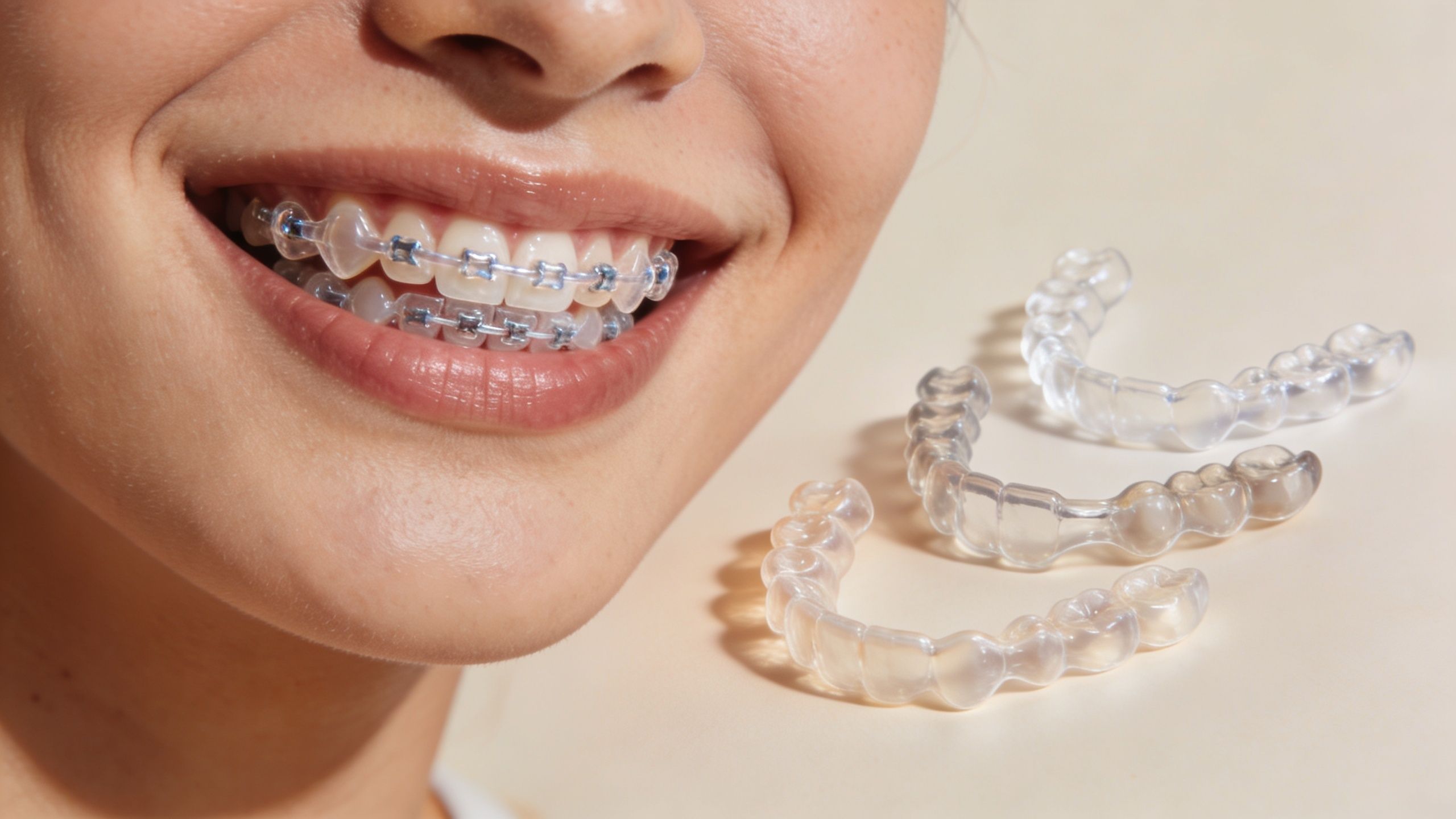
For patients who want to straighten teeth without brackets and wires, Invisalign clear aligners are often the most direct option. Clear aligners like Invisalign are the most popular method for straightening teeth without traditional braces, with treatment timelines typically ranging from 6 to 18 months for mild to moderate cases. They are worn 20 to 22 hours daily and changed every 1 to 2 weeks, according to Magnolia Dentistry's overview of straightening teeth without braces.
How the process starts
Treatment begins with a close look at your teeth, gums, bite, and overall oral health. If clear aligners are a good fit, digital records are taken so the movement can be planned before you ever wear the first tray.
A key part of that planning is the digital scan. You can learn more about invisible clear aligners for straight teeth at any age, including how the trays are customized around your smile goals.
What the digital planning does
Clear aligner therapy works because the movement is sequenced, not improvised. The trays are designed to nudge teeth in small stages so each set builds on the one before it.
According to Crystal Clear Dental's explanation of brace-free straightening methods, an intraoral digital scanner such as iTero creates a 3D model of your teeth, allowing the dentist to predict tooth movement and show a simulation of potential results before treatment begins.
That planning is one of the biggest reasons adults like this option. You get a clearer idea of the intended outcome, and the treatment feels more structured from the start.
What wearing aligners is actually like
Most patients adjust to aligners quickly. They remove them for meals and for brushing and flossing, then put them back in for the rest of the day. Because they're removable, they fit more easily into work meetings, social events, and family routines than traditional braces often do.
There are still responsibilities, though. If aligners stay out too long, teeth don't track the way they should. Consistency matters.
Practical rule: If you want aligners to work, wear them as directed every day. Convenience helps, but compliance drives the result.
Some cases also need small tooth-colored attachments to help guide movement. These are common and planned in advance. Mild crowding, small gaps, and certain bite issues often respond well to this approach.
A short video can help make the process easier to picture:
Who tends to be a good fit
Clear aligners are usually considered when the goal is real tooth movement without the look of braces. They can be a strong choice for adults who want a discreet treatment and are willing to wear the trays consistently.
They often make sense for patients with:
- Mild crowding: Teeth overlap slightly, especially in the front.
- Small gaps: Spaces affect appearance or trap food.
- Minor bite concerns: Selected cases can improve with planned tooth movement.
- Past relapse: Teeth have shifted after previous orthodontic treatment.
This approach isn't ideal for every situation. More advanced alignment problems may call for traditional orthodontic care or a combined plan.
The biggest advantage and the biggest trade-off
The biggest advantage is simple. Aligners move the teeth, which means the result can improve both appearance and function when the case is appropriate.
The biggest trade-off is discipline. Because the trays are removable, success depends on the patient wearing them. If you're the kind of person who will take them out and forget to put them back in, another option may fit your habits better.
For many Walnut Creek adults, though, Invisalign is the treatment that feels realistic. It lets them straighten teeth with less interruption to daily life while keeping the plan focused on real alignment, not just camouflage.
Instant Smile Enhancements Veneers Bonding and Contouring
Not every patient wants orthodontic movement. Some want a faster cosmetic change, especially when the issue is limited to what shows when they smile. That's where veneers, bonding, and contouring come in.
These treatments don't move teeth through the bone the way aligners do. Instead, they change the visible shape, surface, or proportions of the teeth so the smile looks straighter.
Veneers for an immediate visual change
Porcelain veneers are thin shells bonded to the front of teeth. They can improve the look of minor misalignment, uneven edges, spacing, and discoloration in one coordinated cosmetic plan.
Porcelain veneers offer a rapid cosmetic fix, with procedures often completed in 2 visits, and they can last 10 to 15 years on average, according to Botsford Dental's review of ways to straighten teeth without braces.
If you're considering them, this overview on whether veneers are an option for you is a useful starting point.
Veneers can be an excellent choice when the teeth are reasonably well positioned already, but the smile still looks uneven because of shape, size, or color differences. They can also help patients who want a more full cosmetic update rather than simple straightening.
Bonding and contouring for smaller corrections
Dental bonding uses a tooth-colored material to improve shape, close small gaps, or soften irregular edges. Contouring involves very minor reshaping of enamel to create a smoother, more balanced appearance.
These options are more targeted than veneers. They tend to work best when the problem is small and localized, such as:
- A single tooth that looks out of line
- A tiny gap between front teeth
- Small chips or uneven edges
- Slight asymmetry that makes the smile appear crooked
For the right patient, these treatments can make a smile look noticeably straighter without a long treatment period.
The trade-offs patients should understand
Cosmetic camouflage can be the right decision, but it needs to be chosen thoughtfully. If the issue is mainly visual, cosmetic treatment may be enough. If the issue involves crowding, bite imbalance, or unstable tooth position, appearance-only treatment may leave the underlying problem untouched.
That difference is especially important with bonding and veneers. They can improve the look of the teeth, but they don't reposition roots or change the way teeth meet.
Veneers and bonding can create a straighter-looking smile. They don't replace orthodontic movement when the bite or alignment itself needs correction.
There is also a long-term maintenance conversation to have. Veneers are durable, but they are still restorations. Bonding can need touch-ups over time. Contouring is conservative, but only suitable in very limited situations. Each option has a place. The key is matching the treatment to the actual problem rather than choosing only by speed.
For patients asking how to get straighter teeth without braces, these cosmetic options can be very effective. They just answer a different question than Invisalign does.
Targeted Solutions Retainers and Minor Orthodontic Adjustments
Some smiles don't need a full cosmetic makeover or a full aligner sequence. A patient may have had braces years ago, skipped retainer wear, and now sees one front tooth drifting. Another may have a very small alignment issue that bothers them in photos but doesn't affect the rest of the bite much.
In those situations, a more limited solution may make sense.
When small corrections are the right corrections
A restrained treatment plan is often the right one. Minor orthodontic adjustments can be useful when the problem is isolated and the rest of the smile is already stable.
Common examples include:
- Post-treatment shifting: Teeth moved after old braces or aligners.
- One or two mildly crooked teeth: The rest of the arch looks good.
- Preventive retention: Teeth are starting to move, and the goal is to stop further change.
- Minor relapse before cosmetic work: A small correction may make future cosmetic treatment more conservative.
The role of retainers can be more impactful than people realize. In some cases, a retainer helps preserve the position you already have. In some limited cases, a dentist may recommend a minor corrective approach when the movement needed is small.
Why this option is often overlooked
People tend to assume treatment is all or nothing. Either they imagine full braces, or they assume nothing can be done. That isn't always true.
A focused plan can be worthwhile because small shifts often become more noticeable with time. The earlier a minor change is addressed, the more options usually remain available.
Small alignment issues are easier to correct when they’re still small. Waiting can narrow your options.
This approach also respects your time and goals. If you don't need a major intervention, you shouldn't be pushed toward one.
Retention is part of treatment, not an afterthought
Retainers don't get much attention until teeth start moving. By then, many patients wish they had stayed more consistent with them.
Retention is especially important after any correction, whether that correction was full or limited. Teeth can drift. Habits, bite forces, age, and grinding all play a role.
For patients who want practical dental care in Walnut Creek, this matters because the most attractive result is the one that still looks good later. A modest, well-chosen correction with a realistic retention plan often serves a patient better than an aggressive treatment they won't maintain.
If your concern is minor, the answer may be simpler than you think. A consultation can tell you whether you need a full treatment plan, a limited adjustment, or just a better strategy to keep your teeth from shifting further.
Comparing Your Options How to Choose the Right Treatment
A patient in Walnut Creek might come in saying, “I want straighter teeth, but I do not want braces.” The next question is the one that brings real clarity. Do the teeth need to move, or do they need to look more even?
That distinction shapes everything. It affects how long treatment takes, whether enamel is altered, how your bite is handled, and what kind of maintenance you should expect years from now. A result can look similar in a photo while being achieved in very different ways clinically.
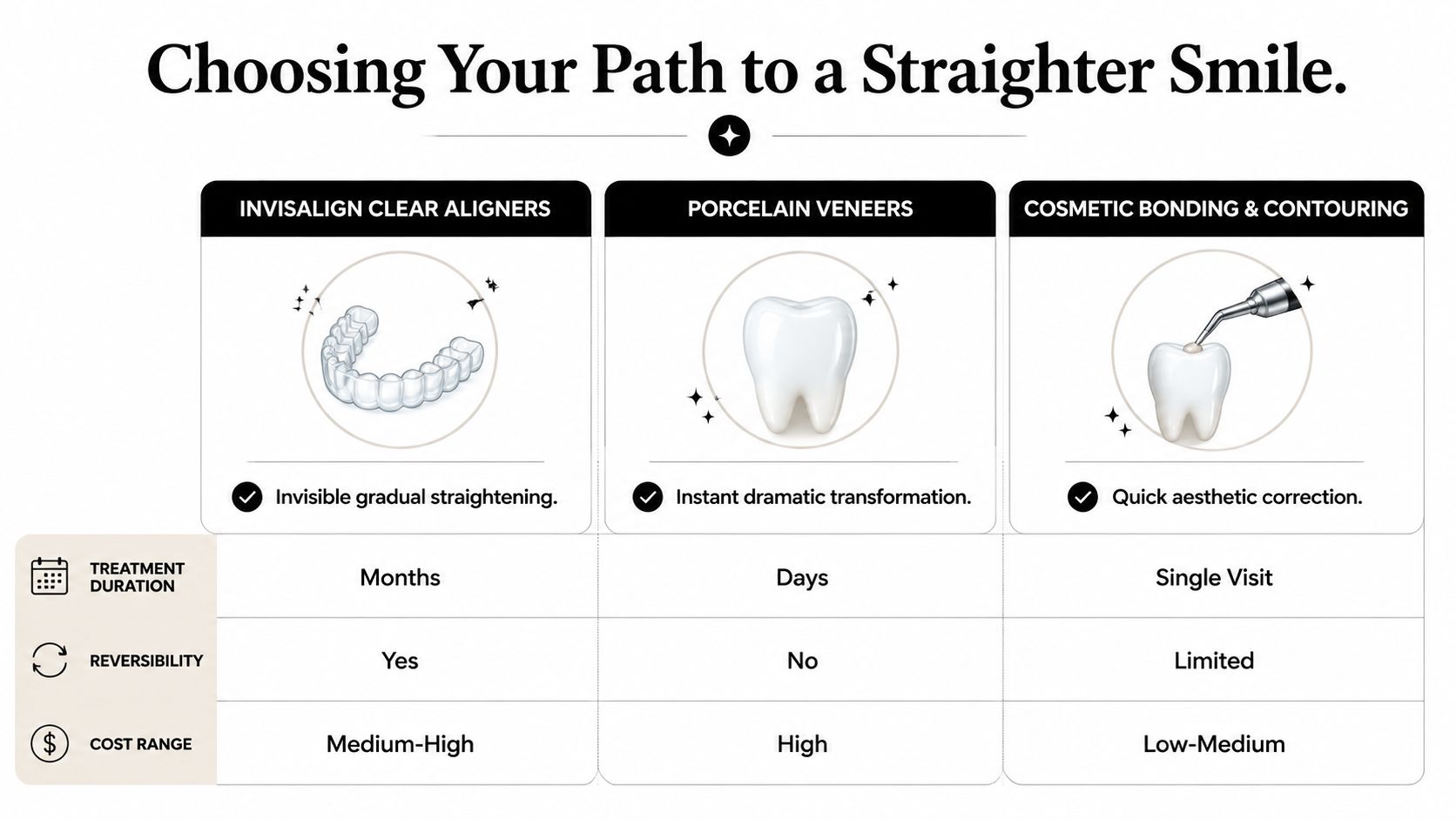
Comparing Teeth Straightening Options Without Braces
| Treatment | Best For | Average Timeline | Invasiveness | Permanence & Maintenance |
|---|---|---|---|---|
| Invisalign clear aligners | Mild to moderate crowding, gaps, and selected bite concerns | Typically months | Low | Moves teeth into new positions. Retainers are needed afterward to help maintain results. |
| Porcelain veneers | Minor visible misalignment, uneven shape, discoloration, smile redesign | Usually completed quickly | Moderate | Long-lasting cosmetic restoration. Doesn't move teeth, and future maintenance may be needed. |
| Cosmetic bonding | Small gaps, chips, minor asymmetry, one or two teeth that look slightly off | Often very quick | Low | Cosmetic improvement with maintenance over time. Best for limited changes. |
| Retainers or minor orthodontic adjustments | Small relapse, one drifting tooth, preservation after prior treatment | Varies by case | Low | Useful for maintaining or making limited corrections. Success depends on consistent wear when prescribed. |
A practical way to decide
Patients who are mainly bothered by the front view of their smile often do well with veneers or bonding, especially if the bite is stable and the teeth are otherwise healthy. Patients with crowding, spacing that traps food, or teeth that meet unevenly usually need actual tooth movement, not a cosmetic cover-up.
A few questions help narrow the decision:
- Is speed your top priority? Veneers, bonding, or contouring may give the fastest visible change.
- Do you want to keep your natural tooth structure as untouched as possible while correcting alignment? Clear aligners are often the better fit.
- Is the problem limited to one tooth or one small area? A focused cosmetic fix or minor orthodontic adjustment may be enough.
- Do you want treatment to stay discreet while your teeth are shifting? Clear aligners are often the most practical choice.
- Do you grind, clench, or already have worn edges? Bite forces need to be assessed before choosing a cosmetic option.
That last point matters more than many patients expect.
If a smile is made to look straighter without addressing heavy bite pressure, the cosmetic work can chip, wear, or feel bulky over time. If teeth are moved into better positions but no retention plan is followed, they can drift back. Good treatment planning is not only about getting a nicer result. It is about choosing a result your mouth can support.
Look past the before-and-after photo
A straighter-looking smile can come from different methods. Teeth may be repositioned. Enamel may be reshaped. Restorative material may be added to change the outline of the smile. Each approach has benefits, limits, and long-term responsibilities.
That is why the best option is not the one with the shortest timeline or the most dramatic photo. The best option is the one that solves your specific problem while respecting your enamel, gums, bite, and willingness to maintain the result.
For many Walnut Creek patients, the right choice comes down to balancing appearance with oral health. If the goal is a better-looking smile for an event, the answer may be different than it is for someone trying to reduce crowding, improve cleaning access, and protect teeth from uneven wear.
The healthiest choice fits the real problem
Patients often ask which treatment is “best.” In practice, the better question is which treatment gives you the improvement you want without creating avoidable trade-offs.
If the issue is cosmetic, cosmetic treatment may be appropriate. If the issue is positional, moving the teeth is usually the sounder plan. The healthiest decision is the one based on an exam, a clear diagnosis, and an honest discussion of what you want your smile to look like now and how you want it to function years from now.
Your Consultation for a Straighter Smile in Walnut Creek
A consultation should feel clear, calm, and useful. It shouldn't feel rushed or sales-driven. Most patients are already doing enough mental math before they come in, balancing appearance, time, cost, and whether treatment will be worth it.
The visit usually starts with a conversation, not a lecture. What bothers you? How long has it bothered you? Are you concerned about crowding, spacing, wear, discoloration, old dental work, or shifting after past orthodontics? Those details matter because they shape the treatment plan.
What happens during the evaluation
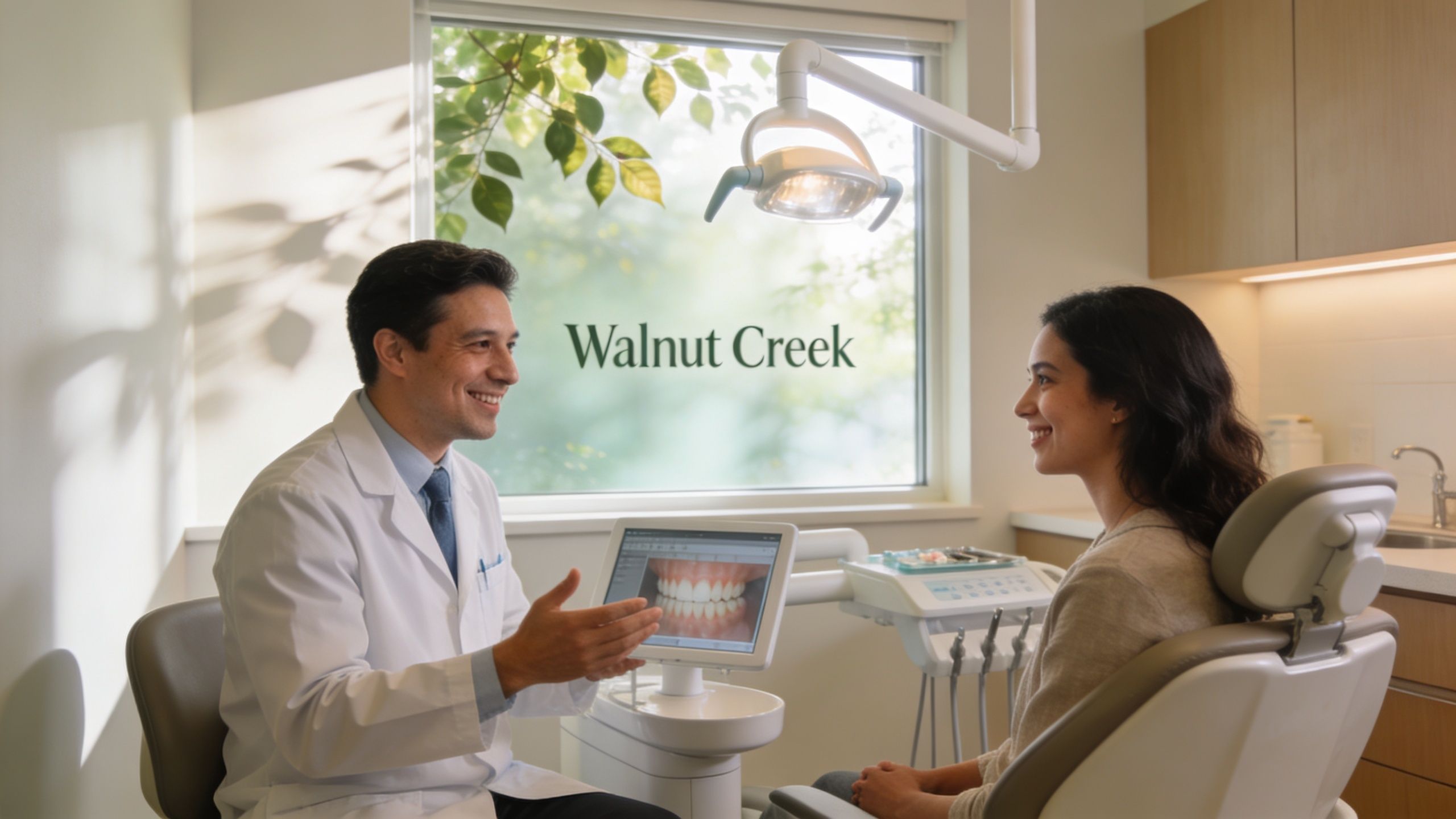
A cosmetic consultation still needs the same foundation as good general dentistry. That often includes an exam, digital dental x-rays when needed, and close evaluation of enamel, gums, bite relationship, existing fillings or crowns, and signs of grinding or clenching.
The planning becomes more useful when it is visual. According to the earlier digital workflow reference, an intraoral scanner such as iTero creates a 3D model of your teeth and can be used to show a simulation of predicted tooth movement before treatment starts.
That kind of imaging helps patients understand the difference between an orthodontic option and a cosmetic one. Seeing the anatomy often makes the decision more intuitive.
What you should leave with
By the end of a good consultation, you should understand more than the name of a treatment. You should know:
- What problem is being treated: Appearance only, function, or both.
- Why a certain option fits: Not just that it's available.
- What the trade-offs are: Speed, maintenance, reversibility, and limitations.
- What supporting care may be needed: Cleanings, restorative work, whitening, or retention.
A useful consultation doesn't pressure you toward the fastest treatment. It helps you understand the consequences of each choice.
Why patients often feel more comfortable after the visit
Most anxiety comes from uncertainty. Patients worry they'll be told they need more than expected, or that they won't understand the terminology. A steady, well-paced consultation usually lowers that stress because it replaces guessing with specifics.
For someone searching for a dentist near me in Walnut Creek, CA, that experience matters as much as the treatment itself. You want an office where questions are welcome, options are explained plainly, and the plan makes sense in the context of your overall dental health.
That first visit isn't just about straightening teeth. It's about figuring out whether the smile you want can be achieved in a way that's healthy, maintainable, and worth your investment.
Frequently Asked Questions About Straighter Teeth
Can I really get straighter teeth without braces?
Yes, in many cases.
The first question is whether teeth need to be moved or whether the smile mainly needs to look more even from the front. Clear aligners are often the better choice when position, spacing, or bite needs correction. Veneers, bonding, and contouring can improve the appearance of straightness when the concern is limited to shape, size, or minor visible irregularities.
For Walnut Creek patients, that distinction matters because the best-looking result is not always the healthiest long-term result. A treatment should fit both your smile goals and the condition of your teeth and gums.
What's the most natural-looking option?
If you want your teeth to move into better alignment without drawing much attention during treatment, clear aligners are usually the least noticeable option. If you want a faster cosmetic change, veneers or bonding can create a very polished appearance.
Natural-looking results depend on more than straightness alone. Tooth shape, color, edge position, gum symmetry, and facial proportions all affect whether a smile looks believable and balanced. Good planning makes the difference.
Are veneers the same thing as straightening teeth?
No. Veneers can make teeth look straighter, but they do not move teeth into a new position.
That does not make veneers the wrong choice. It means they solve a different problem. If the teeth are reasonably well positioned and the main concern is visible unevenness, veneers may work well. If crowding, bite relationship, or root position needs correction, aligners are usually the better biological solution.
What if my teeth shifted after braces years ago?
That is very common in adults. I see this often with patients who had orthodontic treatment years ago and stopped wearing retainers consistently.
In some cases, the correction is limited and straightforward. A focused aligner plan or minor orthodontic adjustment may be enough, followed by a retainer to hold the result. What matters is checking whether the movement is small and stable or part of a larger bite change.
Do retainers really matter that much?
Yes. Retainers are how you keep the result.
Teeth can shift throughout adult life, especially after orthodontic treatment. That is why nightly retainer wear is often recommended long term. Skipping retention does not guarantee immediate relapse, but it increases the chance that crowding or spacing will return over time.
Will my teeth stay straight after bonding or veneers?
They may continue to look straighter cosmetically, but bonding and veneers do not create orthodontic stability by themselves. If the underlying tooth position or bite has not changed, those factors still matter.
This is an important decision point. Patients who want a faster visual improvement may be very happy with cosmetic treatment. Patients who want to change the actual alignment should choose a treatment that moves teeth.
Is Invisalign better than veneers?
They serve different purposes, so the better option depends on your goal.
Invisalign is usually the stronger choice when you want to improve alignment and preserve natural enamel. Veneers are often the better fit when tooth position is already close enough and you also want to change color, shape, width, or overall symmetry. Some patients do best with a staged plan that starts with alignment and finishes with small cosmetic refinements.
How do I know if my problem is cosmetic or functional?
An exam is the clearest way to answer that, but there are signs that suggest the issue goes beyond appearance.
You may have a functional concern if you notice:
- Difficulty cleaning between crowded teeth
- Uneven wear on the edges
- A bite that feels off or unstable
- Teeth that keep shifting
- Jaw tension or clenching patterns
Those findings do not automatically mean you need major treatment. They do mean your smile should be evaluated with long-term oral health in mind, not just surface appearance.
Is this only for adults, or can older patients do it too?
Adults of many ages can be candidates. Age matters less than gum health, bone support, existing dental work, bite condition, and your treatment goals.
Many patients in Walnut Creek start this process later in life because they finally want to address something they have put off for years. That is reasonable. The right plan should match your health, timeline, and budget.
Will straightening my teeth improve oral health too?
Sometimes, yes.
Teeth that are less crowded can be easier to brush and floss, and a better bite can reduce certain wear patterns. Clear aligners may help in those situations because they change position. Veneers and bonding mainly change appearance, although they can still be part of a thoughtful treatment plan when cosmetic concerns are the main issue.
The right answer depends on why your teeth look uneven in the first place.
What should I expect if I'm also interested in whitening or other cosmetic work?
Sequence matters. If you are considering whitening, bonding, veneers, contouring, or restorative treatment, those steps should be planned together rather than chosen one at a time.
For example, whitening is often done before bonding or veneers so the final shade can be matched properly. In other cases, alignment should happen first so cosmetic work is placed on teeth that are already in a better position. Planning the order well helps avoid redoing work later.
When should I schedule an appointment?
If you have been noticing crowding, shifting, uneven wear, or a smile issue that keeps bothering you, it makes sense to schedule a consultation now.
A visit does not lock you into treatment. It gives you answers. At William M. Schneider, DDS, patients in Walnut Creek can review what is cosmetic, what affects function, what can wait, and what is likely to hold up well over time. That kind of clarity makes decisions easier.