If you're reading this, there's a good chance you've already tried the usual whitening aisle routine. Strips, pens, LED kits, whitening toothpaste. Maybe they helped a little, or maybe they barely touched the discoloration that bothers you most when you see yourself in photos, on video calls, or in the mirror before work.
That frustration is common, especially for adults in Walnut Creek who take good care of their teeth but still feel like their smile looks darker, older, or uneven. Some stains sit deeper than the surface. Some have built up over time. Some do not respond well to generic products bought at the store.
For those situations, a professional whitening plan can make much more sense than repeating the same at-home trial and error. The KöR bleaching system is one of the premium options used for stubborn discoloration, and it deserves an honest explanation. Not every patient is the right fit. Not every smile should be treated with whitening alone. But for the right candidate, KöR can be a very effective part of cosmetic dentistry.
Get a Radiant Smile with a Cosmetic Dentist in Walnut Creek
You catch your reflection before a meeting or dinner in Walnut Creek, and your teeth look a little darker than you expected. Not unhealthy. Just tired, uneven, or older than the rest of your appearance. That is usually what brings patients in for a cosmetic whitening consultation.
A brighter smile can help, but the first question is not how strong a whitening system is. The first question is whether whitening is the right tool for your smile. Some teeth respond well. Some have deep discoloration. Some look uneven because old fillings, bonding, veneers, or crowns no longer match.
Why a professional opinion changes the conversation
In practice, I look at more than shade alone. I want to know what caused the discoloration, whether the enamel is healthy, whether you have visible dental work, and whether whitening would improve the whole smile or only part of it. That assessment matters because natural teeth can whiten, but crowns, veneers, and tooth-colored fillings do not.
The practical question is not merely, "Will KöR whiten my teeth?" It is, "Will my smile still look even afterward?" If visible restorations are older or already a different shade, whitening can make that mismatch more obvious. In those cases, the best result may involve whitening first and then replacing selected dental work to match the new color.
That is why an exam saves patients time and money.
When premium whitening makes sense
The KöR bleaching system is a premium option for patients who have already been disappointed by store-bought whitening or who have staining that runs deeper than surface discoloration. It can be a strong choice, but it is not for every smile and it is not the lowest-cost route. Patients considering KöR should know that upfront.
For the right candidate, professional whitening can improve the color of natural teeth in a way that over-the-counter products often cannot. For the wrong candidate, it can create unrealistic expectations, especially if the main issue is mismatched dental work rather than tooth color itself.
At William M. Schneider, DDS, the discussion starts with diagnosis. Then we decide whether KöR fits your goals, your dental history, and your budget. That approach is straightforward, and patients usually appreciate the honesty.
What Is The KöR Deep Bleaching System
A common Walnut Creek scenario is this: a patient has already tried whitening strips, whitening toothpaste, or even a previous tray system, and the teeth still look darker than expected. In that situation, the question is not whether any bleach can make teeth lighter. The question is whether a more structured system can improve deeper discoloration without creating unrealistic expectations.
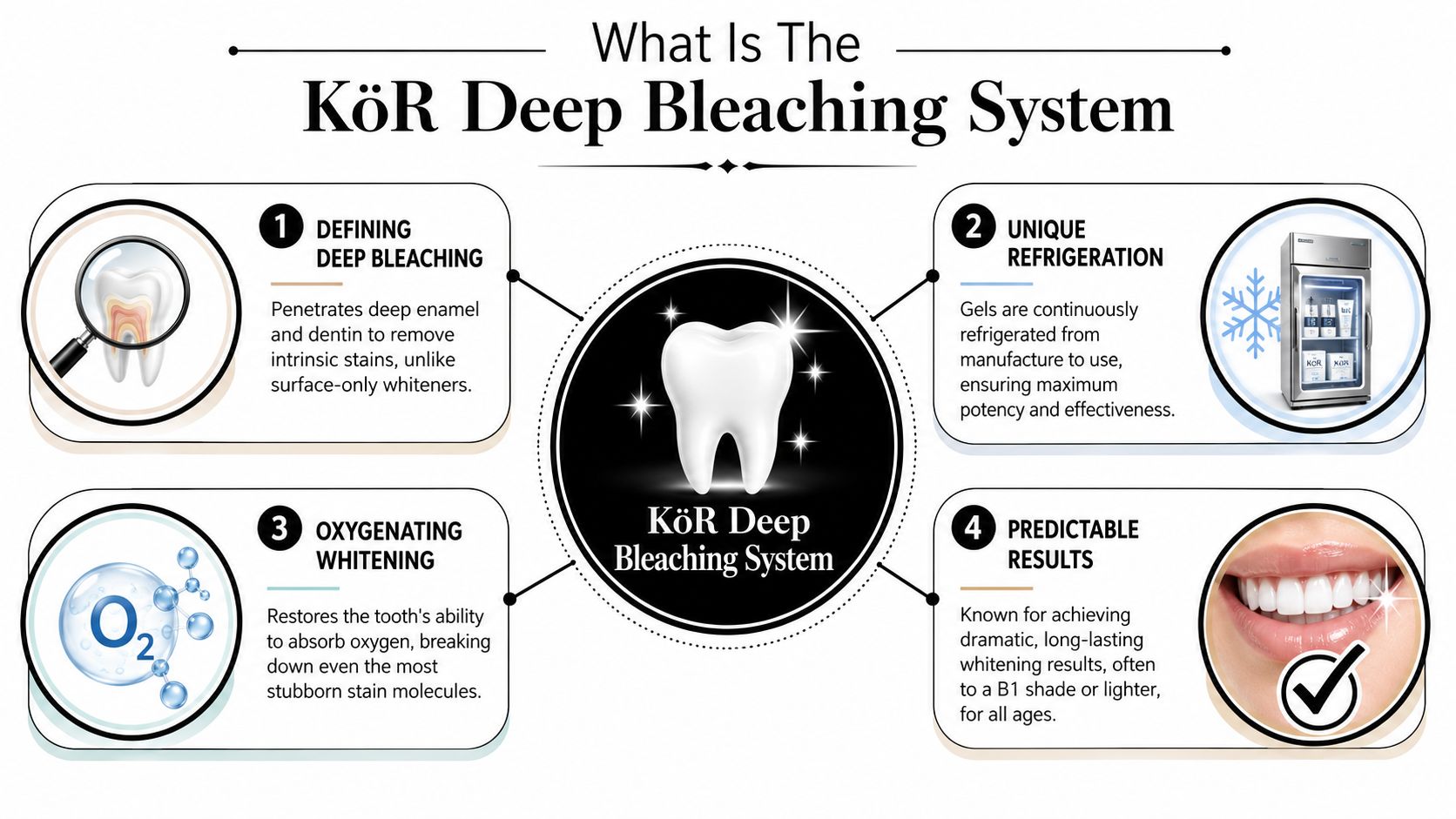
KöR Deep Bleaching is a professionally supervised whitening system built for cases that go beyond routine brightening. It was introduced in 2009 by Evolve Dental Technologies as a system developed by Dr. Rod Kurthy, with an early focus on difficult stains, including tetracycline discoloration, and on reducing sensitivity through pulp protection, according to Dimensions of Dental Hygiene's report on the KöR Whitening Deep Bleaching System.
That background matters. KöR was developed for patients who have a real whitening problem to solve, not just for someone who wants a slight touch-up before an event.
What makes it different from ordinary whitening
KöR is a staged protocol, not a one-appointment cosmetic add-on. The original approach included an initial conditioning visit, a period of nightly home tray use, and a final in-office whitening appointment. The same source also notes that the in-office phase used different hydrogen peroxide strengths during treatment.
From a clinical standpoint, that matters because difficult stains rarely respond well to a casual or inconsistent approach. Better whitening usually comes from a system that controls tray fit, gel handling, timing, and follow-through.
That is also why I present KöR transparently. It can produce impressive improvement on natural teeth, but it asks more of the patient than a drugstore product does. There is more time involved, more cost involved, and more value when the case is selected well.
What kinds of stains it was built for
KöR is best known for use in tougher whitening cases, especially teeth with intrinsic discoloration such as tetracycline staining and deeper age-related darkening. Those are the cases where patients often say they have already spent money on whitening and saw very little change.
The practical distinction is depth. Surface stain from coffee, tea, red wine, or tobacco can sometimes respond to simpler whitening. Deeper discoloration usually requires a more deliberate system and professional oversight.
Patients also need one point explained clearly. KöR whitens natural tooth structure. It does not whiten crowns, veneers, or tooth-colored fillings. If visible dental work is already present, whitening may improve the natural teeth while making older restorations look darker by comparison. That does not mean KöR failed. It means the smile needs a plan, not just bleach.
For that reason, KöR is best understood as a premium whitening option for the right candidate, not a universal fix for every smile.
The Science Behind KöR Whitening Effectiveness
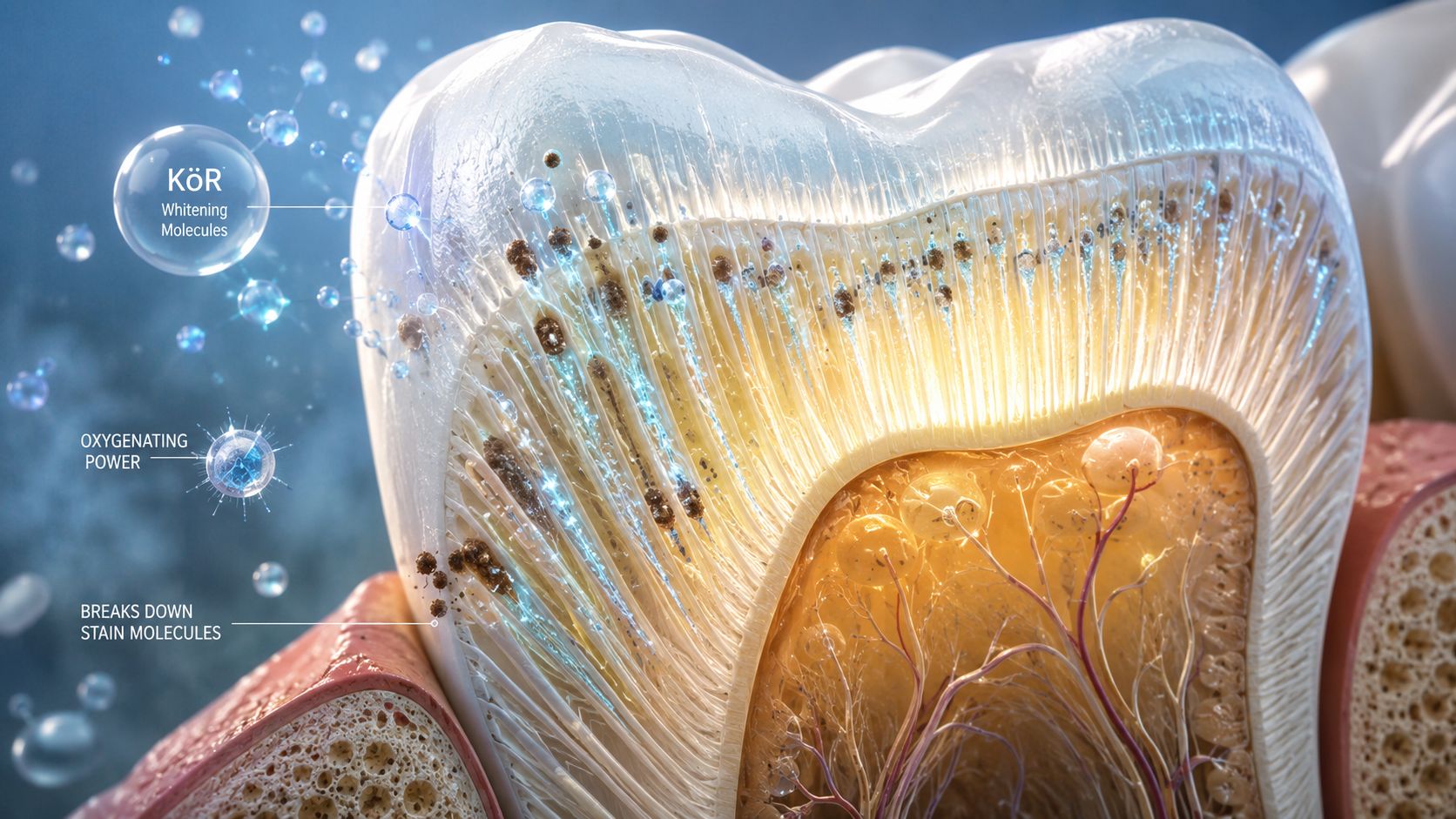
KöR works by keeping active whitening gel in close contact with the teeth for longer than standard tray systems. That longer contact period matters because bleaching has to stay chemically active long enough to penetrate beyond surface stain.
According to KöR's explanation of how the system works, the combination of refrigerated gel and custom KöR-Seal trays is designed to preserve gel activity and reduce saliva contamination. The company describes this as a major reason the system can perform better in tougher cases than looser, generic trays.
Why contact time matters
In practice, whitening success is not just about gel strength. If the material breaks down too quickly or gets diluted by saliva, the treatment can lose momentum before it does much for deeper discoloration.
That is one reason KöR feels more controlled than over-the-counter whitening.
The design focuses on two practical factors:
- Cold-stored gel helps maintain potency until use.
- Close-fitting trays help keep the gel where it belongs and limit contamination from saliva.
For a patient with mild yellowing, that may sound like a technical detail. For a patient with stubborn internal staining, it can be the difference between slight improvement and a result that is noticeable.
Why the process is longer than quick whitening
KöR is a staged whitening system. It usually involves nightly home use for several weeks, then an in-office visit to complete the process, and more time may be needed in difficult tetracycline cases, as the same page explains. That does not make it convenient. It makes it methodical.
I tell Walnut Creek patients to judge KöR by consistency, not speed. The people who do well with it are usually the ones willing to follow instructions closely, wear the trays as directed, and stay realistic about what whitening can and cannot change.
Comfort also matters. Patients who want a clearer idea of what professional teeth whitening can feel like during treatment should understand that premium systems still involve trade-offs. More whitening activity can mean more sensitivity for some patients, which is one reason supervision matters.
The larger point is simple. KöR is built around chemistry, tray fit, and patient compliance. That is why I treat it as a serious option for selected cases, not a cosmetic shortcut.
Your KöR Treatment Process Step by Step
A common Walnut Creek scenario is a patient who wants a noticeably whiter smile, but also wants to know what the process will involve before committing to a premium system. That is a fair question. KöR works best when the steps are followed carefully, so the process matters almost as much as the product.
The consultation and planning visit
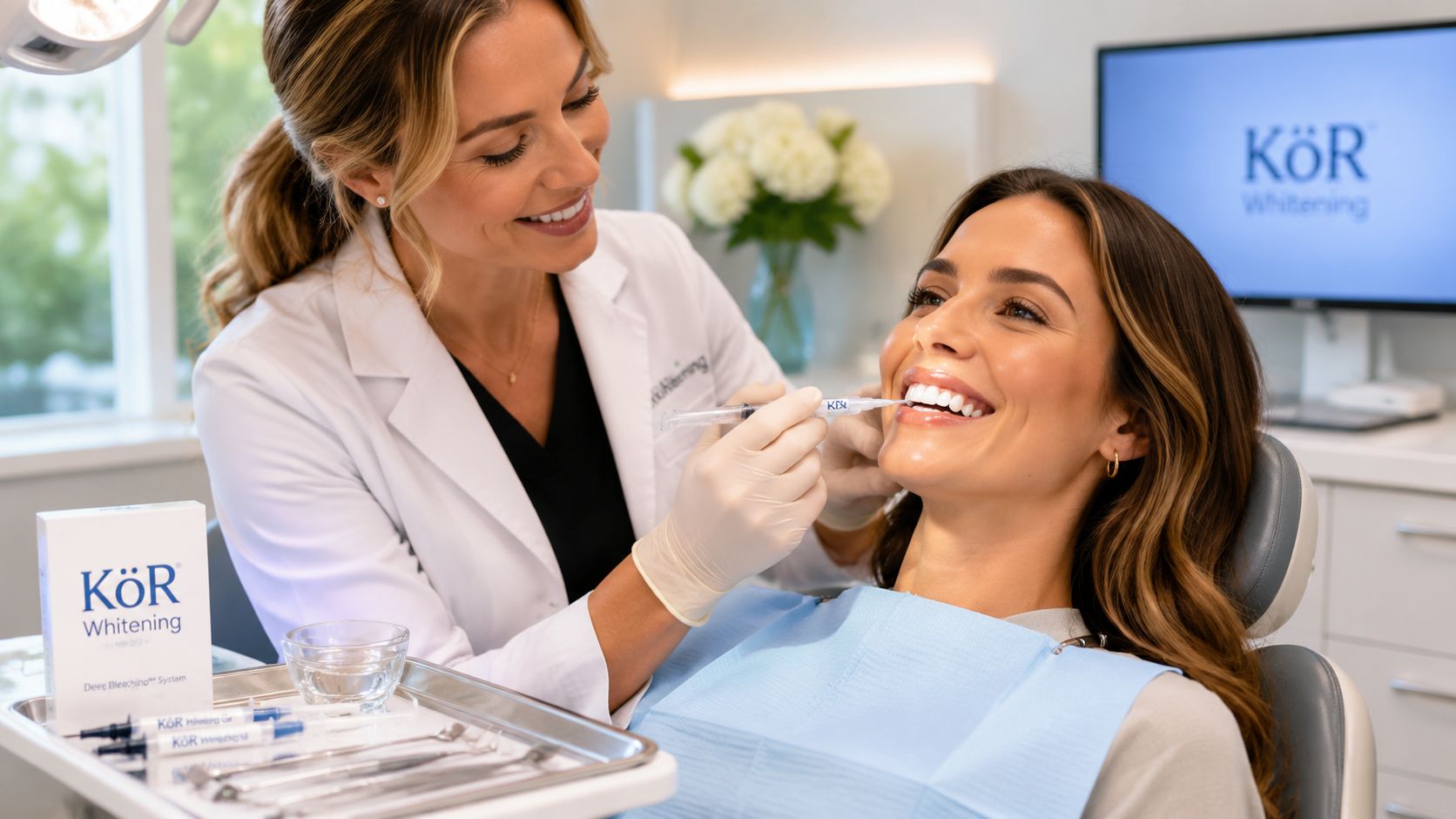
Treatment starts with an in-person exam. I look at the type and depth of staining, check for gum inflammation or untreated decay, and review any crowns, veneers, or visible fillings that could limit how uniform the final result looks.
That planning visit is also where expectations get clarified. A patient hoping to brighten natural enamel may be a strong fit. A patient with several older restorations across the front teeth may need a different cosmetic plan, or may choose whitening first and then replace restorations afterward so the smile matches.
Comfort is part of that discussion too. Patients who want a realistic sense of what professional teeth whitening feels like during treatment should ask before starting, not after trays are made.
Custom trays and the first office visit
If KöR makes sense, the next step is taking impressions or digital scans for custom trays. Tray fit is not a minor detail. Good adaptation helps keep the gel in place and gives more consistent contact across the teeth being treated.
The first office visit is used to prepare the teeth and review the home protocol in plain terms. Patients need to know how much gel to use, how to seat the trays properly, and what to do if a tooth becomes sensitive. Clear instructions prevent avoidable problems.
The at-home phase
The home phase is where patient compliance really shows. KöR is not difficult, but it is structured. Patients wear the trays nightly for the prescribed period, use the gel exactly as directed, and avoid treating it casually.
Missing nights, overfilling trays, or changing the routine on your own usually leads to less even whitening and more frustration.
For many patients, the sequence looks like this:
- Complete the consultation to confirm that KöR fits the type of discoloration and the condition of the teeth.
- Have custom trays made so the whitening gel is delivered accurately.
- Follow the home whitening schedule as instructed, including sensitivity guidance and tray care.
- Return for the final office visit to complete the treatment and assess the color change.
After you've seen the process described, this visual overview can help it feel more familiar:
The final in-office whitening visit
The last visit builds on the work already done at home. At that point, I can see how the teeth responded, check for areas that whitened faster or slower, and complete the in-office phase with a better sense of what result is realistic for that patient.
Patients often like this visit because the improvement is easier to appreciate. It also gives us a chance to judge the outcome accurately. If the shade looks good and fits the rest of the smile, we talk about maintenance. If existing dental work now stands out more clearly, that is not a treatment failure. It is part of cosmetic planning, and it is one reason a careful consultation matters before starting KöR in the first place.
Are You A Good Candidate For KöR Whitening
The most honest answer is that good candidates for KöR aren't solely people who want whiter teeth. They're people whose discoloration pattern, dental history, and cosmetic goals make deep bleaching a sensible choice.
KöR is often worth considering for adults with stubborn internal staining, age-related darkening that hasn't responded well to other methods, or difficult discoloration such as tetracycline staining. It's also appealing to patients who want a professional, supervised plan rather than trial-and-error products.
Who tends to fit this treatment well
A strong candidate often has one or more of these traits:
- Deeper discoloration rather than only light surface stain
- Healthy teeth and gums that are ready for cosmetic treatment
- Patience for a multi-step process instead of a one-visit shortcut
- Realistic expectations about color improvement and maintenance
Patients searching for a dentist near me or cosmetic dentist near me sometimes assume whitening is the first answer for every dark smile. It isn't. That's why the consultation matters so much.
When whitening alone may not be enough
One of the biggest limitations is existing dental work. As noted by Lex Smiles' discussion of KöR candidacy and cosmetic planning, whitening does not change the color of crowns, veneers, or fillings. If those restorations show when you smile, your natural teeth may brighten while the older dental work stays the same shade.
That can create a mismatch.
If visible restorations are already lighter, darker, or simply older than the surrounding teeth, the real question isn't "Will KöR whiten my teeth?" It's "Will my whole smile still look even afterward?"
Transparency matters. Some patients need whitening plus replacement of visible restorations. Others may be better served by a different cosmetic plan entirely. If a front tooth has an old filling, a worn crown, or a veneer that no longer matches, whitening may be only one step in a larger smile design.
Who should pause before moving forward
A patient may need another approach first if they have untreated decay, active gum issues, visible restorative mismatches, or expectations that no whitening system can meet. In those cases, restorative dentistry, cleaning and exams, or other cosmetic services may need to come before or alongside whitening.
That isn't a sales tactic. It's good treatment planning.
Results Side Effects And Whitening Comparisons
Patients usually want straightforward answers to four questions. How white can my teeth get. How long will it last. Will it hurt. And why should I choose this instead of strips or a standard whitening session?
The honest answer is that KöR is a premium whitening system for selected cases, not the default solution for everyone. It asks more from the patient, but it also aims at tougher discoloration problems than many simpler options.
What results usually look like
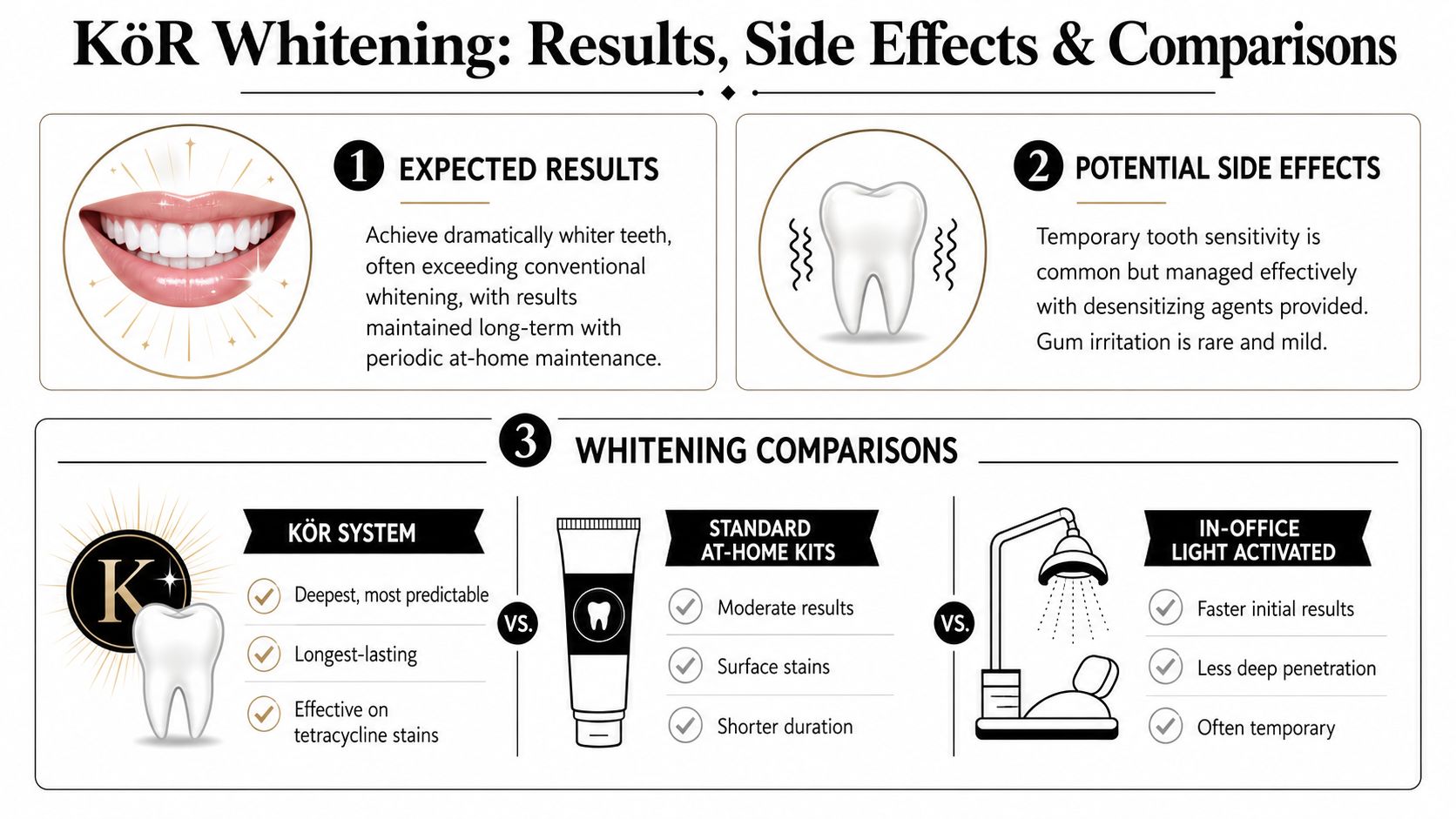
When KöR is chosen appropriately, patients can expect a smile that looks noticeably brighter and more natural than what store-bought whitening often achieves. The appeal isn't just initial brightness. It's that the system is designed for deep, resistant staining rather than quick surface improvement.
Results still vary from patient to patient. Tooth structure, stain type, existing dental work, and consistency during the home phase all influence the outcome.
What to expect with sensitivity and maintenance
A common public question about KöR is whether it really causes less sensitivity. Existing public coverage often repeats that claim without giving independent rates for sensitivity, relapse, or long-term patient-reported outcomes. As summarized by Beulah Family Dentistry's discussion of KöR tolerability and durability questions, the important point is that KöR is a multi-stage process designed for stubborn staining, and for many patients its value may be in both clinical performance and tolerability in those difficult cases.
That's a balanced way to look at it.
Some patients still experience temporary sensitivity with any whitening system. The difference is that KöR is commonly chosen when people want a stronger professional option with a protocol designed around managing that concern more carefully than generic alternatives.
Maintenance matters too. This isn't usually a one-time cosmetic event that lasts forever without touch-ups. Long-term brightness depends on habits, staining exposure, and occasional maintenance. Patients who want to protect their investment should understand how to maintain the results of teeth whitening.
KöR compared with other whitening choices
A simple comparison helps:
| Option | Best for | Limits |
|---|---|---|
| KöR bleaching system | Deeper, harder-to-treat discoloration and patients seeking a structured professional plan | More time, more commitment, and typically a higher fee |
| Over-the-counter strips or kits | Mild surface stain and budget-minded patients | Often less effective for internal or resistant discoloration |
| Standard in-office whitening | Patients who want faster cosmetic brightening | May not be the best match for deeper staining patterns |
What about cost
KöR is generally a premium cosmetic service because it involves professional diagnosis, custom trays, multiple stages, take-home materials, and office time. Exact fees depend on the office, the case, and whether additional cosmetic or restorative work is needed to create an even smile.
Cost should be discussed alongside value. If a patient has difficult staining, paying less for the wrong treatment isn't a bargain.
Choose William M Schneider DDS for KöR Whitening in Walnut Creek
When patients in Walnut Creek look for a new dental home, they usually want more than a menu of services. They want clear explanations, a realistic treatment plan, and care that doesn't feel rushed. That matters even more with cosmetic dentistry, where the right result depends as much on judgment as on the product itself.
Dr. Schneider's practice serves patients who want thoughtful care across preventive, cosmetic, and restorative needs. That includes people exploring whitening, Invisalign, crowns, dental implants, and routine dental care under one roof. If you're also looking for a dentist in Walnut Creek, CA for long-term care, that continuity can make treatment planning much simpler.
Why the consultation matters here
The strongest reason to choose an experienced cosmetic dentist isn't that every patient should get KöR. It's that every patient should get an honest answer about whether KöR is the right fit.
That means evaluating:
- Your stain pattern and whether it's likely to respond well
- Your existing dental work and whether it will match afterward
- Your goals for subtle brightening versus larger smile improvement
- Your overall oral health before cosmetic treatment begins
For some patients, KöR will be the right path. For others, a simpler whitening option, restorative replacement, or a broader cosmetic plan will make more sense. That kind of transparency builds trust and usually leads to better results.
A comfortable, local option for smile care
For many East Bay patients, comfort matters just as much as outcome. Dental anxiety, busy schedules, and uncertainty about cosmetic treatment can all delay care. A private practice environment with clear communication and personalized planning helps remove that friction.
If your smile looks darker than you'd like, if old whitening attempts haven't worked, or if you're unsure whether visible crowns or fillings will affect the final look, the next step isn't guessing. It's a consultation.
If you're considering KöR whitening or want an honest opinion about the best way to brighten your smile, contact William M. Schneider, DDS to schedule a consultation in Walnut Creek. You'll get a clear assessment, practical recommendations, and a treatment plan built around your teeth, your goals, and your long-term oral health.