If you're living with a missing tooth, you may already know the small daily adjustments that come with it. You smile a little more carefully in photos. You chew on one side. You skip crunchy foods or anything that seems likely to catch in the space. Many people in Walnut Creek do this for months or years because the gap doesn't seem urgent.
What often surprises patients is that the long term effects of missing teeth usually start long before pain does. A space in your smile isn't just an empty spot. It can change the way your teeth fit together, the way your jawbone is supported, the foods you feel comfortable eating, and eventually the way your face and oral health age over time.
Your Dentist for Missing Teeth in Walnut Creek CA
A missing tooth can feel easy to postpone, especially if it's in the back. You're busy. Work is full. Family schedules don't leave much room for dental visits. And if you can still get through most meals, it's tempting to assume the problem can wait.
For many adults, though, the effects show up in ordinary moments. You may notice yourself choosing softer foods when meeting friends for dinner in Walnut Creek. You may feel self-conscious speaking up in a meeting or laughing without thinking. Sometimes the issue isn't appearance at all. It's the strange feeling that your bite no longer lands where it used to.
That concern is valid. A missing tooth changes more than your smile.
Why patients often wait
Individuals often don't delay because they don't care. They delay because they aren't sure what matters most.
- Appearance concerns: Front tooth loss is obvious, but back tooth loss can feel easier to ignore.
- Function concerns: Some patients adapt by chewing around the area and assume that's good enough.
- Treatment uncertainty: Many aren't sure whether they need an implant, a bridge, or something simpler.
- Anxiety about the visit: Fear of discomfort keeps a lot of people from getting answers early.
Leaving a gap alone usually doesn't keep the mouth stable. The mouth adapts, and that adaptation often creates new problems.
People searching for a dentist near me, a dentist in Walnut Creek, CA, or dental implants near me are often at exactly this point. They don't just want information. They want a clear path forward from someone who understands both the clinical side and the human side of tooth loss.
Why local care matters
When you're dealing with missing teeth, convenience matters because treatment can involve planning, follow-up, and long-term maintenance. Patients in Walnut Creek and nearby East Bay communities usually do best when they have one local dental home for exams, digital x-rays, restorative dentistry, and ongoing care.
That matters whether the missing tooth came from decay, gum disease, trauma, or a recent tooth extraction. It also matters if the problem has started to feel more urgent and you're looking for an emergency dentist after a cracked tooth, infection, or sudden bite change.
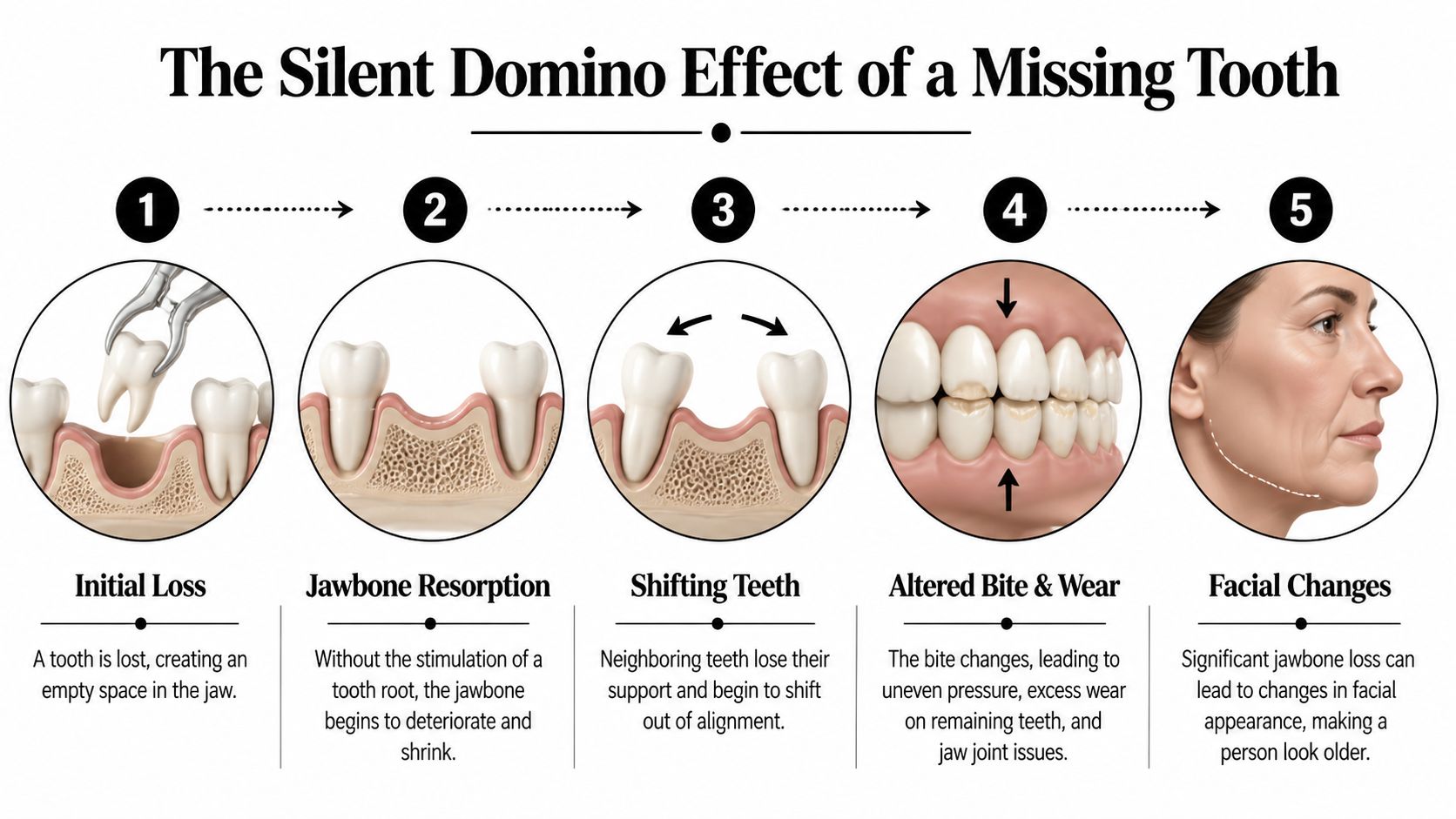
The Silent Domino Effect of a Missing Tooth
A missing tooth doesn't stay still. The space may look unchanged in the mirror, but the supporting bone and nearby teeth begin responding almost immediately. The easiest way to think about it is a row of books on a shelf. Remove one, and the others slowly start leaning into the space.
What happens in the jaw first
Your natural tooth root does an important job every time you chew. It transfers pressure into the jawbone. That stimulation helps the bone stay active and maintain its shape. Once the tooth is gone, that signal disappears.
According to clinical guidance on bone changes after tooth loss, one missing tooth can cause up to 25% jawbone recession within the first year. Patients don't usually feel that loss happening, but the body does respond to it.
A useful analogy is a foundation beneath a support post. If the post is removed, the structure above may still stand for a while, but the area underneath begins to weaken.
Then nearby teeth start to move
Teeth are held in position by bone, gum support, and contact with neighboring and opposing teeth. Once a gap appears, the balance changes. The teeth next to the space can tilt or drift. The opposing tooth can move out of position because it no longer has a matching surface to bite against.
That leads to practical issues patients notice over time:
- Food trapping becomes more common: Gaps and shifting contacts are harder to keep clean.
- Chewing gets less even: One side starts doing more work than the other.
- Wear patterns change: Certain teeth take more force than they were designed for.
- Crowding can worsen: Teeth that were once straight may begin to overlap or rotate.
Practical rule: The longer a gap is left untreated, the less predictable the bite becomes and the more complex replacement can be.
Why waiting makes treatment harder
Early on, replacing a tooth is usually more straightforward because the shape of the gum and bone is closer to what it was before. As the ridge narrows and neighboring teeth shift, the restoration has to work around an altered configuration.
This is one reason long term effects of missing teeth often become more expensive in real life. Not because the missing tooth itself gets bigger, but because the mouth around it stops cooperating. Patients who could have been candidates for a simpler restorative plan may later need additional steps to rebuild support before treatment can begin.
Beyond the Gap Systemic Health Risks You Cannot Ignore
A missing tooth isn't only a local problem inside the mouth. In some patients, it also affects nutrition, inflammation, and overall health in ways that deserve attention. If chewing becomes less comfortable, people often shift toward softer foods and away from foods that take more effort to break down.

What the evidence shows
A 2022 study on missing teeth and mortality risk found that individuals with three or more missing teeth had a 1.19-fold higher risk for all-cause mortality, with especially strong links to deaths from metabolic and digestive diseases. That doesn't mean every missing tooth leads directly to a medical crisis. It does mean tooth loss can be part of a larger pattern of declining health that shouldn't be brushed aside as cosmetic.
The same body of evidence points to plausible reasons for that connection. Poor chewing can affect food choices. Chronic oral inflammation can contribute to systemic strain. Reduced function can make it harder to maintain the kind of diet that supports long-term health.
The nutrition problem patients don't expect
When chewing changes, eating changes. Patients often don't describe this as a health issue at first. They say things like, "I just avoid that side," or "I don't eat that anymore." But over time, avoiding tougher foods can narrow food choices in ways that matter.
Common examples include:
- Crunchy produce becomes less appealing
- Protein-heavy foods may be harder to chew comfortably
- Meals take longer, so people choose convenience foods
- Digestive comfort may worsen when food isn't chewed well
For many adults, especially busy professionals, that shift happens gradually enough that it feels normal. It isn't.
A healthy mouth supports a healthy diet. That's one reason restorative care matters beyond appearance. Patients who want to understand this connection in a broader wellness context may find it helpful to read about the link between gum health and overall wellness.
Bite strain can spill into daily life
When teeth move and chewing becomes uneven, the jaw muscles and joints often compensate. Patients may describe this as tension, clenching, facial fatigue, or headaches that seem unrelated to dental changes. The problem isn't always dramatic. Sometimes it's the slow build of a bite that's no longer balanced.
A missing tooth can affect how your whole mouth works, not just how it looks.
That matters in everyday life in Walnut Creek. If you're talking all day, eating on the go, or managing a stressful schedule, jaw strain tends to show up in the places people feel it most. During meals, during sleep, and during work.
Restoring Your Smile in Walnut Creek Modern Tooth Replacement
The good news is that missing teeth can be treated very effectively. The right option depends on the location of the missing tooth, the health of the surrounding teeth and gums, the condition of the jawbone, and your priorities. Some patients want the most natural feel possible. Others want a fixed solution without surgery. Some need a plan that restores several teeth at once.
Dental implants
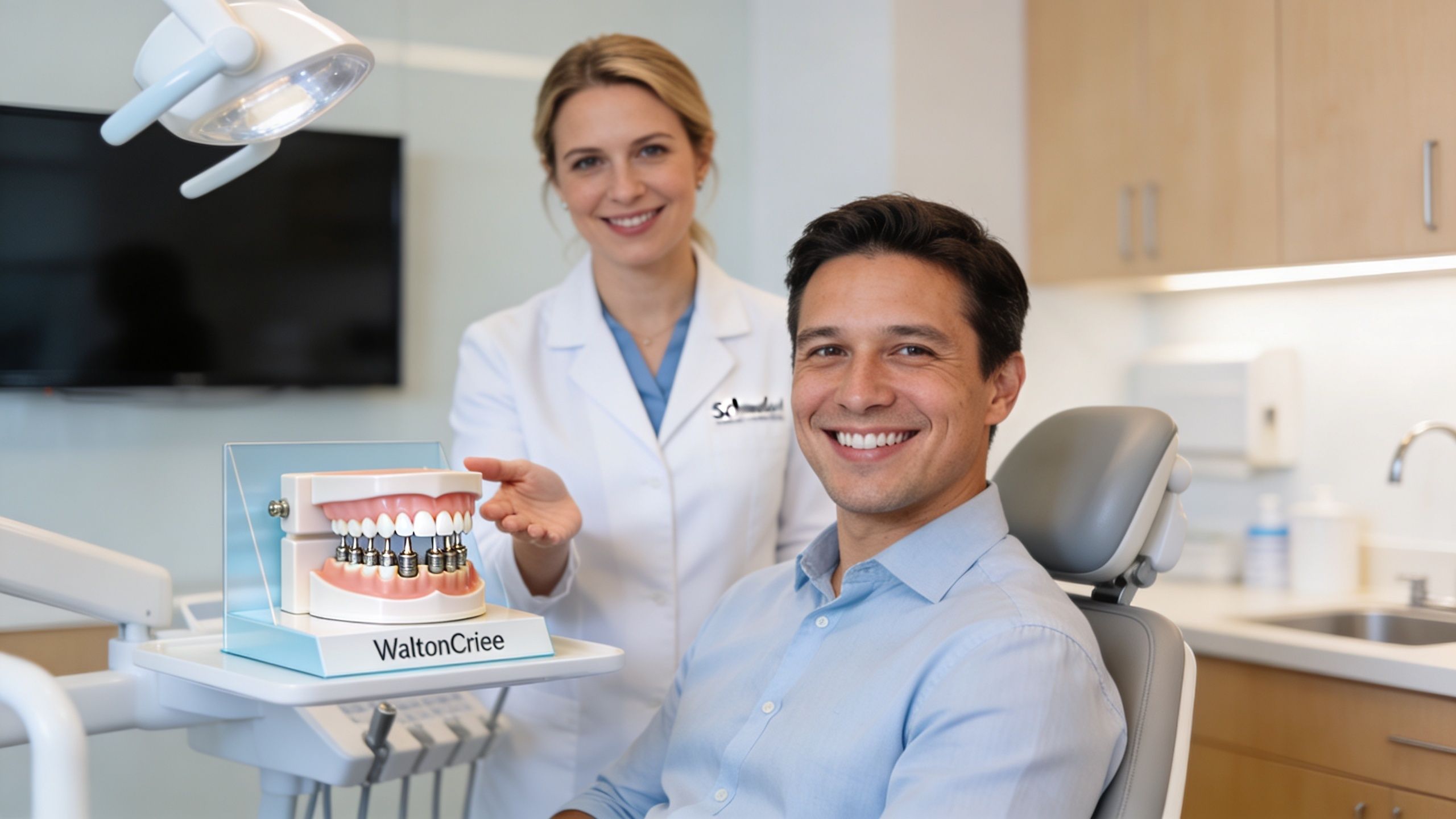
A dental implant replaces the missing root as well as the visible tooth. That's the key difference. The implant is placed in the jawbone, then restored with a crown once healing is complete. Because it functions like a root, it's the option that best supports the bone and helps keep neighboring teeth independent.
For many patients searching for dental implants near me, implants are the most complete long-term answer because they restore function without relying on adjacent teeth for support.
Implants are often a strong choice for patients who want:
- A fixed replacement: It doesn't come out for cleaning.
- A natural chewing feel: The tooth is supported from below.
- Protection for nearby teeth: Adjacent teeth usually don't need to be reshaped.
- Long-term structural support: The restoration addresses the root problem, not only the visible gap.
Patients considering this route can learn more about why many dentists consider implants the strongest replacement option.
Bridges and dentures
A fixed bridge fills the space by anchoring to neighboring teeth. It can be a very good solution in the right case, especially when the surrounding teeth already need crowns or when implant treatment isn't the best fit. The trade-off is that the bridge doesn't replace the root in the bone.
A denture or partial denture may be the most practical choice when several teeth are missing or when a removable option makes sense for health, anatomy, or budget reasons. Modern dentures can look far better than many patients expect, and in the right hands they can restore confidence and daily function.
Here's a simple comparison:
| Option | Best for | Main advantage | Main trade-off |
|---|---|---|---|
| Dental implant | Single missing teeth or strategic replacements | Replaces root and crown | Requires surgical placement |
| Fixed bridge | Patients who want a fixed option without implant surgery | Stable and reliable | Uses neighboring teeth for support |
| Partial denture or denture | Multiple missing teeth | Broad replacement in one appliance | Removable and less root-like in function |
A short overview can help if you're visualizing the process:
When timing matters even more
Upper back teeth deserve special attention. When a molar is missing in the upper jaw, the sinus can gradually expand downward into the space where bone used to be. According to guidance on upper molar loss and sinus changes, 40% of untreated upper molar losses lead to a sinus floor descent of over 4mm within two years, which can complicate future implant placement.
That doesn't mean treatment is impossible later. It means early evaluation gives you more options and often a simpler plan.
The Benefits of a Complete and Healthy Smile
Replacing a missing tooth isn't just about filling space. It's about getting your mouth working normally again. Once the bite is balanced and the gap is restored, patients often notice improvements in areas they had stopped thinking about.
What changes day to day
A complete smile supports more than appearance.
- Eating feels easier: Many patients return to foods they had given up.
- Speech can sound clearer: Certain sounds are easier when teeth are in the right positions.
- Cleaning becomes more predictable: A restored space is often easier to maintain than an open trap for food and plaque.
- Smiling feels natural again: You don't have to calculate every photo or conversation.
For adults in Walnut Creek, that can mean simple things that carry real weight. Ordering what you want at a restaurant. Speaking comfortably in client meetings. Laughing without covering your mouth. Those aren't small wins.
Why treatment is an investment in health
People often ask whether replacing a tooth is worth it if they've already adapted. In many cases, adaptation is exactly why treatment matters. The body can compensate for a long time, but compensation usually means another area is carrying extra stress.
Restorative dentistry works best when it protects function, appearance, and long-term stability at the same time.
A complete smile also supports facial structure. When the mouth loses support over time, the lower face can begin to look more collapsed or aged. Restoring missing teeth helps preserve the shape and support that keep the smile looking healthy.
Whether the answer is implant dentistry, a bridge, or another restorative approach, treatment should make life easier. This is the definitive benchmark. Not just whether the space is filled, but whether your mouth works better, feels better, and supports confidence again.
Your First Visit with Dr Schneider What to Expect
Many patients put off a consultation because they don't want a lecture or a rushed treatment pitch. A good restorative visit should feel calm, clear, and useful. The first goal is to understand what's happening in your mouth right now. The second is to give you realistic options.
Missing-tooth consultations are common
If you've been wondering whether your situation is unusual, it isn't. Data summarized in this overview of the health risks of living with missing teeth notes that by age 50, the average American has only 22–23 of their 28 permanent teeth, and over 100 million Americans are missing at least one tooth. Restorative consultations are a routine and important part of adult dental care.
That should be reassuring. You're not walking in with a rare problem. You're walking in with a common one that deserves individual planning.
What usually happens at the appointment
A first visit for missing teeth typically includes a few core steps:
A conversation about your concerns
Some patients care most about chewing. Others care about appearance, comfort, or avoiding more tooth movement. Those priorities matter.A full oral exam
The dentist checks the gap, neighboring teeth, gum condition, and overall bite.Digital x-rays or other imaging
Imaging helps evaluate bone support, root health, and whether a restoration like an implant is feasible now or may need preparatory treatment.A review of treatment choices
Implants, crowns, bridges, removable options, and timing are discussed in plain language.
What patients should expect from the discussion
The most helpful treatment planning is honest about trade-offs.
| Question | Why it matters |
|---|---|
| How long has the tooth been missing? | Bone and bite changes often depend on time |
| Is the area visible when you smile? | Aesthetics may affect the recommended material and design |
| Are nearby teeth healthy? | Healthy support teeth influence whether a bridge makes sense |
| Do you want fixed or removable treatment? | Daily lifestyle preferences matter |
| Is anxiety part of the picture? | Comfort options should be part of planning, not an afterthought |
You should leave a consultation knowing what the problem is, what your options are, and what happens if you wait.
For patients looking for a dentist in Walnut Creek, CA, cosmetic dentist near me, or a practice that also handles routine cleaning and exams, dental x-rays, and new patient exams, that kind of clarity is what turns a stressful problem into a manageable plan.
FAQs About Replacing Missing Teeth
How long does it take to replace a missing tooth?
It depends on the treatment. A bridge is often completed faster than an implant because it doesn't require healing inside the jawbone. An implant usually takes longer because the site must be evaluated carefully and the implant needs time to integrate before the final crown is placed. The exact timeline varies based on healing, bone condition, and whether the tooth was lost recently or long ago.
Is treatment for a missing tooth painful?
Most patients tolerate treatment better than they expect. The bigger difference is usually anxiety, not pain. Clear communication, gentle technique, and effective local anesthesia make a major impact. If you're especially nervous, ask about comfort-focused care, including whether sedation is appropriate for your case.
Is it really a problem if the missing tooth is in the back?
Yes, it can be. Back teeth do much of the heavy chewing, and their loss can change bite balance over time. A back tooth may not show when you smile, but it still supports chewing efficiency and helps keep the rest of the bite stable. Patients often ignore these spaces until they notice shifting, food trapping, or strain on one side.
Which option is best, implant, bridge, or denture?
There isn't one universal answer. Dental implants are often the most root-like solution and are frequently the best fit when preserving structure is a priority. Bridges can be excellent fixed restorations in selected cases. Dentures or partial dentures may be the right answer when multiple teeth are missing or when a removable option fits your needs better. The best choice depends on your anatomy, goals, and the condition of surrounding teeth.
Can I wait a while before deciding?
You can, but waiting can narrow your options. The mouth doesn't usually hold a missing-tooth space perfectly in place. Bone support can change, nearby teeth can move, and the bite can become less straightforward to restore. If you're unsure, it still makes sense to get examined now. An evaluation doesn't commit you to treatment, but it does give you a better understanding of what timing means in your case.
Will insurance help with treatment?
Coverage varies widely by plan and by the type of restoration being considered. Some plans contribute more readily to certain restorative procedures than others. The practical way to approach this is to ask for a clear breakdown of benefits, estimated out-of-pocket costs, and financing options if needed. Good treatment planning includes both the clinical side and the financial side.
What if I also want cosmetic improvement?
That's common. Replacing a missing tooth often overlaps with cosmetic dentistry because shape, color, spacing, and smile symmetry matter. If you're also thinking about teeth whitening, crowns, or a broader smile update, mention that early. Combining restorative and cosmetic goals often leads to a more cohesive result.
If you're ready to stop working around a missing tooth and start understanding your options, schedule a consultation with William M. Schneider, DDS. Patients in Walnut Creek and the East Bay turn to the practice for thoughtful restorative care, dental implants, cosmetic dentistry, routine exams, and compassionate treatment that puts long-term health first.