If you're looking into orthodontics in california, you're probably balancing a few things at once. You want straighter teeth. You want to know whether braces or clear aligners fit your life. You also want to avoid making an expensive decision without understanding what matters most.
That's especially true in Walnut Creek and the East Bay, where patients often arrive with a mix of practical concerns and cosmetic goals. Some are parents trying to figure out timing for a child. Others are adults comparing Invisalign to braces while also thinking about work, photos, meetings, or long-term dental health. The options can feel simple on the surface, but the details matter.
California is also a large orthodontic market, which gives patients choices. The Bureau of Labor Statistics May 2023 data for orthodontists in California reports 1,060 orthodontists employed in the state, with a mean hourly wage of $208.86 and an annual mean wage of $208,470. Other professional counts cited in the verified data place the statewide total higher, which reflects how much demand exists for specialty care across communities like Walnut Creek and the broader East Bay.
Still, more providers doesn't always mean an easier decision.
Patients usually do best when they slow the process down and start with the basics. What problem are you trying to fix? Is it crowding, spacing, bite function, or appearance? Do you want the least visible option, or the one that gives the most control? Are you dealing with insurance rules, old dental work, or concerns about treatment safety?
A good orthodontic plan doesn't begin with the appliance. It begins with diagnosis, goals, and a realistic look at what you'll need to do to get a stable result.
For patients searching for a dentist in Walnut Creek, CA, or even typing in terms like dentist near me or cosmetic dentist near me, orthodontic treatment often fits into a bigger picture. The same patient may also need cleaning and exams, dental x-rays, whitening, or restorative work before or after tooth movement. That's why it helps to work with a local office that sees your smile as a whole, not just as a set of shifting teeth.
Your Guide to a Straighter Smile in the Golden State
A common Walnut Creek scenario goes like this. A patient has been thinking about straightening their teeth for years. Maybe the front teeth have shifted. Maybe an old retainer was lost. Maybe a teen is finally ready for treatment, but the family isn't sure whether to start with braces, aligners, or a specialist consultation.
The first challenge usually isn't motivation. It's sorting through noise.
Why patients often feel stuck
Many understand that orthodontics can help, yet they're often unsure where to begin. Online searches bring up braces, Invisalign, mail-order aligners, financing talk, before-and-after photos, and lots of simplified promises. None of that tells you whether your bite is healthy, whether your teeth can be moved safely, or whether the treatment recommendation matches your actual needs.
In California, that uncertainty is understandable because the market is large and active. Patients have access to many providers and treatment styles, especially in suburban and metro areas. That creates opportunity, but it also means patients need a practical filter for making decisions.
A useful starting point is to think about orthodontics as part of long-term dental care, not as a stand-alone cosmetic purchase. Straight teeth can be easier to clean. A more balanced bite can reduce wear in some cases. Better alignment can also support future restorative dentistry, including crowns or other planned dental work.
What matters more than marketing
The right orthodontic path depends on a few basics:
- Your diagnosis: Crowding, spacing, bite mismatch, and jaw relationships don't behave the same way.
- Your lifestyle: Some patients can manage removable aligners well. Others need the consistency of fixed braces.
- Your existing dental work: Crowns, fillings, implants, or gum concerns can change the treatment approach.
- Your goals: Some patients want a subtle cosmetic improvement. Others need more complete correction.
Practical rule: If a treatment recommendation arrives before anyone has carefully examined your teeth, bite, and imaging, you're moving too fast.
For local patients, this is where a steady, patient-centered office matters. In Walnut Creek, orthodontic planning often overlaps with routine preventive care, new patient exams, dental x-rays, cosmetic goals, and sometimes restorative needs. That full-picture approach tends to lead to better decisions than chasing the most convenient-looking option.
A local path that feels manageable
Orthodontics doesn't have to feel overwhelming. Most patients feel better once they understand their options, know what records are needed, and hear an honest explanation of trade-offs. That's the goal of this guide. Clear up the confusion, show what works, and help you make a decision that supports both your smile and your oral health.
Understanding Your Orthodontic Treatment Options
Orthodontic treatment isn't one product. It's a set of tools used for different kinds of tooth movement. The best option depends on how complex the case is, how visible you want treatment to be, and how disciplined you're likely to be with daily care.
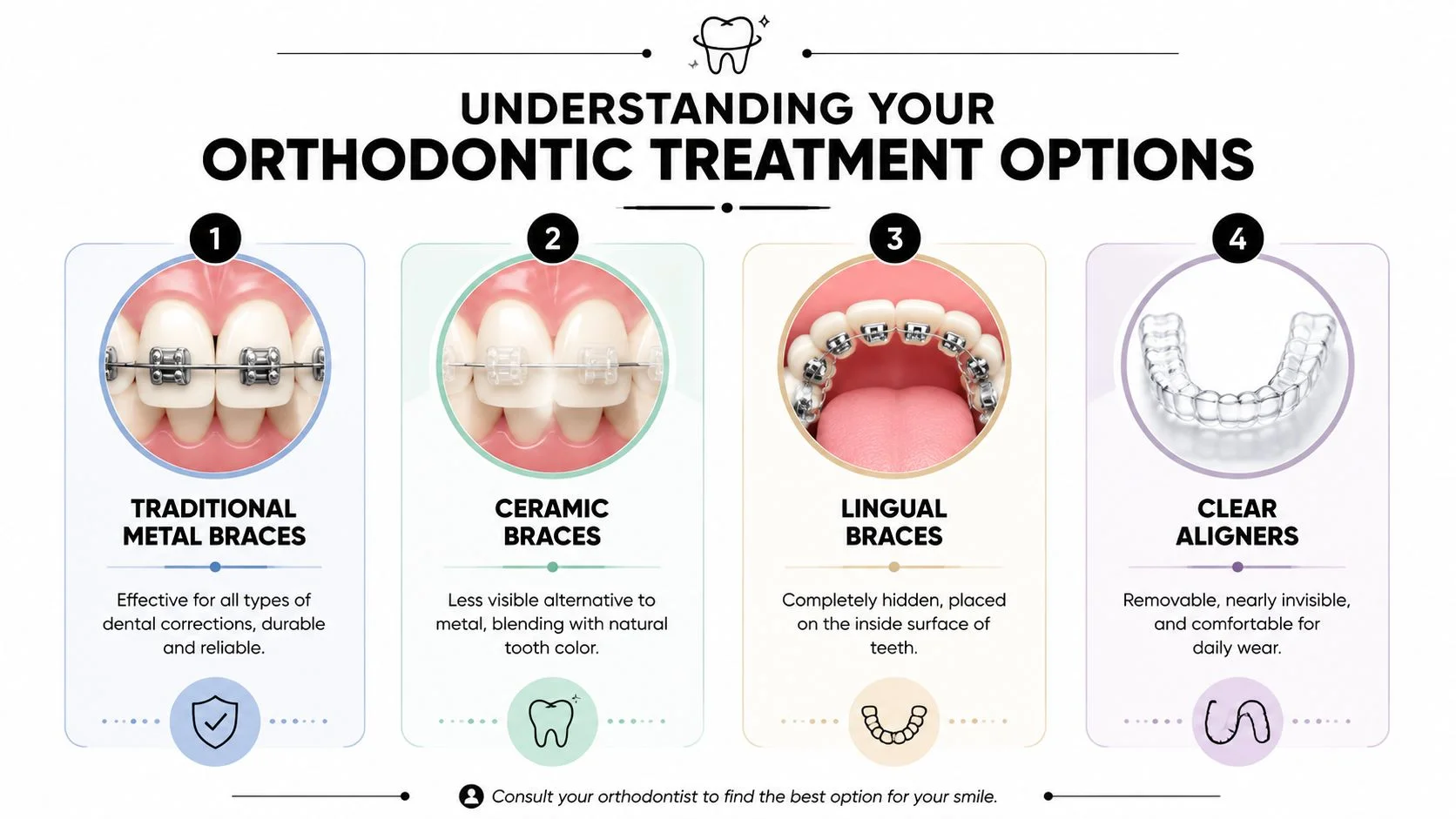
Traditional braces
Metal braces are still the most reliable option for many moderate to complex cases. They're fixed to the teeth, which means the system works continuously. That matters when precise movement, bite correction, or stronger control is needed.
From a patient perspective, braces are less dependent on memory and routine than aligners. You don't remove them for meals, so there's no temptation to leave them out too long. The trade-off is visibility and maintenance. Food can catch around brackets, brushing takes more effort, and some foods need to be avoided to reduce breakage.
Traditional braces often make sense for:
- Complex movement: Cases involving significant rotation, bite correction, or harder-to-control movement
- Younger patients: Children or teens who may not reliably wear removable trays
- Patients who want consistency: The appliance keeps working all day without relying on compliance
Ceramic braces and lingual braces
Ceramic braces work much like metal braces, but the brackets blend in more with natural tooth color. Patients who want fixed treatment without the look of full metal often prefer this option. The trade-off is that ceramic systems can require more attention to cleanliness and may not be the first choice in every case.
Lingual braces sit on the inside surface of the teeth, hidden from view. They can be appealing for patients who want very discreet treatment but need a fixed appliance. They aren't ideal for everyone. They can feel more intrusive to the tongue, and not every office offers them routinely.
Clear aligners
Clear aligners appeal to adults and older teens because they're removable, nearly invisible, and easier to clean around than brackets and wires. They fit well for busy professionals in Walnut Creek who want orthodontic care to interfere as little as possible with work and social life.
They also require discipline. If you don't wear aligners as instructed, treatment slows down or becomes less predictable. That's the biggest practical downside. Convenience only helps if the trays stay in.
Clear aligners are often a good fit for:
- Mild to moderate alignment concerns
- Adults focused on appearance during treatment
- Patients who want easier brushing and flossing
- People willing to follow instructions closely
Clear aligners work best when the patient treats them like part of the daily routine, not an accessory.
Side by side comparison
| Feature | Traditional Braces | Invisalign Clear Aligners |
|---|---|---|
| Visibility | More noticeable | Less noticeable |
| Removal | Fixed in place | Removable |
| Compliance needs | Lower day-to-day patient dependence | Higher patient responsibility |
| Cleaning | More challenging around brackets and wires | Easier to brush and floss |
| Best use | Moderate to complex correction | Mild to moderate cases and appearance-focused treatment |
No option is automatically better. The right choice is the one that fits your bite, your habits, and the level of control your case requires.
Navigating the Cost of Orthodontics in California
Cost is one of the first questions patients ask, and that makes sense. Orthodontics is an investment in health, function, and appearance, but the true issue isn't just the fee. It's whether you're paying for a treatment plan that is appropriate, documented, and realistic.

What changes the financial picture
Orthodontic fees vary because cases vary. A short aligner refinement case is different from a more involved bite correction. The materials matter, but they aren't the only factor. The length of treatment, the complexity of movement, the number of follow-up visits, and whether treatment needs to coordinate with crowns, implants, or other restorative care all affect planning.
For many patients, the more useful question is this: what are you getting for the fee?
You should expect a treatment plan that includes diagnostics, a clear explanation of goals, active monitoring, and retention planning after the teeth move. If the price sounds simple but the process sounds vague, that's a warning sign.
California coverage rules that matter
For patients with Medi-Cal Dental, orthodontic coverage in California follows objective medical-necessity criteria. The state's documentation packet explains that authorization often depends on at least 26 points on the Handicapping Labio-Lingual Deviation Index California Modification, along with required records and radiographs in support of the request, as outlined in the Medi-Cal Dental orthodontic documentation packet.
That matters because many families assume coverage depends mainly on wanting braces or having visible crowding. It doesn't. In this system, the case has to meet the state's threshold for medical necessity.
Patients should ask these questions early:
- Will records support authorization: If coverage is being considered, the documentation has to be complete.
- Is this treatment medically necessary or mainly cosmetic: Those are not handled the same way.
- Are radiographs and scoring part of the process: In California, they often are for covered orthodontic requests.
If you're using Medi-Cal Dental, orthodontic planning is partly a clinical process and partly a documentation process.
A short overview can help if you're trying to understand how offices discuss financing and coverage:
How patients make treatment more manageable
Most private orthodontic treatment is handled through a mix of insurance benefits, phased payments, or in-office financial arrangements when available. The key is transparency. Ask for clarity on what is included, what happens if treatment runs longer than expected, and how retainers are handled at the end.
For patients also comparing broader dental needs, it's worth thinking in sequence. Some people need cleaning and exams, cavity treatment, or gum care before orthodontics starts. Others may want teeth whitening or cosmetic dentistry after alignment is complete. Planning in the right order often saves frustration.
How to Choose the Right Orthodontist in Walnut Creek
Choosing an orthodontic provider isn't only about convenience or whether an office advertises Invisalign. In California, the quality of diagnosis is one of the clearest signs that a provider takes safety seriously.
Start with records and judgment
California dental law has strengthened the expectation that orthodontic treatment should begin only after proper diagnostic review, including a dentist examining x-rays or other bone imaging before teeth are moved. A California dental-law analysis explains that this step helps identify issues such as root position, bone support, impacted teeth, and other concerns that may not appear in a surface-level simulation. You can review that discussion in this analysis of California dental law changes affecting orthodontic treatment and imaging review.
That standard matters in real life. A nice-looking digital preview is not the same thing as a complete diagnosis. Teeth don't move safely just because software shows them lining up.
Questions worth asking at a consultation
A strong consultation should leave you with answers, not marketing language. Ask direct questions such as:
- What records do you need before starting treatment: Look for a thoughtful answer that includes imaging and bite evaluation
- What are the limitations of my preferred option: A good provider will explain where aligners help and where braces may offer more control
- How do you handle patients with crowns, fillings, or gum concerns: Adult cases often need more coordination than people expect
- What happens after active treatment: Retention is part of treatment, not an afterthought
Some of the worst orthodontic decisions start with a patient choosing the appliance first and the diagnosis second.
If you're researching local options, review a provider's orthodontic philosophy and available treatment pathways, not just cosmetic messaging. For readers who want a local reference point, orthodontic treatment options in Walnut Creek at William M. Schneider, DDS outline one example of how a general dental practice may present clear aligner care within a broader dental setting.
What often works best
In practice, patients usually do well with providers who are willing to say no to the wrong treatment. That sounds simple, but it's one of the most reassuring things you can hear. If a case needs more records, more planning, or a different appliance than the one you expected, a careful answer is better than a fast yes.
The right orthodontist in Walnut Creek should make the process feel clearer after the consultation, not more confusing.
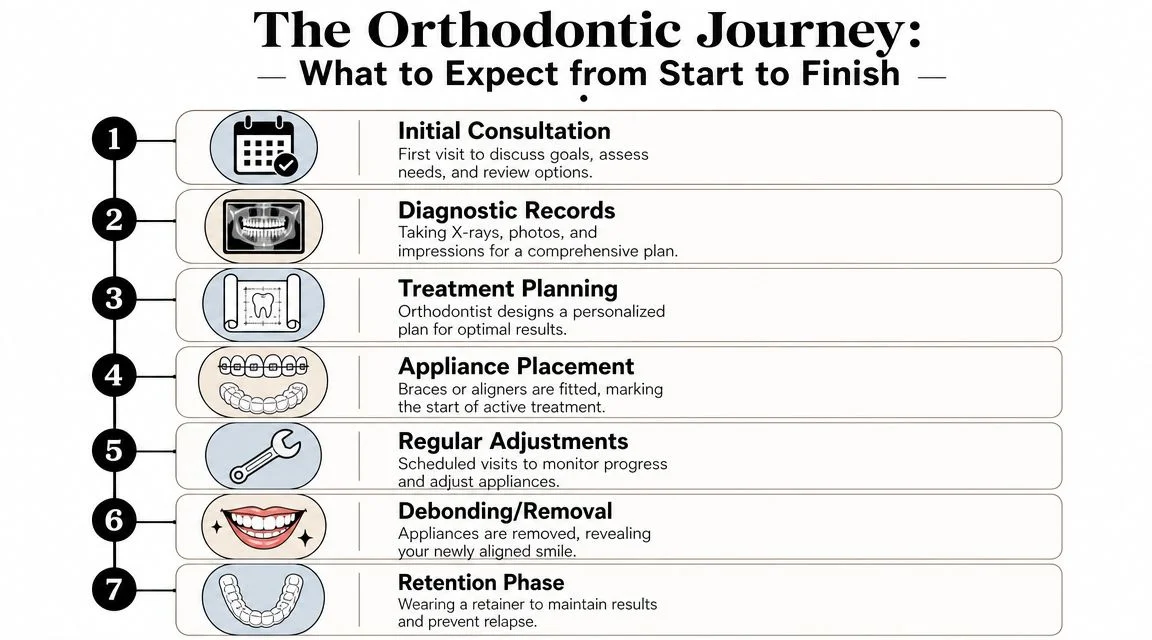
The Orthodontic Journey What to Expect from Start to Finish
Patients feel less anxious about treatment once they know what the sequence looks like. Orthodontics has phases, and each one has a job. When patients understand that rhythm, the whole process feels more manageable.
The first phase
Treatment starts with a consultation and records. That usually includes an exam, photographs, and imaging or scans needed to build a plan. During this stage, the bite, tooth position, spacing, and any complicating factors are reviewed.
After records come planning decisions. Which appliance fits the case. Whether any preliminary dental care is needed. Whether the goal is mainly cosmetic alignment, functional bite improvement, or both.
Active movement
Once braces are placed or aligners are delivered, treatment shifts into active movement. This is the part most patients think of first, but it only works well if the diagnostic steps were done properly.
The day-to-day experience depends on the system:
- With braces, expect periodic in-office adjustments and some short-term soreness after changes.
- With aligners, expect to change trays on schedule and follow wear instructions carefully.
- With either option, home care becomes more important because plaque control directly affects long-term results.
California practices are also using teledentistry more often for selected parts of care. A UCLA-linked report discussed by Orthodontic Products notes that tele-orthodontics can help extend access and improve affordability in underserved settings, while still recognizing that in-person procedures remain necessary. You can read that in this report on tele-orthodontics and access to care.
That means virtual check-ins can be helpful for some follow-up moments, especially for busy patients, but they don't replace chairside procedures like appliance placement, adjustments, or imaging.
The last stage matters more than patients expect
When the teeth look straight, patients often assume they're done. They aren't. The retention phase protects the work. Teeth have a memory for old positions, and without retainers, relapse becomes much more likely.
A helpful mindset is to think of retention as maintenance, much like routine dental visits. It isn't optional if you want the result to last.
The best orthodontic result is not the one that looks good on removal day. It's the one that still looks good years later.
For patients considering clear aligner treatment specifically, timing questions come up often. This Walnut Creek Invisalign timeline overview gives a local example of how treatment duration is usually framed around case complexity and consistency.
Pediatric vs Adult Orthodontics Key Differences
Children and adults can both benefit from orthodontics, but the goals are not always the same. Age changes the planning.

What parents usually need to know
In younger patients, orthodontic evaluation is often about guidance as much as correction. A child's jaws are still developing, teeth are erupting, and bite issues may be easier to manage while growth is active. The purpose isn't always to start full treatment immediately. Sometimes the most useful visit is the one that confirms it's best to watch and wait.
Parents should also know that orthodontics for children may connect with other dental needs. Monitoring eruption, spacing, oral hygiene, and regular cleaning and exams can all affect timing. A child with crowding and frequent plaque buildup, for example, may need both orthodontic planning and stronger preventive support.
What changes in adult treatment
Adults usually seek treatment for one of two reasons. They want to improve smile appearance, or they want to correct a long-standing issue that is now affecting comfort, cleaning, or restorative planning. In Walnut Creek, many adult patients ask about aligners because they want a discreet option that fits work and family life.
Adult cases can be more nuanced because teeth may already have fillings, crowns, recession, wear, or missing teeth. That's why adult orthodontics often needs to coordinate with cosmetic dentistry, restorative dentistry, or even future plans for dental implants. Tooth movement has to respect the condition of the supporting structures.
A simple comparison
- For children: Growth guidance, space management, and bite development often shape the plan
- For adults: Aesthetics, existing dental work, and long-term function usually drive the decision
- For both: Diagnosis, imaging, good home care, and retention remain essential
Adult patients sometimes worry they've missed their window. Usually, they haven't. The better question is whether the treatment plan fits the current condition of the teeth and gums.
Take the First Step to Your New Smile in Walnut Creek
Orthodontics can feel complicated at first because there are several decisions packed into one process. Which treatment works best. Whether your case is cosmetic or more functional. What diagnostics are needed. How treatment fits with insurance, scheduling, and the rest of your dental health.
Once those questions are answered clearly, the path usually feels much simpler.
For patients looking into orthodontics in california, especially in Walnut Creek and the East Bay, the most helpful first step is a consultation grounded in diagnosis rather than sales language. You want to know what your teeth are doing now, what can be improved safely, and what kind of commitment each option requires. That's true whether you're comparing braces and aligners, looking for a dentist near me, or trying to coordinate orthodontic treatment with emergency dentist needs, tooth extraction, restorative work, or cosmetic goals.
Good orthodontic care should do more than straighten teeth. It should support cleaner brushing, better bite balance, healthier long-term planning, and more confidence when you smile. It should also make sense for your life.
If you're in Walnut Creek, CA and you've been putting this off because the process felt unclear, now is a good time to get real answers. A consultation can clarify whether you need braces, clear aligners, monitoring, or a different sequence of care altogether. That clarity is valuable even before treatment begins.
The right plan is the one that respects your health, your time, and your goals.
If you're ready to talk through your options for orthodontics, Invisalign, cosmetic dentistry, or complete dental care in Walnut Creek, schedule a consultation with William M. Schneider, DDS. The office welcomes new patients and can help you understand the next step for a healthier, more confident smile.