Typically, individuals resume their daily routines within 2 to 7 days after a root canal, and the initial discomfort generally subsides within 24 to 48 hours. That's good news if you're reading this with a numb cheek, a tender tooth, or a calendar full of work and family obligations.
A lot of patients don't worry most about the procedure itself. They worry about what happens after. Can you work tomorrow? Is it normal if the tooth feels odd when you bite? What if the pain isn't severe, but it's still distracting?
Those are the questions that matter in real life. If you're looking for a dentist in Walnut Creek, CA, an emergency dentist, or experienced help with restorative dentistry, it helps to know what a normal recovery looks like, not just the shortest version of the story. Root canal recovery time is usually straightforward, but it isn't identical for every tooth or every patient.
Your Guide to Root Canal Recovery in Walnut Creek
If you've just had a root canal, the first few hours are usually uneventful. The numbness wears off, the area feels tender, and you start paying close attention to every sensation. That's normal. In most straightforward cases, patients resume normal activities within 2 to 7 days, and mild soreness or sensitivity usually fades in the first 24 to 48 hours, as described in this overview of average root canal recovery time.
The key word is straightforward. A root canal removes infected or inflamed tissue from inside the tooth, but the surrounding ligament and bone still need time to settle down. That's why a tooth can feel much better than it did before treatment, yet still remain sore when you chew.
What patients usually feel right away
Patients often notice a few common things after treatment:
- Tenderness with pressure. Biting on the treated tooth may feel bruised at first.
- Mild gum or jaw soreness. Holding your mouth open during the procedure can leave the area feeling tired.
- Relief from the original toothache. The sharp, deep pain that brought you in often improves quickly, even if healing soreness remains.
Practical rule: Recovery is usually less about intense pain and more about a short stretch of tenderness that gradually fades.
For many patients in Walnut Creek and the East Bay, the biggest challenge isn't danger. It's uncertainty. That's why good recovery guidance matters. If you're preparing for treatment and want to know what makes the process smoother from the start, this page on how to prepare for a root canal can help you go in with a clear plan.
What actually helps
What works is simple and consistent. Follow the aftercare instructions, avoid chewing hard foods on the treated side, and use the recommended over-the-counter pain relief if your dentist says it's appropriate. What doesn't work is testing the tooth over and over, skipping meals and then chewing something crunchy, or assuming every twinge means something went wrong.
That realistic middle ground matters. Most recoveries go well. A calmer, more informed approach usually makes the first few days much easier.
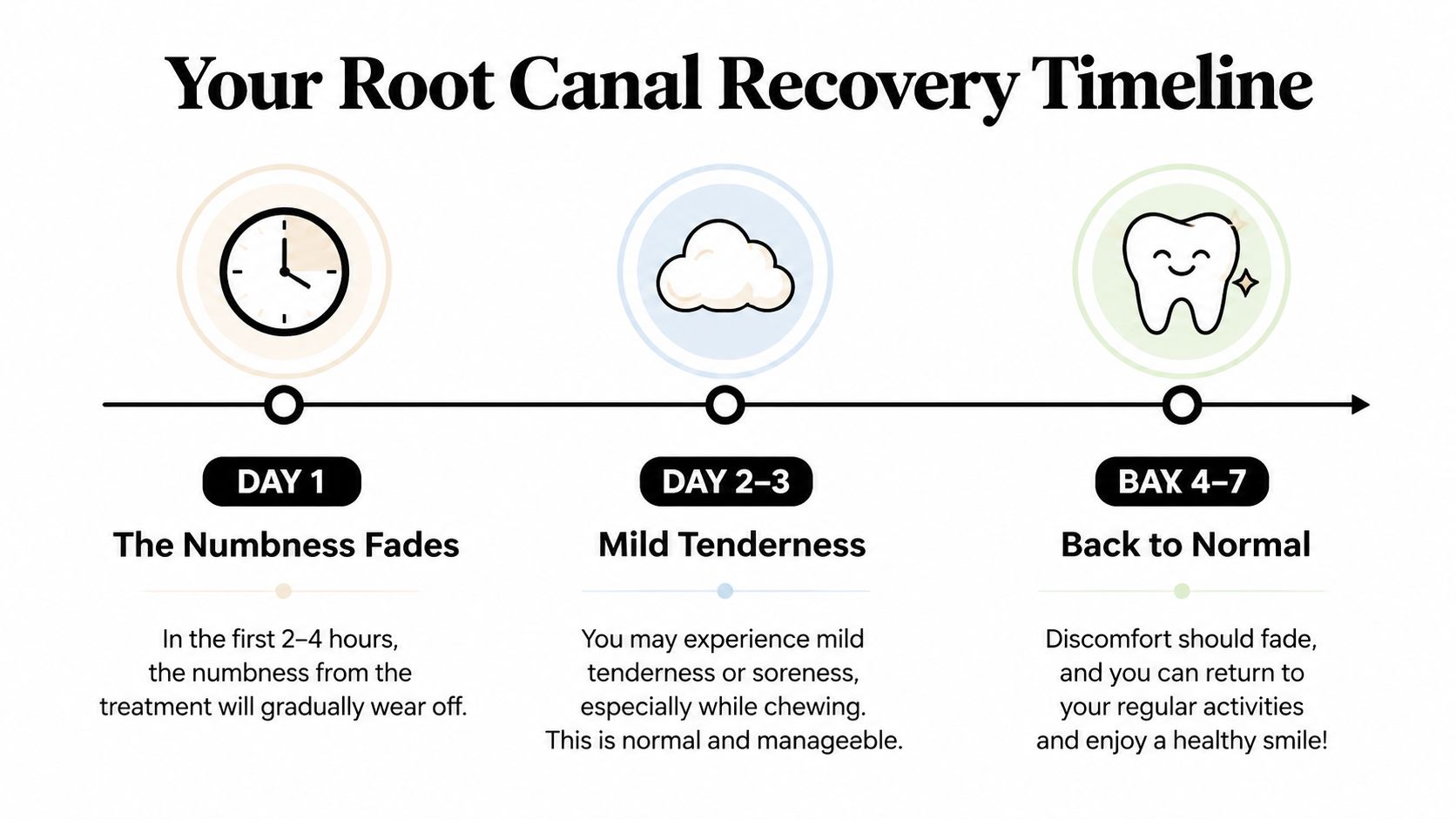
Your Root Canal Recovery Timeline Day by Day
Healing feels more manageable when you know what the next few days are likely to look like. Root canal recovery time tends to follow a pattern, but the exact pace depends in part on which tooth was treated.
According to guidance on how recovery varies by tooth type, front teeth with single canals often heal in 3 to 5 days, while complex molars with multiple canals may take 7 to 10 days for complete comfort restoration. That difference makes sense. A smaller, simpler tooth is usually less demanding to treat than a molar with more anatomy and more chewing force placed on it afterward.
The first 24 hours
The first day is mostly about transition. The anesthesia wears off, and the tooth starts to feel like part of your mouth again. That's often when patients notice tenderness with chewing, light soreness in the surrounding gum, or a general “worked on” feeling.
A few good choices make this period easier:
- Wait for numbness to fade before eating so you don't bite your cheek or tongue.
- Choose softer foods that don't require heavy chewing.
- Use the treated tooth gently or avoid chewing on that side for the moment.
If the tooth had been very painful before treatment, this stage can feel a little confusing. You may feel relieved that the deep infection pain is gone, but still notice surface tenderness. Both can be true at once.
Days 2 and 3
This is usually the point where the recovery direction becomes clear. The area may still feel tender, especially when biting, but the soreness should start becoming less intrusive. Many patients can work, run errands, and return to regular routines with just a few small adjustments.
Most people do best when they judge recovery by trend, not by isolated moments. A brief twinge doesn't matter as much as whether the tooth feels better overall each day.
If you had a front tooth treated, this phase may pass quickly. If you had a molar treated, especially one that was already irritated or difficult to access, this window can feel a little slower.
Days 4 through 7
By the end of the first week, many patients feel close to normal. Chewing is more comfortable, daily life feels easier, and the tooth attracts less attention. Some people are fully comfortable by then. Others still notice minor awareness when biting on firmer foods.
A simple comparison helps:
| Tooth type | Common comfort pattern |
|---|---|
| Front tooth | Often settles more quickly and may feel near normal within several days |
| Premolar | Usually falls in the middle, with steady improvement during the first week |
| Molar | Often takes longer to feel fully comfortable because it has more canals and handles more chewing force |
If your job is sedentary, you may feel ready to return quickly. If your work is physically demanding, the issue is often less about the tooth itself and more about whether you want to deal with soreness while pushing through a full day.
Managing Discomfort After Your Root Canal
Pain after a root canal doesn't usually follow a dramatic pattern. More often, it behaves like a bruise. It's noticeable when you chew, annoying when you focus on it, and then gradually less important as the days pass.
Some patients get concerned when their recovery doesn't match the neatest version of the timeline. That concern is understandable. Still, a slower recovery does not automatically mean a failed procedure. According to patient data on lingering but manageable root canal discomfort, 10 to 15% of routine root canals are associated with mild discomfort lasting longer than 7 to 10 days, even when there's no obvious complication.
Normal discomfort versus concerning pain
Normal discomfort is usually:
- Mild to moderate
- Triggered by chewing or pressure
- Gradually improving
- Manageable with routine aftercare
Concerning pain usually feels different. It may intensify instead of easing, interrupt sleep, or come with swelling or a sense that something is clearly not right.
Mild, lingering soreness can be normal. Worsening pain is a different story.
That distinction matters. Patients often do better when they stop asking, “Is there any discomfort at all?” and start asking, “Is this getting easier to live with each day?”
What tends to work best
The most effective approach is usually uncomplicated.
- Use the recommended medication as directed. Many patients do well with ibuprofen if their dentist says it's appropriate for them.
- Stay with soft, low-effort foods for a bit longer than you think you need to.
- Don't test the tooth with crunchy foods just because it seems improved.
- Keep the area clean without scrubbing aggressively.
If you want more practical guidance for calming post-treatment soreness, this page on root canal pain relief offers useful next steps.
For a quick visual explanation of what post-treatment soreness can feel like, this short video is helpful:
What doesn't help
A few habits make recovery feel worse than it needs to:
- Chewing ice, nuts, chips, or crusty bread too soon
- Skipping pain relief until the tooth is already throbbing
- Poking at the area with your tongue
- Assuming low-grade soreness means the treatment failed
That last point causes a lot of unnecessary stress. The full spectrum of normal includes “fine by day three” and also “mostly fine, but still tender enough to notice for longer than expected.”
Practical At-Home Care for a Smooth Recovery
A root canal doesn't end when you leave the chair. The procedure solves the internal infection problem, but your body still has to calm the surrounding tissues. According to guidance on root canal healing and aftercare, patients often feel better within a week, but internal bone and ligament healing continues for months. The same source notes that dietary restrictions and gentle hygiene help speed the early inflammatory resolution and support that longer healing process.
Eating and drinking
The right food choices lower stress on the tooth and reduce irritation.
- Choose soft foods like yogurt, eggs, soup, oatmeal, pasta, or smoothies.
- Avoid hard and sticky foods that can stress a temporary restoration or make the tooth ache.
- Chew on the other side if biting pressure still feels unpleasant.
This is one of the most common trade-offs in recovery. Patients want to get back to normal quickly, but chewing “normally” too soon is one of the fastest ways to keep a tooth sore.
Brushing and flossing
You still need to keep the area clean. The goal is gentle consistency, not avoidance.
- Brush carefully around the treated tooth with your normal toothbrush.
- Floss with control instead of snapping the floss through the contact.
- Keep the rest of your routine steady so plaque doesn't build up while the area is healing.
A clean mouth heals more comfortably than a neglected one.
Activity and habits
Most people can move through daily life without much trouble, but a few adjustments help.
- Take it easy if your bite feels tender. Heavy chewing and clenching usually irritate healing tissue.
- Stay hydrated and eat regularly so you're not trying to manage soreness on an empty stomach.
- Protect the temporary restoration until your final restoration is placed.
If you're balancing work, school pickup, workouts, or a full family schedule, that's usually enough. Recovery doesn't need perfection. It needs a few smart choices repeated for several days.
When to Call Your Walnut Creek Dentist Signs of Complications
Most root canals heal uneventfully. Patients do best when they know the difference between “this is annoying” and “this needs attention.” That knowledge reduces panic and helps you act early if something changes.
Some cases need closer monitoring from the start. As explained in this discussion of recovery after retreatment or unusual tooth anatomy, expectations should be adjusted for more complex situations such as retreatments or teeth with unusual anatomy. In those cases, staying in touch with your dentist matters even more.
Signs that deserve a call
Call your dentist if you notice any of the following:
- Pain that is getting worse instead of better
- Swelling that seems to be increasing
- A bite that suddenly feels very off
- A temporary filling or restoration that comes out
- A reaction to medication
- Symptoms that make eating, sleeping, or concentrating difficult
This doesn't mean every one of these signs points to a major problem. It means the office should know about it.
The gray area that confuses patients
The hardest category is mild but persistent soreness. It's not severe enough to feel like an emergency, but it's enough to keep drawing your attention. That can be normal in some cases. It can also be a reason to check in if the pattern feels unusual for you.
A good rule is to call when the recovery story stops making sense. If each day looks a little better, that's reassuring. If the tooth becomes more reactive, more swollen, or harder to function with, don't wait and wonder.
If you're debating whether to call, call. Reassurance is part of good dental care.
For patients searching for an emergency dentist near me in Walnut Creek, that accessibility matters. Prompt communication often solves the problem faster than trying to self-diagnose.
Your Follow-Up Visit and Future Dental Care
The root canal itself is only part of the repair. The tooth still needs to function safely in daily life, and that usually means a final restoration. If a treated tooth is left with only a temporary filling for too long, it can remain vulnerable to leakage or fracture under normal chewing.
That's why the follow-up visit matters so much. Your dentist checks how the tooth is settling, confirms that recovery is on track, and places or plans the permanent restoration, often a crown when the tooth needs added protection. This is not optional if the goal is long-term success.
Why the final restoration matters
A root canal-treated tooth has already been through infection, drilling, and internal cleaning. It may no longer hurt, but that doesn't mean it's ready to handle everything on its own.
- A permanent restoration protects the tooth
- A stable bite helps comfort continue improving
- A sealed tooth is easier to maintain over time
For patients looking for a long-term dental home in Walnut Creek, extensive care is important. Good dentistry doesn't stop at pain relief. It includes cleaning and exams, dental x-rays, new patient exams, restorative dentistry, and, when needed, options like tooth extraction, dental implants near me, or even cosmetic dentist near me services such as teeth whitening and cosmetic dentistry after oral health is stable.
A root canal should move you toward comfort, function, and confidence. The follow-up visit is what helps keep it that way.
If you need help with root canal recovery time, a follow-up crown, urgent tooth pain, or you're looking for a trusted William M. Schneider, DDS in Walnut Creek, CA, schedule an appointment today. The practice welcomes new and returning patients from Walnut Creek and the East Bay for compassionate care, restorative dentistry, emergency dental treatment, cleaning and exams, cosmetic dentistry, and long-term smile support.