When seeking a Walnut Creek cosmetic dentist, individuals are often not driven by vanity. More frequently, people are bothered by one or two specific things. A front tooth that looks worn in photos. Staining that doesn't lift with store products. Crowding that makes teeth harder to clean. A chipped edge that pulls your eye every time you look in the mirror.
You may also be wondering whether cosmetic dentistry has to mean a long, uncomfortable process. It doesn't. The right plan can be conservative, staged, and built around your comfort level, schedule, and long-term dental health.
Your Guide to a Confident Smile in Walnut Creek CA
In Walnut Creek, many adults want a smile that looks healthier, cleaner, and more natural, but they don't want treatment that feels aggressive or overwhelming. That concern is understandable. Cosmetic care should improve how you look and how you feel about your dental care, not add stress to your life.
It's also a very common concern. More than one-third of U.S. adults report being dissatisfied with the appearance of their smiles, according to Diablo Creek Dentistry's cosmetic dentistry overview. That helps explain why whitening, bonding, veneers, and similar treatments have become part of everyday dental care rather than a rare luxury service.

What most patients are really asking
People looking for a cosmetic dentist near me usually aren't just asking, "Can you make my teeth whiter?" They're asking:
- Will this look natural
- Will it hurt
- How much treatment do I need
- Can I improve my smile without committing to a major makeover
- Will the result hold up over time
Those are the right questions. Cosmetic dentistry works best when the plan starts with your priorities, not a prebuilt package.
Practical rule: The most successful cosmetic treatment plans usually solve a small number of clearly defined problems well, instead of trying to change everything at once.
A local approach that puts comfort first
For many patients in Walnut Creek and the East Bay, the biggest barrier isn't lack of options. It's hesitation. They may have had uncomfortable dental visits in the past, or they assume cosmetic work means drills, injections, and long appointments.
A modern approach is different. Gentle techniques, careful planning, digital previews, and staged treatment can make cosmetic care much more manageable. If you're anxious, short on time, or trying to stay conservative, that matters.
William M. Schneider, DDS provides cosmetic, restorative, and preventive care in Walnut Creek with a focus on comfort, clear communication, and long-term function. That includes options like teeth whitening, Invisalign, crowns, implants, and other treatments that can improve appearance while also supporting bite stability and oral health.
A Full Spectrum of Cosmetic Dental Services
Cosmetic dentistry isn't one treatment. It's a group of tools used to fix different problems. Some treatments brighten teeth. Others reshape them, replace them, or move them into better positions. The right option depends on what bothers you, what condition your teeth are in, and how conservative you want to be.
Whitening, bonding, and veneers
If your main concern is color, professional teeth whitening is often the simplest place to start. It's appropriate for many patients with extrinsic staining or generalized discoloration who want a cleaner, brighter look without changing tooth structure.
Dental bonding is useful for small chips, uneven edges, minor shape issues, and selected gaps. It can be a good fit when you want improvement with minimal intervention. Bonding usually requires maintenance over time, but it can be an excellent first step for patients who want a lower-commitment cosmetic change.
Porcelain veneers are better suited to patients who want broader changes in color, shape, proportion, or symmetry. Veneers can create a dramatic transformation, but they also require careful planning because they are not the same as whitening or bonding. They should fit your bite, your gum line, and the way your other teeth function.
Invisalign, crowns, and implants
When the issue is alignment, not just color, clear aligners are often the better answer. Clear aligner systems like Invisalign are ideally suited for correcting mild-to-moderate alignment issues such as crowding and spacing, with success hinging on consistent patient wear and expert clinical management, as explained by Walnut Creek Laser Dentistry's cosmetic dentistry page. That's why Invisalign works well for some adults and poorly for others. It depends on case selection and follow-through.
Crowns belong in the cosmetic conversation when a tooth is weakened, heavily restored, broken, or structurally compromised. A crown can improve appearance, but its primary value is often protection. If a tooth needs strength more than surface enhancement, a crown may be the right answer.
Dental implants are important when a missing tooth affects both appearance and function. An implant doesn't just fill a space visually. It also helps support chewing and maintain the balance of the bite. For patients searching dental implants near me, the cosmetic benefit is often inseparable from the restorative one.
For a broader look at smile improvement approaches, this overview of popular cosmetic dentistry treatments to consider can help you compare common options before a consultation.
Cosmetic Dentistry Options at a Glance
| Treatment | Best For | Typical Timeline | Key Benefit |
|---|---|---|---|
| Teeth Whitening | General staining or dull tooth color | Often completed quickly | Brighter smile without changing tooth shape |
| Dental Bonding | Small chips, minor gaps, uneven edges | Often conservative and efficient | Improves details with minimal tooth alteration |
| Veneers | Larger cosmetic changes in shape, color, or symmetry | Requires planning and placement visits | Comprehensive smile refinement |
| Invisalign | Mild-to-moderate crowding and spacing | Gradual staged treatment | Straightens teeth in a removable system |
| Crowns | Worn, broken, or heavily restored teeth | Depends on tooth condition and design process | Restores strength and appearance |
| Dental Implants | Missing teeth | Multi-stage treatment plan | Replaces a tooth at the root and crown level |
A good cosmetic plan matches the problem. Whitening can't fix crowding. Veneers shouldn't be the first answer for every patient. A crown shouldn't be used when a more conservative option will do.
What works and what doesn't
Cosmetic dentistry gets easier to understand when you think in terms of match and mismatch.
What often works well:
- Whitening for healthy teeth with surface discoloration
- Bonding for small, targeted corrections
- Aligners for adults who'll wear them consistently
- Crowns when teeth need structural reinforcement
- Implants when a missing tooth affects appearance and bite function
What often disappoints:
- Whitening when the problem is shape or old restorations
- Veneers used to avoid addressing bite issues
- Aligners for patients who want straight teeth but won't wear trays reliably
- Cosmetic treatment planned without considering gums, clenching, or existing dental work
That last point matters. Beautiful dentistry that doesn't fit the bite tends not to stay beautiful for long.
More Than a Makeover The Health Benefits of Cosmetic Care
Cosmetic dentistry is often described as smile enhancement, but that label can be too narrow. In daily practice, many cosmetic treatments also protect teeth, improve function, and make home care easier. The line between cosmetic and restorative dentistry is thinner than most patients expect.
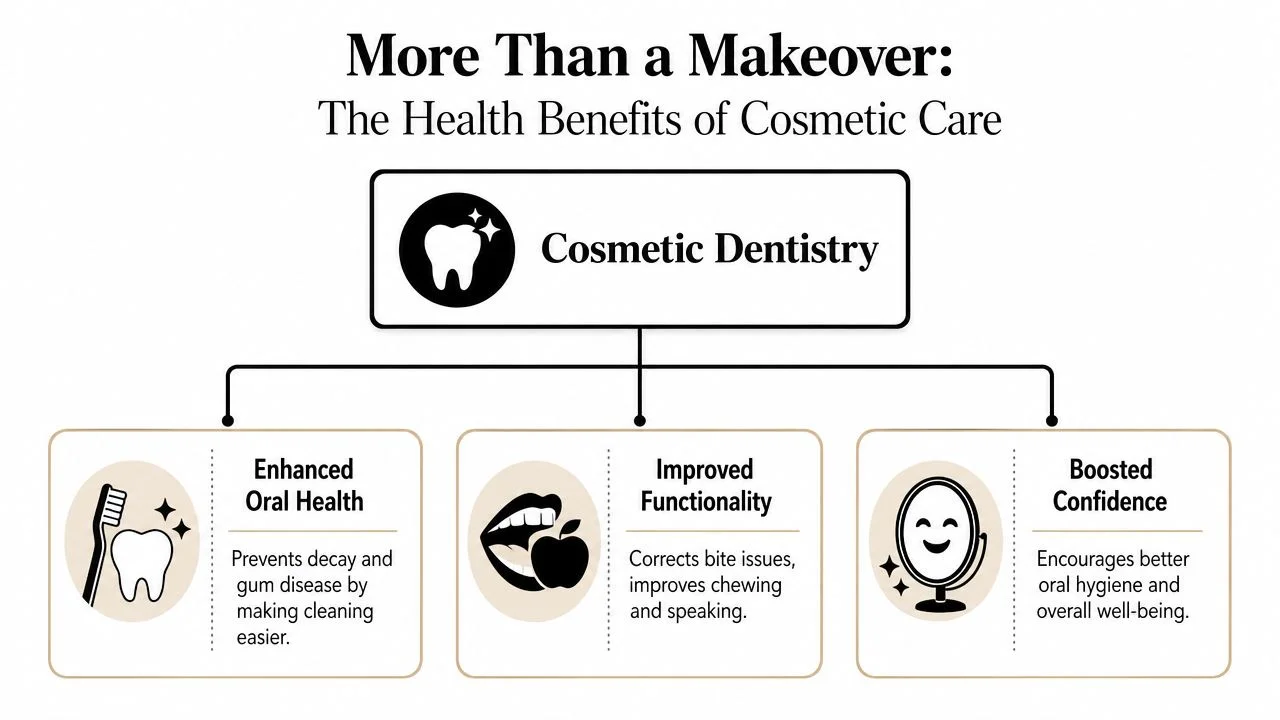
Better form often supports better function
Straightening crowded teeth with aligners can help some patients clean more effectively around overlaps and tight contact points. Restoring worn or broken teeth with crowns can improve the way biting forces are distributed. Replacing missing teeth with implants can help maintain chewing balance. None of those outcomes are just cosmetic.
That's why treatment planning shouldn't stop at "What looks nicest?" It should also include practical questions about durability, maintenance, and how your teeth function together when you chew and speak.
Clinical perspective: The right cosmetic result should feel comfortable in daily life. If it looks good but chips, traps food, or throws off the bite, it wasn't planned well enough.
Confidence matters because behavior matters
The emotional effect of cosmetic treatment is real, and it can influence how people care for their mouths. About 85% of patients report increased confidence after teeth whitening, and veneers may last 10 to 30 years, according to Loud Family Dentistry's review of cosmetic dental treatment statistics. When people feel better about their smiles, they often become more engaged in maintaining them.
This video offers another helpful look at how smile improvements can affect daily comfort and confidence.
Why this matters beyond appearance
A cosmetic plan can support oral well-being in several ways:
- Easier cleaning through improved tooth alignment or smoother restorative contours
- Stronger chewing function when damaged teeth are reinforced or missing teeth are replaced
- More predictable maintenance when treatment is chosen with longevity in mind
- Greater confidence that can make smiling, speaking, and social interaction feel less guarded
Patients sometimes worry that cosmetic care is frivolous. In reality, many treatments sit at the intersection of appearance, comfort, and long-term health. The healthiest smile is often the one that also looks balanced and natural.
Choosing Your Cosmetic Dentist in Walnut Creek
Choosing a Walnut Creek cosmetic dentist shouldn't come down to who offers the longest menu of services. It should come down to how carefully that dentist evaluates your mouth, your goals, and the trade-offs of each option. Cosmetic treatment is personal, but it also has technical consequences. The plan has to work in real life.
Questions worth asking at a consultation
A useful consultation should help you understand not only what can be done, but also what should be done first. Ask questions that reveal how the dentist thinks.
Consider asking:
- What is the most conservative option if you want improvement without unnecessary tooth reduction
- How will this affect my bite if you're considering veneers, crowns, or larger cosmetic changes
- What maintenance will this require over time
- How will this treatment interact with older fillings, crowns, or gum issues
- Can treatment be staged if you want to spread out time, cost, or appointment length
A dentist who welcomes those questions is usually planning carefully.
Look for function, not just appearance
Expert guidance notes that cosmetic and restorative dentistry often overlap, and that treatment plans should balance appearance with bite function, durability, and maintenance, as described in this discussion of cosmetic dentistry and long-term oral health. That matters because a cosmetic result isn't successful if it looks good on day one but creates problems later.
When evaluating a provider, look for signs of disciplined planning:
- Clear explanations of why one option fits better than another
- Attention to enamel preservation when discussing veneers or reshaping
- Real discussion of maintenance instead of promising a one-time fix
- Comfort planning for anxious patients who may need shorter visits or sedation support
The right dentist won't push you toward the biggest treatment plan. They'll explain the smallest plan that can reliably solve the problem.
Comfort and communication matter more than people think
Many patients delay cosmetic care because they associate dentistry with loss of control. A strong cosmetic dentist addresses that directly. That means listening well, outlining each step in plain language, and adapting care for nervous patients instead of treating anxiety as an inconvenience.
Experience matters here too. A seasoned dentist is usually better at recognizing when a simple option will work, when a more complex plan is justified, and when a patient's expectations need adjustment. That's especially important for adults balancing cosmetic goals with old dental work, busy schedules, or fear of treatment.
Your Comfortable and Clear Treatment Journey
Most patients feel calmer when they know what will happen next. Cosmetic treatment doesn't have to feel open-ended or mysterious. A predictable process, explained clearly, lowers stress before treatment ever begins.
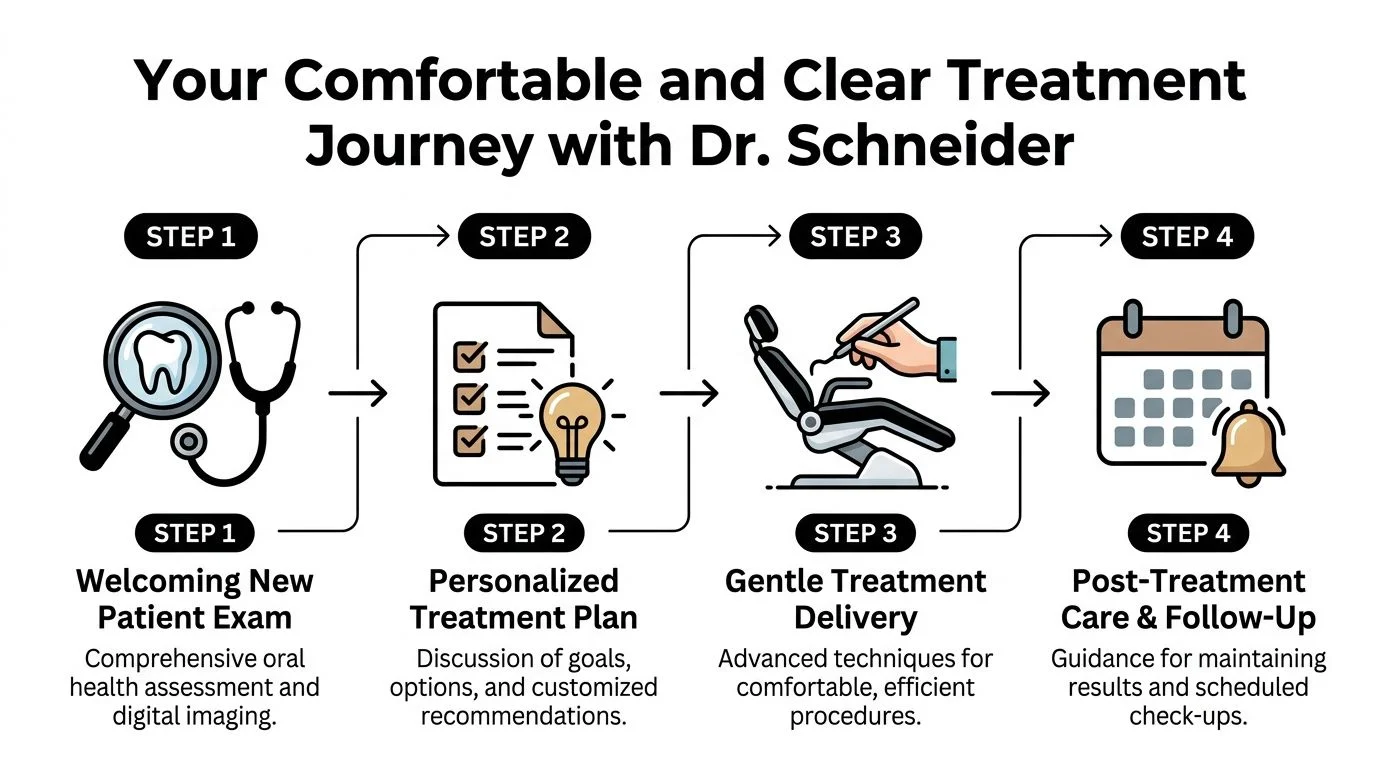
Step one and step two
The process usually starts with a conversation, not a procedure. You come in for a new patient exam or cosmetic consultation, explain what bothers you, and discuss whether the issue is mainly color, shape, spacing, wear, or a missing tooth. That sounds simple, but it's where good planning begins.
From there, records are gathered so the plan is based on your actual anatomy rather than guesswork. Modern tools like digital impressioning can help plan treatment with precise full-arch information and allow a preview of the proposed smile outcome, as described by Walnut Creek Aesthetic Dentistry's explanation of digital impressioning and smile preview tools. This is especially helpful when discussing aligners, veneers, crowns, or multi-step treatment.
Step three feels better when expectations are clear
Once the plan is set, treatment can often be broken into manageable phases. That's important for patients who are anxious, busy, or trying to keep care minimally invasive. Some people do best starting with whitening or bonding. Others need to correct alignment first so later cosmetic work is more conservative.
At William M. Schneider, DDS, patients can expect a process built around exam findings, comfort preferences, and realistic sequencing. That may include painless injection techniques, clear explanations before each step, and sedation options when appropriate.
Anxiety usually drops when patients know three things: what will happen, how long it will take, and what sensations to expect.
Step four protects the result
The final stage isn't just the reveal. It's maintenance. Cosmetic dentistry lasts longer when follow-up is handled seriously. That means checking the bite, reviewing cleaning habits, watching for wear, and making sure restorations or aligner results are holding as intended.
A simple treatment journey often looks like this:
Initial visit and diagnosis
A full exam identifies the underlying cause of the cosmetic concern and screens for decay, gum issues, worn fillings, or bite problems.Personalized planning
The dentist outlines options, explains trade-offs, and sequences treatment in a way that fits your goals and schedule.Gentle delivery
Appointments are kept as efficient and comfortable as possible, with attention to anxiety reduction and minimally invasive choices where appropriate.Ongoing maintenance
You receive guidance on keeping the result stable, whether that means hygiene visits, retainers, night protection, or routine monitoring.
For patients searching for a dentist in Walnut Creek, CA, this kind of structure matters. It replaces uncertainty with a plan you can follow.
Understanding the Investment in Your Smile
Cosmetic dentistry costs vary because treatment plans vary. A simple whitening case is different from veneers. A single crown is different from rebuilding worn teeth. Invisalign has different planning demands than bonding or implant treatment. That's why an accurate fee can only come from an exam and a personalized plan.
What affects cost most
Several factors tend to shape the investment:
- Treatment type such as whitening, aligners, veneers, crowns, or implants
- Case complexity including bite issues, existing restorations, and gum health
- Materials used and the amount of customization required
- Number of visits and whether care is staged over time
- Need for supporting treatment before cosmetic work begins
Patients sometimes focus only on the starting fee, but long-term value matters more. A cheaper option that stains quickly, breaks, or doesn't fit the bite can cost more in maintenance and frustration. A better plan is one that fits your goals and holds up.
For a practical discussion of the factors that influence pricing, this page on how much cosmetic dental cost can vary by treatment plan is a useful starting point.
What to expect financially
A well-run office should give you a clear written estimate before treatment starts and explain what is included. If a case is being staged, you should also know which part comes first and why.
Many patients also want to explore financing or phased care. That's reasonable. Cosmetic treatment is often easier to manage when the sequencing is deliberate and transparent, rather than rushed into one large plan.
Begin Your Smile Transformation with Dr Schneider
A healthier, more attractive smile doesn't have to begin with a major overhaul. It can start with one conversation, one exam, and one practical decision about what would help you most right now. For some people, that's whitening. For others, it's Invisalign, a crown, or a plan to replace a missing tooth. The right approach is the one that improves your smile while respecting your comfort, timeline, and long-term oral health.
If you've been putting off cosmetic care because you're worried about pain, pressure, or committing to too much treatment, it's worth having the discussion. Conservative options exist, and a thoughtful cosmetic plan can often be staged in a way that feels manageable.
You can visit the office at 1855 San Miguel Dr., Suite 31, Walnut Creek, CA. If you're ready to take the next step, scheduling a consultation is the easiest way to find out what fits your goals.
If you're looking for gentle, practical cosmetic care in Walnut Creek, William M. Schneider, DDS offers consultations for patients who want to improve their smiles with clear guidance, modern treatment options, and an anxiety-aware approach.