Finding a new dentist usually starts with a practical problem. You moved to Walnut Creek, your old office no longer fits your schedule, your child is due for a checkup, or a small tooth issue has started to feel too important to ignore. In that moment, individuals aren't just searching for a name. They're looking for a place that feels competent, calm, and consistent.
That's what matters in a walnut creek family dentist. You want a practice that can handle routine cleanings and exams, help when a tooth hurts, talk clearly about treatment options, and make the process feel manageable for every member of the family. You also want to know that if your needs change over time, you won't have to start over with a different office.
In Walnut Creek, families and working professionals often want the same basic things from dental care. They want fewer surprises, more comfort, and a long-term relationship with a dentist who pays attention to details. That combination is what turns a one-time visit into a real dental home.
Your Trusted Family Dentist in Walnut Creek CA
If you've been typing dentist near me or dentist in Walnut Creek, CA into a search bar, you're probably weighing more than location. You're deciding who you can trust with your health, your time, and your comfort. That decision gets even more important when you're choosing for children, a spouse, or aging family members as well as yourself.

A strong family practice does more than fill cavities. It helps patients stay ahead of problems, understand what's happening in their mouths, and get treatment that fits real life. That means balancing prevention with restoration, paying attention to comfort, and creating a setting where questions are welcomed instead of rushed.
What people are usually looking for
Most new patients who are looking for a walnut creek family dentist are trying to solve one of these issues:
- Routine care that stays on track so cleanings, exams, and dental x-rays don't keep getting postponed.
- A more personal experience after feeling like they were processed too quickly at a larger office.
- One place for many needs, including children's visits, restorative dentistry, cosmetic improvements, and urgent concerns.
- A gentler approach because dental anxiety, sensitive teeth, or past treatment experiences have made visits harder than they should be.
Those needs are reasonable. They're also connected. When a practice makes routine care easier and more comfortable, patients are more likely to come in consistently. That consistency is what helps prevent small concerns from becoming painful or expensive ones.
Practical rule: The right dental home should make preventive care simple and treatment decisions clear. If an office doesn't do that, even good dentistry can feel difficult to maintain.
In Walnut Creek, family dentistry works best when it's built around relationships, not just procedures. Patients remember whether a team listened, explained the trade-offs, and respected their concerns. That kind of care supports long-term oral health far better than quick fixes alone.
Meet Dr. William M. Schneider and Our Team
Experience matters in dentistry, but experience by itself isn't enough. Patients need skill, yes, but they also need calm communication and a team that knows how to make a visit feel less intimidating. That mix of expertise and bedside manner is often what people notice first once they're in the chair.
Dr. William M. Schneider brings more than 25 years of experience to patient care, with education from the University of Minnesota and advanced AEGD training in San Francisco. That background supports a broad scope of care, from preventive dentistry to restorative and cosmetic treatment, while keeping the focus on practical outcomes for real patients.

What that looks like in daily practice
A seasoned dentist usually recognizes a pattern quickly. A cracked tooth that doesn't hurt yet. Early gum irritation that could become a larger issue. Bite wear that points to grinding, clenching, or airway concerns. Clinical judgment helps, but the true value is knowing when to treat now, when to monitor, and when a conservative approach makes more sense.
That's where patients often feel the difference between a transactional visit and a relationship-based one. Good care isn't just about what can be done. It's about what should be done first, what can wait, and what will give you the most stable result over time.
The team sets the tone
Dental offices don't feel welcoming by accident. The front desk, assistants, hygienists, and clinical team shape the experience from the first phone call onward. A friendly team can reduce tension before treatment even begins, especially for new patients or anyone who has avoided care for a while.
Patients rarely judge a dental visit on technical quality alone. They remember whether they felt heard, whether the explanation made sense, and whether the room felt calm.
That's especially important in family dentistry. Children learn how to feel about oral health from the way adults around them present it. Busy professionals need efficient visits with straightforward planning. Older adults may need more discussion around comfort, function, and maintenance. A team-centered practice can adapt without making patients feel rushed.
Comprehensive Dental Services for Your Entire Family
The most useful family dental practice is one that can handle ordinary care well and respond appropriately when things become more complicated. That range matters because mouths change over time. A child may need preventive support. An adult may need a crown. Someone else may want cosmetic dentistry or help replacing a missing tooth.
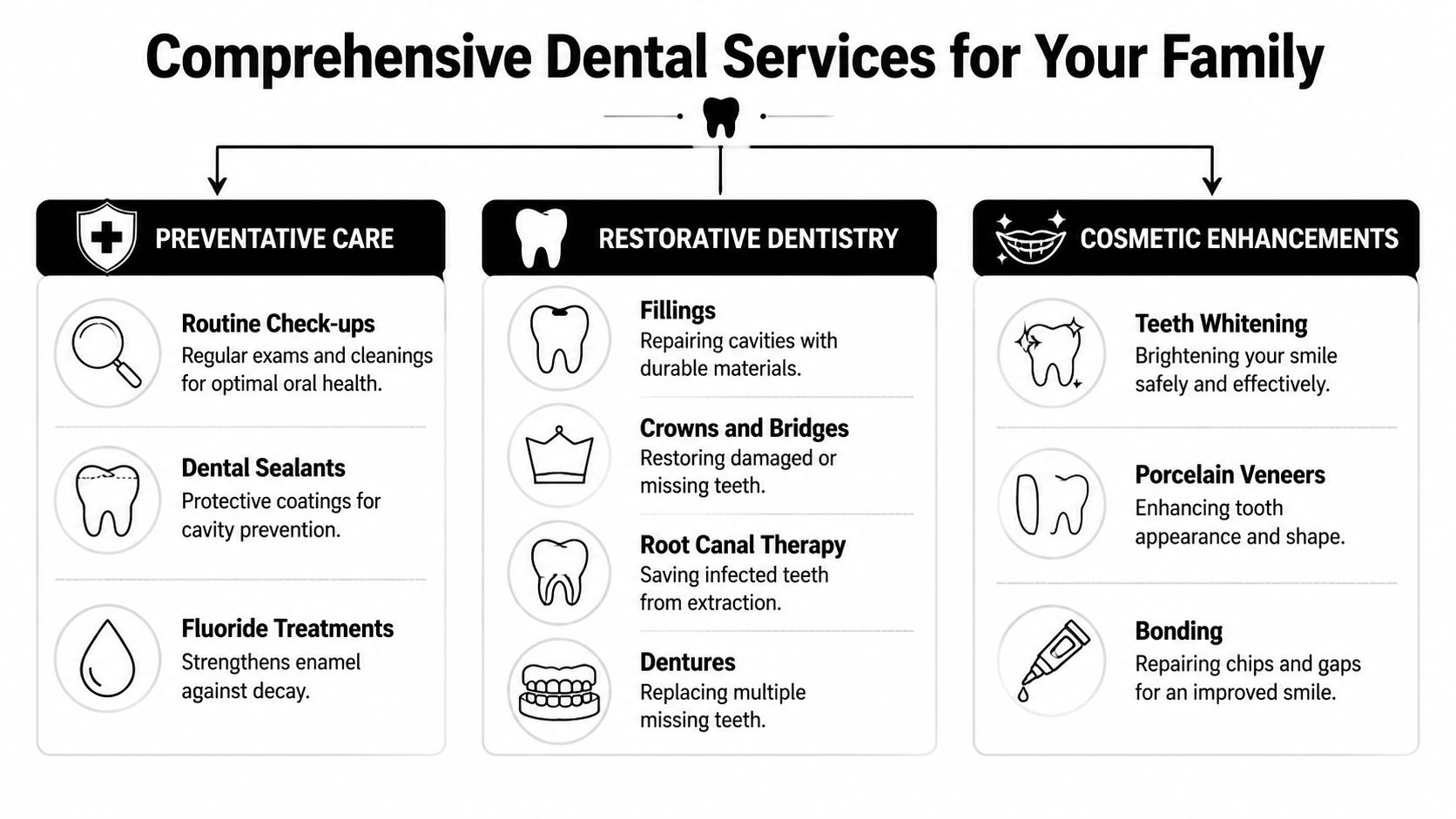
A broad-service model helps families stay in one familiar environment instead of bouncing between multiple offices for basic needs. It also gives the dentist a better long-term view of your oral health, which improves treatment planning and helps reduce fragmented care.
Preventive care that keeps small issues small
Preventive dentistry is still the foundation. Cleanings and exams aren't just checklist appointments. They're the visits where early decay, gum inflammation, bite changes, and soft tissue concerns are often identified before they become larger problems.
Common preventive services include:
- Cleaning and exams that remove buildup, review gum health, and catch developing issues early.
- Dental x-rays when needed to check areas that can't be evaluated fully with a visual exam alone.
- Fluoride and sealants for patients who benefit from extra protection against decay.
- Home care coaching that helps patients improve brushing, flossing, and maintenance habits without overcomplicating things.
One of the biggest trade-offs in dentistry is that prevention doesn't always feel urgent. Restorative treatment usually does. But the offices that protect long-term oral health well are the ones that don't let prevention drift to the sidelines.
Here's a closer look at how a full-service family practice is often organized:
Restorative dentistry that protects function
Restorative care becomes important when a tooth is damaged, infected, weakened, or missing. The goal isn't only to remove pain. It's to restore chewing, speech, bite balance, and day-to-day comfort.
A practical way to think about common restorative options is this:
| Concern | Common treatment | Why it helps |
|---|---|---|
| Small to moderate decay | Fillings | Seals the tooth and stops further breakdown |
| Larger damage or fracture | Crowns | Reinforces structure and helps the tooth function normally |
| Infection or deep inflammation | Root canal therapy | Preserves the tooth when the nerve is compromised |
| Missing teeth | Bridges, dentures, or dental implants | Restores function and reduces shifting or bite problems |
If you need a tooth extraction, that decision should be made carefully. Extraction can be the right treatment when a tooth can't be predictably saved, but preserving natural teeth is usually preferable when the outlook is good. Good dentists don't rush that call.
Cosmetic and general services under one roof
Cosmetic dentistry works best when it's tied to oral health, not separated from it. Teeth whitening, Invisalign clear aligners, bonding, and other aesthetic options can improve confidence, but they should also respect bite function, gum health, and maintenance.
General family practices may also help with concerns that patients don't always expect to discuss at the dentist, including:
- Gum disease care for bleeding, tenderness, recession, or deeper periodontal concerns
- Sleep apnea solutions when oral appliance therapy may be appropriate
- Pediatric dental care for children who need a positive start with routine visits
- Emergency dentist care for pain, swelling, trauma, or a broken tooth that can't wait
William M. Schneider, DDS provides preventive, restorative, and cosmetic services, including Invisalign, whitening, implants, crowns, bridges, root canals, and care for gum disease and sleep apnea through the practice website at William M. Schneider, DDS.
A Gentle Approach to Ease Dental Anxiety
Many people who avoid the dentist aren't ignoring their health. They're protecting themselves from an experience they expect to be uncomfortable, embarrassing, or overwhelming. That fear can come from pain during past treatment, feeling rushed, hearing sounds they dislike, or not knowing what's going to happen next.
That's why a gentle approach isn't a luxury. It's a clinical advantage. When patients feel safer, they communicate more clearly, tolerate treatment better, and are more likely to return before problems become emergencies.

What actually helps anxious patients
Anxiety reduction works best when it's practical rather than performative. Patients usually respond well to a few specific things:
- Painless injection techniques that reduce one of the most feared parts of treatment.
- Clear explanations given before and during care, so nothing feels sudden or confusing.
- A slower pace when needed for patients who need breaks or want to understand each step.
- Sedation options when appropriate for people whose anxiety would otherwise keep them from getting care.
These details matter because fear often grows in silence. If a patient doesn't know what sensation to expect, even normal pressure can feel alarming. If a patient feels trapped, even a short visit can feel long. Good communication changes that.
Comfort is part of quality
A calm environment doesn't replace good clinical dentistry. It supports it. Patients who feel respected are more likely to say when they're getting numb slowly, when they need a pause, or when they're worried about a recommendation. That information helps the dentist adjust treatment in real time.
Some anxious patients don't need sedation. They need predictability, patience, and a team that doesn't minimize what they're feeling.
If dental fear has kept you from making an appointment, practical support can make the first step much easier. The guidance on how to overcome dental anxiety is useful because it focuses on preparation, communication, and realistic ways to make care feel more manageable.
Transform Your Smile with Cosmetic and Implant Dentistry
People usually seek cosmetic or implant treatment for one of two reasons. Something about their smile bothers them every day, or a missing tooth has started to interfere with chewing, confidence, or both. Sometimes those concerns overlap. A patient may want straighter teeth, a brighter smile, and a more stable bite at the same time.
The important thing is not to treat appearance and function as separate topics when they aren't. Cosmetic care lasts better when the bite is stable and the gums are healthy. Implant care succeeds best when the final result also looks natural and feels comfortable.
Cosmetic dentistry that looks like you
The best cosmetic work rarely looks obvious. It looks healthy, balanced, and appropriate for the person wearing it. That's why treatment planning matters more than trend-driven smile makeovers.
Patients looking for a cosmetic dentist near me are often considering options like:
- Teeth whitening for stains that make the smile look tired or older than it is
- Invisalign clear aligners for crowding, spacing, or mild bite concerns
- Bonding or veneers when shape, chips, edges, or symmetry affect appearance
- Crowns in visible areas when both strength and aesthetics matter
The trade-off in cosmetic care is that faster isn't always better. Whitening may be simple, but alignment or shape changes need planning. A result that looks good in a mirror but creates bite stress later isn't a real success.
Cosmetic dentistry should improve confidence without creating new maintenance problems. That usually means choosing the most conservative option that will still achieve the goal.
Dental implants and long-term tooth replacement
For patients searching dental implants near me, the underlying question is usually broader than the implant itself. They want to know whether the replacement will feel stable, look natural, and let them chew comfortably again.
Dental implants are a strong option for many adults because they replace a missing tooth without relying on adjacent teeth the way some bridge designs do. They can also help support function and reduce some of the changes that happen when a gap is left untreated. Still, they aren't automatically the right answer for every patient. Bone support, gum health, bite forces, and healing capacity all matter.
When restoration and appearance meet
Implant and cosmetic cases often overlap with restorative dentistry. A patient may need to replace an old crown, restore a worn bite, or decide between saving a compromised tooth and extracting it. These aren't purely cosmetic decisions. They involve lifespan, comfort, maintenance, and overall oral health.
A thoughtful consultation should sort through questions like these:
- Is the main issue color, position, shape, or structure
- Can the tooth be preserved predictably
- Would orthodontic movement improve the final result before cosmetic work
- If a tooth is missing, is an implant, bridge, or removable option the most practical fit
That kind of planning leads to smiles that don't just photograph well. They function well too.
Your First Visit and New Patient Information
For many new patients, the hardest part is not the treatment. It's the uncertainty before the first appointment. People want to know what will happen, how long it will take, whether their concerns will be heard, and what comes next if something needs attention.
A well-run first visit should answer those questions clearly. It should also gather enough information to create a treatment plan that makes sense instead of jumping straight to a procedure.
What to expect at the beginning
When a new patient arrives, the goal is to establish a useful baseline. That usually means reviewing health history, discussing concerns, evaluating the teeth and gums, and looking at the bite and supporting structures carefully enough to make informed decisions.
At Walnut Creek Family Dentistry, the first visit is described as about 1.5 hours and includes a detailed oral exam, with a complete cleaning if the patient doesn't have gum disease, along with digital photography, digital radiography, a head-and-neck exam, occlusion assessment, oral cancer screening, and oral-hygiene instruction on the practice's new patient information page.
That kind of appointment structure is useful because it separates routine preventive care from cases that need periodontal therapy or a different sequencing of treatment. It also gives patients a clearer picture of what's healthy, what needs attention, and what can wait.
Practical details that reduce friction
The first visit tends to go better when a few logistics are easy:
- Insurance coordination so patients understand benefits and expected coverage as clearly as possible
- Online forms or appointment access that reduce paperwork stress
- Convenient payment options for treatment that may be completed over time
- A personalized plan that prioritizes health needs while respecting budget and schedule realities
The page for new patients at William M. Schneider, DDS is a helpful starting point for understanding how to schedule and prepare.
What doesn't work well
Patients often feel frustrated when a first appointment is either too minimal or too rushed. A quick polish without a real diagnosis may feel pleasant in the moment, but it can delay appropriate care. On the other hand, a long list of recommendations without context can feel overwhelming.
A good first visit should leave you with three things: a clear understanding of your current dental health, a realistic treatment sequence if work is needed, and confidence that the office is listening to your priorities.
Why Walnut Creek Families Choose Our Dental Practice
Families don't stay with a dentist for years because of a single good visit. They stay because the office becomes reliable. The care feels consistent. Questions get answered. Small concerns are taken seriously before they become bigger ones. That kind of trust builds gradually, and it's what gives family dentistry its value.
In Walnut Creek, that trust often comes down to a simple combination. People want experienced clinical care, a full range of services, and an environment that doesn't make them dread the appointment. When those elements come together, routine visits become easier to keep, restorative decisions become easier to understand, and long-term oral health gets better support.
What families tend to value most
Some priorities come up again and again:
- Continuity of care so your dentist understands your history instead of starting from scratch every time
- Comfort-focused treatment for children, busy adults, and anxious patients alike
- Extensive services that reduce the need to coordinate basic care across multiple offices
- Thoughtful planning that respects both health needs and everyday practical realities
The strongest family practices also know that convenience matters, but convenience alone isn't enough. Patients want a dentist who can explain trade-offs transparently. Sometimes the right answer is a conservative repair. Sometimes it's a crown, root canal, extraction, or implant. Good care means choosing the option that fits the tooth, the patient, and the long-term outlook.
A dependable dental home should make you feel less uncertain after the appointment than you did before it.
If you've been looking for a walnut creek family dentist who combines experience, compassionate care, preventive focus, cosmetic options, and restorative solutions, the next step is simple. Schedule a visit, ask your questions, and see whether the office feels like the right long-term fit for you and your family.
If you're ready to find a dental home in Walnut Creek that supports comfort, prevention, and long-term oral health, schedule a visit with William M. Schneider, DDS.