You wake up after what should have been a full night of sleep, but your head feels heavy, your mouth is dry, and your energy is already gone before the day starts. Maybe your partner keeps telling you that your snoring is getting worse. Maybe you already tried a CPAP machine and found that the mask, tubing, noise, or overall hassle made it hard to stick with.
That situation is common in adults looking for answers in Walnut Creek, CA. Sleep apnea can affect your focus at work, your mood at home, and your long-term health in ways that go far beyond snoring. It also leaves many people searching online for a dentist near me, a dentist in Walnut Creek, CA, or a provider who can offer a more comfortable solution than a bedside machine.
A dental appliance for sleep apnea can be that solution for the right patient. At William M. Schneider, DDS, care is built around comfort, clarity, and practical treatment planning. For patients who also need ongoing dental care, cleaning and exams, dental x-rays, new patient exams, restorative dentistry, cosmetic dentistry, or even help with concerns that may later involve tooth extraction, dental implants near me, cosmetic dentist near me, or an emergency dentist, it can be helpful to have one local office that understands both oral health and sleep-related treatment.
Tired of Being Tired? A Sleep Apnea Solution in Walnut Creek
Some patients reach this point slowly. They notice they're falling asleep on the couch earlier. They need more coffee to get moving. Their partner complains about loud snoring, then starts talking about pauses in breathing that sound frightening. Others hit a wall after trying CPAP and realizing they just can't sleep naturally with a mask on.
That's often when they start looking for a local answer that feels more realistic. In Walnut Creek, CA, many adults want a treatment that fits into normal life. They want something quiet, portable, and easier to tolerate night after night.
A custom oral appliance can fill that role. It's not a gadget bought off a shelf. It's a professionally fitted device worn during sleep to help keep the airway open. For the right person, that can mean less snoring, better rest, and a treatment they'll use.
Sleep apnea treatment only helps when it becomes part of your real routine at home, not just something that looks good in theory.
For patients who are also choosing a long-term dental home, this matters. They may already be searching for a dentist near me or a dentist in Walnut Creek, CA because they want one office that can handle preventive care and more advanced needs with the same thoughtful approach. Sleep apnea care fits naturally into that kind of practice when the process is handled carefully and followed over time.
Why local care makes a difference
Sleep apnea treatment isn't one appointment and done. It usually involves communication with a sleep physician, a review of your diagnosis, a close look at your teeth and jaw, a custom fitting, and later adjustments. That follow-through is easier when your care happens close to home in Walnut Creek.
Patients also appreciate having one office where comfort is already part of the experience. That matters whether you're coming in for a sleep appliance, a routine exam, teeth whitening, or restorative work.
Understanding Obstructive Sleep Apnea and Its Health Risks
A common Walnut Creek sleep apnea story starts at home. A bed partner notices loud snoring, long pauses in breathing, or gasping during the night. The patient usually notices something different. Dry mouth in the morning, headaches, poor focus, and the feeling that a full night of sleep never really restored them.
Obstructive sleep apnea happens when the airway repeatedly narrows or closes during sleep. The throat muscles relax, the tongue and soft tissues fall back, and airflow drops or stops until the brain briefly pushes the body to breathe again. Many patients never remember those interruptions, but their bodies feel the effects the next day.
That repeated strain is the problem.
Snoring may be the symptom that gets attention first, but the health concern goes far beyond noise. Untreated obstructive sleep apnea is linked with daytime sleepiness, mood changes, trouble concentrating, and a higher burden on the heart and blood vessels, as explained by the National Heart, Lung, and Blood Institute overview of sleep apnea. Some patients also notice irritability, reduced work performance, or a greater risk of drowsy driving. Others come in because a spouse is worried, then realize their own fatigue has been building for years.
Diagnosis comes before dental treatment. That matters because snoring alone does not confirm sleep apnea, and not every patient with fatigue has an airway disorder. A sleep physician or primary care physician helps establish the diagnosis with a sleep study, then the dental side of care begins if oral appliance therapy is appropriate.
In practice, that partnership matters a great deal. The physician identifies the sleep disorder and its severity. The dentist evaluates whether the teeth, gums, jaw joints, and bite can safely support an appliance, then adjusts treatment over time so it stays both effective and wearable. Patients who want a clearer picture of the medical risks can review these complications of untreated sleep apnea.
This is also where expectations need to be realistic. A dental appliance can be an excellent option for the right patient, but it is not merely a response to snoring. It is a medically guided treatment used after diagnosis, with follow-up to confirm that breathing and sleep are improving.
From the dental side, the exam is very specific. We look at jaw position, tooth support, gum health, signs of grinding, and any history of TMJ pain because those details affect comfort, fit, and long-term success. Patients often appreciate having this done in the same local office where they already receive routine preventive and restorative care, because sleep treatment works best when follow-up is close at hand and easy to maintain.
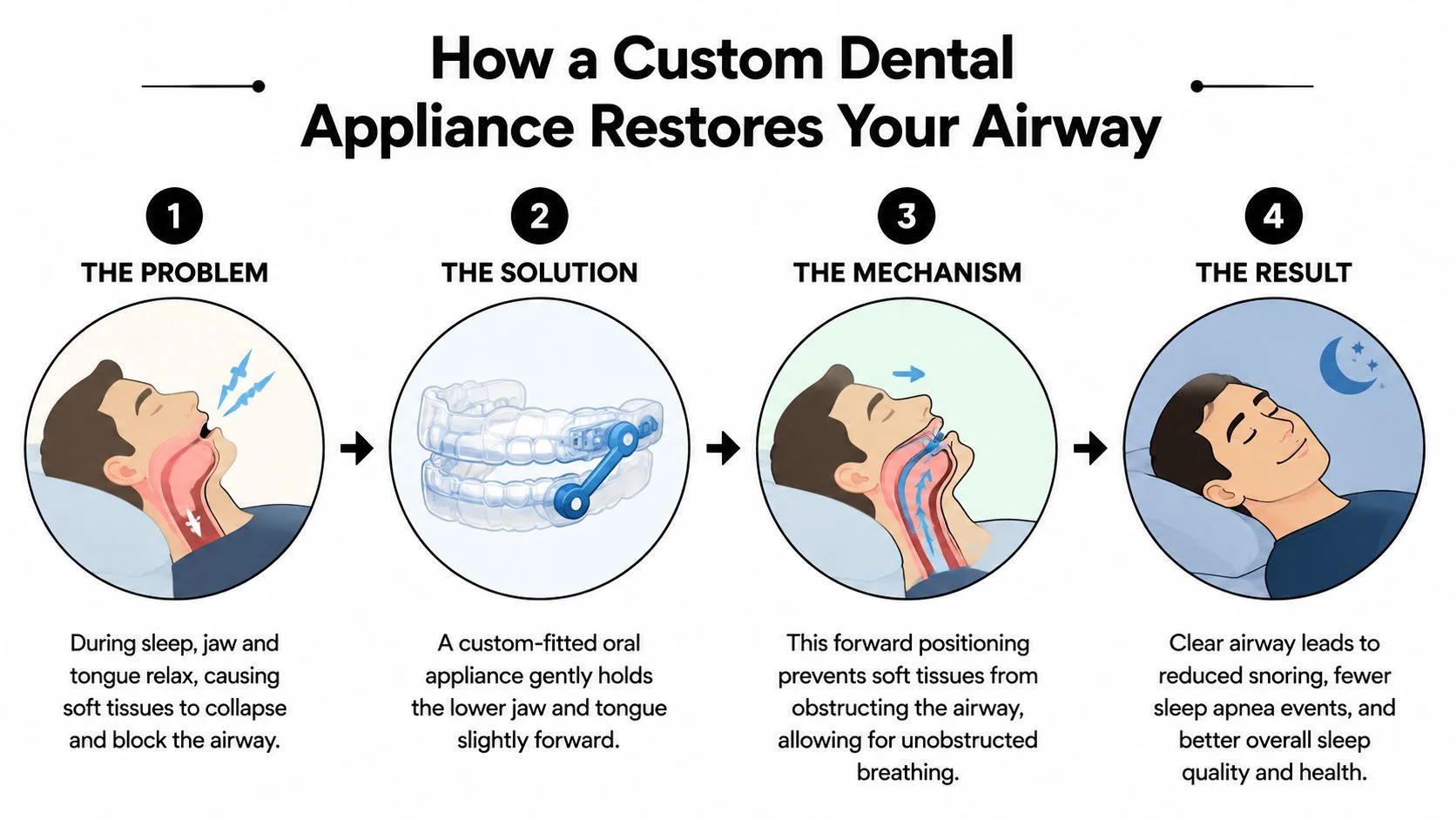
How a Custom Dental Appliance Restores Your Airway
A dental appliance for sleep apnea usually works by moving the lower jaw slightly forward during sleep. That small shift helps create more room behind the tongue and reduces the chance that soft tissues will block airflow. This effectively maintains an open passage. The device doesn't force the airway open with air pressure. It supports the anatomy so collapse is less likely.
The most common option is a mandibular advancement device, often shortened to MAD. It's custom made to fit your teeth and adjusted in small increments to find a position that balances comfort and effectiveness.
What the device is actually doing
Custom-made, titratable MADs are the clinically recommended type because they allow gradual jaw advancement, and they work by pulling the jaw and tongue forward to help prevent airway collapse during sleep, as described in this clinical review on oral appliance therapy for obstructive sleep apnea.
That adjustability matters. A device that can be fine-tuned has a better chance of feeling wearable while still improving the airway. A one-size-fits-all solution usually doesn't offer that precision.
Custom appliance versus store-bought device
Patients sometimes ask about boil-and-bite mouthguards they see online. Those products may look similar at first glance, but they aren't the same as a medical sleep appliance fitted by a dentist.
Here's the practical difference:
- Custom fit: A professionally made appliance is fabricated from records of your bite and dental anatomy.
- Adjustability: It can be advanced gradually instead of forcing one fixed position.
- Monitoring: Your dentist checks comfort, fit, side effects, and whether the appliance is doing its job.
- Medical coordination: Treatment is based on a real diagnosis, not guesswork.
A store-bought device might feel like a shortcut, but shortcuts don't work well when the goal is safe, long-term airway management.
What patients often notice first
Many people first notice quieter nights. Bed partners notice it too. Some patients also report fewer disruptions in sleep quality and easier mornings once the appliance is dialed in.
Specific fully adjustable oral appliances such as the Klearway™ have shown a 77% success rate in treating patients with moderate obstructive sleep apnea, and temporary side effects such as salivation or dry mouth may occur during the first 1–2 weeks, according to this overview of oral appliances including Klearway™. The same source notes that this jaw- or tongue-forward mechanism is approved by the American Academy of Sleep Medicine as a valid treatment for OSA.
Comparing Your Options CPAP vs Oral Appliance Therapy
A patient in Walnut Creek often arrives at this decision after a frustrating stretch of poor sleep. They may already have a diagnosis from a sleep physician, maybe even a CPAP prescription, but they still need a treatment they can realistically use night after night. That is where the comparison becomes practical, not theoretical.
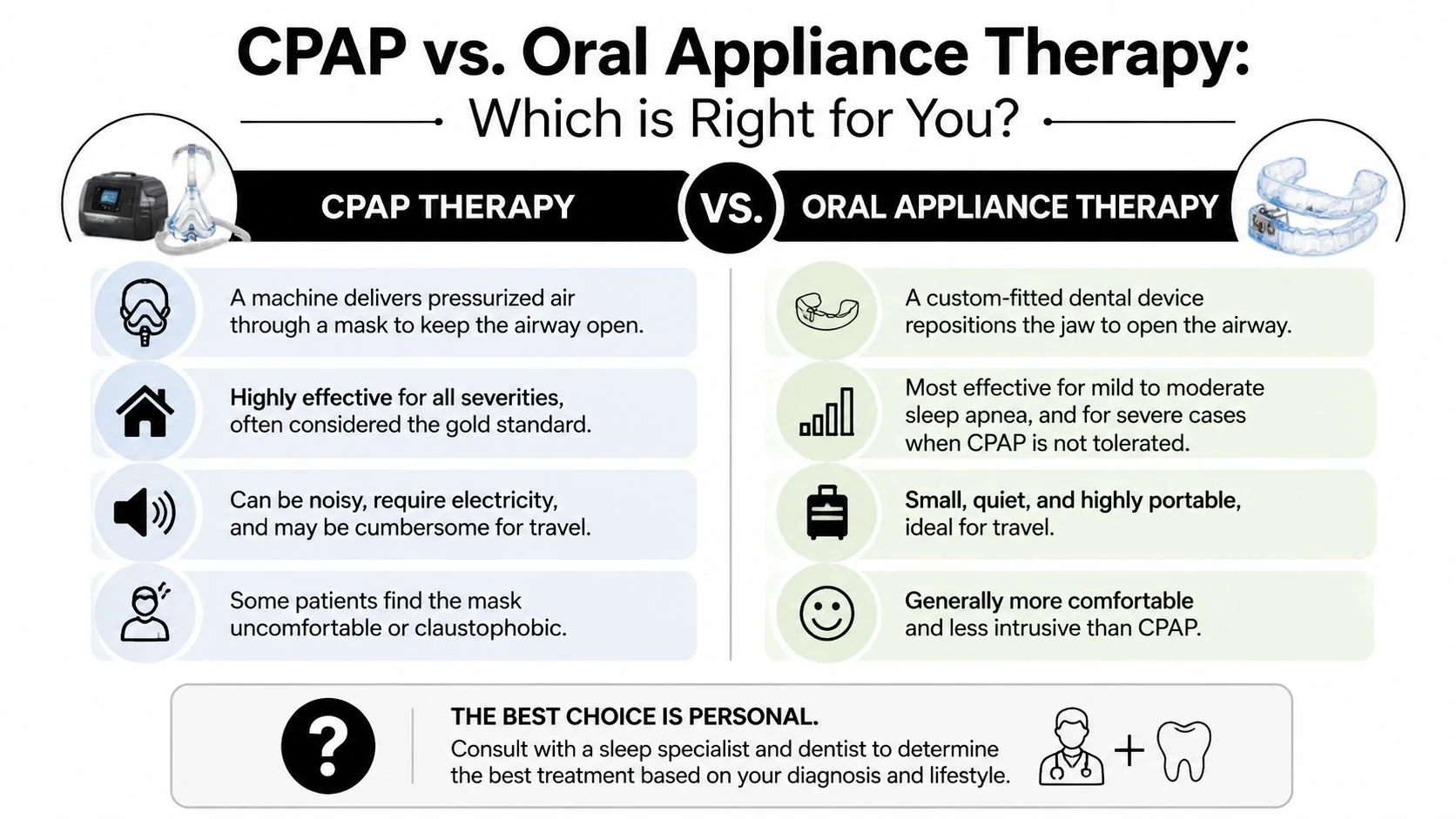
CPAP and oral appliance therapy both treat obstructive sleep apnea, but they do it differently. CPAP uses pressurized air through a mask to keep the airway open. An oral appliance repositions the lower jaw or tongue to reduce collapse during sleep. One approach is usually stronger at lowering breathing events in a sleep study. The other is often easier to wear consistently in daily life.
Side-by-side differences that matter at home
| Treatment | How it works | Everyday experience | Best fit |
|---|---|---|---|
| CPAP | Uses air pressure through a mask | Requires a machine, tubing, power, cleaning, and mask tolerance | Common across severity levels, especially when maximum AHI reduction is the main goal |
| Oral appliance | Repositions the jaw or tongue | Small, quiet, portable, and easier for many patients to sleep with | Often used for mild to moderate OSA, and for some severe cases when CPAP is not tolerated |
In practice, comfort matters because treatment only works when it is used.
The trade-off between efficacy and real-world use
CPAP is often the first recommendation because it can control airway obstruction very effectively. I still recommend it for many patients, especially those with more severe disease or oxygen drops that call for the strongest therapy available. But a technically effective treatment loses value if the mask comes off after an hour, sits unused during travel, or never becomes part of a patient's routine.
Oral appliance therapy earns its place in that gap between ideal treatment and realistic treatment. For the right patient, a custom device can be easier to accept, quieter, simpler to travel with, and less disruptive to a bed partner. That does not make it the automatic winner. It makes it a serious medical option that should be considered alongside CPAP, with the diagnosis, symptoms, airway pattern, and patient habits all taken into account.
What the research shows in moderate and severe cases
In moderate and severe OSA groups, CPAP reduces AHI to fewer than 5 events per hour in 71% and 63% of patients, compared with 51% and 40% for oral appliances. The same American Academy of Dental Sleep Medicine journal article reports that both treatments are similarly effective for improving daytime sleepiness, hypertension, and cardiovascular outcomes.
That difference is worth understanding clearly. CPAP often performs better on the sleep study metric. Oral appliance therapy can still produce meaningful health and quality-of-life benefits when patients wear it more reliably.
When oral appliance therapy is often the better fit
An oral appliance often makes sense when:
- CPAP is prescribed but not tolerated: Mask discomfort, pressure intolerance, dryness, or claustrophobia can make nightly use difficult.
- Sleep needs to feel less medicalized: Some patients rest better without a machine, tubing, and mask beside the bed.
- Travel is part of life: A compact appliance is easier to pack and simpler to use away from home.
- A bed partner is affected by noise or equipment: Oral appliances are silent and low profile.
- Care is being coordinated locally: A sleep physician can diagnose and monitor the medical side, while a dentist adjusts the appliance and manages fit, bite, and comfort over time.
Patients who want to review additional sleep apnea treatment alternatives can compare choices in more detail before scheduling a consultation.
Are You a Good Candidate for a Dental Sleep Appliance
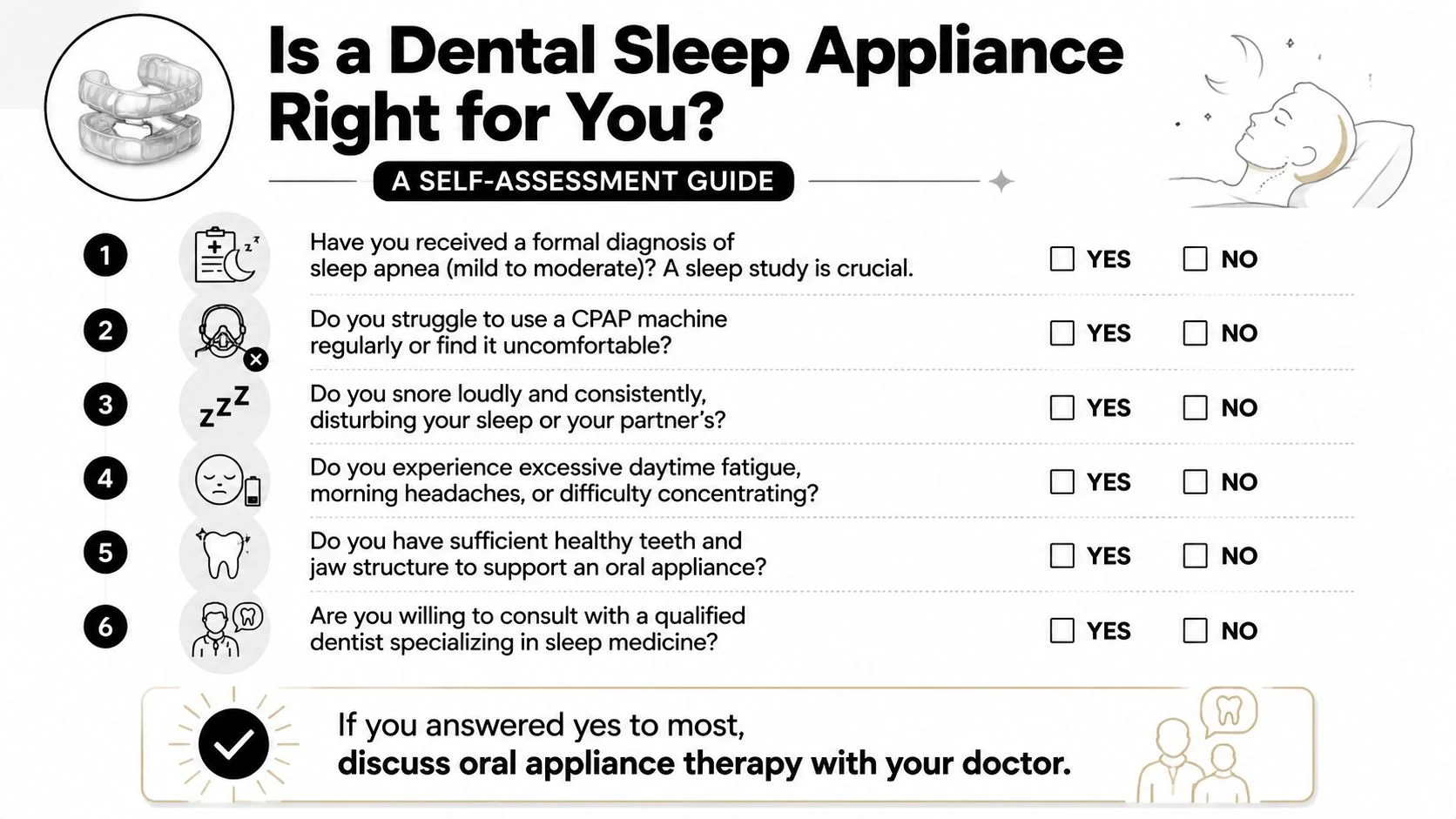
Candidacy starts with diagnosis. A dentist doesn't diagnose obstructive sleep apnea from symptoms alone. A physician and sleep study come first. Once that diagnosis is established, the dental side of the decision becomes clear: can your teeth, gums, bite, and jaw support a custom device safely and effectively?
That screening matters because an oral appliance depends on stable dental support. It isn't just about wanting an alternative to CPAP. It has to be an option your mouth can handle well.
The first questions to answer
Before an appliance is made, these are the usual starting points:
- Do you have a confirmed diagnosis? A sleep study identifies the type and severity of the problem.
- Are you trying to replace an intolerable CPAP setup? That often brings people to oral appliance therapy.
- Are your teeth and gums healthy enough? A device has to anchor securely and comfortably.
Dental requirements patients often don't know about
A key requirement for stable fabrication is having at least eight healthy teeth on each arch, upper and lower. Patients with implants can often still be treated, but people with insufficient teeth or severe temporomandibular disorders are generally not good candidates, based on this clinical discussion of oral appliance candidacy.
That point surprises a lot of people. They assume that if they have sleep apnea, they can request a device. In reality, the appliance has to fit your bite securely and distribute pressure in a way your mouth can tolerate.
If the dental foundation isn't stable, the appliance won't be stable either.
Who may need other dental work first
Some patients need preliminary care before moving forward. That can include treatment for gum disease, repair of damaged teeth, or broader restorative planning. In a full-service office, those concerns may overlap with services patients are already seeking, such as restorative dentistry, tooth extraction, or planning around dental implants near me if missing teeth affect appliance design.
For the right patient, though, oral appliance therapy can be an excellent fit, including some people with severe OSA who can't tolerate CPAP and need another medically guided option.
Your Treatment Journey at Our Walnut Creek Dental Office
The process usually begins with a conversation, not a gadget. You come in with a sleep study, a history of snoring or fatigue, and often a story about why your current treatment isn't working. From there, the dental side of sleep care becomes very practical.
Here's a look at the office environment where that process starts.
The first visit
At the initial appointment, your diagnosis is reviewed along with your symptoms, dental history, and any concerns about jaw discomfort, bite changes, or previous CPAP use. Your teeth, gums, existing dental work, and jaw function are examined carefully to make sure an oral appliance is a sound option.
This is also where the broader value of a full-service local office shows up. If a patient is overdue for cleaning and exams, needs updated dental x-rays, or is coming in as a new patient and wants one office for long-term care, those needs can be factored into the overall plan rather than treated as separate issues.
Digital records and custom fabrication
If you're a candidate, detailed records are taken so the appliance can be custom fabricated. Many patients are relieved to learn that modern workflows often rely on digital records instead of traditional messy impressions.
William M. Schneider, DDS provides custom oral appliances for sleep apnea as one dental treatment option within a practice that also offers preventive, cosmetic, and restorative care in Walnut Creek. That matters for patients who want continuity between sleep treatment and the rest of their oral health needs.
A typical sequence looks like this:
- Review the sleep diagnosis: The office confirms the medical findings and treatment goal.
- Examine the mouth and jaw: Teeth, restorations, bite, and jaw movement are evaluated.
- Capture records: Digital scans or other precise records are used to guide fabrication.
- Order the appliance: The custom device is made to fit your specific anatomy.
The fitting and adjustment phase
When the appliance returns, the fitting visit is focused and hands-on. The device is placed, checked, and adjusted so it sits securely and feels balanced. You're shown how to insert it, remove it, clean it, and store it properly.
This stage matters more than many patients expect. A dental appliance for sleep apnea is rarely a one-click solution. Small adjustments often improve comfort and help refine the jaw position over time.
A brief overview can help make that process feel less abstract.
Follow-up is where success is built
Follow-up visits are part of the treatment, not an optional extra. They allow the dentist to check fit, ask about side effects, refine the advancement if needed, and coordinate with the physician when confirmation of treatment effectiveness is appropriate.
Patients often appreciate that these visits are straightforward. They're not major procedures. They're fine-tuning appointments that help turn a custom device into a treatment you can live with comfortably.
For people already searching for a dentist in Walnut Creek, CA, especially one who can also help with cosmetic dentistry, teeth whitening, or future restorative needs, that continuity can make the whole process much easier.
Living with Your Appliance Maintenance Benefits and Risks
Once you've adjusted to the appliance, daily use tends to feel simple. You wear it at night, clean it in the morning, store it safely, and bring it to follow-up visits so fit and function can be checked. Most of the long-term success comes from consistency and a little routine care.
Daily maintenance that keeps it working well
A few habits make a big difference:
- Clean it every morning: Use the cleaning method your dentist recommends so plaque and odor don't build up.
- Store it in its case: That protects it from damage and helps it dry properly.
- Keep follow-up appointments: Small fit changes are easier to correct early.
- Report bite or jaw changes: Don't assume discomfort will always resolve on its own.
Because the device is custom made, it deserves the same attention you'd give to a retainer, nightguard, or other precision dental appliance.
What can happen during the adjustment period
Some side effects are temporary and manageable. Patients may notice jaw soreness, increased salivation, dry mouth, or mild gum irritation at first. Those early changes don't automatically mean the treatment is failing. They often mean the mouth is adapting to sleeping with a new device.
What matters is monitoring. If soreness persists or the bite starts to feel different in the morning, your dentist can evaluate whether the fit or level of advancement needs adjustment.
A good appliance should feel manageable. If it feels like a nightly struggle, it usually needs a reassessment, not more guesswork at home.
The benefits patients care about most
For many people, the first obvious win is quieter sleep. Snoring may improve, which helps both the patient and anyone sharing the room. Over time, the more meaningful benefit is often how the patient feels during the day: clearer thinking, steadier energy, and less frustration from interrupted sleep.
Oral appliances have an overall success rate of 54% when success is defined as reducing apnea and hypopnea events to fewer than 10 per hour, along with a 42% reduction in snoring frequency, according to this overview of oral device effectiveness.
That's why this treatment can have value beyond sleep itself. Better rest supports work, family life, mood, and the kind of daily comfort that people often don't realize they've been missing.
FAQs and Your Next Step to Better Sleep
Is a dental appliance only for mild cases
Not always. Oral appliances are commonly used as a first-line treatment for mild to moderate obstructive sleep apnea, and they can also be a valid alternative in severe cases when CPAP isn't tolerated.
Will it feel bulky
A custom appliance is usually much smaller and less intrusive than CPAP equipment. There is still an adjustment period, but most patients find it easier to incorporate into nightly life than a mask-and-machine setup.
Can I use one if I have implants
Often, yes. Implant patients can frequently be considered for treatment, but candidacy depends on the overall stability of the teeth, bite, and jaw.
What if I also need other dental work
That's common. Some patients need routine maintenance first. Others may already be looking for a cosmetic dentist near me, an emergency dentist, or help with restorative concerns before or during sleep appliance planning. A complete exam helps determine the right sequence.
A comfortable, medically guided path to better sleep is available locally in Walnut Creek. If snoring, fatigue, or CPAP frustration have been taking over your nights, the next step is a consultation where your diagnosis, oral health, and treatment options can be reviewed clearly.
If you're ready to explore a custom sleep apnea appliance and want care from a local practice that also provides complete dental services, contact William M. Schneider, DDS to schedule a consultation. The office serves Walnut Creek, CA with patient-focused care, and you can request your visit through the practice website or call for assistance with the next available appointment.