Full mouth restoration typically costs between $20,000 and $90,000 in the United States, depending on how complex your case is. For many people in Walnut Creek, that number feels overwhelming at first, but it helps to view it as an investment in long-term health, comfort, chewing ability, and confidence.
If you're reading this, there's a good chance you're tired of juggling several problems at once. Maybe one tooth broke, another is missing, older dental work is failing, and chewing on one side has become your normal. Many people start by searching for a dentist near me, a dentist in Walnut Creek, CA, or even dental implants near me because they want one clear answer instead of piecing together one small fix after another.
That frustration is real. So is the uncertainty around cost. The part that confuses patients most isn't only the treatment itself. It's trying to understand what they need, what it may include, and what they'll really pay out of pocket.
A full mouth restoration can help when teeth are broken, worn down, missing, infected, loose, or no longer working together properly. It can also help if you've had years of patchwork dentistry and you're ready for a more stable plan. In practical terms, this kind of care combines restorative dentistry, and sometimes procedures like tooth extraction, gum treatment, crowns, bridges, dentures, or implants, to rebuild how your mouth functions.
Your Path to a Healthy Smile in Walnut Creek
A patient in the East Bay recently described the experience this way. Breakfast had become a chore, smiling in work meetings felt awkward, and every new ache brought a new internet search. First it was emergency dentist. Then cosmetic dentist near me. Then questions about implants, crowns, and whether everything would have to be redone.
That pattern is common.
When several dental problems stack up, people often assume they have only two options. Either keep fixing one tooth at a time, or accept that the situation is too big and too expensive to handle. In reality, a well-designed restoration plan usually starts by organizing the problem, not by rushing into treatment.
Why daily function changes first
Full mouth issues don't stay cosmetic for long. Broken or missing teeth can change how you chew. Uneven bite pressure can make some teeth wear faster. Gum problems can affect the support around otherwise restorable teeth. People often notice:
- Chewing discomfort that makes them avoid certain foods
- Speech changes when front teeth are worn or missing
- Jaw strain from biting unevenly
- Lower confidence in social or professional settings
A complex dental situation feels less scary once it's mapped out in the right order.
That's the heart of full mouth restoration. It isn't one procedure. It's a coordinated plan to restore comfort, appearance, and stability. Some patients need more restorative dentistry. Others need periodontal care first. Others are best served with implant-based treatment or replacement options after extractions.
Why local patients ask about cost first
For Walnut Creek families and professionals, cost isn't a side question. It's often the first one, and that's reasonable. People want to know whether this is a practical next step before they schedule a visit.
The honest answer is that the number depends on the combination of treatments involved. A simpler case may center on crowns and bridges. A more advanced case may involve implants, grafting, and rebuilding the bite. The treatment can also unfold in phases, which matters for both healing and budgeting.
If you're also due for cleaning and exams, dental X-rays, or new patient exams, those first visits help create the roadmap. Once the underlying problems are identified clearly, the path usually feels much more manageable.
Understanding Full Mouth Restoration and Its Components
A full mouth restoration is best understood as a master plan, not a product. If a house has a damaged roof, cracked walls, and a weak foundation, painting one room won't solve the underlying problem. Dentistry works the same way. If the bite is unstable, gum tissue is unhealthy, or several teeth are failing at once, isolated repairs may not last.
What the treatment may include
Some plans are relatively straightforward. Others combine several forms of care. The common components often include:
- Crowns that cover and protect damaged teeth
- Bridges that replace missing teeth by anchoring to neighboring teeth
- Dentures that replace multiple missing teeth
- Dental implants that replace missing tooth roots and support crowns or larger restorations
- Periodontal therapy to treat gum disease and improve the foundation around teeth
- Bone grafting when the jaw needs more support for future implant placement
- Tooth extraction when a tooth can't be predictably saved
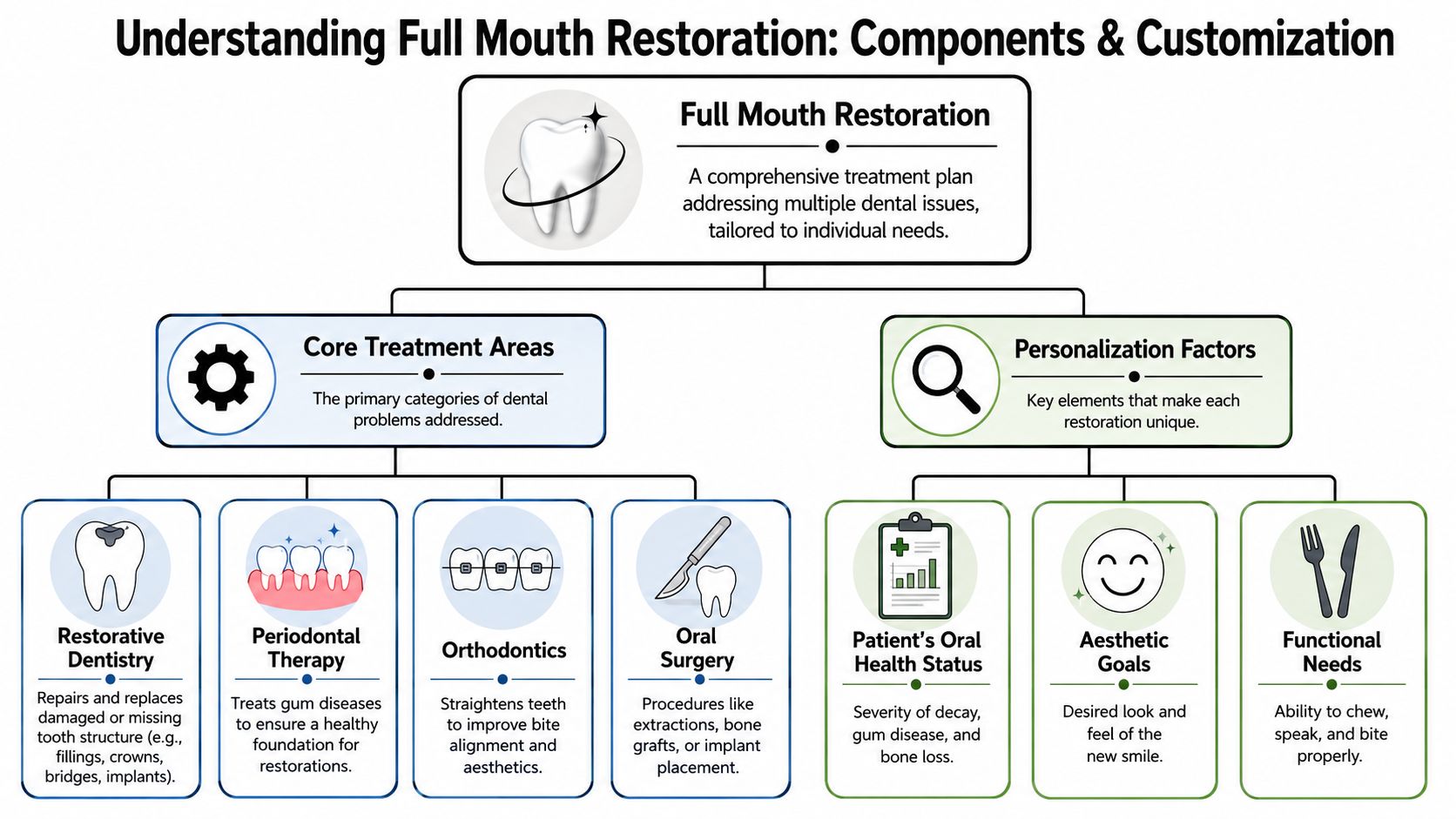
A helpful way to think about it is this. Restoring a smile isn't only about replacing what you can see. It also means rebuilding support, balance, and function underneath. That's why a dentist may talk about gums, jawbone, bite alignment, and the condition of existing teeth before discussing the visible final result.
For a broader overview of how a custom plan comes together, this explanation of what a full mouth restoration involves is a useful starting point.
Why no two plans are the same
Two people can both say, "I need my whole mouth fixed," and still need very different treatment. One may have healthy gums but several cracked teeth. Another may have advanced wear, missing back teeth, and bone loss where implants are planned.
Here are the main questions that shape the plan:
| Question | Why it matters |
|---|---|
| Are the gums healthy enough? | Restorations last better on a healthy foundation |
| Which teeth are savable? | Preserving strong natural teeth can simplify treatment |
| Are teeth missing already? | Replacement choices affect function and appearance |
| Is the bite stable? | Bite problems can damage new restorations |
| What are the patient's goals? | Some prioritize chewing, others appearance, many need both |
Clinical perspective: The best full mouth restorations solve the reason the teeth failed, not just the visible damage.
This is why full mouth rehabilitation often overlaps with restorative dentistry, cosmetic dentistry, and gum treatment. It can also involve replacing old dentistry that no longer fits well. If you've spent years moving from filling to crown to emergency repair, a thorough plan can be the first time everything is evaluated together.
Factors Influencing Your Full Mouth Restoration Cost
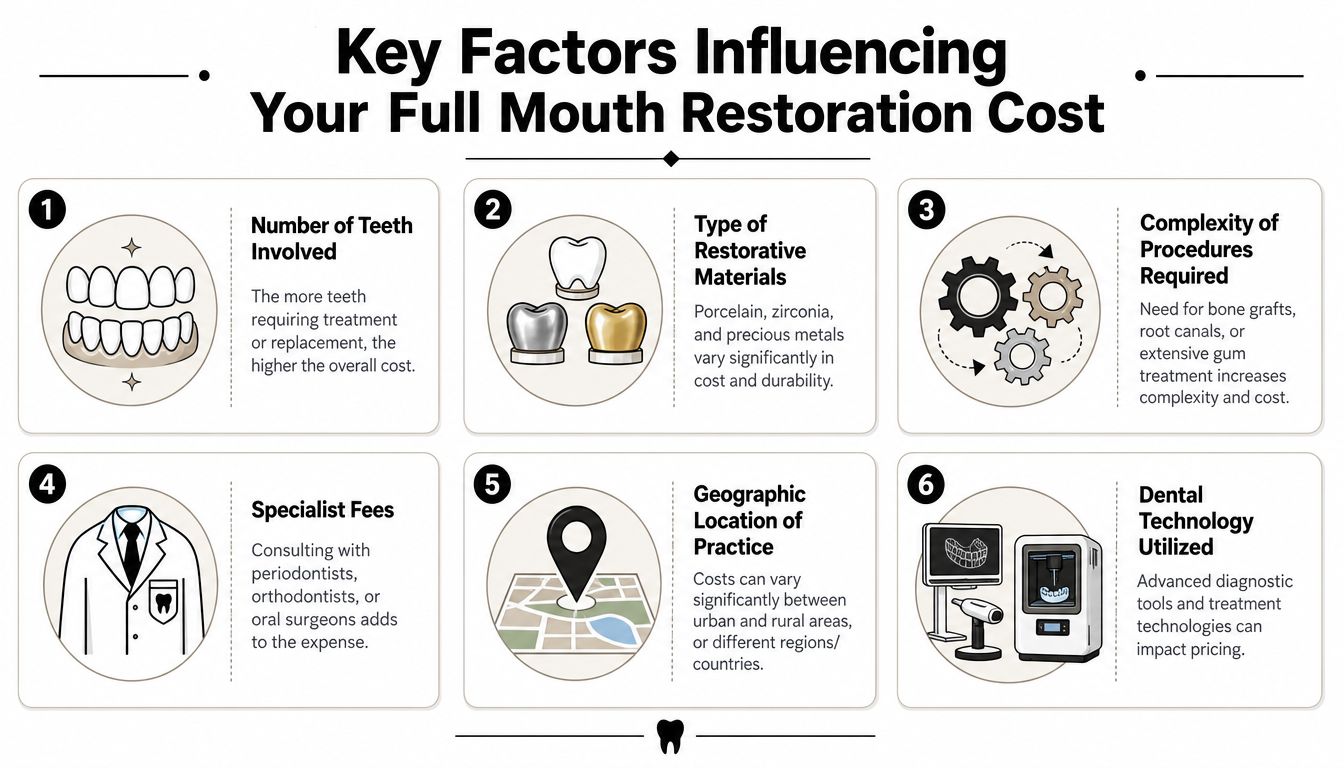
The price of treatment starts to make more sense when you stop looking for one flat fee. Full mouth restoration cost is really the sum of several choices and clinical needs. According to Dr. Joseph Standaert's overview of full mouth restoration pricing, the total cost of full mouth restoration in the United States typically ranges from $20,000 to $90,000, with dental implants averaging $3,000 to $5,000 per tooth, All-on-4 implants ranging from $20,000 to $35,000 per arch, crowns or veneers costing $500 to $3,000 per tooth, and bone grafting adding $500 to $3,000 per site.
The biggest cost drivers
The total usually changes based on a few core variables:
- How many teeth need work. Rebuilding several teeth is different from rebuilding nearly every tooth.
- What type of replacement is chosen. A bridge, denture, or implant-supported solution each changes the overall investment.
- Whether surgery is needed. Extractions, grafting, and implant placement add time and complexity.
- The materials selected. Porcelain, zirconia, and other restorative materials can differ in appearance, feel, and cost.
- The condition of the gums and bone. Healthy support structures make treatment simpler.
Why preparation can change the budget
Many online estimates often fall short. Patients often search by the price of the visible restoration, but the supporting treatment matters just as much. If the gums are inflamed, bone has shrunk, or old infection is present, those problems usually need attention before final crowns, bridges, or implant restorations are placed.
That doesn't mean treatment is out of reach. It means the quote reflects the whole job, not just the final layer.
A short video can make that easier to visualize.
Why local context matters in Walnut Creek
Walnut Creek patients often want a balance of durability, comfort, and aesthetics. In a community where many adults are active professionally and socially, treatment planning often includes discussion of how the teeth will look in conversation, how they will feel while eating, and how long they are expected to serve.
The final number isn't random. It reflects the condition of the mouth, the sequence of care, and the materials chosen for the long term.
That also explains why one patient's treatment is centered on crowns and bite correction while another's is centered on implants and grafting. Same category of treatment. Very different starting points.
Example Full Mouth Restoration Plans and Costs
A treatment estimate starts to make more sense when you can see how it applies to a real person. I often explain it to Walnut Creek patients the way I would explain a home repair. Repainting a room costs one thing. Rebuilding the wall behind it costs something else. Full mouth restoration works the same way. The final fee depends on how much of the structure can be kept, how much needs to be rebuilt, and whether treatment can be staged over time.
A moderate restoration plan
Sarah is in her 40s, stays fairly consistent with dental visits, and wants to fix problems before they turn into bigger ones. She has several aging fillings and crowns, one missing molar, and wear from a bite that no longer lines up evenly. Her gums are healthy, and many of her natural teeth are still good candidates to keep.
Her plan could include several crowns, replacement of the missing tooth with a single implant, and bite adjustment so the new work functions together instead of carrying stress in one area. Wilton Manors Dental's overview of full mouth restoration costs describes moderate reconstruction as commonly falling in the $15,000 to $40,000 range nationally.
For a patient like Sarah, the out-of-pocket question usually matters more than the national range. A plan in this category may feel more manageable because it often preserves more natural teeth and limits the number of surgical steps. If you are trying to estimate what monthly payments might look like, our guide on how to budget for dental implants and larger restorative treatment can help you start the math before your consultation.
A more extensive reconstruction
John is in his 60s and has spent years patching one problem at a time. He has several missing teeth, multiple broken teeth that are no longer predictable to save, and a bite that has started to collapse. He is tired of chewing carefully, avoiding certain foods, and wondering which tooth will flare up next.
His treatment may involve extractions, bone grafting in selected areas, temporary restorations, and implant-supported replacement for a larger portion of the mouth. In that same Wilton Manors Dental cost overview, more extensive full mouth restoration cases are described in a national range that can extend well beyond moderate treatment, with many larger cases landing between $45,000 and $90,000 or more.
That wide spread confuses patients, but the reason is straightforward. One person needs reinforcement and replacement in a few areas. Another needs to rebuild the foundation, replace many teeth, and restore the bite from the ground up.
A few patterns show up often:
- Moderate cases usually involve saving more existing teeth and using fewer surgical procedures
- Extensive cases often include more implant work, more provisional phases, and more healing intervals
- Phased care can break a large plan into parts, so a patient addresses comfort and chewing first, then completes longer-term rebuilding in steps
The quote that matters is the one built around your mouth, your goals, and your likely insurance contribution. For Walnut Creek patients, that is often the difference between seeing treatment as one overwhelming number and seeing it as a plan with clear phases and a realistic path to paying for it.
Your Guide to Insurance Coverage and Financing
Insurance is where many people feel blindsided. They hear a large treatment estimate, assume insurance will absorb a meaningful portion, and then discover that dental benefits often work very differently from medical benefits.
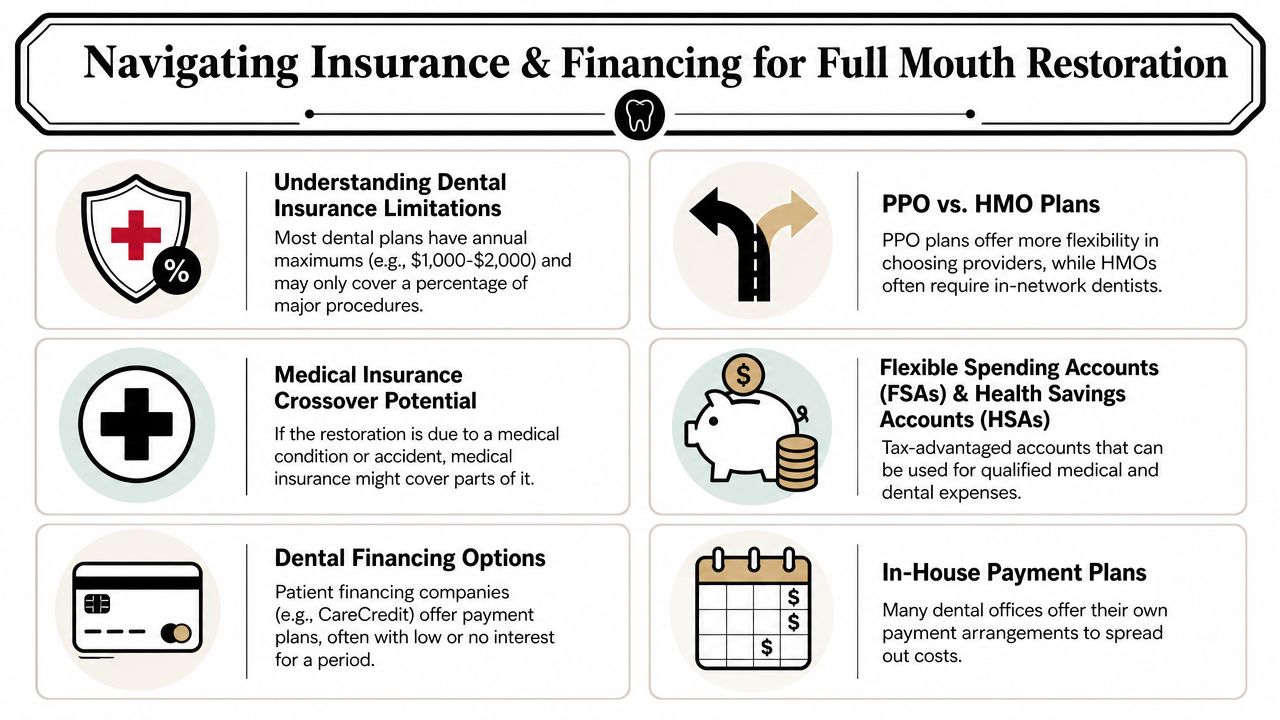
According to Perfect White Smile's discussion of common full mouth restoration questions, standard dental insurance often covers only about $1,500 to $2,000 annually as major services at a lower percentage, effectively leaving patients with 95%+ out-of-pocket costs. That's the part most cost guides skip, and it's often the most important number for patients trying to plan realistically.
Why the out-of-pocket amount surprises people
The sticker price of treatment and the amount a patient pays aren't the same thing, but not always in the way people hope. With large restorative cases, common insurance limits can leave the patient responsible for most of the balance.
That doesn't mean you should avoid getting a plan. It means you should ask better questions:
- What is medically necessary versus cosmetic. Coverage is often stronger for functional treatment than for appearance-driven upgrades.
- What is the annual maximum. Some plans run out quickly during major treatment.
- Which phases can be timed strategically. In some cases, spreading treatment can help patients use benefits across more than one coverage period.
- Can HSA or FSA funds be used. Many patients forget these accounts can help with qualified dental expenses.
For a practical planning resource, this guide on how to budget for dental implants can help you think through timing, financing, and priorities.
Financing can make treatment more manageable
Patients in Walnut Creek often assume the only way to move forward is a single large payment. That's not usually the only option. Depending on the office, financing may include third-party healthcare lenders, monthly payment arrangements, or staged treatment that addresses urgent issues first.
Practical rule: Ask for the out-of-pocket estimate, not just the treatment estimate.
A clear financial conversation should answer three things. What needs to happen first. What can be phased. What the feasible monthly or staged payment path looks like. That kind of transparency reduces stress because it turns a vague fear into a plan.
If you're also weighing dental implants near me against bridges or removable options, financing discussions matter even more. The right choice isn't always the cheapest starting point. It's the solution that best fits your health, priorities, and ability to complete treatment predictably.
Your Treatment Timeline and Recovery Process
A common Walnut Creek scenario goes like this. A patient finally decides to fix years of broken teeth, worn fillings, jaw soreness, or missing teeth, then immediately worries that treatment will mean months of constant appointments and one long recovery. In practice, full mouth restoration is usually much more orderly than that.
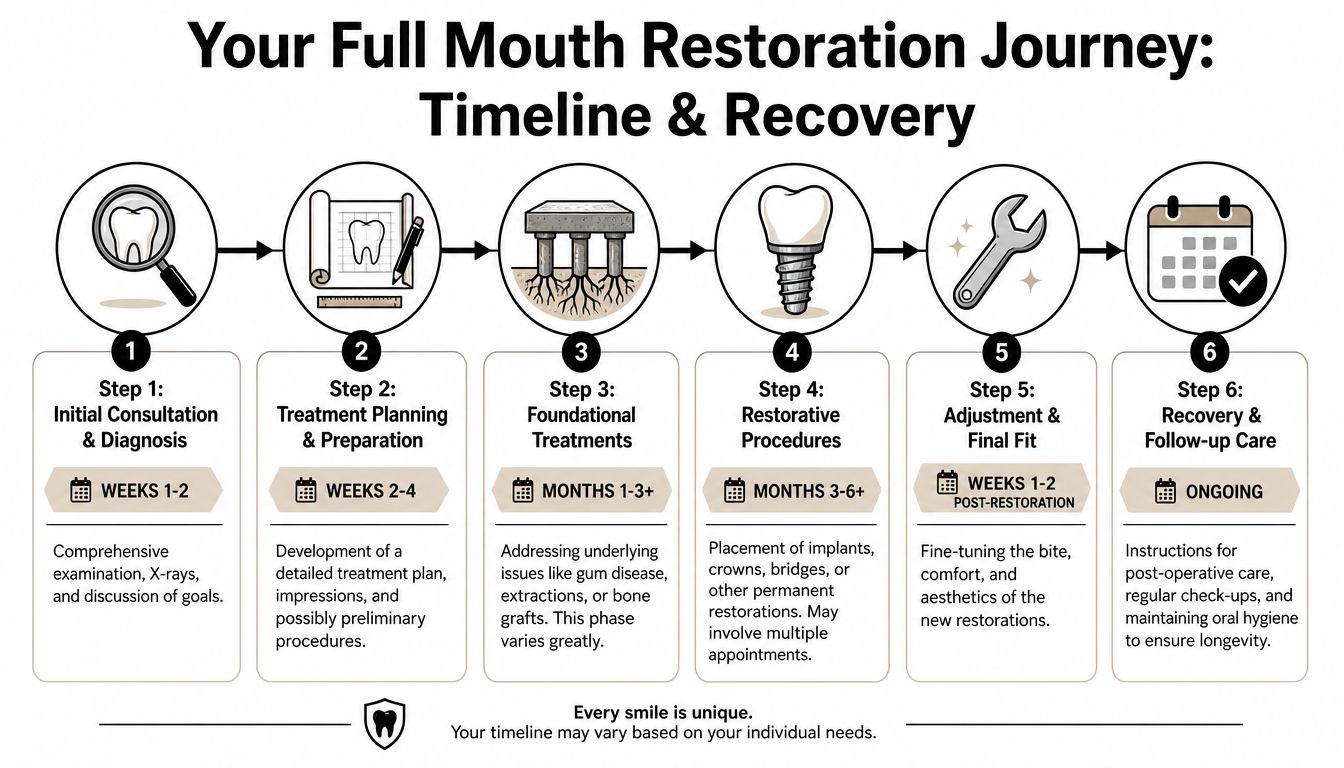
The process works in phases because your mouth needs a stable foundation before the final work goes in. Building a home follows the same logic. You do not place the roof before the frame is secure. Dentistry works the same way. In many cases, treatment unfolds over several months, and the exact pace depends on healing, the number of procedures involved, and whether implants, gum treatment, or extractions are part of the plan.
The treatment journey in plain language
Patients often move through care in a sequence like this:
Consultation and diagnosis
We start with a detailed exam, digital images, bite evaluation, and a conversation about what is bothering you day to day. Pain, appearance, chewing, loose teeth, and old dental work all matter here.Preparation
Some patients need gum treatment, temporary restorations, or tooth extraction before the final plan can succeed. This stage is about removing active problems and creating a healthier starting point.Foundational treatment
If implants are part of the plan, they may be placed now, followed by healing time. If teeth can be saved, the focus may shift to strengthening them with the right restorative care first.Final restorations
Crowns, bridges, dentures, or implant restorations are placed and adjusted so your bite feels balanced, your teeth look natural, and chewing becomes more comfortable.Follow-up and refinement
Small bite adjustments, comfort checks, and healing reviews are normal. Final results often improve through these visits because fine tuning matters.
What recovery usually feels like
Recovery is not one single block of time. It is a series of shorter healing periods tied to specific procedures.
That distinction helps many patients relax.
A crown appointment may leave you a little sore for a day or two. An extraction, bone graft, or implant placement usually calls for more downtime and softer foods. Temporary teeth can also feel different at first, much like a new pair of shoes. They often need a short adjustment period before they feel natural.
Here is what patients commonly focus on during each phase:
| Phase | What patients often focus on |
|---|---|
| Early visits | Understanding the sequence and knowing what happens first |
| Preparation phase | Relief from pain, infection, or unstable teeth |
| Surgical phase | Swelling, diet changes, and protecting healing areas |
| Final delivery | Bite comfort, speech, appearance, and chewing confidence |
| Maintenance | Keeping the result stable and catching small issues early |
A long treatment plan feels far more manageable when you only have to focus on the next clear step.
For Walnut Creek patients, that step by step structure also helps with the financial side. You are often not recovering from everything at once, and you are usually not paying for every phase on the same day either. The timeline and the payment plan often work together. That is one reason a written schedule matters so much. It lets you see what happens now, what waits until healing is complete, and when larger costs are due out of pocket.
Long-term success depends on follow-up care as well. Regular dental care, cleaning and exams, and prompt attention to bite changes or discomfort help protect the work you have completed and reduce the risk of expensive repairs later.
Start Your Journey with a Trusted Walnut Creek Dentist
A full mouth restoration can look intimidating from the outside. Up close, it's usually a structured process with clear decisions, logical phases, and options for making the financial side more manageable.
The key is getting the right diagnosis first. When you know which teeth can be saved, which problems need to be treated before cosmetic work, and which replacement options fit your goals, the path becomes much clearer. That's true whether you're exploring restorative dentistry, cosmetic dentistry, implants, or care after a dental emergency.
For many adults in Walnut Creek, the turning point isn't finding a perfect number online. It's finally sitting down with a dentist who can explain the plan in plain language, answer questions without pressure, and help prioritize treatment in a way that fits real life.
That matters even more if you've been delaying care because of fear. A calm setting, painless injections, and sedation options when appropriate can change the entire experience. So can a practice that welcomes questions about timelines, alternatives, and budget.
If you've been searching for a dentist in Walnut Creek, CA, a cosmetic dentist near me, or an emergency dentist because your teeth no longer feel stable, this is the right time to get clarity. You don't have to solve everything today. You just need a real starting point.
If you're ready to talk through your options with a compassionate local team, schedule a consultation with William M. Schneider, DDS. His Walnut Creek practice provides complete general, cosmetic, and restorative dental care for East Bay patients who want clear answers, gentle treatment, and a personalized plan for rebuilding a healthy, confident smile.