You may be searching for a dentist near me after putting off care because you remember uncomfortable impression trays, blurry dental X-rays, or long appointments that seemed to accomplish very little. That hesitation is understandable. Modern dental technology has changed many of those experiences, but the important question isn't whether an office owns impressive equipment. It's whether a tool helps your dentist find problems earlier, plan treatment more carefully, protect your comfort, or make your care easier to follow.
At William M. Schneider, DDS, a Walnut Creek practice with more than 25 years of experience, technology supports a personal approach rather than replacing it. Whether you need routine cleaning and exams, a tooth extraction, an emergency dentist, cosmetic dentistry, restorative care, or dental implants near me, the goal is the same: understand what's happening, explain your options, and build a plan around your long-term oral health.
Why Dental Visits Feel Different Today
A patient who has avoided the dentist for years often remembers the same details: a tray filled with impression material, an X-ray that was difficult to see, and a treatment plan explained in a hurry. Those memories can make even a routine new patient exam feel intimidating. The good news is that many offices now use tools that make the experience more comfortable and easier to understand.
A digital sensor can display an image on a monitor instead of leaving you to interpret a small piece of film. An intraoral scanner can create a digital model without requiring a mouthful of impression material. When a dentist needs a deeper view for implant planning or another complex concern, cone-beam computed tomography, or CBCT, can show anatomy in three dimensions.
At William M. Schneider, DDS, Dr. Schneider combines current technology with more than 25 years of dental experience and a calm, compassionate manner. That combination matters. A scanner can capture information, but a dentist still needs to decide what the information means, which treatment is appropriate, and whether treatment is needed at all.
The practical difference: Technology should make your care clearer, gentler, and more predictable, not make you feel as if you're being sold a machine.
You can learn more about the patient experience in this guide to what to expect from a modern dentist office near you. By the time you finish, you'll understand what the main tools do, where they help, and what a visit to a Walnut Creek dentist may feel like.
What Modern Dental Technology Means
Modern dental technology is a group of tools that helps a dentist see more clearly, plan treatment with greater precision, and care for patients more gently. It is not one device, and having newer equipment does not mean every patient needs every scan. Your dentist chooses each tool according to your symptoms, examination findings, and proposed treatment.
The tools fit into three practical families.
Imaging tools show more than the eye can see
Digital X-rays provide a clear image of teeth and supporting structures that can be viewed and enlarged quickly. CBCT adds depth, creating a three-dimensional view that may help evaluate bone and nearby anatomy during implant planning. A flat photograph shows the front of a building. A detailed map shows surrounding streets, elevation, and boundaries. Both views have value, but they answer different clinical questions.
Digital design tools turn scans into treatment plans
An intraoral scanner uses a small handheld wand to record the surfaces of your teeth and gums. That information can support computer-aided design and computer-aided manufacturing, known as CAD/CAM. CAD/CAM systems digitally design and manufacture restorations and appliances, including crowns, bridges, implant restorations, dentures, and surgical guides. They can often work from digital scans instead of conventional impressions, as described in this overview of CAD/CAM dentistry.
The scanner creates a detailed digital pattern, much like a tailor taking careful measurements before making a garment. Your dentist and the laboratory can use that pattern to plan a restoration that fits the recorded shape of your mouth.
Comfort tools support the person in the chair
Modern care also includes techniques and systems focused on your experience. Painless injection techniques, sedation options when appropriate, careful infection control, and accessibility accommodations can reduce stress before and during treatment.
These tools work like climate control in a car. They do not choose the destination or determine where treatment should go. They help make the visit calmer and more manageable, while the dentist remains responsible for diagnosis and treatment decisions.
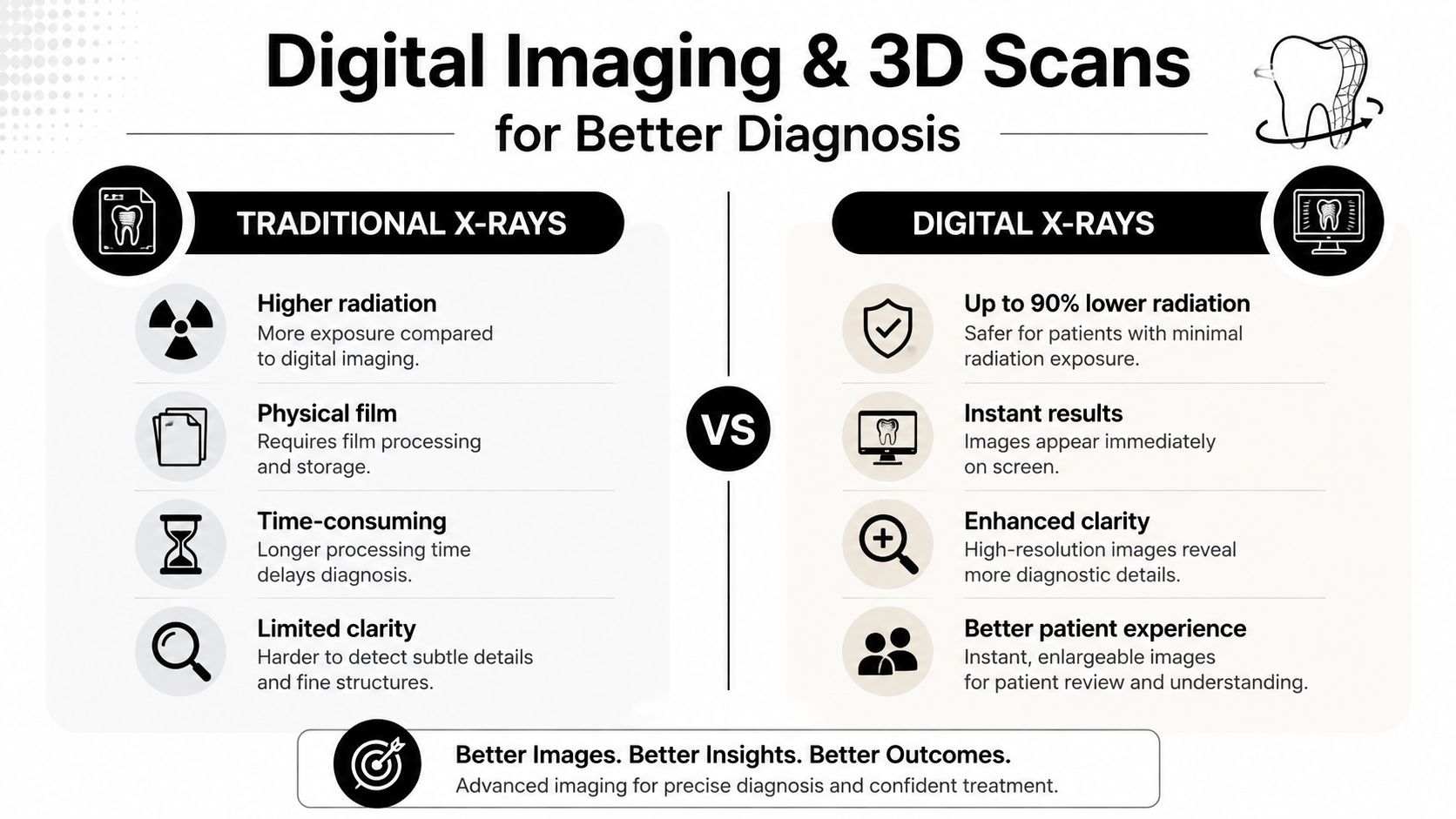
Digital Imaging and 3D Scans for Better Diagnosis
Diagnosis comes before treatment, and the quality of the information available can shape every decision that follows. Digital dental X-rays use electronic sensors, allowing images to appear quickly on a screen and be enlarged for discussion. That makes it easier for you and your dentist to look at a specific tooth, compare areas, and discuss what a finding may mean.
Digital imaging has an important historical context. Dental X-ray use dates back to 1896, when the first dental X-ray of a living person was taken, according to the American Dental Association's dental history. Current digital systems are designed to provide useful images with lower radiation exposure than older film-based approaches, while the dentist still orders imaging only when it supports diagnosis or treatment planning.
CBCT adds a three-dimensional view
A CBCT scan is especially useful when a dentist needs to understand the relationship between bone, teeth, nerves, and other surrounding structures. In implant dentistry, it can provide cross-sectional bone measurements and help with the planned implant position. That matters for patients researching dental implants near me, because implant placement depends on anatomy beneath the gum, not just what can be seen during a visual examination.
Research on CBCT planning found that a voxel size of 0.3 to 0.4 millimeters is generally adequate for acceptable diagnostic quality in implant planning, while low-dose protocols showed a pooled planning measurement error of about -0.24 millimeters, tending to slightly underestimate real dimensions. The review supports clinical use when the plan includes a 2 millimeter safety margin around adjacent anatomy, as reported in this systematic review of CBCT accuracy in implant planning.
What this means for you: A 3D scan doesn't guarantee a particular result. It gives the dentist a more complete map to use alongside examination, experience, and careful planning.
Intraoral scanners replace the messy impression
An intraoral scanner is a small wand that captures the shape of your mouth digitally. For dentate arches, a systematic review reported IOS accuracy ranges of roughly 20 to 100 micrometers, while edentulous jaws showed ranges of roughly 50 to 250 micrometers. CBCT-constructed 3D models showed lower surface-capture accuracy, around 200 to 1,000 micrometers, depending on dose and voxel settings, according to this review of digital implant workflows.
In plain language, an intraoral scanner is often better for recording the visible surfaces of teeth, while CBCT remains important for seeing the anatomy underneath. You may experience the difference as a shorter, cleaner scan instead of a tray of setting material.
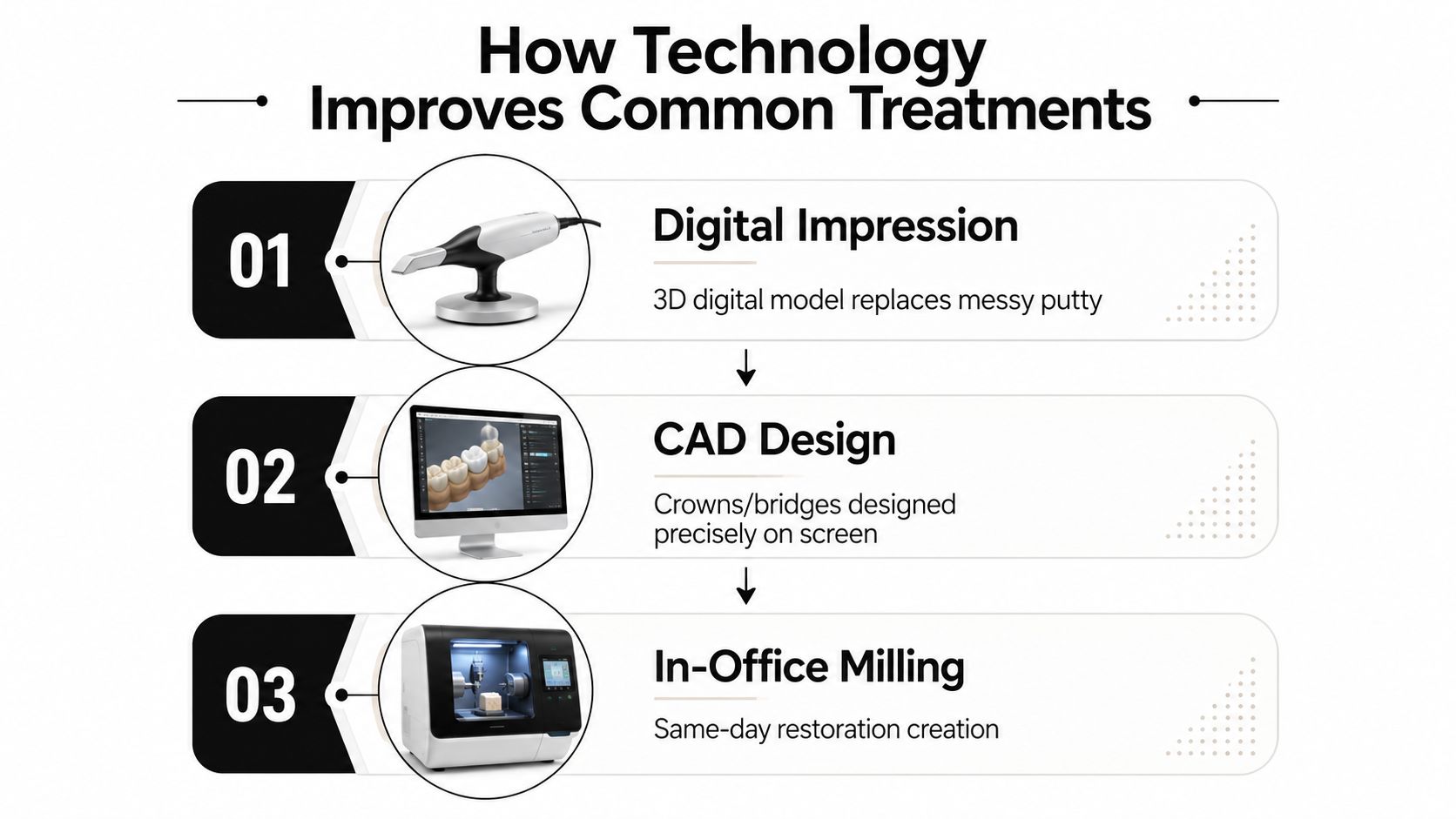
How Technology Improves Common Treatments
The value of technology becomes easiest to understand when you connect it to a treatment you may need. A digital tool is useful when it changes a clinical decision, improves communication, or reduces unnecessary discomfort.
Crowns, bridges, and restorations
For a crown or bridge, a digital scan can capture the shape of the prepared tooth and neighboring teeth without a conventional impression. CAD/CAM software can then help design the restoration, while manufacturing equipment produces the planned shape from that digital file. Your dentist still checks the fit, bite, contacts, color, and function. The software supports the work, but it doesn't replace clinical judgment.
A better digital record can also make communication more precise between the dental office and laboratory. That may help reduce avoidable adjustments and make the restoration process feel more organized. Whether you need a single crown, a bridge, dentures, or a broader full-mouth restoration plan, the dentist can use the information to coordinate care around your actual needs.
Dental implants and surgical planning
Implant treatment begins with understanding available bone and the position of important structures. CBCT can provide the three-dimensional information needed to evaluate those relationships before surgery. A digital workflow may also connect the scan with a planned restoration and surgical guide, creating a more coordinated path from diagnosis to placement.
This doesn't mean every patient needs the same scan or that technology eliminates surgical judgment. It means the dentist can identify anatomical considerations before treatment rather than relying only on what is visible during the procedure.
Invisalign and cosmetic dentistry
Digital scans can also support Invisalign clear aligners by creating a three-dimensional record of your teeth. The record helps the dentist evaluate alignment and plan movement while discussing what changes are realistic for your smile and bite. For patients looking for a cosmetic dentist near me, digital planning can make the conversation more concrete because you can review the starting condition and proposed direction together.
Other cosmetic services, such as teeth whitening, may not require advanced imaging at every visit. Technology still has a role in examining existing restorations, documenting concerns, and coordinating cosmetic goals with healthy teeth and gums.
Root canals, extractions, and gum care
Clearer imaging can help a dentist evaluate the source of pain, identify tooth structure that needs attention, and plan procedures such as root canals or tooth extraction. For gum disease care, clinical measurements and visual findings remain central, while imaging can help assess supporting bone when appropriate.
The result patients notice is often practical: fewer surprises, a clearer explanation, and a treatment plan that connects the diagnosis to the next step. A Walnut Creek practice that offers preventive cleaning and exams, restorative dentistry, dental implants, root canals, gum disease care, Invisalign, and whitening can help patients maintain one consistent dental record as their needs change.
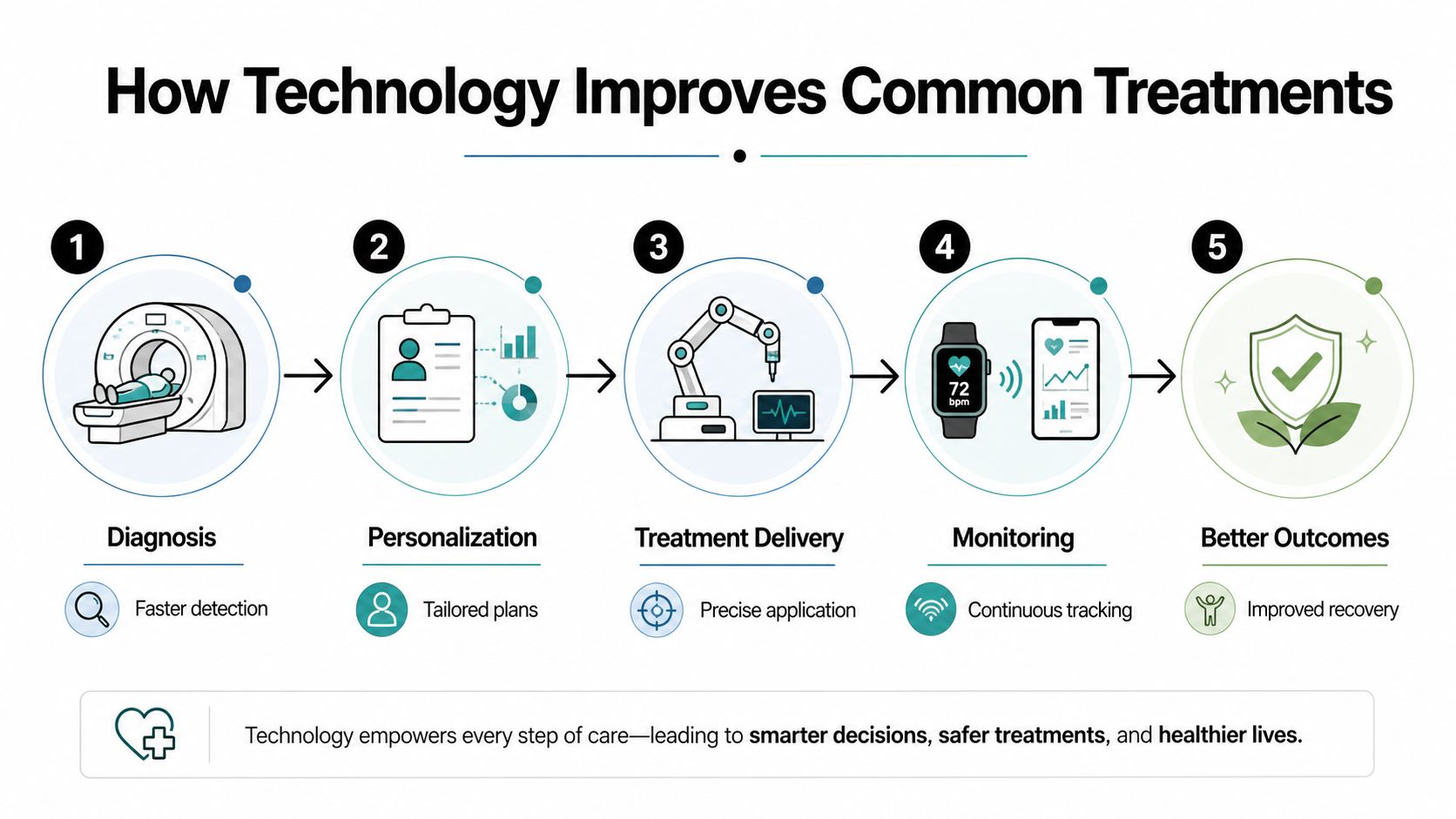
Separating Proven Technology From the Hype
Newer doesn't automatically mean better. A scanner may be useful for one treatment and unnecessary for another. A 3D image may improve implant planning, but it isn't a substitute for a careful examination or a conversation about alternatives, risks, cost, and follow-up.
Adoption also isn't universal. A 2025 study found that 22% of surgical practitioners, 44% of general practitioners, and 45% of orthodontic practitioners had implemented digital workflows, with adoption higher in larger cities and group practices and lower among older clinicians, according to the study on digital workflow adoption. The finding matters because patients shouldn't assume that every office offers the same digital options.
Questions worth asking before treatment
If you're comparing a dentist in Walnut Creek, CA, ask specific questions rather than asking whether the office is “advanced.”
- Digital X-rays: Does the office use digital imaging, and how will the dentist explain the findings?
- Intraoral scanning: Can a scanner be used for my crown, aligner, or restoration instead of a conventional impression?
- Implant planning: Is CBCT recommended for my case, and what question will the scan answer?
- Comfort: What injection techniques, sedation options, and anxiety support are available?
- Treatment value: Will the technology change my treatment, or is it mainly a convenience?
Technology is becoming more connected across imaging, AI-supported diagnosis, robotic or guided surgery, direct 3D printing, and interoperability standards. A 2026 review describes these developments as market-ready in several areas while characterizing hybrid care models and outcome-based reimbursement as emerging rather than settled, as outlined in this review of integrated digital dentistry.
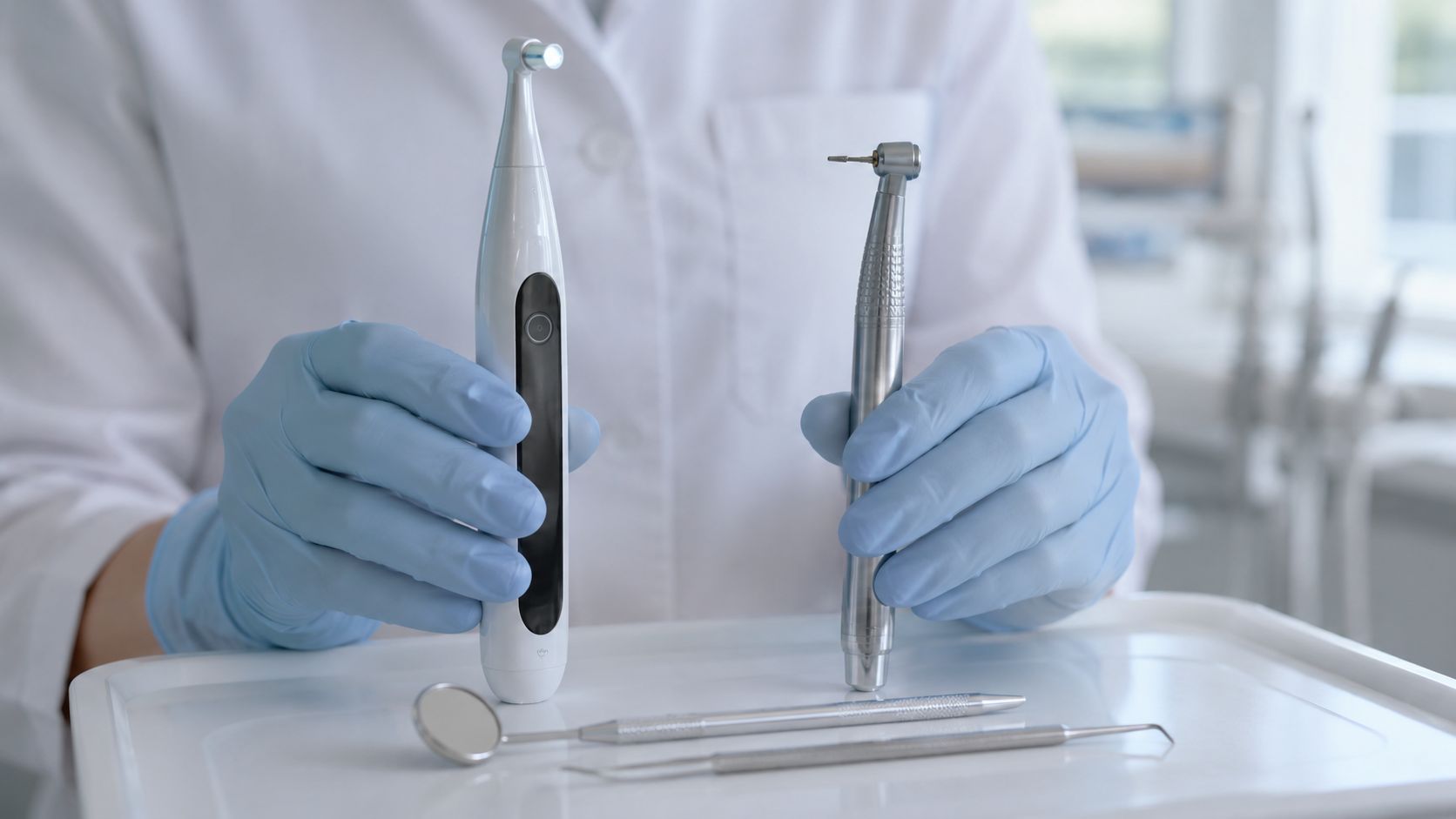
At William M. Schneider, DDS, technology is used with clear explanations, realistic expectations, transparent treatment planning, and convenient payment options. The focus is not on upselling equipment. It's on choosing tools that fit the diagnosis and help you make an informed decision.
What to Expect as a New Patient in Walnut Creek
Booking a first visit can feel harder than the appointment itself because uncertainty leaves room for anxious questions. At William M. Schneider, DDS, you can begin by using convenient online appointment scheduling, then arrive at the office at 1855 San Miguel Dr., Suite 31, in Walnut Creek.
The front-office experience is designed to be welcoming and organized. Accessibility accommodations are available, and online payments can make administrative details easier to manage. If you have dental anxiety, mention it before you arrive. The team can discuss comfort preferences, sedation options when appropriate, and ways to make the visit feel more manageable.
Your first examination
A new patient exam typically begins with a conversation about your concerns, medical history, dental history, and goals. You may be seeking a routine cleaning, looking for a dentist near me after moving to the East Bay, or arriving with pain that requires an emergency dentist. Those details help the dentist decide which examination and imaging are appropriate.
Modern imaging may be part of the evaluation when it supports a diagnosis. You'll have the opportunity to see relevant findings and ask what they mean. Clear explanations matter just as much as clear images, especially when the next step could be preventive care, a filling, a crown, root canal treatment, an extraction, or a dental implant consultation.
Discussing your options
After the examination, the conversation should connect findings with choices. A treatment plan may address an immediate problem first, then outline preventive or restorative care that protects function over time. If your priorities include a brighter smile, Invisalign, teeth whitening, or cosmetic dentistry, those goals can be discussed alongside the health of your teeth and gums.
Patients from Walnut Creek and the broader East Bay can expect a compassionate setting, meticulous infection control, and attention to comfort throughout care. You shouldn't leave wondering what was found, why treatment was recommended, or what happens next.
Schedule Your Visit With a Modern Walnut Creek Dentist
Modern dental technology isn't about collecting gadgets. Digital imaging, CBCT planning, intraoral scanning, CAD/CAM design, and comfort-focused techniques matter when they help detect concerns, explain findings, plan treatment, or make care easier to tolerate.
The right technology also needs the right human judgment. At a Walnut Creek dentist, your care should include a thorough examination, honest recommendations, understandable choices, and a plan that respects your comfort, schedule, and long-term oral health.
For a dentist in Walnut Creek, CA, dental implants near me, a cosmetic dentist near me, or help with tooth pain, don't wait for uncertainty to become an emergency. Request an appointment or consultation online at wcfamilydentist.com or contact the Walnut Creek office to take the next step toward a healthier, brighter smile.
William M. Schneider, DDS provides preventive, cosmetic, restorative, and implant care supported by modern dental technology, including digital imaging and patient-centered treatment planning. Visit William M. Schneider, DDS to request an appointment or consultation and discuss comfortable, personalized care in Walnut Creek.