TL;DR: Nationally, Invisalign for adults typically costs $3,000 to $8,000, with most extensive cases falling between $4,500 and $6,000 based on 2025 Invisalign cost data. In Walnut Creek and the Bay Area, many adults should expect pricing that often lands in the $5,000 to $9,000 range, and the only way to know your exact cost is to have your case complexity evaluated in person.
If you're researching invisalign for adults cost, you're probably not casually browsing. You're likely looking in the mirror before work, noticing the same crowding, spacing, or bite issue you've thought about fixing for years, and wondering whether now is finally the right time to do it.
For many adults in Walnut Creek, the hesitation isn't whether straighter teeth would help. It's whether the process will be worth the money, whether the fee will keep growing once treatment starts, and whether clear aligners are the right fit for a busy professional or family schedule.
Considering a Straighter Smile in Walnut Creek
A lot of adults put this decision off for practical reasons. They don't want metal braces in meetings, at community events, or in family photos. They want something discreet, removable, and manageable. Then the cost question shows up and stops everything.

In Walnut Creek, that question carries extra weight. Patients here are often balancing work, commuting across the East Bay, family obligations, and other health expenses. They want a better smile, but they also want a real explanation of what they're paying for. That includes the aligners, the scans, the follow-up visits, the retainers, and the clinical judgment behind the plan.
Why cost feels uncertain
The frustration usually isn't the existence of a fee. It's the lack of clarity. Many adults search for a single number and find a wide range instead. That happens because Invisalign isn't one product with one universal price. It's a custom treatment process built around your bite, your tooth movement, and how much correction your smile needs.
Some adults only need limited cosmetic movement. Others need full correction of crowding, spacing, or bite problems that developed over time. The fee changes because the work changes.
Chairside reality: The right question usually isn't “How much does Invisalign cost?” It's “What does my smile need, and what's included in that fee?”
What patients are really trying to solve
Most adults aren't only buying straighter front teeth. They're trying to improve one or more of these issues:
- Professional confidence: You want to smile freely in conversations, presentations, and photos.
- Daily function: Teeth that overlap or don't meet well can make cleaning harder and chewing less comfortable.
- Long-term maintenance: A healthier alignment can support cosmetic dentistry, restorative dentistry, and routine dental care over time.
- A dental home: Many patients looking for a cosmetic dentist near me or a dentist in Walnut Creek, CA also want one office they can trust for cleanings and exams, dental x-rays, whitening, crowns, and future care.
That matters because the best value rarely comes from the cheapest quote. It comes from a treatment plan that's accurate from the start and supported all the way through.
Understanding the Investment Invisalign Cost in 2026
A Walnut Creek patient often sits down expecting one clear Invisalign price and finds a spread instead. In 2026, a realistic adult fee range in the U.S. is often discussed as roughly $3,000 to $8,000, but that broad number is only a starting point. Local costs in the Bay Area commonly land toward the higher end because the cost of delivering treatment here is higher, and adult cases often require more planning than patients expect.
That does not automatically mean you are overpaying. It means the quote needs context.
A practical way to read the range
The fee usually follows the amount of tooth movement, the bite correction involved, and how much doctor time is needed to keep the case on track. A small cosmetic adjustment is different from a case that also needs rotation control, space creation, or bite improvement.
| Treatment level | Typical situation | Common cost pattern |
|---|---|---|
| Mild correction | Small spacing or minor cosmetic alignment changes | Often near the lower end of the overall range |
| Moderate correction | Noticeable crowding, rotation, or limited bite adjustment | Often in the middle of the range |
| Full correction | Broader bite changes or multiple teeth moving in a coordinated way | Often near the upper end of the range |
This explains why two adults can both say they are getting Invisalign and receive very different estimates.
Why Walnut Creek pricing can look higher
Walnut Creek is not priced like a lower-cost part of the country. Rent, team costs, technology, lab coordination, and chair time all cost more here. Patients also tend to expect digital scanning, careful cosmetic planning, and appointment options that fit a busy work schedule.
Provider experience affects value too. Adult Invisalign is rarely just about lining up front teeth. Existing crowns, old fillings, wear, recession, and bite habits can all change how movement should be staged. In my experience, that planning work is where patients either save time and frustration or end up paying later in refinements, delays, or repairs.
A higher fee only makes sense if it buys better diagnosis, tighter treatment control, and fewer surprises.
What a quote should actually cover
The top-line number matters, but what is included matters just as much. Ask whether the fee covers digital scans, records, aligners, review visits, refinement trays, and retainers at the end. If those items are separated out, a lower quote can become more expensive than it first appears.
For Walnut Creek adults, true cost transparency also means looking at how the fee will be paid. Insurance orthodontic benefits, FSA dollars, and HSA funds can reduce your out-of-pocket cost in a meaningful way. A well-structured treatment plan from an experienced provider, including Dr. Schneider, often gives patients a better return than choosing the lowest advertised number and finding out later that key parts of treatment were never included.
What Drives Your Final Invisalign Price
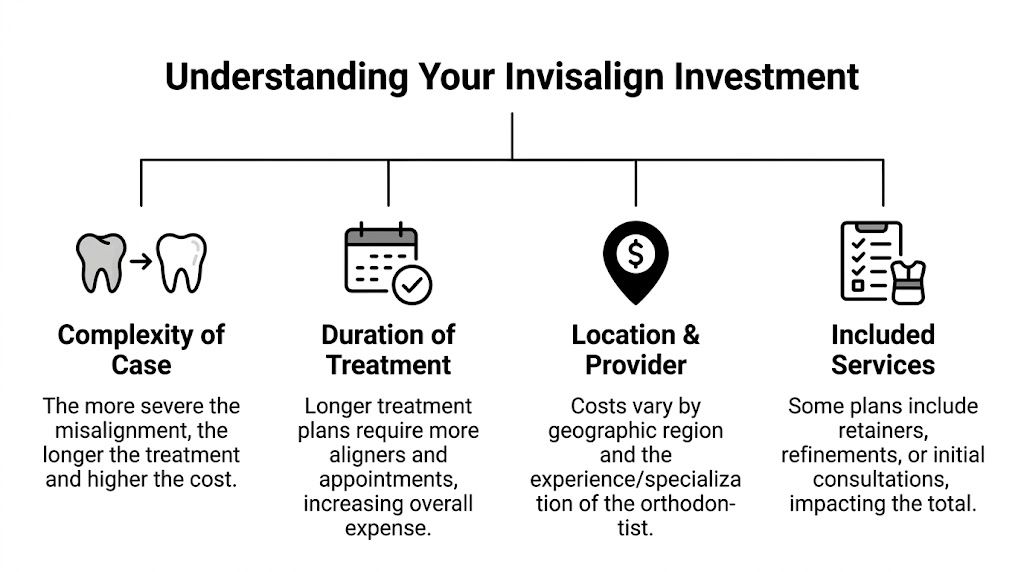
Your Invisalign fee isn't pulled from a menu. It's built from a custom treatment blueprint. The main drivers are how hard the teeth are to move, how long the plan will take, and what extra tools are needed to get a predictable result.
Adult full treatment typically costs $4,500 to $7,000 because mature teeth move through denser bone, and those cases often require 12 to 24 months of wear and 20 to 50+ aligner trays, with attachments and added monitoring used for more controlled movements, according to clinical cost factors described here.
Case complexity comes first
The single biggest factor is the starting condition of your teeth and bite.
A small gap or minor crowding case is usually more efficient to plan and complete. A case involving rotations, bite discrepancies, or significant crowding takes more digital staging, more aligners, and closer review. Adults also bring more history to treatment. Existing crowns, bridges, and worn teeth can change how movement is planned.
Treatment length affects cost
Longer treatment usually means more trays and more review appointments. That's not “extra” in a negative sense. It's the practical reality of moving adult teeth carefully.
Here are common reasons treatment gets longer:
- Broader tooth movement: More teeth need to shift, or they need to move farther.
- Bite correction: Front-to-back or side-to-side relationships need controlled adjustment.
- Adult dental history: Restorations, uneven wear, or gum concerns require more careful sequencing.
Attachments, IPR, and refinements
Many adults hear “clear aligners” and imagine only trays. In reality, a well-run Invisalign case may also involve tooth-colored attachments, elastics, or conservative enamel reshaping between teeth to create space.
These details often make the difference between a cosmetic-looking plan and a stable one. They also affect cost because they add planning, chair time, and monitoring.
What works: A plan that accounts for attachments, compliance, and likely refinements at the start.
What doesn't: Choosing a lower quote that treats these steps like surprises later.
Provider judgment matters more than most patients realize
Two treatment plans can look similar on paper but differ in efficiency. One may move teeth in a way that reduces unnecessary delays. Another may lead to extra refinements because the initial setup wasn't realistic for adult tooth movement.
That's why experience matters, especially if you're also thinking about future restorative dentistry or cosmetic work. Invisalign doesn't happen in isolation. It affects how the bite comes together, how teeth wear, and how other treatment fits around it.
The All-Inclusive Invisalign Experience at Our Practice
One of the most common fears adults have is hidden fees. That's a fair concern. If you're comparing options, the important question isn't just “What's the price?” It's “What exactly am I getting for that price?”
A well-structured Invisalign fee should cover the full treatment journey, not just the trays. That means diagnosis, planning, delivery, progress checks, and protection of the result after treatment ends.
What patients should expect to be included
An all-inclusive approach usually makes treatment easier to understand and easier to budget for. Patients should look for clarity around items such as:
- Initial evaluation: A close look at your teeth, bite, oral health, and smile goals.
- Digital records: Modern scanning and imaging used to plan tooth movement precisely.
- Custom treatment design: A personalized digital simulation and aligner sequence.
- Progress visits: Scheduled appointments to confirm tracking and make needed adjustments.
- Post-treatment retention: The retainers that help keep your result from shifting back.
That last item matters more than many adults expect.
Why retainers are part of the real cost
Post-treatment Vivera retainers can cost an additional $400 to $800, and they're important because 0.5 to 1 mm of relapse is common in the first year after adult orthodontic treatment, according to GoodRx's Invisalign cost review. When retainers are included up front, patients get a clearer picture of the true investment.
This is one of the easiest ways to compare value between offices. If one quote looks lower but doesn't clearly include retention, the savings may not be real.
A straighter smile isn't finished when the last tray comes out. It's finished when the result is protected.
Why this matters for long-term dental health
Adults often pursue Invisalign as part of a bigger oral health plan. Better alignment can make home care easier. It can support cleaning and exams, reduce frustration when flossing crowded areas, and create a stronger foundation for cosmetic dentistry or restorative work later.
If you're already searching for a dentist in Walnut Creek, CA who can handle preventive care, cosmetic improvements, and restorative needs under one roof, transparency around what is and isn't included becomes a major part of value.
Invisalign vs. Alternatives A Cost and Value Comparison
Invisalign isn't the only way to straighten teeth. For some adults, traditional braces are still the better clinical choice. For others, the convenience and appearance of clear aligners make Invisalign the better fit even if the starting fee is higher.
The key is to compare value, not just sticker price.
Orthodontic Treatment Comparison
| Feature | Invisalign | Traditional Metal Braces | Ceramic Braces |
|---|---|---|---|
| Appearance | Clear and discreet | Most visible | Less visible than metal |
| Removability | Yes | No | No |
| Eating | Remove to eat | Food restrictions apply | Food restrictions apply |
| Brushing and flossing | Easier because trays come out | More difficult around brackets and wires | More difficult around brackets and wires |
| Comfort profile | Smooth plastic aligners | Brackets and wires can irritate tissue | Similar issues, though less visually noticeable |
| Best fit for adults wanting flexibility | Strong option | Sometimes less appealing cosmetically | Often chosen for a more discreet fixed option |
Traditional braces remain a dependable treatment. They don't rely on the patient removing and replacing trays correctly, and some bite mechanics are easier to control with fixed appliances. For adults who want something less noticeable, ceramic braces can offer a middle ground.
Where Invisalign tends to win
For working adults, Invisalign often stands out for lifestyle reasons:
- Meetings and social settings: The trays are much less noticeable.
- Meals and coffee breaks: You remove them instead of navigating around brackets.
- Home care: Brushing and flossing are more straightforward than they are with fixed braces.
- Comfort: Many adults prefer smooth aligners to wires and brackets.
There is also a financial context. Adult Invisalign treatment is often priced above traditional metal braces. Earlier in this article, the price range for adults was covered along with the reasons that denser bone and added planning can raise the fee.
If you're weighing options carefully, this adult Invisalign vs braces comparison is a useful next read.
A word about unsupervised aligners
Mail-order or lightly supervised aligner systems may look simpler because the marketing focuses on convenience and lower upfront commitment. The problem is that adult bites are rarely simple. A treatment plan that ignores gum health, restorations, bite function, or tracking problems can create more cost later, not less.
That risk matters if you're also trying to avoid future restorative work, emergency dentist visits, or treatment corrections. Cheap orthodontics can become expensive dentistry.
Making Invisalign Affordable Insurance and Financing
The most helpful cost conversation usually starts after the clinical one. Once you know what your smile needs, the next step is figuring out how to pay for it without unnecessary stress.

Adults often assume Invisalign is uncovered cosmetic treatment. That's not always true. Insurance can make a meaningful difference if your dental plan includes orthodontic benefits.
Start with insurance, not assumptions
According to Invisalign cost information from Invisalign, 77% of patients qualify for up to $2,000 in orthodontic coverage, and 92% qualify for up to $3,000. That's one of the biggest reasons sticker price and true out-of-pocket cost can be very different.
A few practical steps help:
- Verify orthodontic benefits early: Ask whether adult orthodontic treatment is covered and whether there is a lifetime maximum.
- Check timing rules: Some plans have waiting periods or age restrictions.
- Ask how claims are handled: Direct billing and benefit coordination make the process easier.
For patients trying to get more from their plan this year, this guide on how to maximize your health insurance benefits can help you think through timing, deductibles, and account usage more strategically.
Use FSA or HSA funds if you have them
For many Walnut Creek professionals, an FSA or HSA is one of the smartest ways to lower the actual cost of treatment. These accounts let you pay with pre-tax dollars, which can make the expense feel more manageable.
That doesn't make Invisalign cheap. It does make the payment more efficient.
Smart money move: If your employer offers an FSA or HSA, ask how much of your treatment you can route through that account before you choose a financing plan.
A second helpful resource is this page on affordable Invisalign and smart ways to save on clear aligners, which walks through practical savings strategies without oversimplifying the decision.
Monthly financing can help, but ask for the full picture
Monthly payment plans can make treatment feel much more approachable. They spread the expense instead of forcing one large payment at the start. That can be the right choice for many families and professionals.
What matters is transparency. Ask these questions before agreeing:
- What is the down payment?
- How long is the financing term?
- Is there interest or an administrative fee?
- What does the total paid amount become over time?
Here is a short overview that may help before you compare plans:
The best financing plan isn't always the lowest monthly number. It's the plan that lets you complete treatment comfortably without losing sight of the total cost.
Your Next Step to a Confident Smile in Walnut Creek
The most honest answer to invisalign for adults cost is that there isn't one universal number. There is a national range, and there are common Bay Area patterns, but your actual fee depends on what your teeth and bite need.
That is why an in-person consultation matters. A real evaluation can show whether your case is mild, moderate, or complex, whether attachments or refinements are likely, and what should be included in the total fee from the start.
For patients in a high-income area like Walnut Creek, premium pricing often reflects provider experience and advanced training. As noted in this discussion of Invisalign pricing and expertise, that value proposition matters. Dr. Schneider's 25+ years of experience and AEGD training support a level of planning and care that many adults want when they're making a long-term investment in their smile.
If you're also looking for a cosmetic dentist near me, a dentist near me for ongoing care, or a Walnut Creek office that can connect Invisalign with whitening, restorative dentistry, tooth extraction planning when needed, or future dental implants, the consultation is where those pieces come together.
A precise quote should be personal, not guessed from a website. So should your treatment plan.
Frequently Asked Questions About Invisalign Costs
Is Invisalign more expensive than braces
It can be. Adult Invisalign treatment often costs more than traditional metal braces, especially when treatment is complex and requires more planning, trays, and monitoring. The trade-off is usually discretion, removability, and easier hygiene.
Are retainers included in the price
Sometimes yes, sometimes no. That's why this is one of the first questions to ask. Retainers are part of the actual cost of treatment, and they protect your final result.
What happens if I lose an aligner
The answer depends on where you are in treatment and how well your teeth have tracked. Sometimes patients can move to the next tray. Sometimes they need a replacement or an adjusted plan. This is one reason professional supervision matters.
How can I get an exact quote
You need an exam, digital records, and a treatment plan. Online ranges can help you prepare, but they can't tell you how many trays you'll need, how complex your bite is, or what should be included in your fee.
Is Invisalign worth it for adults
For many adults, yes. The value usually comes from a combination of aesthetics, convenience, comfort, and the ability to fit treatment into work and family life without the look and feel of metal braces.
If you're ready for a clear, personalized answer on Invisalign cost, schedule a consultation with William M. Schneider, DDS. You'll get a professional evaluation, a transparent discussion of your options, and a treatment plan built around your smile, your goals, and your budget in Walnut Creek.