A full mouth restoration is a customized plan to rebuild or replace most or all teeth in both the upper and lower jaws, restoring how your mouth looks, feels, and functions. It matters because tooth loss and severe dental damage are common in the United States, where 178 million adults are missing at least one tooth and about 40 million are completely toothless.
If you're reading this, you may already feel overwhelmed. Maybe you have several broken teeth, missing teeth, old dental work that keeps failing, or pain when you chew. Many people in Walnut Creek put off care because the problems seem too big, too expensive, or too complicated to fix all at once.
The good news is that what is a full mouth restoration isn't a mystery or a one-size-fits-all procedure. It's a carefully planned, step-by-step approach that helps us rebuild your smile in a way that makes sense for your health, comfort, and goals. At a local office like ours, that means slowing things down, listening first, and creating a treatment path you can understand.
Why You Might Need a Full Mouth Restoration
A full mouth restoration is usually recommended when one small fix won't solve the underlying problem anymore. A single filling or crown can help one tooth. But when many teeth are worn, infected, loose, missing, or out of balance, your whole mouth starts working against itself.
For some people, the warning signs are obvious. You may have trouble chewing on one side, avoid smiling, or feel embarrassed about missing teeth. For others, the damage builds gradually over time through grinding, untreated decay, gum disease, or years of patchwork dentistry.

Common reasons patients need comprehensive care
Here are some of the most common situations that point to a more complete solution:
- Multiple missing teeth that make eating harder and let neighboring teeth shift out of place
- Widespread tooth decay across several areas of the mouth
- Advanced gum disease that weakens the support around teeth
- Severely worn teeth from grinding or acid erosion
- Cracked, broken, or failing dental work that no longer fits the bite properly
- Jaw discomfort or bite problems that affect comfort every day
The need for this type of treatment is broad. In the United States, 178 million adults are missing at least one tooth, around 40 million are completely toothless, and nearly half of adults over 65 have lost six or more teeth, according to full mouth restoration statistics reviewed here.
Why patchwork treatment stops working
When problems affect many teeth at once, fixing one area without looking at the rest can create new strain elsewhere. A crown placed on one damaged tooth won't correct missing teeth on the other side. A denture alone won't address active gum disease. Cosmetic improvements won't last if the bite is unstable.
Practical rule: If your teeth, gums, bite, and old dental work are all part of the problem, they usually need to be planned together.
Patients often get confused, thinking full mouth restoration means "everything has to be removed." It doesn't. In many cases, we save healthy teeth whenever possible and rebuild around them.
It affects more than your smile
An unhealthy mouth changes daily life in ways that are easy to underestimate. People often avoid crunchy or healthy foods, chew less effectively, speak less confidently, and live with a background level of irritation or pain they have started to accept as normal.
Bite strain can also show up as jaw soreness, headaches, or muscle tension. If that sounds familiar, this guide to TMJ disorder signs can help you recognize whether your jaw joints may be part of the picture.
A full mouth restoration looks at the whole system. That matters because a stable, healthy bite can support comfort, appearance, and long-term oral health in a way isolated repairs often can't.
The Building Blocks of a New Smile
People often hear the term and assume it's one procedure. It isn't. A full mouth restoration is a combination of treatments selected for your mouth, your goals, and what needs to be repaired first.
Some patients need to replace missing teeth. Others need to save damaged teeth, rebuild a worn bite, or treat gum disease before anything cosmetic happens. The best plans combine function and appearance instead of treating them like separate issues.
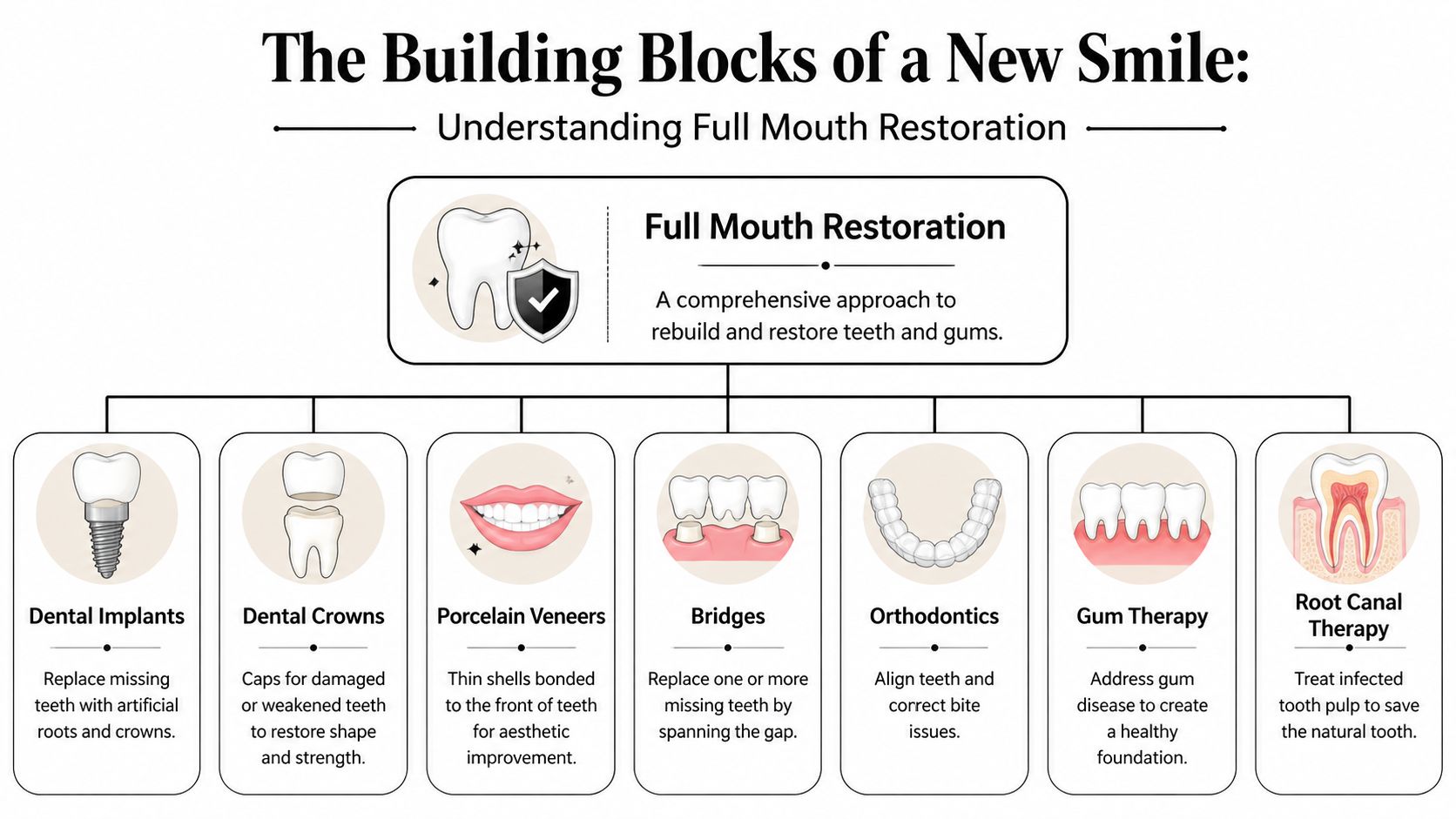
The procedures that may be included
A restoration plan may involve:
- Dental implants to replace missing teeth with a stable foundation
- Crowns to protect weakened or heavily restored teeth
- Bridges to span gaps when one or more teeth are missing
- Porcelain veneers when front-tooth appearance needs improvement and the teeth are otherwise suitable
- Root canal therapy to save teeth with deep infection
- Gum therapy to create a healthier foundation around teeth
- Orthodontic treatment such as Invisalign to improve alignment and bite balance
- Extractions when a tooth can't be predictably saved
Common procedures in full mouth restoration
| Procedure | Primary Purpose | Best For |
|---|---|---|
| Dental implants | Replace missing teeth at the root level | Patients with one or more missing teeth who want a fixed solution |
| Dental crowns | Restore shape, strength, and function | Teeth that are cracked, worn down, or heavily filled |
| Bridges | Fill a gap with connected replacement teeth | Patients missing teeth between healthy or restored neighboring teeth |
| Porcelain veneers | Improve visible front-tooth appearance | Patients focused on shape, color, and symmetry |
| Gum therapy | Treat infection and stabilize the foundation | Patients with bleeding gums, bone loss, or periodontal disease |
| Root canal therapy | Remove infection and preserve the tooth | Teeth with deep decay or nerve damage |
| Orthodontics | Reposition teeth and improve bite alignment | Patients with crowding, shifting, or bite imbalance |
Materials and technology matter
The quality of the plan isn't only about which procedures are chosen. It's also about the materials and how precisely everything fits together. Modern restorations often use zirconia, which has a bending strength of 1000 to 1200 MPa, especially in back teeth that handle heavier chewing forces. Lithium disilicate is often chosen for visible front teeth because it offers a more lifelike translucency. Digital workflows with CAD/CAM can produce restorations with less than 50μm deviation, as described in this overview of advanced full mouth reconstruction materials and digital precision.
Good dentistry doesn't just replace teeth. It creates a bite that works comfortably every day.
If you're exploring options for replacing missing teeth, our page on dental implants in Walnut Creek, CA explains how implants fit into a broader restorative plan.
What this means in real life
A patient with several worn teeth and two missing molars might need gum treatment first, then implants in the back, then crowns to rebuild the bite. Another patient may keep most of their natural teeth but need root canals, crowns, and clear aligners to create a healthier bite.
That's why a full mouth restoration isn't sold as a package. It's built like a blueprint.
Your Restoration Journey at Our Walnut Creek Office
Most patients feel better once they can see the process. The unknown is often the hardest part. A full mouth restoration becomes much less intimidating when it's broken into clear phases and tied to your specific needs.
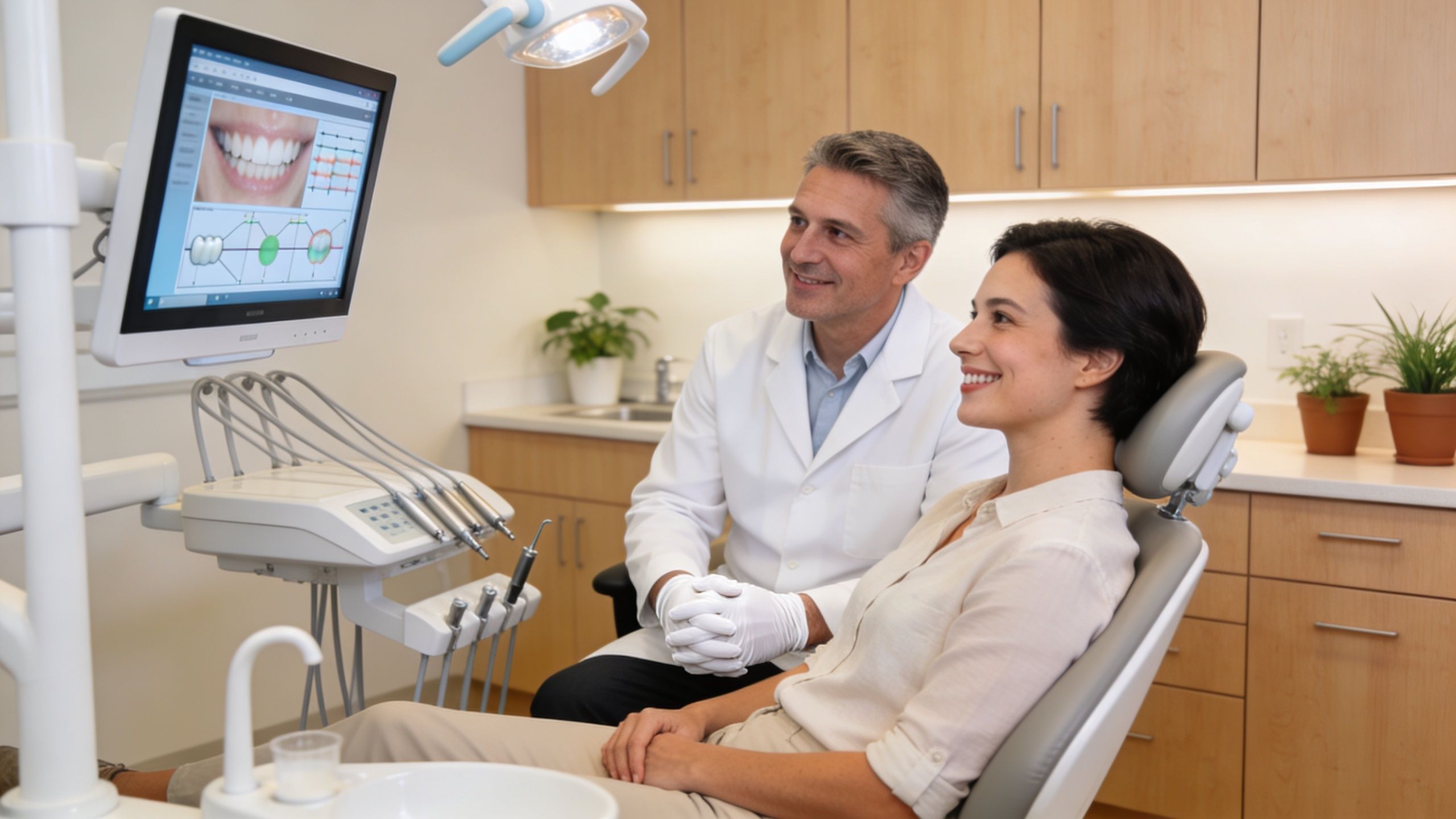
The first visit is a conversation as much as an exam. We want to know what hurts, what worries you, what you hope to change, and what has kept you from moving forward in the past.
Step one is understanding the whole picture
Your evaluation may include a clinical exam, digital dental x-rays, photos, and bite assessment. For more complex cases, planning often uses CBCT scans to evaluate bone, tooth roots, and anatomy in three dimensions. That level of detail helps us decide what can be saved, what should be replaced, and how to stage treatment safely and predictably.
A full mouth restoration is a phased process that starts with diagnostics, then foundational treatment such as gum therapy or bone grafting, followed by implant placement when needed, and finally permanent crowns or bridges. In some cases, early healing stages can take 3 to 6 months, as outlined in this explanation of the phased full mouth restoration process.
What the phases often look like
Most complete plans follow a sequence like this:
Diagnostic planning
We examine the teeth, gums, jaw function, and bite to map the final goal before any major treatment begins.Foundation and disease control
If gums are inflamed, teeth are infected, or certain teeth can't be saved, those issues need to be addressed first. This may include periodontal therapy, root canals, extractions, or grafting.Rebuilding support
Missing teeth may be replaced with implants or other restorations. Temporary restorations may also be used so you can function and smile during treatment.Final smile design and bite refinement
Crowns, bridges, or other final restorations are placed and adjusted so your teeth look natural and meet evenly.
Patients often ask whether everything happens at once. Usually, it doesn't. Breaking care into stages lets your mouth heal, lets us confirm each step is working, and makes the process more manageable physically and financially.
What your visits feel like
Care should feel organized, not chaotic. That means explaining why each phase comes first, what you'll feel afterward, and how long the next step may take. It also means making room for your questions.
This short video gives helpful visual context for how full mouth rehabilitation planning can come together in a real clinical setting:
Some patients arrive thinking their mouth is "too far gone." Often, what they really need is a clear plan and a starting point.
At William M. Schneider, DDS, full mouth cases are approached through personalized planning, modern diagnostics, and a phased sequence that helps patients in Walnut Creek understand exactly where they are in the process.
The Life-Changing Benefits of a Restored Smile
The biggest change isn't only cosmetic. It's functional. Patients often come in focused on how their teeth look, then realize later that the most meaningful difference is how normal daily life feels again.
Chewing becomes easier. Speech can feel more natural. You stop planning meals around pain, avoiding certain foods, or worrying that a damaged tooth will crack further.
Better function every day
When your bite is rebuilt properly, the mouth works more efficiently. That can mean being able to chew on both sides again, speaking without worrying about slipping dental work, and feeling less strain in the jaw muscles.
For many people, this translates into simple but important freedoms:
- Eat more comfortably with teeth that can handle daily function
- Speak more clearly when missing or unstable teeth are replaced
- Smile without covering your mouth in photos, meetings, and social settings
Confidence that looks natural
A good full mouth restoration shouldn't look artificial or bulky. It should fit your face, your smile line, and your bite. The goal is not a generic "perfect" smile. The goal is a healthy smile that looks like it belongs to you.
That matters for professionals, parents, and anyone who spends time talking face-to-face with others. When you no longer feel self-conscious about broken, worn, or missing teeth, you carry yourself differently.
Restoring a smile often restores ease. Patients notice it when they laugh, when they order in a restaurant, and when they stop thinking about their teeth every hour.
Long-term value for your oral health
Complete treatment also gives us a chance to stabilize the mouth instead of constantly reacting to the next failure. Clinical data support that long-term view. Full-mouth prostheses showed a 92% overall survival rate after five years, and individual components are durable as well. Dental implants can last 20 to 30 years or more, while crowns and bridges often last 10 to 20 years with proper care and regular checkups, according to this review of full mouth restoration longevity and survival outcomes.
No restoration lasts forever without maintenance. But when the foundation is healthy and the bite is balanced, you're no longer stuck in a cycle of temporary fixes. You're investing in stability.
Understanding the Cost and Investment in Your Health
Cost is one of the first questions people have, and it should be. Full mouth restoration is a significant decision, so you deserve a clear explanation of what affects the price and what options may help.
The total investment depends on your diagnosis. A person replacing several missing teeth with implants has different needs than someone rebuilding a worn bite with crowns and gum therapy. Materials, number of procedures, and whether preparatory treatment is needed all shape the final estimate.
Why the price varies so much
A full mouth plan is customized, so there isn't one flat fee that applies to everyone. Costs change based on factors such as:
- How many teeth are involved and whether they can be saved or must be replaced
- Which procedures are needed such as crowns, implants, bridges, extractions, or periodontal care
- What materials are selected for strength and appearance
- Whether staged treatment is required over time rather than in one concentrated phase
Published guidance notes that total costs can range from $20,000 to over $100,000, and that financing plans such as CareCredit are commonly used to help manage that expense. The same guidance notes that the initial outlay can deter 40% of candidates, and that foundational work often represents about 20% of the total cost, which may help when planning phased treatment. You can review those details in this discussion of full mouth restoration cost and financing considerations.
How patients make treatment more manageable
A large plan doesn't always have to start all at once. In many cases, treatment can be phased in a way that protects urgent needs first and spaces out later steps.
Patients often use a combination of:
- Insurance benefits for eligible restorative or disease-control portions of care
- Third-party financing such as CareCredit
- Phased scheduling so health priorities are addressed first
- Health spending funds when applicable through benefit plans
The best next step for a real estimate
Online numbers can only stay general. They can't tell you how many teeth are restorable, whether your bone support is adequate, or which option gives you the best long-term value.
That's why the most useful financial conversation starts after an exam and planning appointment. Once we know what your mouth needs, we can explain the order of treatment, what may be covered, and what payment options may help you move forward without guessing.
Are You a Candidate? Comfort and Sedation Options
Many people who need full mouth restoration delay care for two reasons. They aren't sure whether they qualify, and they're worried treatment will feel overwhelming.
Both concerns are reasonable. The answer usually starts with an exam, but there are some broad signs that help you know whether this kind of care may fit.

Who may be a good candidate
You may be a strong candidate if you have several problems happening at once. That could mean missing teeth, extensive wear, recurring breakage, old dental work that keeps failing, chronic infection, or a bite that no longer feels stable.
Good candidates are often people who:
- Want a long-term solution rather than repeated patch repairs
- Are healthy enough for dental treatment or can work with their physician when medical issues need coordination
- Are ready to commit to follow-up care and home hygiene after treatment
Some patients need medical clearance or additional planning first. If someone has uncontrolled health issues or active gum disease, we usually need to address those concerns before moving into the restorative phase.
Anxiety should not stop you from getting care
Fear of dentistry is common, especially for patients who have had painful experiences or who know they'll need several visits. Compassion matters here just as much as clinical skill.
A gentle approach includes clear explanations, comfortable pacing, and making sure you know what to expect before treatment begins. For patients who need extra help relaxing, sedation can make longer visits feel much more manageable.
Comfort matters: When patients feel safe and informed, they can finally start care they've delayed for years.
If you'd like to understand the options in more detail, this page explains how dental sedation works.
What comfort can look like during treatment
Comfort support may include local anesthesia, a calm treatment pace, and sedation when appropriate. Some patients benefit from shorter visits. Others prefer to complete more treatment in fewer appointments when possible.
The goal isn't to rush you. It's to help you move through treatment without dread. For many anxious patients in Walnut Creek, that change alone is what makes a full mouth restoration feel possible.
Frequently Asked Questions About Full Mouth Restoration
What is the difference between a smile makeover and a full mouth restoration
A smile makeover focuses mainly on appearance. It may improve color, shape, symmetry, or alignment. A full mouth restoration goes deeper. It addresses health, structure, bite function, damaged teeth, missing teeth, and gum support. In some cases, a treatment plan includes cosmetic elements, but health and function come first.
Will I lose all of my natural teeth
Not necessarily. This is one of the most common misunderstandings. Full mouth restoration doesn't automatically mean removing every tooth. If a tooth is healthy enough to keep and it fits the long-term plan, preserving it is often the better option.
How long does treatment take
The answer depends on what needs to be done and how much healing is required between phases. Some patients move through treatment more quickly because they need fewer procedures. Others need to slow down for healing, scheduling, or financial reasons. What's most important is that the sequence is planned correctly, not rushed.
Will my new teeth look natural
Yes, that is the goal. Natural-looking results come from careful planning, good materials, and designing the teeth to fit your face and bite rather than making them look generic or oversized. A well-done restoration should look healthy, balanced, and believable.
Is full mouth restoration painful
Treatment itself is managed with local anesthesia and, when appropriate, sedation support. After certain procedures, you may have soreness during healing, especially after extractions, gum treatment, or implant surgery. Most patients find that the process is more manageable than they expected once they understand the steps and know comfort options are available.
How do I take care of my restored smile
Daily care still matters. Restorations last longer when patients brush thoroughly, clean between teeth, follow home-care instructions for implants or bridges, and keep regular dental visits. Maintenance isn't an extra. It's part of protecting the investment you made.
Is this only for older adults
No. While many older adults need extensive dentistry, younger adults can also need full mouth restoration after trauma, grinding, severe decay, acid wear, or long-term bite problems. The right age is the age when your mouth needs a coordinated solution.
What if I feel embarrassed about how bad things have gotten
You're not alone, and you don't need to have everything figured out before you come in. Most patients seeking this kind of care have spent years adapting to discomfort, hiding their smile, or feeling unsure where to start. A consultation isn't a commitment to treatment. It's the first step in understanding your options.
If you've been searching for a dentist near me, a dentist in Walnut Creek, CA, dental implants near me, or a cosmetic dentist near me because you know your dental problems need more than a quick fix, this is the time to get clear answers. Whether you also need tooth extraction, restorative dentistry, or a new patient exam with dental x-rays, a thoughtful plan can make the process feel much more manageable.
If you're ready to find out what a full mouth restoration could look like for you, schedule a consultation with William M. Schneider, DDS. We'll evaluate your teeth, gums, bite, and goals, then walk you through a personalized plan so you can move forward with clarity, comfort, and confidence in Walnut Creek.