If you've been waking up tired in Walnut Creek, hearing that you snore, or noticing crowded teeth and jaw clenching, it can feel like three separate problems that never quite add up. Airway focused dentistry looks at those clues together, because the mouth, the jaw, the tongue, and the upper airway all work as one system.
For many people, that means a routine dental visit becomes the first place the bigger pattern finally gets noticed. At William M. Schneider, DDS in Walnut Creek, that kind of visit can connect the dots between sleep, breathing, and the way your teeth and jaws fit together.
When Snoring, Crowded Teeth, and Daytime Fatigue Point to the Same Problem
A lot of Walnut Creek patients come in with a simple story. They sleep a full night, but they still drag through the workday. A spouse mentions snoring. A teenager's teeth are crowded. Someone wakes with a dry mouth, clenches at night, or feels like sleep never fully restores them.
Those complaints can look unrelated at first. They're not always caused by the same thing, but they often point toward the same conversation, how well air moves through the upper airway while you sleep.
The mouth and airway are connected
The jaw, tongue, palate, and nasal passages all share space. If the arch is narrow or the jaw sits back, the tongue has less room, and breathing can become less efficient. A modern dental exam looks past the teeth alone and asks whether the shape of the mouth is helping or crowding the airway.
Practical rule: when sleep feels light, noisy, or unrefreshing, it's worth asking whether the problem is not just sleep itself, but the space air has to move through.
That shift in thinking matters for families in Walnut Creek because it changes where help starts. Instead of waiting for fatigue, snoring, or crowding to get worse, an airway-aware dental visit can identify whether the issue belongs in dentistry, sleep medicine, ENT care, or some combination of all three.
For patients searching for a dentist near me, a dentist in Walnut Creek, CA, or a cosmetic dentist near me who also understands airway concerns, that broader view can be the difference between treating symptoms and addressing the pattern behind them.
What Airway Focused Dentistry Means
Airway focused dentistry means the dentist looks at breathing space, not just tooth position. In plain language, it is a way of planning care that considers the upper airway, the tongue, nasal breathing, and jaw development before deciding how to move teeth or support the bite.
The mouth works like a gateway. If the entrance is tight, you can straighten the teeth all you want, but the crowding at the opening can still affect how air, the tongue, and the bite work together. Airway focused dentistry asks whether that gateway gives enough room for comfortable function.
How this differs from tooth-only treatment
Traditional dentistry often starts with the teeth, the gums, and the bite. That still matters. Airway focused dentistry adds another layer, because it asks whether a treatment plan could make the airway tighter, wider, or more stable over time.
That matters for both adults and children. In adults, it can influence whether orthodontic movement, a tooth extraction, or a restorative dentistry plan leaves enough room for the tongue and comfortable breathing. In children, it can help a dentist spot jaw and arch patterns early enough to guide growth instead of only straightening teeth later.
A practical local example is an Invisalign consult that does not stop at straight teeth. It also considers whether the arch shape supports the tongue and whether expansion, monitoring, or referral would make the plan more complete.
The same logic applies to sleep-related care. A dentist can help coordinate a sleep apnea pathway, but the dental role is not to do everything alone. It is to identify what is happening in the mouth and know when ENT or sleep medicine should join the case.
For more on an airway-centered orthodontic approach, the practice's airway-focused orthodontist information gives a useful local starting point.
Why Airway Focused Dentistry Matters Clinically
A Walnut Creek patient may come in for something ordinary, a cleaning, a sore jaw, or teeth that feel crowded, yet mention they wake up tired, snore, or breathe through the mouth at night. Those everyday complaints matter because they can point to a larger breathing issue that shows up first in the chair before it is fully recognized anywhere else.
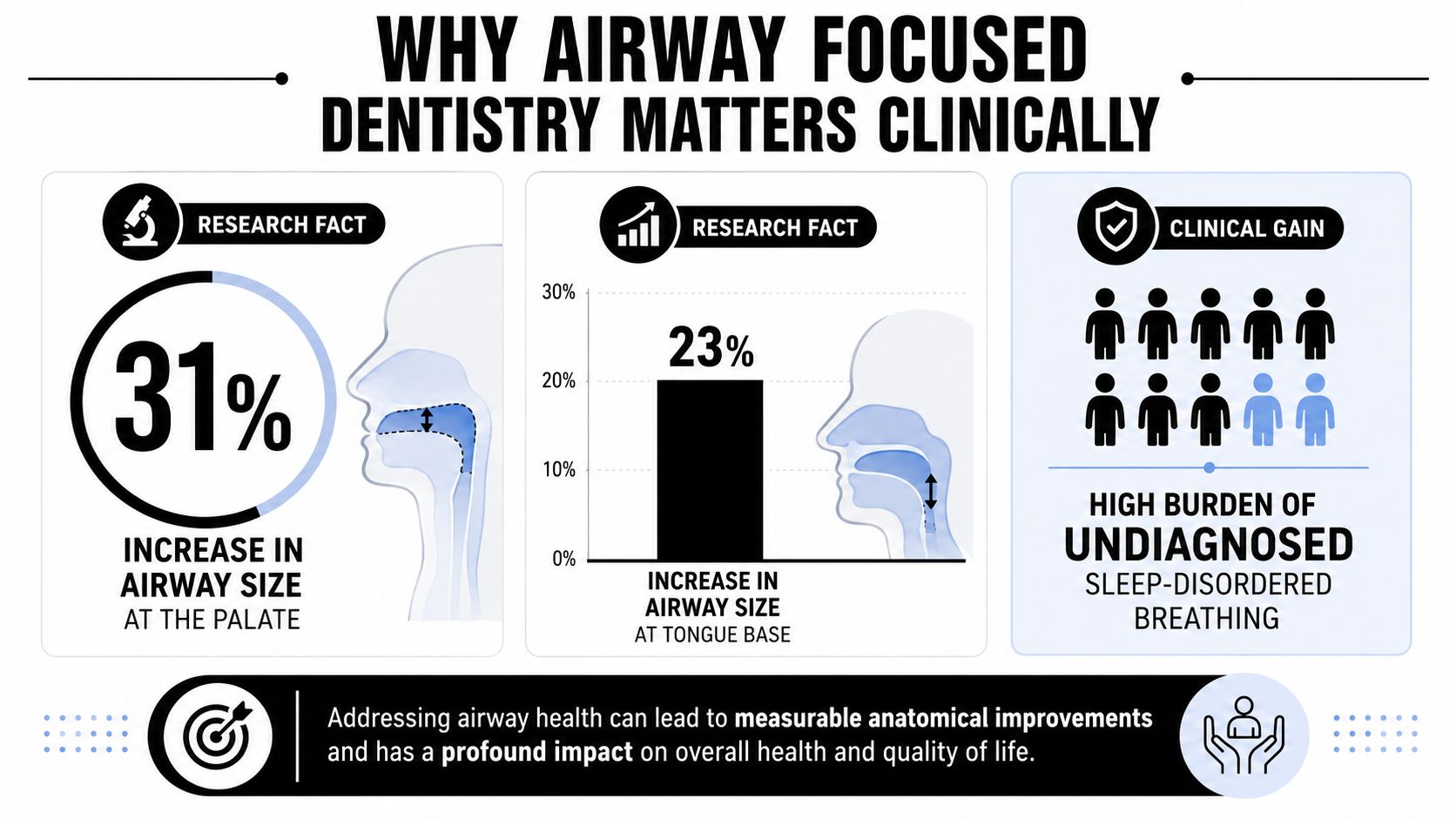
The clinical reason airway focused dentistry deserves attention is simple. Sleep-disordered breathing is common and often missed, and a NIH-hosted review states that obstructive sleep apnea affects approximately 20% of U.S. adults, while about 90% are undiagnosed. For a dentist, that means the mouth may be the place where a sleep problem first becomes visible, especially when a patient describes tired mornings, dry mouth, snoring, or a child with a narrow arch and restless sleep.
The numbers behind better airflow
Clinical value also comes from looking at what changes when airflow improves. The same NIH-hosted review describes a randomized trial of 302 patients in which oral appliance therapy reduced apnea-hypopnea index by 12 to 14 events per hour. It also cites a meta-analysis where 70% of children treated with rapid maxillary expansion showed decreased AHI by about 6 events per hour. Those findings help explain why airway focused dentistry pays attention to jaw shape, arch width, and tongue space instead of only whether the teeth line up neatly.
For a parent in Walnut Creek, that can mean a child who is bright in the morning but struggles later in the day may need more than a simple orthodontic opinion. For an adult, it can mean a history of snoring and low energy deserves a closer look before it is dismissed as stress or a busy schedule. The mouth and the airway share space, so a narrow arch or a jaw that does not leave enough room can affect how comfortably air moves during sleep.
A 2016 Airway Centric® dentistry article argued that airway optimization should become the standard of care and described child orthodontic changes showing a 31% increase in airway size at the palate, a 23% increase at the angle of the mandible, and a 9% increase at the hyoid level after Orthotropics® treatment. Those numbers matter because they show that airway-centered care can be tied to measurable anatomy, not just a vague sense that sleep or breathing seems better.
Why that changes the dental conversation
That is why a routine dental visit can become the place where symptoms finally get connected. A dentist does not diagnose every sleep problem alone, but the dental exam can identify crowded arches, a tongue that has nowhere comfortable to rest, signs of mouth breathing, or wear patterns that suggest clenching and interrupted sleep. From there, the next step may be an ENT evaluation for nasal or throat issues, or a referral into sleep medicine when the pattern suggests sleep-disordered breathing.
For a local patient, this matters because it creates a practical co-management path instead of an isolated opinion. One clinician can look at the bite, another can assess the nose and throat, and sleep medicine can evaluate what is happening overnight. That shared approach is often the cleanest way to separate a simple snoring problem from something that deserves a full airway workup.
Airway focused dentistry matters clinically because it helps the dental team see the mouth as part of the breathing system, not as a separate box. When the symptoms are tired mornings, snoring, crowded teeth, or a child who seems to sleep poorly, that broader view can change what gets noticed, what gets documented, and who should be involved next.
Signs You or Your Child Should Be Evaluated
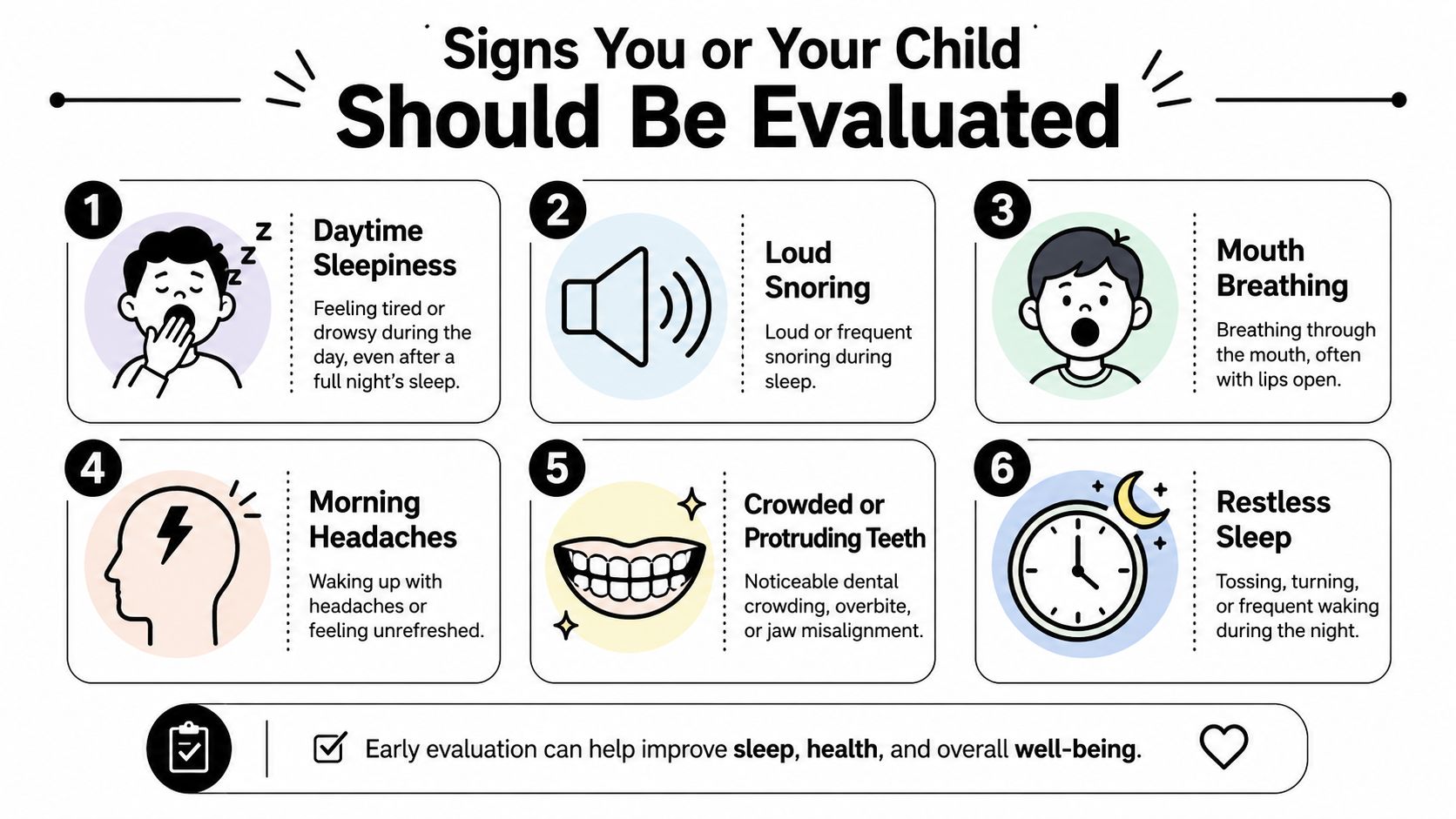
Some airway problems are obvious. Others look like everyday life until you step back and connect the dots. A patient might describe daytime sleepiness, loud snoring, or mouth breathing. A parent might notice a child sleeping restlessly, waking cranky, or struggling to stay focused.
Red flags worth taking seriously
The symptoms that tend to raise concern in a dental setting include:
- Daytime sleepiness, especially when sleep time sounds normal but energy doesn't return.
- Loud snoring, which can signal airway narrowing during sleep.
- Mouth breathing, a common clue that nasal breathing may not be working well.
- Morning headaches, which can show up when sleep quality is disrupted.
- Crowded or protruding teeth, because jaw shape and tongue space can be related.
- Restless sleep, which often shows up as frequent movement, tossing, or waking.
- Bedwetting or attention issues in children, which can sometimes travel with poor sleep quality.
None of those symptoms proves a diagnosis by itself. Plenty of people snore without having a serious airway disorder, and plenty of tired people are tired for other reasons. The point is pattern recognition. If several of these signs are happening together, it's time for a closer look.
Quick screening helps decide what comes next
A dental practice doesn't need to guess in the dark. The Epworth Sleepiness Scale (ESS) and STOP-Bang style screening are named tools used in airway review literature to flag risk quickly and comfortably (airway-centric orthodontics review). Those tools don't diagnose disease on their own. They help decide whether the patient needs dental monitoring, sleep testing, or medical co-management.
That's a reassuring place to start for families in Walnut Creek. You don't have to know the answer before walking in. You just need to notice the pattern and bring it up.
What Happens During an Airway Evaluation in Walnut Creek
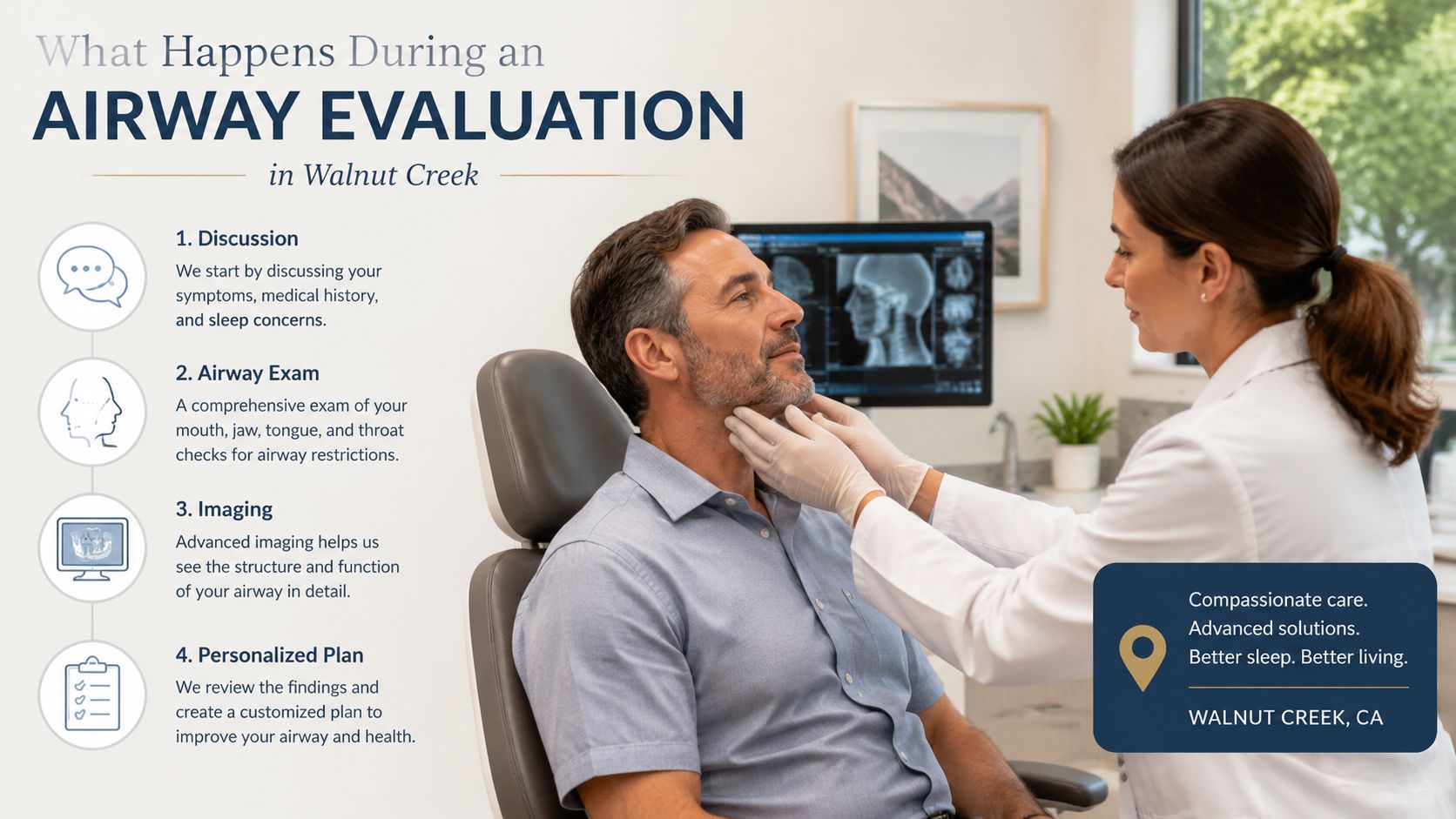
An airway-focused visit starts with conversation, not a machine. A dentist or team member asks about snoring, sleep quality, morning headaches, mouth breathing, tiredness, grinding, and any known sleep diagnosis. That history matters because the mouth exam only makes sense when it's matched to the way you sleep and feel.
The exam focuses on structure and function
The clinical exam looks at the tongue, palate, bite, jaw position, and signs that can hint at airway narrowing. One of those clues is the Mallampati view, which helps a dentist estimate how much of the throat space is visible. A high or narrow palate, mouth breathing, or crowded arches can all influence the next step.
If the case suggests airway compromise, the dentist may use CBCT imaging to visualize airway volume and surrounding anatomy. That's where a dental practice can see beyond the teeth and into the space behind them. The goal is not to chase every finding. The goal is to figure out whether the anatomy supports healthy breathing or seems to be working against it.
Independent clinical guidance also describes rhinomanometry for nasal airflow and resistance, plus overnight oximetry or sleep studies when the signs point toward sleep-disordered breathing (FOMM airway review). Those tools help connect anatomy with physiology, which is where airway care becomes practical instead of speculative.
What patients can expect after the exam
The result should be a written plan, not a vague worry. Sometimes that plan stays in dentistry, sometimes it includes orthodontic expansion or an oral appliance, and sometimes it means referral to an ENT or sleep medicine physician when the issue needs medical management.
For families looking for new patient exams, cleaning and exams, dental x-rays, or a more complete airway workup, this is the kind of visit that can fit into regular care without feeling overwhelming. If the symptoms point to a sleep problem, the practice can co-manage with medical colleagues so the patient isn't stuck carrying the whole process alone.
Treatment Options Available Locally
Airway treatment is usually a menu, not a single product. The right choice depends on whether the problem is mainly muscle pattern, tooth position, jaw shape, nasal airflow, or a sleep disorder that needs medical care. That's why a patient in Walnut Creek might hear about more than one option during the same consultation.
| Common Airway Focused Treatment Options at a Glance | What It Does | Best Suited For |
|---|---|---|
| Myofunctional therapy | Retrains tongue and breathing habits to support nasal breathing | Patients with mouth breathing patterns or poor tongue posture |
| Custom oral appliances | Moves the lower jaw forward during sleep to help open the airway | Mild to moderate sleep-disordered breathing, snoring, or appliance candidates |
| Orthodontics and expansion | Widenes the arch or improves space for the tongue and bite | Crowded arches, narrow palate, growth-related concerns, or airway-aware Invisalign plans |
| ENT or surgical referral | Addresses structural issues outside dentistry's scope | Patients who need medical airway management or further evaluation |
How the options fit together
Myofunctional therapy is about retraining habits. It won't move teeth by itself, but it can help the tongue rest higher and the lips close more naturally, which supports better breathing mechanics.
Custom oral appliances are a different tool. The practice can use a sleep apnea oral appliance pathway when a patient needs a non-CPAP dental option and meets the right clinical profile. These devices are often discussed with patients who snore, have mild to moderate sleep-disordered breathing, or need a travel-friendly treatment.
Orthodontics, including Invisalign when appropriate, addresses the shape of the bite and the room available for the tongue. In some cases, expansion or alignment supports a broader restorative plan too, especially when a patient is also considering dental implants near me searches, crowns, or other restorative dentistry needs.
Where dentistry stops and medicine starts
Some airway problems need medical care first. Structural nasal blockage, enlarged tonsils, or a more complex sleep disorder may call for ENT or sleep medicine involvement. That doesn't mean the dental visit failed. It means the patient got routed to the right team.
William M. Schneider, DDS also provides Invisalign, sleep apnea appliance care, and restorative services, so the plan can stay coordinated when orthodontic or functional treatment overlaps with routine dental work. That combination is often what makes the care pathway feel manageable instead of fragmented.
Benefits Beyond a Better Night's Sleep
When airway care works, the changes show up in ordinary life. Patients often feel steadier through the workday, wake with less morning fog, and notice that bedtime is quieter for the whole house. For parents, it can also mean fewer worries about restless sleep or behavior that seems out of sync with a child's energy.
Airway focused dentistry can also support other dental goals. Straightening teeth on a jaw that has enough room tends to be more stable than forcing alignment into a crowded space. That matters for cosmetic dentistry, and it matters for dental implants, because good function helps protect the work you invest in.
The bigger benefit is a clearer plan. Instead of guessing whether the tiredness, snoring, or crowding are connected, the patient gets an evaluation that links symptoms to anatomy and sleep physiology. That makes follow-through easier, especially when the next step is co-management with ENT or sleep medicine.
For Walnut Creek and the East Bay, the value is simple. You can bring a sleep complaint, a jaw concern, or a crowded smile to one local office and get a thoughtful answer instead of a shrug.
If you're ready to find out whether snoring, fatigue, mouth breathing, or crowded teeth are connected, William M. Schneider, DDS offers dental care with airway-aware evaluations, Invisalign, sleep apnea appliance treatment, and restorative options in Walnut Creek. Schedule a visit with William M. Schneider, DDS to talk through your symptoms, review your airway concerns, and choose the next step with a local team that knows how to coordinate care.