You wake up with a sore spot near your lip or inside your mouth. By breakfast, talking stings, coffee irritates it, and you’re already searching “dentist near me” or “emergency dentist” because you want a clear answer fast.
That confusion is common. Many people use cold sore and canker sore as if they mean the same thing, but they don’t. They have different causes, different risks, and different treatments. Getting that distinction right matters, especially if you’re trying to avoid spreading a cold sore to a partner or child, or if you keep getting painful sores and want to know why.
For perspective, cold sores caused by HSV-1 are extremely common. The World Health Organization reports that about 3.7 billion people under age 50 carry HSV-1 globally, and in the U.S. nearly 90% of adults are estimated to be infected, although many never develop symptoms, according to the National Institute of Dental and Craniofacial Research on fever blisters and canker sores. That’s one reason mouth sores create so much uncertainty. A very common viral sore can look similar, at first glance, to a noncontagious ulcer.
If you’re in Walnut Creek, CA and trying to figure out whether you’re dealing with a cold sore vs canker sore in mouth, the fastest way to reduce stress is to look at a few specific clues: where it is, how it started, what it looks like, and how long it lasts.
Finding a Painful Sore in Your Mouth? Your Walnut Creek Dentist Can Help
A painful mouth sore can throw off your whole day. Eating becomes careful. Brushing feels like a chore. Even smiling or speaking at work can be uncomfortable.
A common initial question is simple: What is this? The second is usually more urgent: Is it contagious? Those are the right questions to ask.
Why the right diagnosis matters
Cold sores and canker sores overlap in one important way. Both hurt. That’s where the similarity starts to end.
A cold sore is linked to HSV-1, a virus that can reactivate after lying dormant in the body. A canker sore is a nonviral ulcer that appears inside the mouth and doesn’t spread from person to person. If you mistake one for the other, you can waste time on the wrong treatment and miss the bigger issue.
A few practical examples:
- If it’s a cold sore, protecting other people matters. Kissing, sharing utensils, and close contact can spread the virus.
- If it’s a canker sore, the focus is usually comfort, reducing irritation, and figuring out whether trauma, stress, or another trigger is involved.
- If the sore doesn’t heal on schedule, it needs a closer look, no matter which type you suspect.
Practical rule: A mouth sore that keeps returning in the same pattern, becomes hard to ignore, or lasts longer than expected deserves an in-person exam.
What patients usually want to know right away
Individuals aren’t looking for a textbook explanation. They want clear guidance they can use today.
Start with these questions:
- Is the sore inside the mouth or on the lip border?
- Did it begin with tingling or itching, or did it start as a tender ulcer?
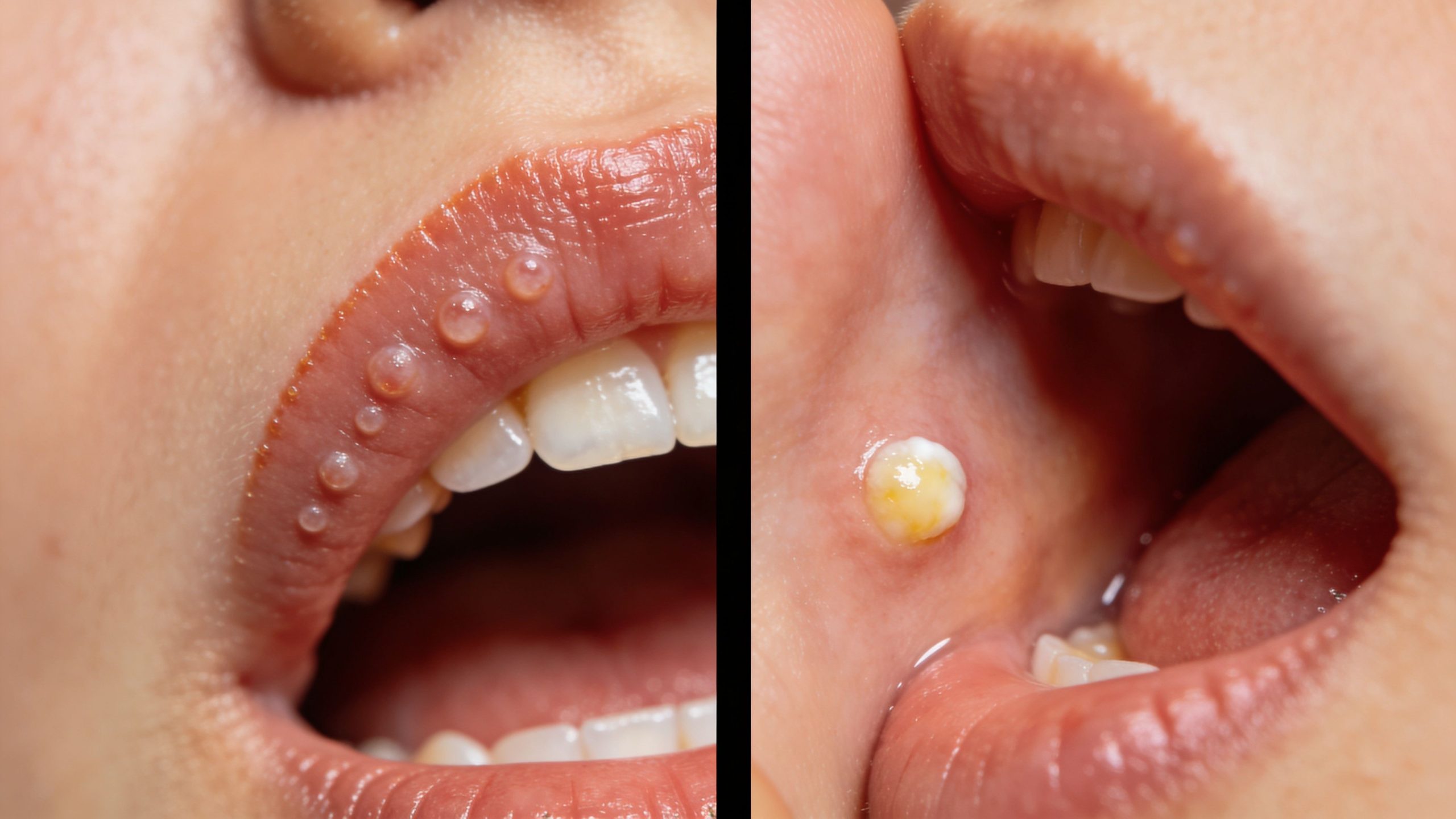
- Does it look like a blister cluster or a single round sore?
- Is it getting better, or is it lingering?
Those details usually point in the right direction.
If you’ve been searching for a dentist in Walnut Creek, CA because a sore is interfering with meals, speech, or daily comfort, a dental exam can help sort out what’s routine, what needs treatment, and what shouldn’t be ignored. That’s true whether you came in for sore relief, a new patient exam, urgent dental care, or because you want a local office that can explain things plainly.
The First Clue Location and Initial Symptoms
The easiest way to start telling a cold sore vs canker sore in mouth apart is by location. That single clue clears up a lot of confusion.
| Feature | Cold sore | Canker sore |
|---|---|---|
| Typical location | Usually on or around the lips | Only inside the mouth |
| Early sensation | Often tingling or itching first | Often soreness or burning |
| Contagious | Yes | No |
| Common look | Small fluid-filled blisters in clusters | Round or oval ulcer with pale center |
| Best first move | Avoid close contact and consider early antiviral treatment | Reduce irritation and support healing |
Where the sore shows up
Cold sores usually appear outside the mouth, especially on the lip border or nearby skin. Canker sores happen inside the mouth on softer tissues such as the inner cheeks, tongue, gums, or inner lip.
That inside-versus-outside rule is the first thing I’d want any patient to know. It’s not perfect in every case, but it’s the most useful first filter.
How it feels before you can see much
The second clue is how the sore begins.
Cold sores often announce themselves before they fully appear. According to Orajel’s overview of the difference between canker sores and cold sores, a tingling prodrome happens in 80% to 90% of cases, and cold sores are highly contagious when the blisters rupture around day 4. Canker sores, by contrast, are shallow ulcers with a white-yellow center found only on soft, non-keratinized tissue inside the mouth, and they have zero contagion risk.
That means the early feeling matters:
- Tingling or itching near the lip points more toward a cold sore.
- A sore, raw feeling inside the mouth points more toward a canker sore.
If a patient says, “I felt a tingle yesterday and woke up with little blisters on my lip,” I think cold sore first. If they say, “I have one painful round spot inside my cheek,” canker sore moves much higher on the list.
Who commonly gets canker sores
Canker sores are also common enough that many people will deal with them sooner or later. According to Medical News Today’s canker sore vs cold sore comparison, canker sores affect up to 25% of the population, and about 1 in 5 people in the U.S. experience them at least once a year. That same source notes they’re more common in women and young adults and are often triggered by minor mouth injuries, stress, or nutritional deficiencies.
So if you bit your cheek, switched to a harsher oral care routine, or have a sore after irritation from food or dental appliances, a canker sore becomes more likely.
Cold Sore vs Canker Sore A Detailed Comparison
A sore can look small and still raise big questions. Patients usually want more than a label. They want to know whether it is contagious, why it keeps happening, and whether it signals a larger health issue.
Cause and contagiousness
The clearest medical difference is the cause.
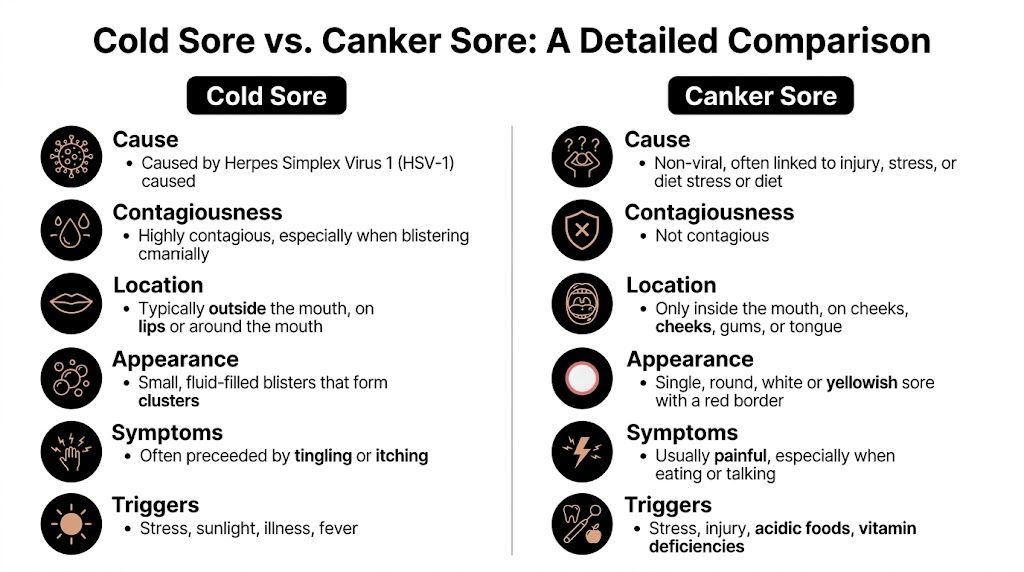
A cold sore is caused by HSV-1, a virus that can spread through direct contact while the sore is active. A canker sore is an inflammatory ulcer, not an infection, so it does not spread from person to person.
That difference affects daily decisions. A cold sore means being careful with kissing, shared drinks, utensils, towels, and lip products. A canker sore calls for comfort and irritation control, not isolation.
Safety point: If the sore might be a cold sore, avoid close contact and shared items until the area has fully healed, especially around children, older adults, and anyone with a weakened immune system.
Appearance and feel
Appearance helps, but the tissue involved matters just as much.
Cold sores usually:
- Begin with tingling, burning, or itching
- Form small grouped blisters
- Break, ooze, and crust during healing
- Appear on or around the lips most often
Canker sores usually:
- Look like a round or oval ulcer
- Have a white or yellow center with a red border
- Show up on softer tissue inside the mouth
- Sting with eating, brushing, or speaking
In practice, I also pay attention to whether the sore is sitting on movable inner cheek or lip tissue versus tissue that is tighter and more fixed. That detail can help sort out less obvious cases.
Healing timeline
Timing gives useful clues.
Cold sores often follow a more staged pattern, with blistering, breaking, and scabbing before they resolve. Minor canker sores usually heal faster and without crusting because they stay inside the mouth. A sore that lasts longer than expected, grows, or keeps returning in the same area deserves a closer exam.
Quick comparison at a glance
| Category | Cold sore | Canker sore |
|---|---|---|
| Cause | HSV-1 virus | Nonviral ulcer |
| Usual location | Lip border, around mouth | Inside mouth only, usually on soft tissue |
| How it starts | Tingling, itching, burning | Tender spot, burning, raw feeling |
| Look | Clustered blisters, then crusting | White or yellow ulcer with red rim |
| Contagious | Yes | No |
| Typical healing | Often about 1 to 2 weeks | Often shorter if minor |
The confusing cases patients ask about
Patients in Walnut Creek often come in saying, “It’s inside my mouth, so it can’t be a cold sore, right?” Usually that is true. Canker sores stay on the soft lining inside the mouth. Cold sores usually affect the lip border and nearby skin.
There are exceptions, and that is where self-diagnosis gets tricky. HSV-related sores can sometimes show up on oral tissues, especially in patterns that do not match the classic single canker sore look. Recurrent sores, clusters, widespread tenderness, or ulcers that do not behave like the usual brief canker sore need professional evaluation.
This is one reason I treat recurring mouth sores as a diagnostic issue, not just a comfort issue. Sometimes the answer is simple irritation. Sometimes we need to look harder at stress, immune status, nutritional factors, dental friction, or oral hygiene habits. Consistent oral hygiene best practices from your Walnut Creek dentist can reduce irritation, but they do not replace an exam when the pattern is unusual.
What works and what usually does not
Treatment works better when the diagnosis is right.
For a cold sore, soothing products may reduce discomfort, but they do not address the viral process the way early antiviral treatment can. For a canker sore, antiviral medication is usually not the answer. Protection, reduced friction, and anti-inflammatory care are often more helpful. The basic idea overlaps with how pimple patches heal acne. A protected area is less likely to get irritated over and over. The difference is that mouth tissue needs products made for oral use.
That trade-off matters. If you keep treating a canker sore like a cold sore, or a cold sore like a canker sore, you lose time and stay uncomfortable longer.
Finding Relief At-Home and Professional Treatment Options
You feel a sore in the morning, try an over-the-counter product that seemed right, and by dinner it still burns when you eat or talk. That is a common reason patients call our office. Relief usually comes faster when the treatment matches the type of sore.
Home care that makes sense
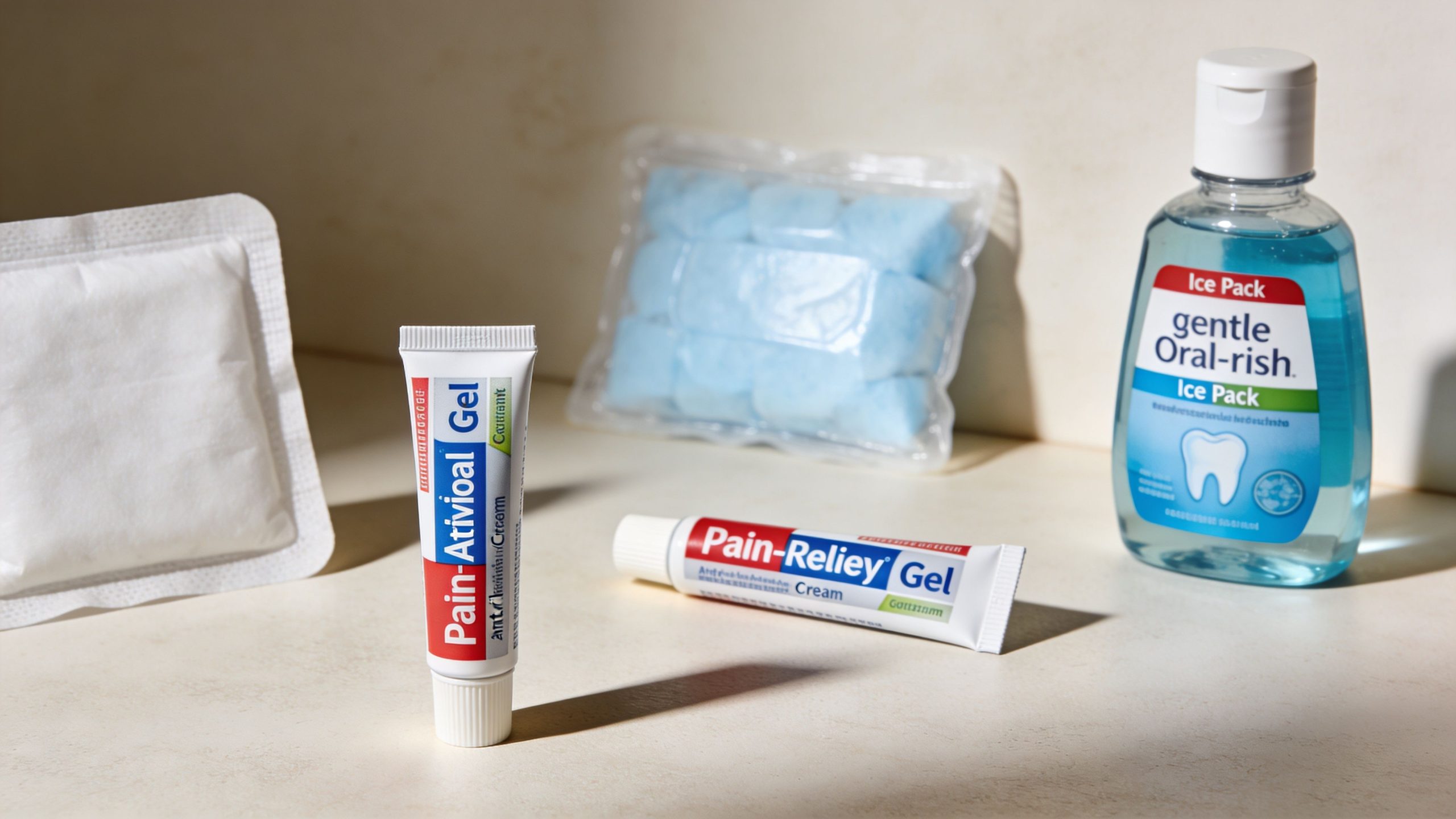
The first goal at home is to calm the tissue and stop anything that keeps re-irritating it. Patients often want the strongest product available. In practice, the better first step is usually reducing friction, avoiding trigger foods, and keeping the area clean without scrubbing it.
These steps are usually helpful:
- Choose bland, softer foods until the sore settles down. Citrus, tomatoes, spicy foods, salty snacks, and sharp chips can keep the area angry.
- Use a soft toothbrush and brush gently around the sore.
- Avoid touching or picking at it. That slows healing, and with cold sores, it can also spread the virus to nearby skin.
- Use a cool compress on a cold sore near the lip if you have swelling or throbbing discomfort.
- Rinse gently with a mild saltwater rinse if your mouth feels irritated, as long as it does not sting too much.
Protection also matters. If you have seen how pimple patches heal acne, the concept is similar. Covered tissue gets less repeated irritation. The difference is that oral tissues need products made for the mouth or lips, not skin-only treatments.
Small changes in your daily routine can help more than people expect. If recurring irritation is part of the problem, these oral hygiene best practices in Walnut Creek can help you spot habits, products, or brushing patterns that may be slowing healing.
Over-the-counter and prescription options
Cold sores and canker sores respond to different treatments. That is the practical issue.
For cold sores, early treatment matters most. An antiviral cream or prescription antiviral medication can help if you start it at the tingling or burning stage, before the sore fully develops. Once the blister is established, treatment may still help, but the benefit is usually smaller.
For canker sores, the focus is different. These sores often respond better to anti-inflammatory treatment, pain-relieving oral gels, protective pastes, and reducing trauma from food, brushing, or appliances. If a canker sore is large, unusually painful, or keeps returning, a prescription topical steroid may be appropriate.
Here is the trade-off I explain in the office. Cold sore care aims to shorten the viral outbreak and reduce spread. Canker sore care aims to reduce inflammation, control pain, and give the tissue a chance to heal without being rubbed over and over.
A short clinical explainer can also help if you like seeing the basics summarized:
When professional care helps most
Home care is reasonable for a small, familiar sore that improves on schedule. An exam makes sense sooner if the pain is significant, the sore lasts longer than expected, or you are not sure what you are looking at.
Professional dental care may include:
- Confirming the diagnosis based on location, appearance, and symptoms
- Checking for trauma from a sharp tooth edge, dental work, aligners, dentures, or a night guard
- Prescribing stronger treatment when over-the-counter care is not enough
- Looking for patterns that suggest stress, nutritional factors, immune issues, or another oral condition
- Deciding when a biopsy or referral is appropriate if a sore does not heal normally
That last point matters. A recurring sore is not always just a recurring sore. Some patients have repeated canker sores because of irritation or inflammation. Others have a lesion that only looks similar at first. Rarely, cold sores can show up on internal mouth tissue in a way that confuses the picture, which is why a careful exam is more useful than guessing from a photo online.
A sore that keeps interfering with eating, speaking, or daily comfort deserves a clear diagnosis, not repeated trial and error.
In our Walnut Creek practice, the goal is not just to get you through this week’s sore. It is to figure out why it happened, what will help it heal now, and whether anything in your mouth is setting you up for the next one.
Understanding Why Your Mouth Sores Keep Returning
A one-time sore is annoying. A sore that keeps coming back is different. At that point, the question shifts from “How do I get rid of it?” to “Why does this keep happening?”

Why cold sores recur
Cold sores recur because HSV-1 stays in the body after the first infection. A person may go long periods without symptoms, then get a flare when a trigger shows up.
Common triggers include:
- Stress
- Sun exposure
- Illness
- Hormonal changes
If cold sores are a repeated issue for you, prevention becomes as important as treatment. Practical prevention guidance can help you reduce cold sore recurrences by paying closer attention to trigger patterns and early symptoms.
Why canker sores may keep returning
Canker sores can be more frustrating because there isn’t one single cause. They often come from a mix of irritation, stress, food sensitivity, or tissue trauma. A sharp food edge, accidental cheek bite, or rubbing from an appliance can be enough to start the cycle.
The harder cases are the recurrent ones that don’t fit a simple pattern.
According to this discussion of canker sores and cold sores, 5% to 10% of recurrent canker sore cases may be linked to underlying systemic conditions such as celiac disease, Crohn’s disease, or nutrient deficiencies including B12, iron, and zinc. That same source notes these nutrient deficiencies are prevalent in up to 20% of U.S. adults.
That doesn’t mean every recurring canker sore signals a major medical problem. It does mean persistent recurrence shouldn’t always be brushed off.
Recurrent canker sores sometimes act like a clue, not just a nuisance. The sore may be the symptom you feel first, while the real issue is nutritional, inflammatory, or mechanical.
When recurrence changes the conversation
A dentist looks at more than the sore itself.
If sores keep returning, useful questions include:
- Do they always show up in the same spot?
- Is there a rough tooth, filling edge, or appliance rubbing there?
- Did the pattern change recently?
- Are meals, stress, or hormonal cycles involved?
- Is healing becoming slower or less predictable?
That broader view matters for long-term oral health. Sometimes the answer is simple, such as removing a source of friction. Sometimes a dental exam points to the need for medical follow-up. Both are valuable outcomes because they move you closer to a real solution.
What to Expect at Your Dental Visit in Walnut Creek
Most patients feel better once they know what the appointment will involve. A sore evaluation is usually straightforward, focused, and much less intimidating than people expect.
The exam itself
The visit starts with a conversation about timing, symptoms, recurrence, and triggers. A dentist wants to know when the sore appeared, whether it started with tingling or pain, whether it has happened before, and what makes it worse.
Then comes the visual exam. The key details are:
- Exact location
- Shape and surface
- Whether it looks ulcerated or blistered
- Whether nearby teeth, restorations, or appliances may be irritating the tissue
If you’ve never had a focused oral exam for a sore before, this overview of what happens during a dental exam gives a good sense of the process.
How the visit connects to other dental care
A mouth sore appointment can overlap with other parts of dentistry more than patients expect.
For example:
- A recurring sore may be worsened by a rough edge on a tooth or crown
- Orthodontic movement or clear aligners may be creating localized irritation
- A patient planning teeth whitening or cosmetic dentistry may need to wait until tissue heals
- A patient with urgent pain may think they need a tooth extraction or root canal, when the underlying issue is soft tissue
That’s why a careful diagnosis matters. It prevents overtreating the wrong problem.
Comfort and anxiety support
Patients with dental anxiety often delay care because they assume the exam will be painful. For a mouth sore concern, that fear usually doesn’t match reality. Most evaluations are visual, gentle, and brief.
The right office should explain findings clearly, tell you what type of sore is most likely, and give you a plan that makes sense. If the sore appears routine, you leave with reassurance and practical care steps. If it doesn’t, you leave with a clearer path instead of ongoing guessing.
A good dental visit doesn’t just identify the sore. It answers the questions that have been bothering you since you noticed it.
For people searching dentist in Walnut Creek, CA, cosmetic dentist near me, or emergency dentist because something in the mouth suddenly hurts, that clarity is often true relief.
Frequently Asked Questions About Mouth Sores
Is it safe to get a dental cleaning or other dental work done if I have a cold sore
Sometimes yes, but it depends on the type of appointment and where the lesion is. A cold sore is contagious, so the office needs to consider your comfort, tissue irritation, and the risk of spreading the virus during treatment.
If the procedure requires stretching the lips or working close to an active lesion, rescheduling may be the better choice. If the issue is urgent, the team can decide whether treatment should still move forward with appropriate precautions. Call before the appointment instead of guessing.
Can a cold sore be inside the mouth
Cold sores are commonly perceived as lip lesions, and that’s the classic presentation. But when patients search cold sore vs canker sore in mouth, they’re usually asking because the location seems less obvious than expected.
That’s one reason self-diagnosis gets tricky. A sore inside the mouth isn’t automatically a canker sore. The exact tissue type, the appearance, and the timing still matter. If the area is confusing or you’ve had similar sores before, an exam is the fastest way to sort it out.
When should I worry that a sore could be something more serious
A sore deserves closer attention if it lasts longer than 14 days, keeps returning without a clear reason, becomes unusually large, or doesn’t behave like the common patterns described earlier. A lesion that won’t heal on schedule should never be dismissed repeatedly.
This doesn’t mean the sore is something dangerous. It means the normal “wait and see” window has passed, and it’s time for a professional evaluation.
How can I avoid spreading a cold sore to my family
Focus on direct-contact precautions while the sore is active.
Helpful habits include:
- Don’t kiss anyone while the lesion is active
- Don’t share cups, utensils, towels, or lip products
- Wash your hands after touching the area
- Avoid picking at crusting or blistered tissue
These steps matter most with children and partners because cold sores spread through close personal contact.
Why do I keep getting canker sores every month
Monthly canker sores usually mean there’s a repeating trigger. For one person, that might be cheek biting, a rough edge on a tooth, or irritation from a dental appliance. For another, it may line up with stress, certain foods, or a nutritional issue.
The key is not to stop at “I guess I’m prone to them.” If sores are frequent, a dentist can check for local causes inside the mouth and help determine whether you also need medical follow-up for an underlying issue.
If you’re dealing with a painful mouth sore and want a clear diagnosis from a trusted local dental office, William M. Schneider, DDS provides compassionate, thorough care for patients in Walnut Creek, CA. Whether you need reassurance, relief, or a closer look at recurring sores, schedule an appointment to get answers and a treatment plan that fits your needs.