A missing molar can make ordinary moments feel surprisingly difficult. Food gets trapped in the gap, chewing shifts to one side, and a smile that once felt automatic starts to feel guarded. If you're searching for a dentist in Walnut Creek, CA, or comparing dental implants near me, the first question is usually simple: “Am I a candidate?”
At William M. Schneider, DDS, implant candidacy isn't treated as a quick yes-or-no answer. The decision depends on your jawbone, gum health, medical history, medications, habits, imaging, and willingness to complete the care needed for predictable healing. A tooth extraction, periodontal treatment, bone graft, or other preparatory step may change the answer.
A Walnut Creek Patient's First Question About Implants
A patient sitting in the chair after a routine cleaning near Civic Park recently asked a question I hear regularly: “I lost a molar months ago. Could I get a dental implant, or is it too late?”
The question usually carries several others underneath it. Patients want to know whether the surgery will hurt, how long healing will take, whether the treatment will fit their budget, and whether a diagnosis such as diabetes will automatically disqualify them. Older adults often ask whether age alone rules out treatment. Some people have already been told they have “too little bone,” and they assume that means the conversation is over.
It usually isn't.
A practical way to think about candidacy: You aren't applying for a permanent pass or failing a single test. You're building the conditions an implant needs to heal and function.
Modern implant dentistry no longer treats chronological age as the primary gatekeeper. Evidence indicates there is no upper age limit for dental implants, and adults in their 70s, 80s, and even 90s may be candidates when their oral and systemic health support surgery and healing. The relevant questions are whether the jaw can support osseointegration, whether the gums are stable, and whether your body can tolerate the procedure and aftercare. This shift toward health-based implant evaluation explains why age alone rarely settles the decision.
For Walnut Creek patients, the process should be practical as well as clinical. A proper evaluation looks at local anatomy with imaging, identifies risks that can be changed, and separates a patient who is ready now from one who needs preparation first. It also identifies situations where a bridge, partial denture, or another restorative option may make more sense.
That is the central idea behind dental implant candidacy. Some patients qualify immediately. Others become candidates after gum therapy, smoking cessation, diabetes management, bone grafting, or treatment of an infection. A smaller group may be better served by a non-implant restoration. The responsible answer comes from a complete examination, not a slogan.
What Dental Implants Are and Why Candidacy Matters
A dental implant replaces the root of a missing tooth. The implant itself is a small titanium post placed in the jawbone. An abutment connects that post to the visible restoration, usually a custom crown for a single missing tooth.
The process has three basic parts:
- The implant post provides an artificial root.
- The abutment connects the post to the restoration.
- The crown, bridge, or denture restores the part you see and use when chewing.
A single implant can replace one tooth without attaching to the neighboring teeth. Several implants can support a bridge when multiple teeth are missing. For complete tooth loss, an implant-supported denture or full-arch restoration can provide more stability than a conventional removable denture.
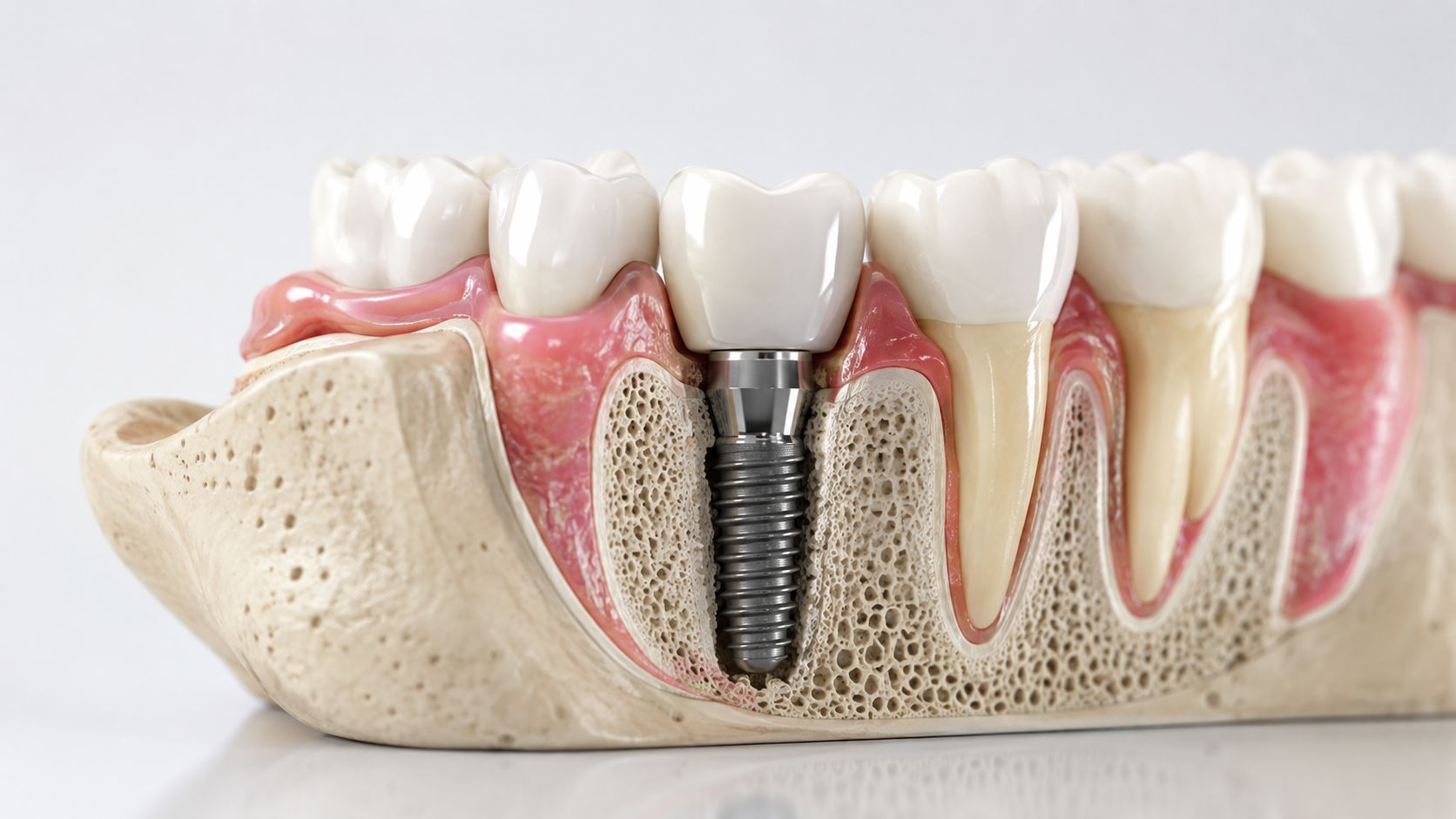
The reason candidacy matters is the way an implant heals. Your jawbone must gradually bond with the titanium surface through osseointegration. If the bone is too thin or weak, the implant may lack a stable foundation. If gum disease remains active, inflammation and bacteria can threaten the tissues around the implant. If healing is impaired by uncontrolled disease, tobacco exposure, or certain treatments, the procedure may carry more risk.
A good candidate generally needs:
- Adequate bone volume and quality at the planned site.
- Stable gum health without untreated periodontal infection.
- Medical conditions managed well enough to support healing.
- A bite that can be planned safely, especially if you grind or clench.
- The ability to maintain the implant with daily cleaning and professional follow-up.
The process also requires patience. Implant treatment may involve extraction, healing, placement, integration, and restoration rather than one quick appointment. The right plan respects biology instead of rushing the calendar.
Key Factors That Decide Dental Implant Candidacy
The implant site tells us a great deal. After a tooth is removed, the jawbone no longer receives stimulation from that root, and the ridge can gradually narrow. A molar that has been missing for a long time may therefore require more planning than a recently lost tooth. A three-dimensional scan helps determine whether the site has sufficient height, width, and density, or whether grafting should come first.
Healthy gums matter just as much. Active periodontal disease must be treated and stabilized before implant placement because the tissues surrounding an implant need to remain free of uncontrolled infection. A history of gum disease isn't an automatic rejection, but it does make maintenance and periodontal monitoring more important. Patients can review how periodontal care and implants fit together in this guide to dental implants and periodontics.
Medical history and lifestyle risks
Well-controlled diabetes isn't automatically a barrier. A 2023 S3 guideline states that implant treatment can be safe and predictable when glucose is controlled, while poorly controlled diabetes calls for extra caution, particularly with immediate or early loading because osseointegration may be delayed. The guideline on dental implants and diabetes supports a control-based assessment rather than a diagnosis-based refusal.
Uncontrolled diabetes, immunosuppression, active cancer treatment, recent intravenous bisphosphonate use, and head-and-neck radiation can substantially change the plan. These conditions may increase infection risk, interfere with bone remodeling, or reduce healing capacity. They don't always mean treatment is impossible, but they may require medical coordination, staging, or a different restoration.
Smoking deserves direct discussion. A large meta-analysis found that smoking nearly doubled overall implant failure risk, with a risk ratio of 1.92, and another systematic review reported about 2.4 times higher failure risk among smokers than non-smokers. Heavier smoking was associated with still higher risk. The systematic review and meta-analysis on smoking and implant failure explains why tobacco cessation is a serious part of candidacy, not a minor preference. One clinical guideline specifically discourages heavy smoking or vaping above 10 uses per day and recommends cessation as a prerequisite for eligibility. The clinical guideline on smoking and implant treatment provides that threshold.
Age has no upper limit when health, anatomy, and healing capacity are appropriate. Younger patients, however, generally need to complete jaw growth before implant placement. Medications also deserve review. SSRIs, anticoagulants, drugs affecting bone turnover, and other prescriptions don't belong in a simple “allowed” or “not allowed” list. Never stop an anticoagulant or other medication without direction from the prescribing clinician.
| Factor | Impact on Candidacy | Typical Clinical Response |
|---|---|---|
| Bone volume and density | Determines whether the implant can be stabilized | Use 3D imaging, then consider grafting or a modified plan |
| Gum health | Active disease threatens tissue stability | Treat periodontal infection and establish maintenance |
| Diabetes | Control affects healing and loading decisions | Review glucose management and coordinate care when needed |
| Smoking or vaping | Tobacco exposure raises failure and inflammation risk | Encourage cessation and delay placement when risk is unacceptable |
| Age | Chronological age alone isn't a disqualifier | Evaluate health, anatomy, and ability to heal |
| Medications and medical history | Some treatments alter bleeding, immunity, or bone remodeling | Review prescriptions and coordinate with medical providers |
Most factors are assessable and manageable, not absolute. The consultation should identify the risk, explain the trade-off, and show you what would make treatment safer.
What Happens at Your Implant Consultation
Your consultation begins with a focused examination, not a sales presentation. The dentist checks the missing-tooth area, the neighboring teeth, your bite, the amount of space available for the final crown, and the condition of the gums. If a tooth needs extraction, the team also evaluates infection, remaining tooth structure, and whether ridge preservation may help.
The imaging step answers questions that a visual examination can't. At the Walnut Creek office, a cone beam CT scan can map the jawbone in three dimensions, including height, width, density, nearby nerves, and the relationship between upper back teeth and the sinus. Standard digital dental X-rays or impressions may also be used when they add information for the surgical or restorative plan.
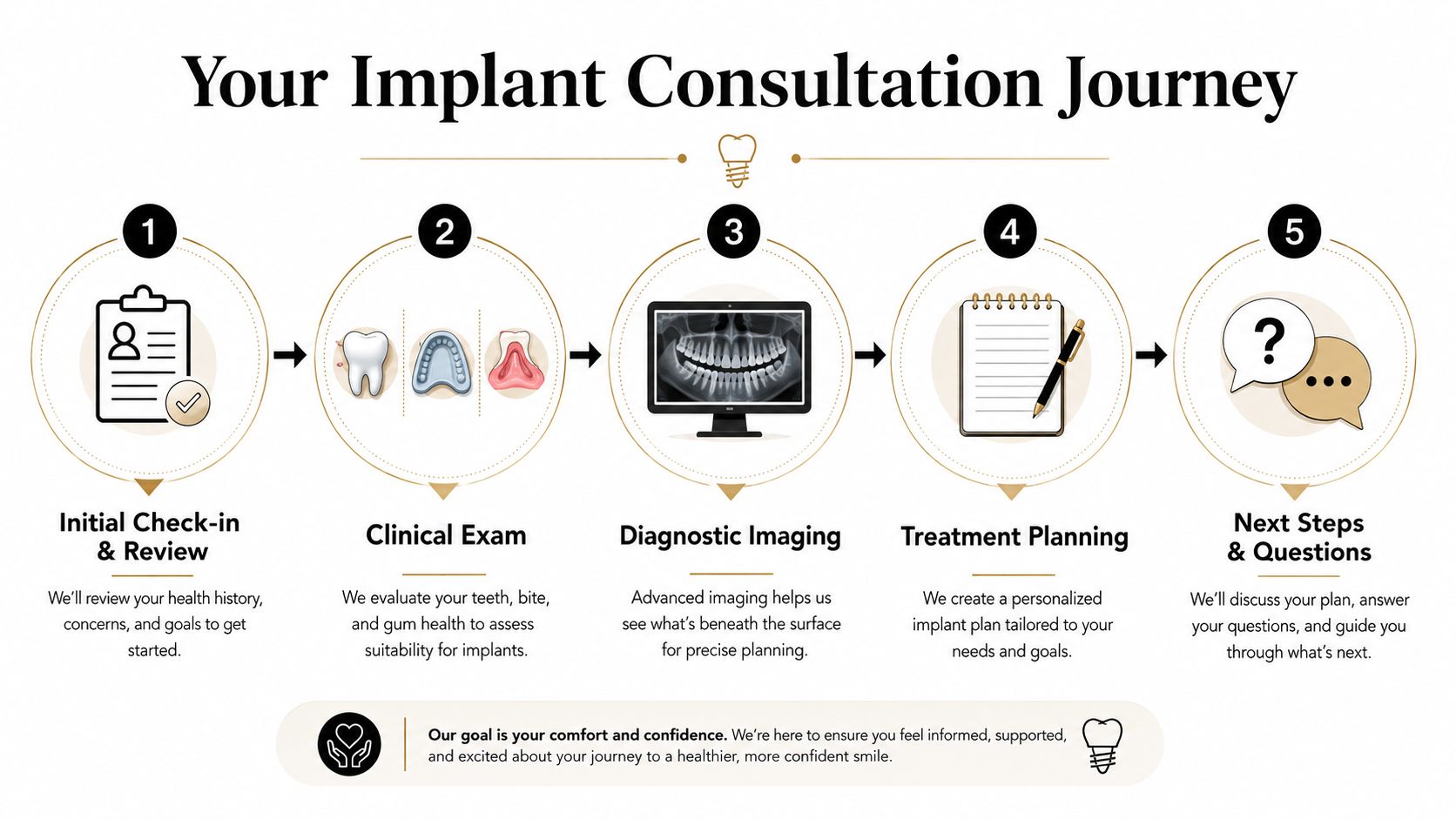
Medical history is reviewed with the same care as the scan. Bring a medication list and mention diabetes, osteoporosis, immune conditions, prior radiation to the jaw or head and neck, cancer treatment, allergies, bleeding concerns, and tobacco use. Honest answers help the dentist choose the safest sequence.
The office can also use digital and AI-assisted planning as an additional aid in complex cases. Recent review evidence describes automated identification of bone, teeth, nerves, and the maxillary sinus, with one systematic review reporting identification accuracy of 96% in the maxillary arch and 83% in the mandibular arch. The review of artificial intelligence in implant planning describes how these tools may help clinicians assess borderline anatomy more efficiently. They support clinical judgment, they don't replace it.
For a clearer overview of the treatment stages, see this step-by-step dental implant process guide.
Here is a short visual explanation of the planning process:
The appointment should end with a usable answer: ready now, ready after preparation, or better served by another option. You should receive a proposed sequence, expected healing stages, and a cost outline before committing. Walnut Creek patients can begin this workup in one local visit without needing a referral to start the evaluation.
Preparatory Treatments That Restore Candidacy
A patient with insufficient bone isn't necessarily a patient who has been ruled out. Often, the implant site needs to be rebuilt or stabilized before placement. The treatment is staged around your anatomy and health rather than forced into a standard timetable.
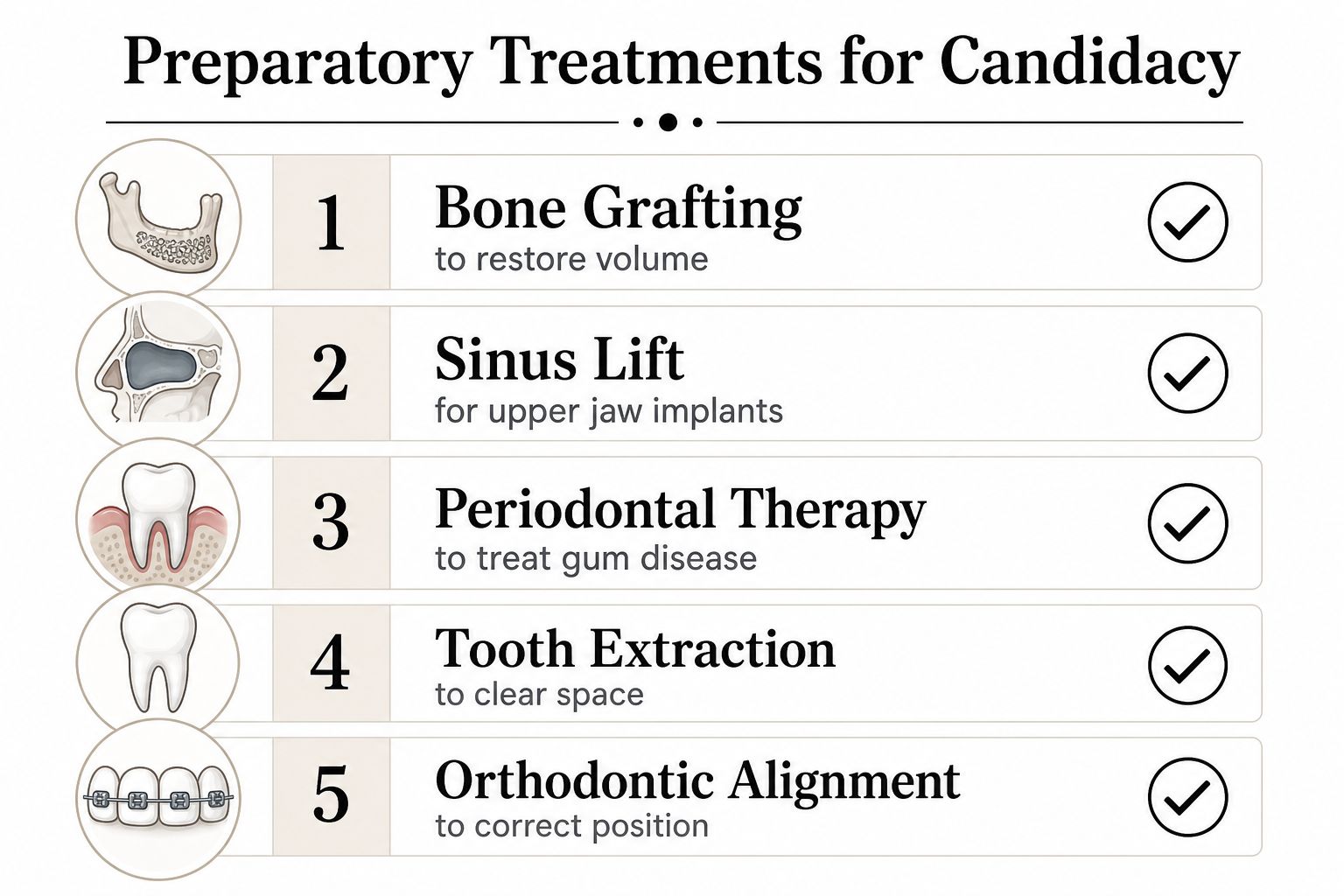
Bone grafting can restore lost ridge volume after extraction, long-term tooth absence, or denture wear. The graft creates a broader or taller foundation for the future implant. Healing commonly takes three to six months, depending on the grafting material, the patient's biology, and the amount of reconstruction required.
For upper back teeth, a sinus lift may be appropriate when the sinus has expanded downward into the space left by missing molars. The procedure adds usable bone beneath the sinus membrane so an implant can be planned safely. This is a common consideration in older adults who have lived without upper molars for an extended period.
Treating the tissues before the implant
Periodontal therapy comes first when gum disease is active. Deep cleaning, improved home care, periodontal maintenance, and other treatment may be needed before the implant site is considered stable. Placing an implant into inflamed tissue doesn't solve the underlying problem.
Other tools may be used selectively:
- Ridge preservation can protect the shape of an extraction site while it heals.
- Tooth extraction may remove an infected or fractured tooth that cannot be restored.
- Orthodontic extrusion can sometimes improve the amount of usable tissue around a compromised site.
- Orthodontic alignment may create space or improve the bite before restorative treatment.
Most grafting procedures can be performed in-office by the same Walnut Creek surgical team when the case is appropriate. The important point is that preparation isn't a punishment or a delay without purpose. It is often the step that changes a borderline site into a more predictable one.
Alternatives When Implants Are Not the Right Fit
Implants are not the only way to replace a missing tooth, and they aren't automatically the right choice for every patient. A fixed bridge, removable denture, implant-supported denture, or even observation may fit better depending on your health, anatomy, priorities, and budget.
A conventional bridge fills the gap by attaching an artificial tooth to crowns on the neighboring teeth. It doesn't require implant surgery, but the supporting teeth must be strong enough, and healthy enamel usually needs to be reshaped permanently. A bridge can be practical when the adjacent teeth already need crowns, less so when those teeth are untouched and healthy.
A removable partial denture replaces several teeth without surgery and can be taken out for cleaning. A full denture replaces an entire arch. These choices may suit patients with limited healing capacity or medical contraindications, and they generally involve a lower initial commitment. The trade-offs include movement during chewing, daily removal, possible adhesive use, and continued jawbone changes beneath the denture.
| Option | Longevity | Bone Preservation | Daily Maintenance |
|---|---|---|---|
| Fixed bridge | Can provide years of service when supporting teeth remain healthy | Doesn't directly stimulate the missing-tooth site | Brush, floss under the bridge, and attend maintenance visits |
| Removable partial denture | Requires adjustment or replacement as the mouth changes | Doesn't replace the missing root | Remove, clean, and inspect supporting teeth |
| Full denture | May need relining or replacement as the ridge changes | Doesn't preserve the root area | Remove for cleaning and manage fit |
| Implant-supported denture | Uses implants for added stability | Provides some root-like support where implants are placed | Clean the denture and implant attachments carefully |
| No replacement | May be reasonable for some back-tooth spaces after evaluation | Bone changes can continue | Monitor the gap, bite, and neighboring teeth |
Implant-supported dentures and full-arch approaches can provide a middle ground for people who want a more stable removable or fixed result but have extensive tooth loss. Fewer strategically placed implants may support a complete arch, although bone, bite, medical history, and restorative design still determine feasibility.
Choosing not to replace a missing back tooth can also be reasonable in selected cases. That decision should follow an examination of the bite, neighboring teeth, chewing pattern, and risk of shifting, not the absence of pain.
Long-Term Outcomes and Benefits You Can Expect
A properly planned implant replaces both the visible tooth and the missing root. That distinction matters because the implant post can provide functional support to the jawbone, while a denture or bridge replaces the crown portion without recreating a root in the missing site.
For healthy non-smokers, one long-term review cited a 97% implant survival rate at 10 years. The clinical evidence on implant risk factors and outcomes also makes clear that survival isn't guaranteed by the surgery alone. Smoking, periodontal history, bone quality, medical control, bite forces, and maintenance all influence the result.
Patients often notice practical gains:
- Chewing feels more balanced because the replacement is anchored rather than resting on the gum.
- Speech may feel more natural when a loose or shifting denture is no longer involved.
- Daily removal can be eliminated with a fixed crown or fixed full-arch restoration.
- Neighboring teeth can remain intact when a single implant replaces a tooth without using those teeth as bridge supports.
- The ridge receives functional support that a conventional removable restoration doesn't provide.
These advantages come with responsibilities. You still need to brush and clean around the implant every day, attend professional hygiene visits, and manage conditions that threaten the surrounding gums. Patients who clench or grind may need a night guard to reduce excessive force on the crown and implant.
Peri-implantitis also deserves honest attention. A 2024 review reported published 12-month resolution outcomes ranging from 75% to 93% of implants and 76% to 100% of patients in selected treatment studies. The review of peri-implantitis treatment outcomes reinforces a point I discuss with every implant patient: maintenance, early diagnosis, and follow-up are part of treatment, not optional extras.
| Option | Typical Lifespan | Bone Preservation | Daily Care | Effect on Other Teeth |
|---|---|---|---|---|
| Implant crown | Long-term when maintained and protected | Supports the implant site through the artificial root | Brush, clean around the implant, and attend hygiene visits | Neighboring teeth can remain independent |
| Fixed bridge | Long-term service varies with the supporting teeth | Doesn't directly replace the missing root | Clean beneath the bridge and around the crowns | Requires preparation of supporting teeth |
| Removable denture | Changes as the ridge and fit change | Doesn't stimulate the missing root area | Remove, clean, and manage fit | Uses remaining teeth or tissues for support |
| Implant-supported denture | Depends on implant health and restoration design | Provides support at implant locations | Clean both the denture and attachments | Can reduce reliance on individual natural teeth |
| No replacement | Depends on how the bite and gap behave | Doesn't preserve the missing site | Monitor changes during exams | Neighboring teeth may shift in some cases |
Scheduling Your Walnut Creek Implant Consultation
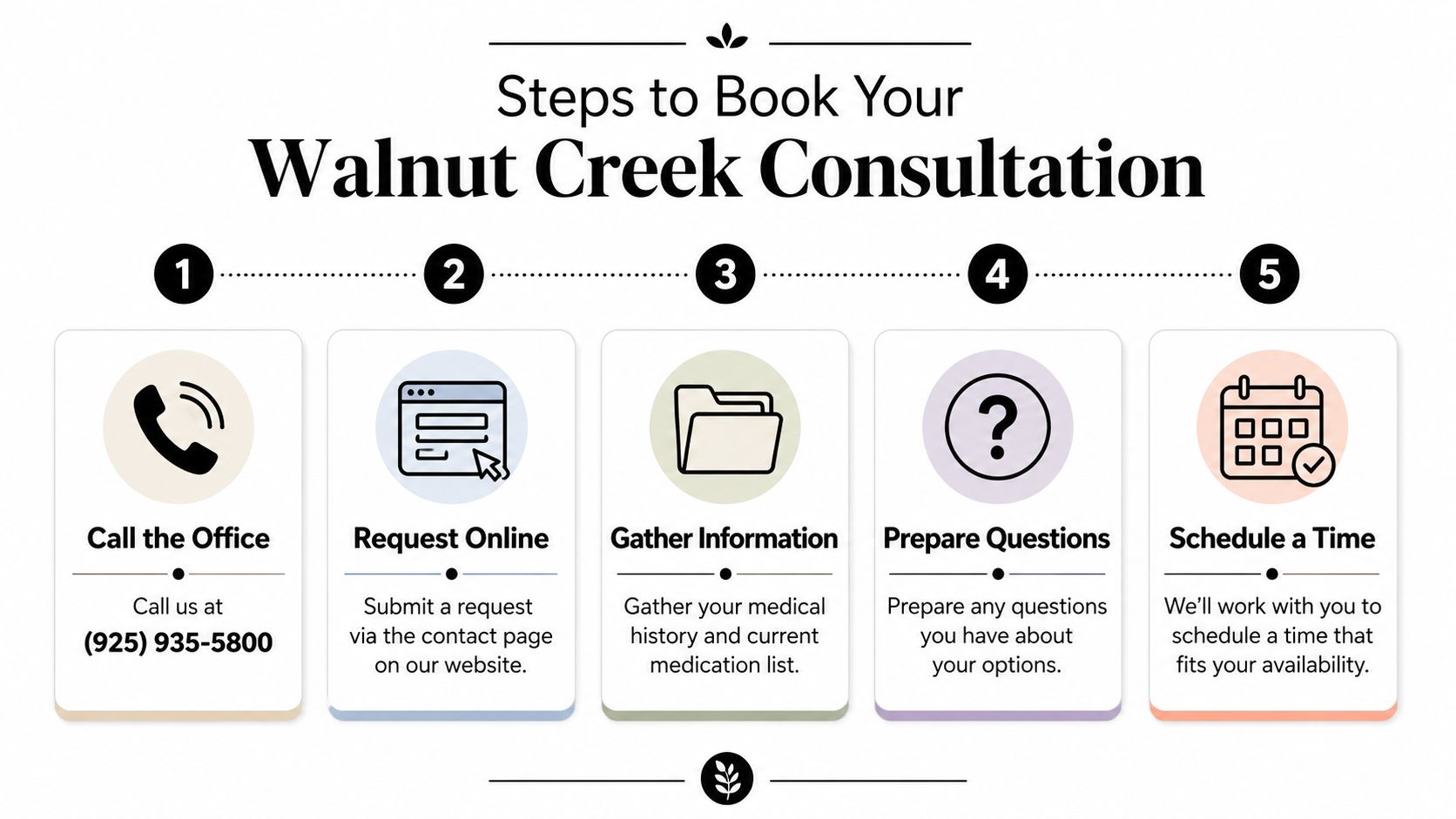
Start by calling the Walnut Creek office or requesting an implant evaluation through the practice website. A consultation itself is non-invasive. There is no drilling and no obligation to proceed, so you can use the visit to understand your options before making a decision.
Bring information that helps the team avoid guesswork:
- Medication list: Include prescriptions, supplements, anticoagulants, SSRIs, and medications affecting bone health.
- Previous records: Bring recent dental X-rays or CT scans if you have them.
- Insurance details: Bring your dental insurance card so coverage questions can be reviewed.
- A short concern note: Write down which tooth or teeth are missing, painful, loose, or difficult to clean.
- Medical updates: Mention diabetes, osteoporosis, immune conditions, cancer treatment, prior radiation, and tobacco use.
Questions worth asking at the first visit
Ask who will place the implant, whether placement is completed in-house or coordinated with a referred specialist, and what training the surgical provider has. You can also ask whether bone grafting or a sinus lift is likely, what sedation options are available, how treatment will be staged, and what the total fee includes.
Clarify the restoration as well as the surgery. Ask who makes and places the crown or denture, how long each phase is expected to take, what follow-up is included, and whether the practice offers a warranty on the restoration. A written plan should separate surgical, restorative, imaging, grafting, and maintenance costs rather than leaving you with one vague estimate.
Patients with dental anxiety should say so early. Appropriate sedation may range from oral anxiolytics to IV sedation, depending on the procedure, medical history, and the clinician's assessment. Treatment can also be staged, allowing you to address an infection, complete a tooth extraction, stabilize gum health, and then revisit implant placement when you feel prepared.
Before booking, ask the office about parking near the practice, expected availability for new-patient appointments, payment plans, and financing options if you're uninsured. A local dental home can also coordinate related care, including cleaning and exams, dental X-rays, periodontal treatment, crowns, bridges, cosmetic dentistry, and emergency dental services when a missing or damaged tooth becomes painful.
If you're comparing a dentist near me, a cosmetic dentist near me, or an emergency dentist, choose a practice that will explain the full decision rather than pushing one procedure. William M. Schneider, DDS offers implant evaluations alongside general, cosmetic, and restorative care, with digital imaging, medical-history review, treatment planning, and sedation options when appropriate.
William M. Schneider, DDS can evaluate your dental implant candidacy in Walnut Creek, including your bone, gums, bite, medical history, and realistic alternatives. Schedule an implant consultation through William M. Schneider, DDS to get a clear plan for replacing your missing tooth and protecting your long-term oral health.