You're sitting in a Walnut Creek dental office with a treatment estimate open on your tablet. The recommended care makes sense, but the total still feels difficult to fit into a household budget. Perhaps you've delayed a cleaning because you're unsure what insurance covers, or you've just learned that a crown, dental implant, or tooth extraction needs attention.
Dental payment plans can make care easier to budget, but the monthly figure doesn't tell the whole story. The provider, credit inquiry, interest terms, promotional deadline, and consequences of a missed payment all matter. At William M. Schneider, DDS, patients in Walnut Creek and the broader East Bay can discuss those details before treatment begins, alongside options for preventive care, cosmetic dentistry, restorative dentistry, dental implants, and emergency dental services.
Finding a Local Dentist Who Understands Your Budget
A patient looking for a dentist near me often needs more than an appointment. They need someone who'll explain what's urgent, what can wait, what insurance may contribute, and what each payment option really costs. That conversation should happen before you feel pressured to approve treatment.

At William M. Schneider, DDS, Dr. Schneider has spent more than 25 years caring for families and professionals in Walnut Creek and the East Bay. His approach is built around clear explanations, gentle treatment, and transparent pricing. A new-patient conversation can include the immediate dental concern, the recommended sequence of care, and the ways you may be able to spread payments over time.
That matters whether you're searching for a dentist in Walnut Creek, CA for routine cleaning and exams or looking for Dental implants near me, a cosmetic dentist, or an emergency dentist. The right plan depends on the treatment, your timeline, and the agreement attached to the financing. A monthly payment may help, but it should never replace a clear understanding of the total obligation.
Start with the care you need
Preventive appointments, dental x-rays, and new patient exams can identify problems before they require more involved restorative treatment. If pain, swelling, a broken tooth, or an infection has appeared, an emergency dentist can help determine whether you need urgent treatment, a root canal, or a tooth extraction.
Patients considering Invisalign, teeth whitening, crowns, bridges, gum disease treatment, or dental implants can also ask for a staged treatment plan. The practice's guide to choosing a dentist can help you assess communication, comfort, services, and financial transparency before committing to ongoing care.
What Dental Payment Plans Actually Are
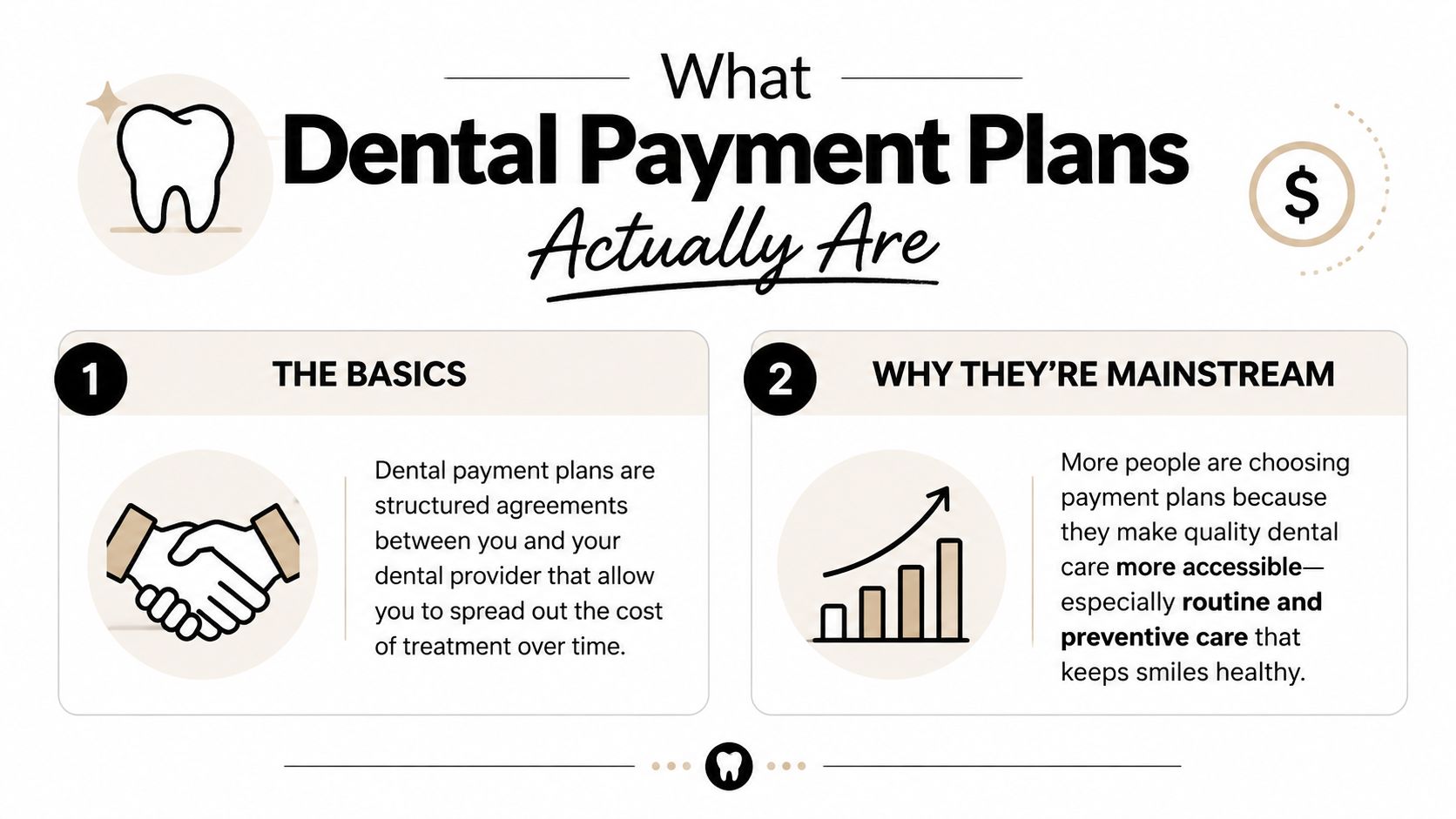
A dental payment plan is an agreement that spreads the cost of dental care across scheduled payments instead of requiring the patient to pay the entire amount at once. The agreement may be made directly with the dental office, through a healthcare financing company, or through a credit product. Those arrangements can look similar at checkout, but their terms may be very different.
Payment plans also aren't limited to large procedures. A patient may use a structured arrangement for ongoing preventive care, or for treatment such as a crown, implant, or restorative procedure. The practical benefit is predictability. You know what payment is expected and when, rather than postponing necessary care because the full cost arrives at one time.
A 2022 consumer oral health survey found that 25% of private dental patients had a monthly dental payment plan, and 46% of adults on a payment plan visited every six months, compared with 42% of NHS patients. These figures appear in the peer-reviewed oral healthcare analysis, which also reports that 56% of adults who attend the dentist at least every two years would consider a dental payment plan.
A plan is different from an unpaid bill
If an office allows you to pay an outstanding bill later, that may be an informal balance arrangement. A formal payment plan usually sets out the payment amount, due dates, interest or fees, the treatment covered, and what happens if you miss a payment. Read those terms before agreeing.
Payment plans have become a substantial part of private dental financing in the United Kingdom. By 2022, 3.8 million people were enrolled in a dental payment or insurance plan, in a market valued at £868 million, up from £710 million in 2019, when 3.2 million patients were members, according to Denplan's 2022 consumer oral health survey. The same source reports that capitation-style subscriptions covered 2.7 million people, while dental insurance subscribers exceeded 1.1 million.
Practical rule: Treat a payment plan as a financial contract, not just a smaller number on a treatment estimate.
For a general overview of how payment arrangements work, patients can also watch the following educational video:
Comparing the Three Main Types of Dental Payment Plans
The first question is who receives your payment and who controls the contract. An in-house plan is arranged by the dental office. A third-party installment loan is provided by a lender. A deferred-interest card is a credit account with promotional terms that can change the cost if the balance isn't cleared by the deadline.
| Plan Type | How It Works | Credit Check | Key Risk |
|---|---|---|---|
| In-house office plan | The practice sets a payment schedule directly with the patient. | The office may use little or no credit checking, depending on its policy. | The arrangement may have a shorter repayment period or require a deposit, so ask for the complete written terms. |
| Third-party installment loan | A lender such as Cherry or Sunbit pays or finances the treatment, and you repay the lender in scheduled installments. | A soft inquiry may be used initially, but confirm whether any stage involves a hard inquiry. | Interest, fees, approval conditions, and missed-payment consequences vary by lender and offer. |
| Deferred-interest credit card | A credit provider such as CareCredit offers a promotional period, often marketed around low or zero interest. | Ask whether the application uses a soft or hard inquiry. | If the promotional balance isn't paid in full on time, interest may be charged retroactively on the original balance. |
How the same treatment can create different obligations
Suppose a filling costs $1,200. An in-house arrangement might divide that amount according to the office's terms, while an installment loan may create a fixed monthly schedule with an applicable interest rate. A deferred-interest card may appear cheaper during its promotional period, but the final cost depends on clearing the balance within the stated deadline.
The same issue applies to a $3,000 dental implant. A fixed installment schedule can make the monthly obligation easier to predict. A promotional card may work for someone with a reliable short-term cash inflow, but it becomes risky if the patient can't eliminate the balance before the promotion expires.
These examples show why the monthly payment alone isn't enough. Ask for the total repayment amount, the APR after any promotion, the exact payoff deadline, late fees, and the result of missing a payment. Independent dental financing guidance specifically recommends asking whether the plan is branded by Cherry, CareCredit, or Sunbit, whether the inquiry is soft or hard, and what happens when promotional terms end.
How to Choose the Right Plan for Your Situation
Start with your treatment timeline. A routine cleaning and exam may be easier to budget through an ongoing membership-style arrangement, while a crown, root canal, or dental implant may require a larger structured loan. Emergency treatment, including a tooth extraction, demands a conversation about what needs attention now and what can safely be scheduled later.
Then consider how comfortable you are with a continuing monthly obligation. A payment that looks manageable on paper can become stressful if your income changes, your household expenses rise, or additional dental treatment becomes necessary. Don't choose a plan until you understand how the payment fits alongside your existing commitments.
Use these questions before signing
- Do you want one direct relationship? An in-house office plan may be appealing if you prefer to work directly with the practice and avoid a third-party lender.
- Do you need a fixed schedule? An installment loan can provide a defined repayment structure, but review the APR, fees, and approval terms.
- Can you meet a promotional deadline? A deferred-interest card should only be considered if you're confident you can pay the balance in full before the promotion ends.
- What happens after a missed payment? Ask about late charges, account suspension, collection activity, and whether the promotional terms change.
- What happens if treatment changes? Confirm whether additional procedures can be added, financed separately, or require a new application.
- Can you leave the plan early? Check for prepayment restrictions or fees before assuming early payoff is always cost-free.
At a new-patient consultation, the team at William M. Schneider, DDS can review the proposed care, discuss insurance information, and explain available monthly payment and third-party financing options before treatment starts. You should leave with a written understanding of what you're paying for, when payments are due, and which terms apply.
The right plan isn't necessarily the one with the lowest advertised payment. It's the one whose full cost and obligations you can comfortably understand and manage.
Financial Safety Tips and Hidden Costs to Watch For
Financing can improve access to care, but it can also hide risk behind an attractive monthly payment. The most familiar example is deferred interest. A promotion may advertise no interest for a set period, yet interest can be applied retroactively to the original balance if the account isn't paid in full by the stated deadline.
Patients also deserve a broader conversation about debt. U.S. data cited in 2024 found that 36% of households had medical debt, 21% had a past-due medical bill, and 23% were paying a medical bill over time to a provider, as reported in the medical debt reference. Earlier KFF and NPR survey work found that 49% of adults with medical debt said dental bills contributed to it. Dental financing may help someone begin treatment, but it shouldn't make unaffordable care feel harmless because the first payment is small.
Ask these questions before approval
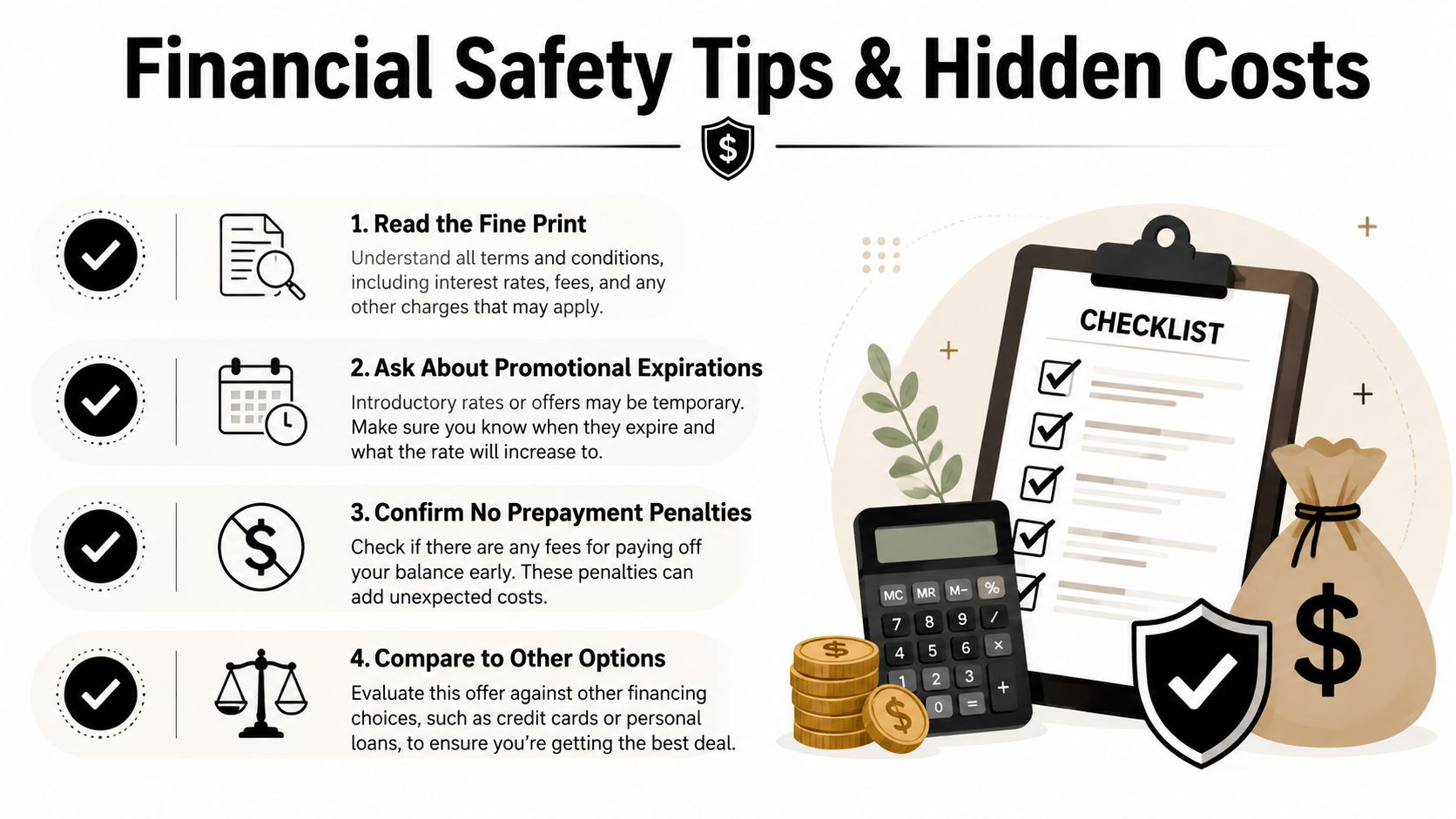
- Read the full cost: Request the amount financed, APR, interest calculation, fees, and total repayment in writing.
- Confirm the inquiry type: Find out whether the application creates a soft or hard credit inquiry.
- Clarify promotional expiration: Ask for the exact end date and the amount that must be paid before then.
- Plan for income changes: Consider whether you could keep paying if your work or household circumstances changed.
- Check missed-payment rules: Ask whether late fees, penalty interest, or loss of promotional terms may apply.
- Compare alternatives: Consider an in-house arrangement, a conventional installment loan, or delaying nonurgent care while maintaining necessary preventive or urgent treatment.
Red flags include vague total-cost disclosures, pressure to approve financing immediately, and contracts that emphasize the promotional rate while burying the later APR. Before reviewing insurance coverage or payment options with a practice, patients can read about the insurance verification process.
What to Expect When You Visit William M. Schneider, DDS
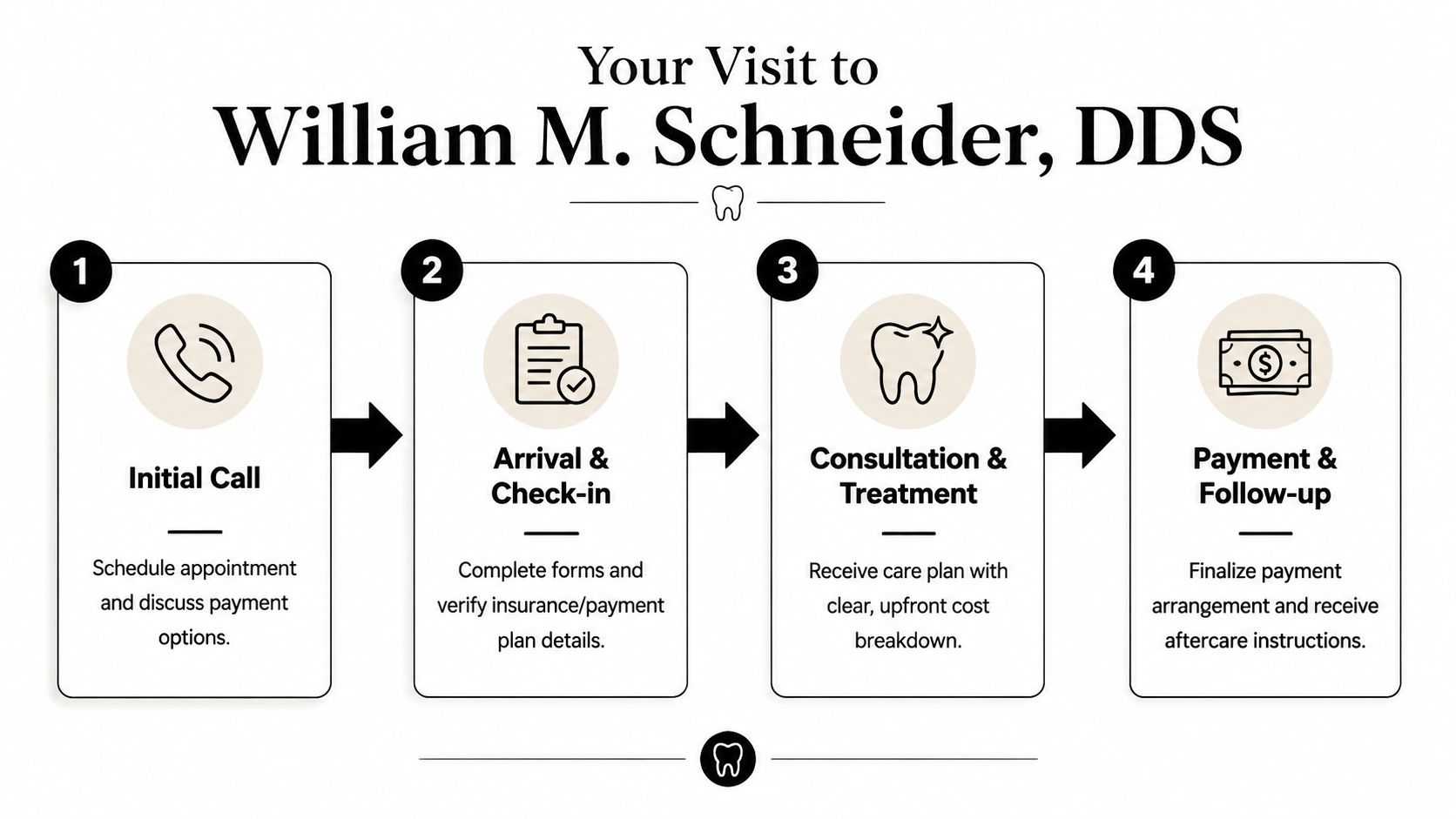
Before you sit in the dental chair, call the office at 1855 San Miguel Drive, Suite 31 and explain what you need. Ask about scheduling, insurance information, and available payment arrangements. Sharing concerns about monthly costs during that call gives the team time to prepare relevant information for your consultation.
Dr. Schneider studied at the University of Minnesota and completed advanced training in General Dentistry through an AEGD program in San Francisco. At the Walnut Creek practice, the team reviews findings, discusses treatment choices, and uses modern diagnostic technology to build a plan around your oral health needs. You should leave knowing which care requires prompt attention and which services can wait.
A consultation built around clarity
Your appointment may include a cleaning and exam, dental x-rays, or an evaluation of a specific concern. The practice provides preventive care, Invisalign, teeth whitening, dental implants, crowns, bridges, root canals, gum disease treatment, and emergency dental services. If dental anxiety affects you, painless injection techniques, appropriate sedation options, and a calm environment can make the visit easier.
During the financial conversation, ask which treatment is urgent, whether care can be staged, what insurance covers, and how a monthly arrangement would work. The team can explain third-party financing, including CareCredit where applicable. Ask for the total repayment and the terms after any promotional period, rather than judging an option by its advertised monthly payment.
Comfort and follow-up matter
Meticulous infection control, accessibility accommodations, and clear aftercare instructions support a predictable patient experience. Whether you're seeking a cosmetic dentist near me, restorative care, or an emergency dentist, confirm the next appointment, home-care instructions, and contact process before leaving.
A responsible payment arrangement connects three decisions: the treatment plan, the payment schedule, and the follow-up path. The monthly amount must fit your budget without obscuring the clinical priorities or making unaffordable care feel harmless just because the first payment is small. Ask whom to contact if your dental needs or financial circumstances change.
Take the Next Step Toward Affordable Dental Care
Dental payment plans can be a sensible way to budget for necessary care, ongoing preventive visits, or larger treatment. They're not automatically affordable, however. The safest choice depends on the total cost, interest terms, credit inquiry, promotional deadline, and your ability to keep paying if circumstances change.
William M. Schneider, DDS has served Walnut Creek and the East Bay for more than 25 years, combining general, cosmetic, and restorative dentistry with direct conversations about treatment and payment options. Whether you need a routine cleaning, a smile makeover, dental implants, a crown, tooth extraction, or emergency care, you can ask questions before approving treatment.
Schedule a consultation through the practice's online booking system or contact the office directly. A conversation about your budget doesn't commit you to a financing product. It gives you the information needed to make a careful decision about your oral health.
William M. Schneider, DDS offers preventive, cosmetic, restorative, implant, and emergency dental care, along with monthly payment and third-party financing options that may help spread treatment costs over time. Visit William M. Schneider, DDS to review services, request an appointment, and discuss a treatment plan that respects both your dental needs and your budget.