A small white spot on a tooth can be easy to dismiss. Many people in Walnut Creek first notice it in bright bathroom light, wonder if it’s just a stain, and hope it goes away on its own.
Sometimes that spot is nothing urgent. Sometimes it’s the earliest sign of decay, and that’s the good news. When dental caries are found early, treatment is often far more conservative than people expect. The goal isn’t to rush you into a filling. The goal is to protect healthy tooth structure and keep a small problem from turning into a larger one.
For families and professionals in Walnut Creek and the East Bay, that matters. Busy schedules make it tempting to wait until something hurts, but early dental caries often progress undetected. A tooth can look mostly fine, feel mostly fine, and still be losing minerals in a way that deserves attention.
Patients who are looking for a dentist in Walnut Creek, CA or searching for a dentist near me are usually asking a practical question underneath the search. Can I get a clear answer, without pressure, and avoid bigger dental work if possible?
That’s the right question. Gentle, modern dental care starts with early detection, good judgment, and a plan that matches the stage of the problem. If you’re worried about a suspicious spot, mild sensitivity, or a child’s newly erupted teeth, it helps to know what early caries look like and what works to stop them.
Your Trusted Dentist for a Healthy Smile in Walnut Creek
A common first visit starts with something very simple. A patient says, “I saw a chalky area on my tooth and wasn’t sure if I should be worried.” That concern is reasonable. Early changes in enamel don’t always look dramatic, and they rarely feel dramatic at first either.
In Walnut Creek, many adults are balancing work, family, and long to do lists. Parents are watching their children’s teeth just as closely, especially when baby teeth seem to change quickly. In both cases, what people usually want is reassurance paired with honest guidance. They want to know whether the issue can be handled gently or whether it’s already become a cavity that needs more active treatment.
Why small changes deserve attention
Early dental caries are often manageable when they’re found before the tooth develops a true hole. That’s the point where prevention and minimally invasive dentistry can make a real difference. Waiting until pain shows up usually narrows your options.
Practical rule: If a spot on a tooth looks new, feels rough, or catches your attention more than once, it’s worth having it examined.
This is one reason routine cleaning and exams, new patient exams, and dental x-rays matter so much. These visits are not just about polishing teeth. They give your dentist a chance to compare what your teeth looked like before, what’s changing now, and whether the enamel can still recover without drilling.
A calm approach for Walnut Creek families
People often associate cavities with a lecture or a filling. That mindset keeps some patients away longer than they should stay away. In practice, the most useful appointment is often the one where you come in early, get a clear diagnosis, and leave with a manageable plan.
That might involve monitoring, fluoride support, a sealant, a very small restoration, or changes to home care and diet. It depends on the tooth and the stage of the decay, not on a one size fits all script.
For patients searching for a cosmetic dentist near me, this matters too. Early enamel changes can affect how a smile looks long before they become painful. Addressing the cause first protects your tooth. Cosmetic options such as teeth whitening make more sense after the enamel is stable.
What Are Early Dental Caries?
Early dental caries are the first stage of tooth decay. At this stage, the enamel is weakening, but the surface may still be intact. That means the damage may still be reversible with the right treatment and home care.
A helpful way to think about enamel is to picture it as a hard outer shell that can lose and regain minerals. When your mouth spends too much time in an acidic state, minerals leave the enamel. When conditions improve, some of those minerals can return. Dentists call that balance demineralization and remineralization.
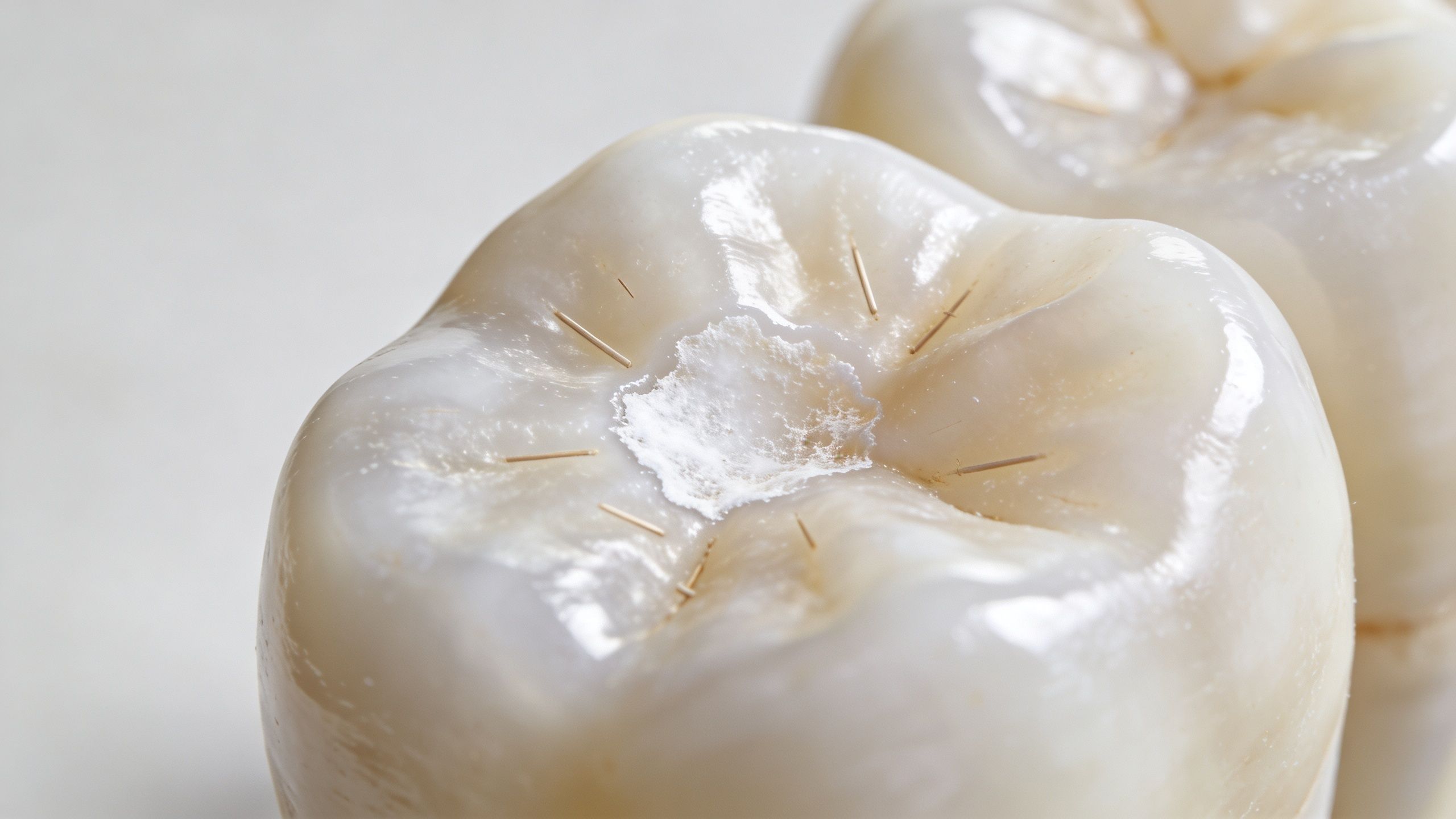
What the earliest stage looks like
The first visible sign is often a dull, white band of demineralized enamel on the tooth surface. This happens when bacteria such as Streptococcus mutans ferment sugars and create an acid attack that drops the pH below 5.5, causing minerals to leach from the tooth, as described in this clinical review of early childhood caries.
That white area is different from a deep cavity. It tells us the tooth has been under repeated acid stress, but it does not automatically mean a drill is the next step. If the surface is still intact, the tooth may respond well to remineralizing treatment and changes in daily habits.
Why sugar frequency matters more than most people think
Many patients assume decay is only about eating candy. The bigger issue is often how often teeth are exposed to sugar and acid throughout the day. Frequent sipping, grazing, or bedtime snacks can keep the mouth in a cycle where enamel doesn’t get enough time to recover.
Here’s the simple version:
- Bacteria use sugars: Oral bacteria feed on sugars left on the teeth.
- Acid follows: Those bacteria produce acid.
- Enamel softens: Repeated acid exposure pulls minerals from enamel.
- A cavity can form: If the surface breaks down, the tooth moves beyond the reversible stage.
Early caries are a warning sign, not a failure. They tell us the tooth needs support before a permanent defect forms.
Why appearance alone can be misleading
A white spot can be an early decay issue, but not every white mark means active decay. Some are related to development, past orthodontic treatment, or natural enamel variation. That’s why a proper exam matters.
For adults considering cosmetic dentistry or teeth whitening, this distinction is important. Whitening won’t fix active demineralization. In some cases, it can make the color contrast more noticeable until the tooth is stabilized first.
Recognizing the Signs of Early Tooth Decay
Early tooth decay is easy to miss. Some patients notice a color change right away. Others have no symptoms at all and only learn about it during a routine exam.

What you may notice at home
Several signs can suggest early dental caries:
- Chalky white areas: These often look dull instead of glossy.
- A rough spot near the gumline or in grooves: Enamel changes can alter the surface texture.
- Mild sensitivity: Sweets, cold drinks, or even air can bother a tooth before a cavity becomes obvious.
- A spot that darkens over time: Some lesions shift from white to yellow or brown as they progress.
These clues are useful, but they are not enough to diagnose the stage accurately. A tooth can have an early lesion between teeth or under a surface that looks normal from the outside.
What you probably won’t notice
Many people are often caught off guard because early decay often does not cause strong pain. There may be no swelling, no throbbing, and no clear sign that tells you to call an emergency dentist. By the time a tooth hurts consistently, the decay is often more advanced.
That’s why regular exams matter even when everything feels fine. Professional evaluation can detect subtle changes before they become restorative problems.
A short overview can help make those warning signs easier to recognize:
When to schedule an exam
You don’t need to panic over every spot, but there are a few situations where it makes sense to book promptly with a dentist near me or a dentist in Walnut Creek, CA:
- The area is new: A recent change is more useful to evaluate than to guess at.
- Sensitivity keeps returning: Repeated discomfort deserves a closer look.
- A child’s tooth looks chalky or stained near the gums: Baby teeth can change quickly.
- It’s been a while since your last checkup: Missed time creates room for small problems to grow.
If you can see a change, there may be more happening in areas you can’t see, especially between teeth.
Modern Diagnosis and Gentle Treatments for Early Caries
A common visit goes like this. A parent or new patient comes in worried that we are about to find a cavity and immediately recommend a filling. In many early cases, that is not what happens. If we catch the change before the surface breaks down, treatment can stay gentle and focused on stopping the problem early.
How dentists find early decay before it worsens
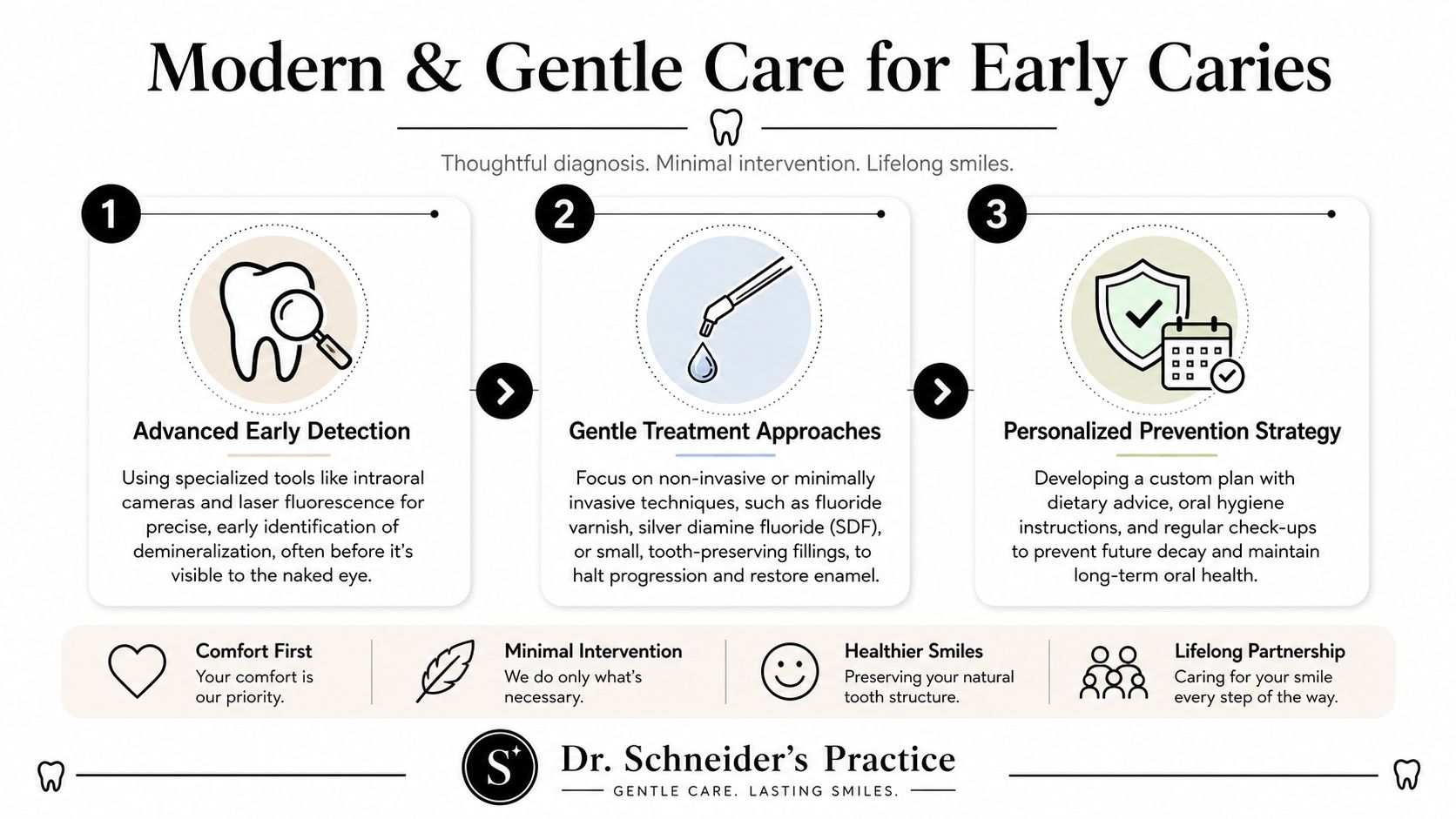
Early caries is diagnosed by putting several pieces together. I look at the tooth under proper lighting, check the texture and location of the area, review your risk factors, and use dental x-rays when the concern may be between teeth or under the surface. Magnification and other diagnostic tools can also help identify demineralization before a cavity is clearly visible.
Visual inspection still matters, but it never stands alone. One spot may only need watchful follow-up. Another may look small yet already have a surface breakdown that changes the treatment plan.
What works when the lesion is still early
For a non-cavitated lesion, treatment often starts with remineralization. That can include fluoride varnish, better fluoride exposure at home, sealants for vulnerable grooves, and a shorter recheck interval so we can confirm the area is stabilizing instead of progressing. A clinical review cited earlier reported that 5% sodium fluoride varnish applied quarterly reduced the incidence of early childhood caries by 37%. That is one reason fluoride varnish is often part of a conservative plan.
Conservative care still requires follow-through. Success depends on whether the enamel surface is intact, whether plaque is collecting in that area, and whether diet or dry mouth is keeping the tooth under repeated acid stress.
Conservative treatment means choosing the smallest step that is likely to stop the disease and preserve healthy tooth structure.
Once the surface has opened and bacteria can hold in the defect, a filling often becomes the more predictable choice. At that point, the goal is still to keep treatment small. A carefully placed restoration done early usually preserves more of the tooth than waiting until the damage spreads deeper. If you want a clearer sense of that next step, this explanation of when a tooth-colored filling supports long-term oral health can help.
Understanding the treatment timing
Understanding the trade-offs is important for patients.
- If treatment is delayed: An area that might have been managed with fluoride, sealant, or monitoring can progress to a filling, crown, root canal, or replacement options such as dental implants near me.
- If treatment is too aggressive: Tooth structure may be removed before it is necessary.
- If treatment is timed well: The tooth usually stays stronger, and care stays simpler.
William M. Schneider, DDS provides general, restorative, and preventive dental care in Walnut Creek, including exams, x-rays, and cavity treatment. That allows early lesions and more advanced decay to be evaluated in one place, with the treatment matched to what the tooth needs.
A Partnership in Preventing Cavities for Your Family
Cavity prevention works best when it isn’t reduced to one product or one lecture. It’s a partnership between what happens at home and what happens at regular dental visits.

Home care, diet, and timing all matter
Brushing and flossing are the foundation, but technique and consistency matter more than good intentions. If plaque sits in the same places day after day, those areas stay vulnerable. The same is true for frequent sugar exposure. The mouth needs time between meals and drinks to recover.
For many families, prevention becomes easier when the routine is simplified:
- Use fluoride toothpaste consistently: Not occasionally, and not only when things feel sensitive.
- Clean between teeth: Flossing matters because many early lesions begin where a toothbrush doesn’t reach well.
- Reduce frequent snacking and sipping: It’s the repeated exposure that often drives the problem.
- Keep recall visits on schedule: Small changes are easier to manage than delayed ones.
Families who want additional everyday guidance can review practical ways to prevent tooth decay naturally. The most effective prevention plans are usually the ones people can stick with.
Why starting early helps children most
A major challenge in preventing advanced decay is the age of the first dental visit. Many insured children don’t have their first oral exam until ages 3 or 4, well after early childhood caries can begin, according to CareQuest’s discussion of access and integration in children’s dental health. Establishing a dental home by age 1 creates a stronger foundation for lifelong oral health.
That early visit is less about treatment and more about guidance. Parents learn what normal eruption looks like, how to clean new teeth, what feeding habits increase risk, and how to spot changes before they become severe.
Prevention should feel realistic
Perfect habits are not the standard. Consistent habits are.
A practical prevention plan usually includes:
- regular cleanings and exams
- periodic review of cavity risk
- support for children, teens, and adults at different stages
- timely restorative care when prevention alone is no longer enough
This is also why family dentistry matters. Parents, children, and busy professionals often need different advice, even when the underlying issue is the same.
Your Comfort-Focused Visit with Your Dentist in Walnut Creek
A lot of people delay dental care because they expect judgment, surprises, or discomfort. That expectation usually comes from a past experience where nobody explained what they were seeing or why they were recommending treatment.
A comfort focused visit feels different from the start. You check in, meet a friendly team, and go through a clear exam process without being rushed. If you’re a new patient, the first priority is understanding your current dental health, your concerns, and your goals. Some patients want to address sensitivity. Some are overdue for cleaning and exams. Others are also thinking ahead about restorative dentistry, teeth whitening, Invisalign, crowns, or even whether a damaged tooth may eventually require tooth extraction.
What happens at a new patient exam
A thorough visit usually includes an exam, appropriate digital x-rays, and a conversation about what the findings mean. If an area looks like early dental caries, the discussion should focus on the stage of the lesion and the most conservative option that still protects the tooth.
That matters because not every suspicious area needs the same response. One tooth may need monitoring and fluoride support. Another may need a small filling now to avoid a larger restoration later.
The right dental visit should leave you feeling informed, not cornered.
What anxious patients can expect
Dental anxiety is common, and it doesn’t only affect people who have avoided the dentist for years. Plenty of successful, organized adults still tense up in the chair. What helps most is a calm environment, painless injections when needed, and a dentist who explains what’s happening before treatment begins.
Patients in Walnut Creek often say they appreciate straightforward communication. They want to know what can wait, what should be treated soon, and what options exist if they’re nervous about treatment. That’s a reasonable expectation.
If you’re looking for a dentist near me who can help with prevention, cosmetic concerns, restorative needs, or urgent discomfort, the best first step is usually the simplest one. Schedule an exam before the problem becomes harder to solve.
Frequently Asked Questions About Early Cavities
A common concern I hear is simple: “If you find something early, will I need a filling right away?” Often, the answer is no. Early decay is exactly where dentistry can stay conservative. The goal is to catch a weak area before it turns into a hole, so treatment can start with fluoride, home care changes, and monitoring instead of a drill.
Can an early cavity heal without a filling
Sometimes. If enamel has started to lose minerals but the surface is still intact, the tooth may respond well to remineralization and careful follow-up. Once the surface breaks down and a true cavity forms, a filling is usually the safer choice.
Are white spots always cavities
No. White spots can be early decay, but they can also come from other enamel changes. A proper exam helps sort out which areas need treatment, which need observation, and which are mostly a cosmetic concern.
Do early cavities hurt
Often, they do not. Early lesions may cause no symptoms at all, which is why routine exams matter. When symptoms do show up, they are usually mild, such as sensitivity to sweets, cold drinks, or a rush of air.
Are dental x-rays necessary for finding decay
Often, yes. A visual exam shows a lot, but decay between teeth or under the surface can be easy to miss without imaging. X-rays help catch smaller problems while the treatment can still stay limited.
What age should my child first see a dentist
Children should establish a dental home early. Waiting until a child has pain or obvious decay makes the first visit harder than it needs to be. An earlier visit gives parents guidance on feeding habits, brushing, fluoride, and what to watch for at home.
What happens if decay is no longer early
Treatment shifts from prevention alone to a small restoration when the tooth has started to break down. Even then, the goal stays the same. Preserve as much healthy tooth structure as possible and stop the problem before it becomes larger, deeper, and more expensive to fix.
Stages of Early Caries and Our Approach
| Stage | Appearance | Our Recommended Treatment in Walnut Creek |
|---|---|---|
| Early demineralization | Dull or chalky white area, often with intact surface | Exam, cavity risk review, fluoride support, home care and diet changes, monitoring |
| Suspicious deeper change | White, yellow, or brown area that may be softening | Closer evaluation with x-rays and clinical exam, then a decision about whether conservative restoration is needed |
| Cavitated decay | Visible hole, breakdown, food trap, or clearer sensitivity | Tooth-preserving filling or other restorative treatment based on the tooth’s condition |
If you’ve noticed a white spot, mild sensitivity, or it has been a while since your last exam, William M. Schneider, DDS provides preventive, restorative, and family dental care in Walnut Creek with a calm, patient-centered approach. Schedule a visit to get a clear diagnosis and choose the most conservative treatment that fits your needs.