We’ve all heard it a thousand times: floss every day. But are you sure you're doing it correctly? As your local dentist in Walnut Creek, CA, we see firsthand how a small change in technique—specifically, mastering the ‘C-Shape’—can transform your oral health and help you avoid future dental issues.
This simple method is the key to removing stubborn plaque and food particles that brushing alone can't reach. If you're looking for a dentist near you who prioritizes patient education and long-term health, you've come to the right place.
Your Walnut Creek Guide to Flossing Like a Pro
Think of flossing less as a chore and more as one of the most important parts of your preventive dental care. Many of our new patients are surprised when we show them just how crucial proper technique is. Without it, you could be leaving behind harmful plaque that leads to cavities and gum disease, or even accidentally damaging your gums.
This guide provides the same practical advice we share with patients every day here at the office of William M. Schneider, DDS. Our goal is to empower you with the know-how to make perfect flossing an effortless part of your daily routine, protecting your smile and reducing the need for services like tooth extractions or fillings.
The Power of Professional Guidance
When dental organizations launch educational campaigns about oral health, people listen. These efforts have led to a documented 15% increase in dental floss sales in developed markets, which shows that once people understand the why behind a habit, they’re far more likely to stick with it. You can discover more about how education impacts oral health trends and see the data for yourself.
Think of this guide as a personal coaching session from our team. Mastering this one skill is one of the best investments you can make in preventing cavities and gum disease for years to come.
Ultimately, our team in Walnut Creek wants to help you keep your smile healthy and bright between visits. We firmly believe that informed patients are the healthiest patients. If you're looking for more ways to improve your daily habits, be sure to check out our guide on oral hygiene best practices.
Mastering The C-Shape Flossing Method
If you think flossing is just about snapping a string between your teeth, you might be leaving the most harmful plaque behind. As dental professionals, the one secret we always share with our patients is the C-Shape method. It’s the only way to effectively clean beneath the gumline—the tiny pocket where gum disease begins.
Let’s walk through the exact steps we teach everyone who comes into our Walnut Creek dental office for a new patient exam or cleaning.
Prepare Your Floss Correctly
First, let's get your tool ready. Pull out about 18 inches of floss—roughly the length from your hand to your elbow. This ensures you can use a fresh section for every tooth and avoid spreading plaque.
Wrap most of it around one middle finger and a small bit around the other. That second finger will act as your take-up reel for used floss. Now, pinch a tight one- to two-inch section between your thumbs and index fingers to guide it.
Gently Guide It Into Place
This next part is critical. Do not snap the floss down into your gums, as this can cause trauma and gum recession over time. Instead, gently work it between two teeth with a soft, back-and-forth sawing motion.
Be patient, especially if your teeth are crowded. Forcing the floss will only hurt your gums, cause bleeding, and discourage you from flossing regularly.
Create The “C” And Clean
Once the floss is between the teeth, you’re ready for the most important step. Form a tight “C” shape with the floss, hugging it firmly against the side of one tooth.
The goal isn’t just to go between the teeth, but to clean the front and back surfaces of each tooth that your brush can’t possibly reach. The C-shape makes full contact with these hidden areas.
Gently slide the floss into the space between your tooth and gum until you feel slight resistance. This tiny pocket, called the sulcus, is a favorite hiding spot for plaque. Scrape the side of the tooth by moving the floss up and down several times. You’ll feel it clearing away that sticky film.
The visual guide below breaks down this simple three-step process for a perfect clean.
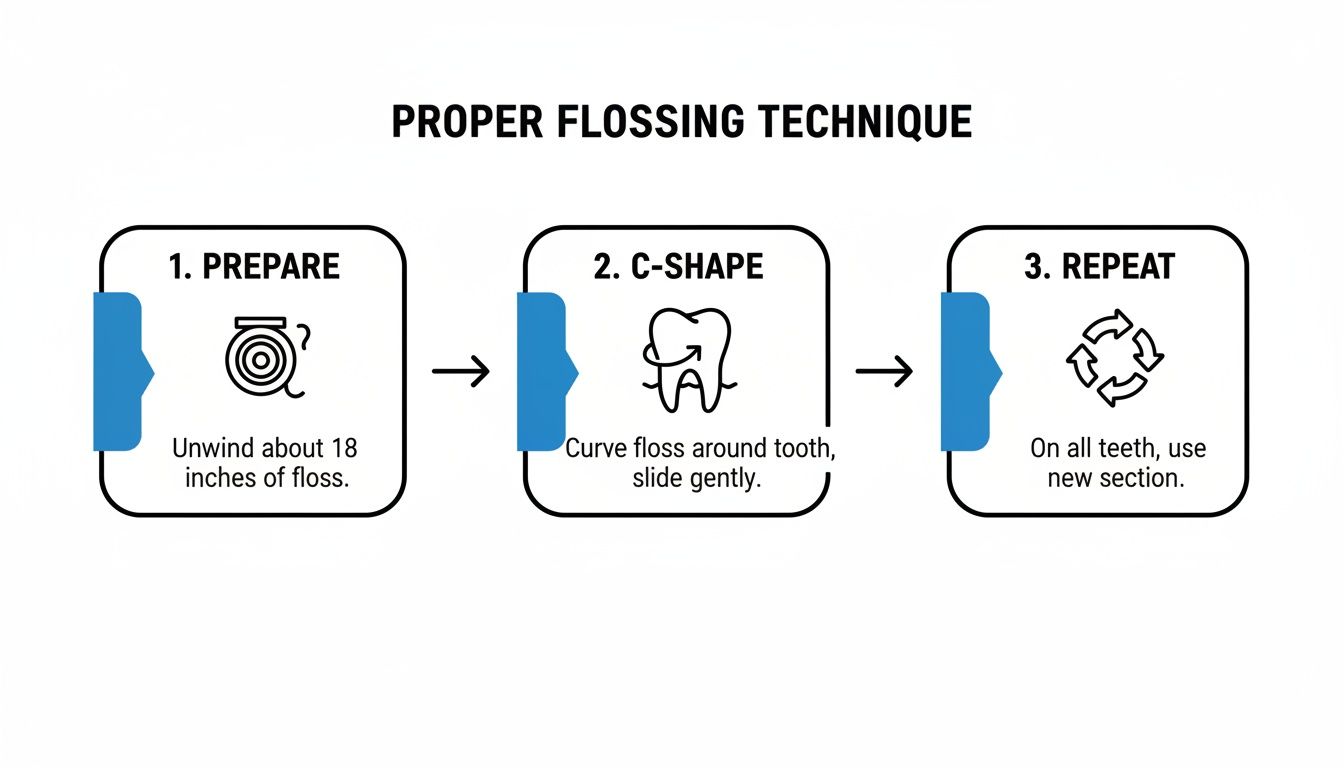
This graphic highlights the key actions: preparing the floss, creating the crucial C-shape, and repeating the motion for every tooth.
Repeat For Every Tooth
After cleaning one side, don’t just pull the floss out. Gently curve it around the neighboring tooth in the same space and repeat the up-and-down scraping.
Once both sides are done, lift the floss out. Unwind a fresh section from your clean finger and wrap the used piece onto the other. This step is non-negotiable—reusing dirty floss is like trying to wash dishes with a dirty sponge.
And don’t forget the backs of your very last molars! These spots are easy to miss, but they’re prime real estate for decay that can eventually lead to a tooth extraction. Mastering this technique turns flossing from a quick chore into a powerful cleaning process that prevents cavities and gum disease right here in Walnut Creek, CA.
Why Brushing Alone Misses 40% of Your Tooth
Did you know that even the most thorough brushing routine has a massive blind spot? While your toothbrush cleans the front, back, and chewing surfaces of your teeth, it simply cannot reach the tight spaces between them.
Those small gaps make up a shocking 40% of your tooth’s total surface area. This is a huge, hidden space where dental problems can easily start, completely untouched by your brush.
These in-between surfaces are where plaque—that sticky, bacterial film—loves to hide. If not physically removed by flossing, plaque hardens into tartar (calculus) in as little as 24 to 48 hours.
From Plaque To Tartar
Once tartar forms, it’s like cement on your teeth. No amount of brushing will remove it; only a professional dental cleaning can. This hardened buildup is a major cause of cavities between teeth and the first stage of gum disease, known as gingivitis.
Here at our Walnut Creek practice, we often see patients who are diligent brushers yet are stunned to discover they have decay or gum inflammation. Almost every time, it’s due to plaque that has been lurking where their toothbrush just can’t reach.
It’s a simple fact that reframes how we should think about flossing. It’s not an optional extra—it’s the only way to clean your entire tooth.
This growing understanding is why more people are making flossing a non-negotiable part of their day. Thanks to educational efforts from dental professionals, the global dental floss market was valued at USD 604.9 million in 2023 and is projected to reach USD 753.93 million by 2025. It's a clear signal that the message is getting through. You can read more about these findings on flossing's market growth and its link to public health.
The True Goal of Daily Flossing
The real point of flossing isn’t just to remove a piece of spinach. The primary goal is to disrupt and remove that invisible film of plaque before it can cause real damage. Regular flossing is a key component of both restorative and cosmetic dentistry, as it keeps the foundation of your smile healthy.
When you make flossing a daily habit, you’re actively preventing common dental problems like:
- Interproximal Cavities: These are cavities that form between your teeth. They are often harder to spot on your own and can become serious if left untreated.
- Gingivitis: Flossing clears away plaque at the gumline, preventing the inflammation, bleeding, and soreness that signal the start of gum disease.
- Halitosis (Bad Breath): Lingering food particles and the bacteria that feed on them are a major source of unpleasant mouth odors.
Think of it this way: brushing and flossing are a team. For our patients in Walnut Creek, CA, embracing both is the single most effective strategy for maintaining a healthy, confident smile and avoiding the need for future dental work.
Flossing Tips for Braces, Implants, and Crowns
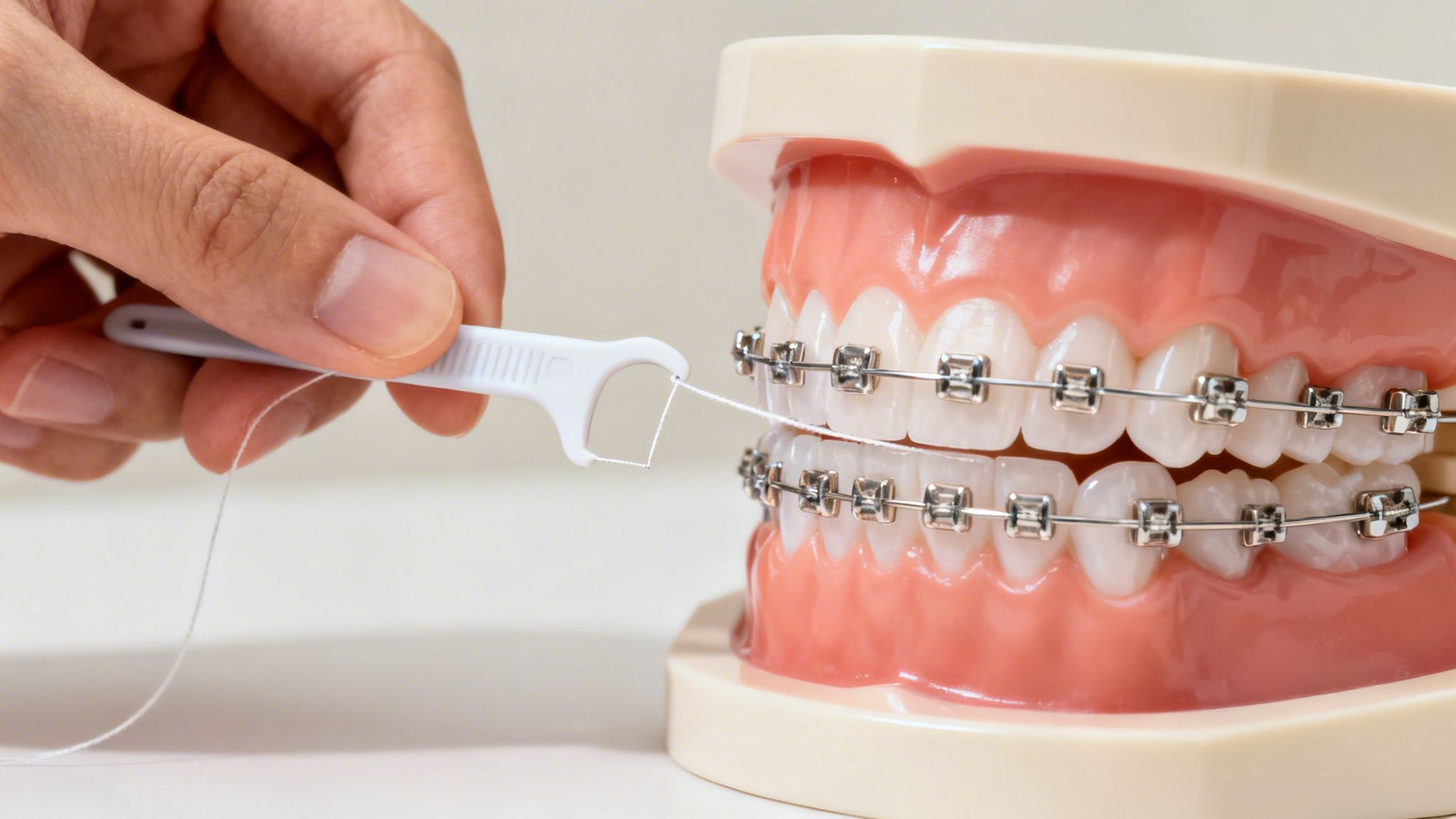
Learning to floss correctly is a game-changer for everyone, but it’s absolutely critical if you have dental work like braces, implants, or crowns. Think of it as protecting your investment in your smile.
These restorations create new nooks and crannies where plaque loves to hide, making your daily hygiene more important than ever. It takes extra patience and the right tools, but you can keep your smile healthy and ensure your dental work lasts. Here in our Walnut Creek, CA, practice, we help our patients create personalized hygiene plans to handle their unique situations.
Navigating Wires and Brackets with Braces
For our patients with braces, getting floss between teeth can feel like a frustrating puzzle. The archwire is always in the way, but a simple tool called a floss threader becomes your best friend.
A floss threader is a small, flexible plastic loop that acts like a needle and thread. Guide your usual 18-inch piece of floss through the loop, then slide the stiff end of the threader underneath your archwire.
Once it's through, you can floss the sides of both teeth using the C-shape technique. Pull the floss out, and you're ready for the next set of teeth.
Protecting Dental Implants and Bridges
If you have dental implants near me in Walnut Creek or a bridge, your mission is to clean around the posts and under the artificial tooth. Plaque here can cause peri-implantitis, a type of inflammation similar to gum disease that can lead to implant failure.
To get the job done right, we often suggest specialized tools:
- Superfloss: This all-in-one product has a stiff end for threading, a spongy section for cleaning wider gaps around the implant or under a bridge, and a regular floss segment.
- Water Flossers: An oral irrigator is fantastic for flushing out stubborn food particles and plaque from hard-to-reach spots, protecting your investment in restorative dentistry.
Keeping your dental restorations clean is a daily commitment. Failing to clean around an implant or under a crown can lead to serious issues that require more extensive treatment, including emergency dental care.
Caring for Crowns and Sensitive Gums
A dental crown restores a tooth, but the edge where the crown meets your natural tooth is a hotspot for plaque. Flossing this margin is vital.
If your gums are tender—perhaps from early-stage gum disease or recent dental work—don't skip flossing! Be more gentle. A soft, waxed floss is less likely to shred or catch on a crown's edge.
A water flosser on a low-pressure setting can also clean the area without irritation. If you have questions about maintaining your crown, you can learn more about how to care for dental crowns in our detailed guide.
No matter what type of dental work you have, the team at William M. Schneider, DDS is here to help you develop the perfect at-home care routine.
Common Flossing Mistakes You Might Be Making
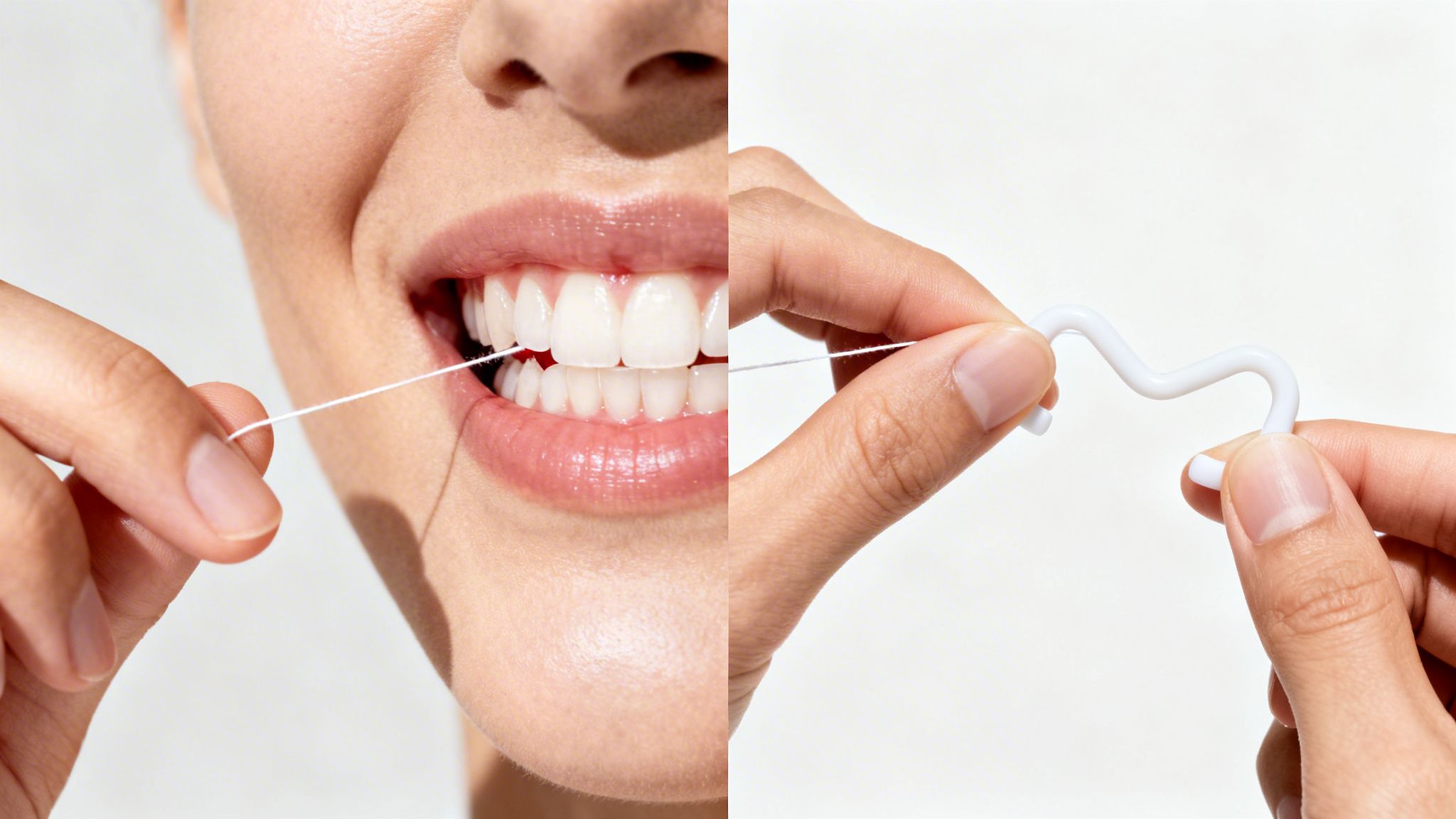
Are you flossing daily but not seeing the results you hoped for? It’s a common story. Even with the best intentions, a few small errors can undermine your hard work.
Here at our Walnut Creek dental practice, a frequent misstep we see is being too aggressive. Many people snap the floss straight down, which can injure the delicate gum tissue. Done repeatedly, this can even cause your gums to recede.
Reusing the Same Section of Floss
Another habit that derails your efforts is cleaning your entire mouth with the same small section of floss. When you do this, you’re not removing plaque—you're just moving it from one tooth to the next.
This is why we always recommend starting with about 18 inches of floss. This gives you plenty of room to advance to a fresh, clean section for each new space between your teeth.
Forgetting the Back Molars
It’s easy to focus on the front teeth you see in the mirror. But the most critical areas to floss are often the ones you can’t see. Many people unintentionally skip the backside of their very last molars.
These hard-to-reach spots are prime real estate for trapped food and plaque, which can lead to cavities that might require restorative dentistry services like fillings or crowns. It only takes an extra moment to carefully wrap the floss around the back of those final teeth.
A little bleeding when you first start flossing consistently is often a sign that your gums are inflamed and need the attention. It’s an indication that the cleaning is working.
Being Discouraged by Bleeding Gums
Finally, please don’t panic if you see a little blood when you first get into a consistent flossing routine. This is typically a sign that your gums are inflamed from plaque that was already there. Keep at it! The bleeding should stop within a week or two as your gums get healthier.
However, if you notice heavy bleeding or it continues for more than two weeks, it might point to a bigger issue. That’s your cue to schedule a cleaning and exam with your local dentist in Walnut Creek, CA, so we can get a closer look at your gum health. This could be a sign of a more serious problem that requires prompt dental care.
Your Partner for Dental Care in Walnut Creek
Mastering at-home care with proper flossing is a huge step toward lifelong oral health, and our team is here to support you. At the office of William M. Schneider, DDS, we see ourselves as your partners in health, building a relationship based on education and trust right here in Walnut Creek.
Our professional cleanings and exams are the perfect complement to your daily routine. During these visits, our hygienists can gently remove stubborn tartar that even perfect flossing can’t dislodge, and we can check your progress and offer personalized advice.
A Partnership for Your Health
During your visit, our expert hygienists can gently remove the stubborn tartar that even the most perfect flossing technique can’t dislodge. We’ll also take a close look at your gum health with dental x-rays if needed and can even provide hands-on demonstrations to fine-tune your technique, making sure you feel completely confident.
This focus on proactive care is something we’re seeing everywhere. The demand for preventive tools is growing, with the dental floss market projected to reach USD 1,121.6 million by 2032. It just goes to show how much people value taking control of their own health, and you can see how education is changing dental care habits across the board.
We are proud to serve families throughout Walnut Creek and the East Bay in a comfortable, welcoming environment. Whether you need a routine check-up, cosmetic dentistry services like teeth whitening, or are facing a dental emergency, our team is here to provide exceptional care. If dental anxiety is a concern, please let us know. We offer painless injections and sedation options to ensure your visit is as relaxed and stress-free as possible.
Ready to take the next step in your oral health journey? We invite you to schedule your new patient exam and experience our commitment to personalized, high-quality dental care firsthand.
Frequently Asked Questions About Flossing
We get a lot of great questions from our patients here in Walnut Creek, CA, about the finer points of flossing. Getting the details right is a huge part of building oral health habits that actually stick.
Here are a few of the most common things people ask when looking for a "dentist near me."
Should I Floss Before Or After Brushing My Teeth?
This is the classic chicken-or-the-egg question of dental care! We generally recommend flossing before you brush your teeth.
Think of it this way: flossing first clears out the food particles and plaque hiding between your teeth. When you follow up with your toothbrush, the fluoride from your toothpaste can reach those freshly cleaned surfaces and do its job more effectively.
That said, the most important thing is that you're flossing consistently. Whether it's before or after brushing, doing it is always better than skipping it.
Is It Normal For Gums To Bleed When I Start Flossing?
Yes, it's actually very common to see a little bleeding when you first start a regular flossing routine. This is usually a sign of gingivitis, which is just a fancy term for inflamed gums caused by plaque that your toothbrush couldn't reach.
With gentle, daily flossing, you should see the bleeding stop within one to two weeks as your gums get healthier and stronger. If you experience heavy bleeding or it continues past that timeframe, give our Walnut Creek office a call. It's best to have us take a look and rule out anything more serious.
Many people wonder how to make flossing a consistent part of their day. Practical strategies like quick, practical routines like habit stacking can help you seamlessly integrate flossing into your daily regimen.
If you ever need personalized advice on your at-home care, our team is always here to help you find what works best for you.
At William M. Schneider, DDS, we are dedicated to being your partner in achieving excellent oral health in Walnut Creek, CA. Schedule your appointment today and let us help you build a confident, healthy smile that lasts a lifetime.