You've got a big day coming up, and your smile is on your mind. Maybe it's a wedding, a reunion, a new job, or just the feeling that years of coffee, tea, or red wine have made your teeth look dull even though you've kept up with your routine. For a lot of Walnut Creek patients, in office whitening treatment is the quickest professional way to get a brighter smile without waiting weeks for gradual changes.
At William M. Schneider, DDS, that matters because people don't usually ask about whitening for abstract reasons. They want to look good in photos, feel confident talking face-to-face, and know they're making the right choice for their teeth, not just following a trend. Chairside whitening can fit into a busy schedule, and it's often part of a larger cosmetic or preventive visit with a dentist in Walnut Creek, CA who already knows how to balance appearance, comfort, and long-term oral health.
The best whitening plan isn't always the most aggressive one. Modern evidence supports a more conservative approach, and it also makes clear that some stains respond better than others. If you're weighing whitening against take-home trays or wondering whether your crowns or fillings will change color, you're in the right place.
Why Walnut Creek Patients Choose In-Office Whitening
A common story in Walnut Creek starts the same way. Someone has a wedding in a few weeks, a class reunion is on the calendar, or a work event is coming up and their smile feels a little too dull in photos. They want a change they can see soon, not a slow project that stretches across several weeks.
Chairside whitening fits that need well. It gives working adults a professional option that can show visible change in one visit, which is one reason people searching for a cosmetic dentist near me or a dentist near me often ask about it first. Consumer-facing dental guidance notes that in-office whitening typically takes only one office visit, while out-of-office whitening can take days to weeks (Loud Family Dentistry). For someone trying to fit treatment into a lunch break, a day off, or a tight calendar, that difference is easy to understand.
A useful way to think about it is this. Home whitening is more like a steady drip, while in-office whitening is the focused treatment patients choose when they want professional supervision and a faster visible result. That does not make it the right answer for every smile, but it does explain why it gets so much attention.
Fast results, but not a one-size-fits-all fix
Speed is only part of the appeal. A single appointment is easier to schedule than a series of home applications, and that convenience matters when life is already full. For many patients, that is the difference between finally taking care of discoloration and keeping it on the back burner.
Cost is part of the conversation too. Professionally supervised in-office whitening is commonly discussed in the $500 to $650 range on average, with some clinics charging more depending on the system used. At William M. Schneider, DDS, whitening is offered alongside preventive and cosmetic care, so it feels less like an isolated add-on and more like one part of a larger plan.
That broader plan can matter just as much as the color change itself. A whitening visit may sit next to a cleaning and exam, dental x-rays, or a cosmetic consultation if you are thinking beyond brightness alone. If your goal is to feel better for a wedding, a new role, or just day-to-day conversations in Walnut Creek, the right choice is the one that fits both your schedule and your teeth.
Practical rule: if you want the fastest change for natural teeth and you are okay with some temporary sensitivity risk, chairside whitening is usually the most direct professional route.
How In-Office Whitening Works
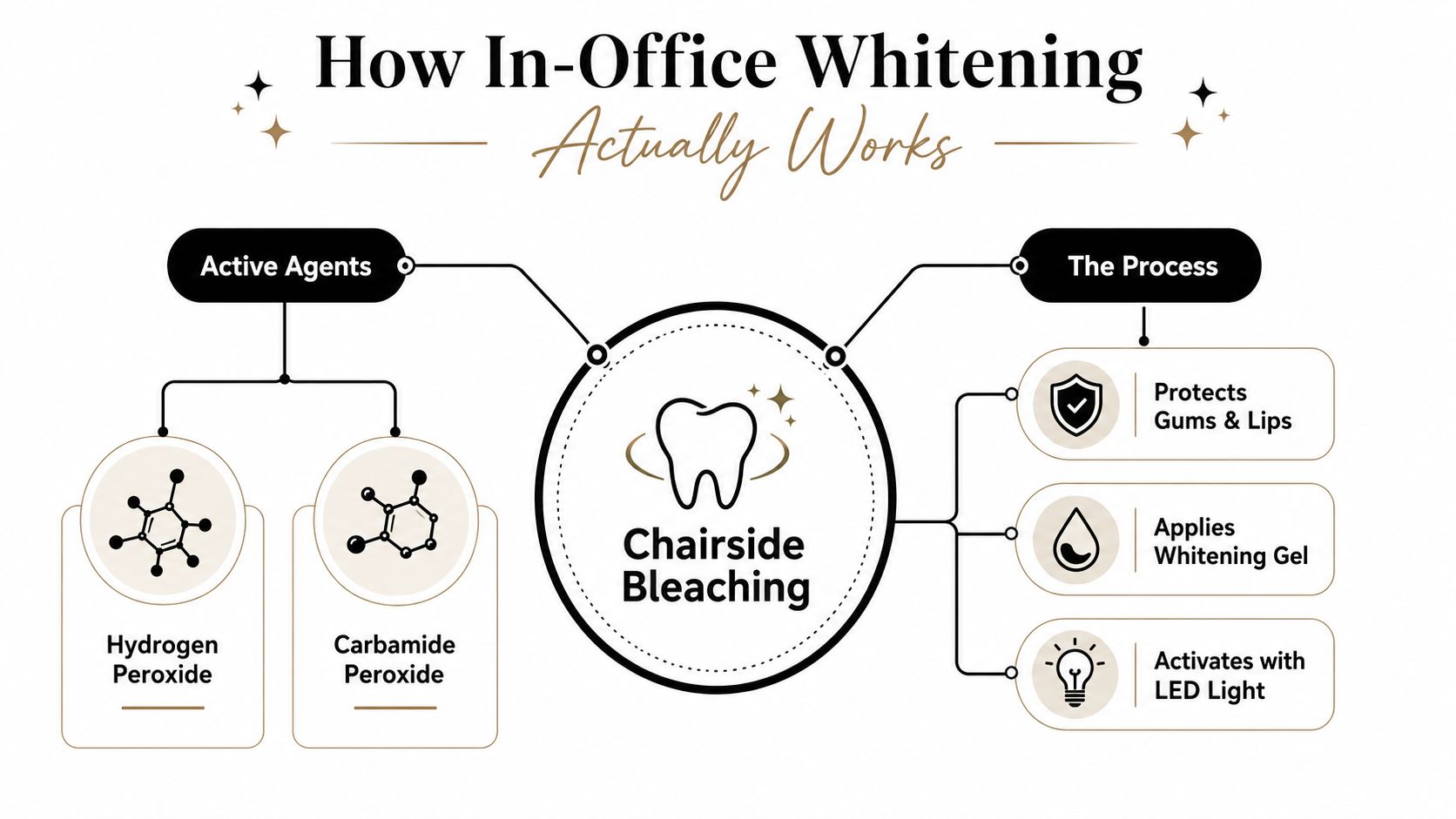
The active ingredients in chairside whitening are usually hydrogen peroxide or carbamide peroxide. Peroxide works like a stain-busting cleaner for natural enamel. It does not scrape enamel away. It breaks stain molecules into smaller pieces so the tooth looks lighter and reflects less discoloration.
That difference matters in the chair, because whitening is a chemical process, not a polishing step. The American Dental Association explains that whitening works on natural teeth, not on fillings, crowns, or other tooth-colored restorations (ADA whitening guidance). A dentist checks what is causing the color change before recommending treatment. If the shade problem comes from enamel, whitening can help. If the darker area is a restoration, a different fix may be needed.
Why the gums are protected first
A good office protocol starts with gum isolation. A resin dam or rubber shield keeps the whitening gel on the tooth surface and away from soft tissue. That step protects comfort as well as safety. The stronger the peroxide, the more important that barrier becomes.
Office whitening also shows why stronger does not always mean better. An umbrella review of 24 systematic reviews found that low-to-medium hydrogen peroxide levels of about 25% to 35% produced whitening results comparable to higher concentrations, while lowering tooth sensitivity (umbrella review). The same review found that routine light activation methods such as LED, halogen, or laser generally did not improve whitening efficacy and could increase sensitivity. In plain language, more peroxide and more light do not automatically give a better clinical result.
That is why a trained dentist focuses on controlled application instead of using the strongest material available. The goal is a cleaner-looking smile with fewer side effects, especially for patients who already worry about sensitivity or who want a predictable result that fits a busy day.
What Happens During Your Whitening Appointment
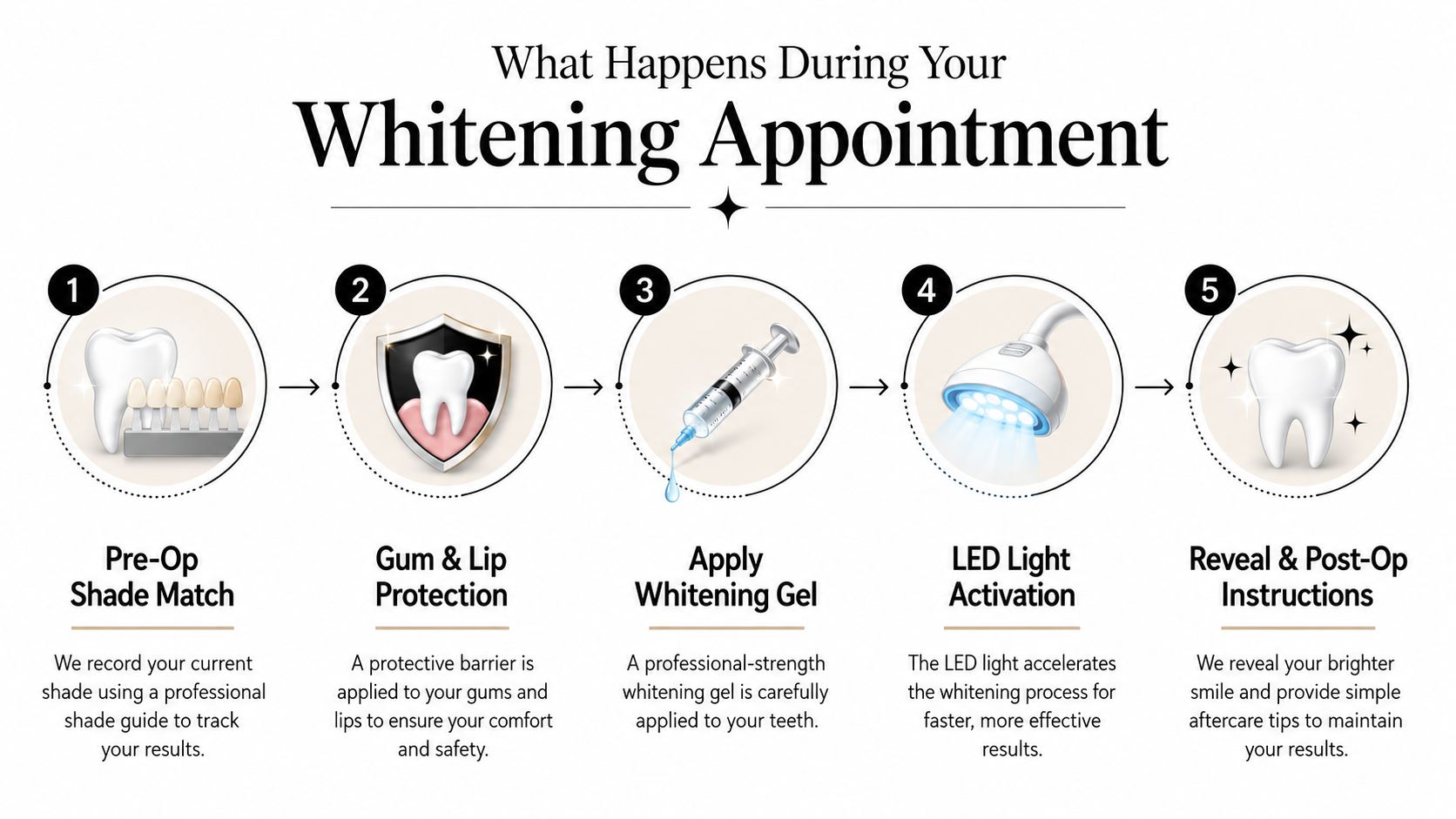
A chairside whitening visit usually starts before any gel touches your teeth. The team records your starting shade first, so you can see the change clearly at the end of the appointment. That matters because many people do not realize how much discoloration has built up until they compare the before and after side by side.
Then the protection goes in. Cheek retractors keep your mouth open comfortably, and the gums are isolated with a resin or rubber barrier so the whitening material stays on the teeth. After that, the gel is placed in controlled rounds, with suction between applications to reduce contact with the soft tissues and keep the process predictable.
A typical visit, step by step
One clinical protocol describes three cycles of application with suctioning between cycles, with an optional fourth application if more lift is needed (SDI protocol PDF). In plain language, your dentist is not just coating the teeth and waiting. The office is controlling where the gel goes, how long it stays there, and how much exposure the gums receive.
Visible change can happen during a chairside appointment, and people often leave looking noticeably brighter. Results still vary by stain type, enamel condition, and the whitening product used. That is why a smile can look different before you even stand up from the chair, while the exact amount of change depends on what the teeth started with.
You should expect your teeth to look brighter right away, but the final shade can settle a bit as the teeth rehydrate over the next day or so.
For anxious patients, comfort still matters. A calm office, clear narration of each step, and careful technique go a long way. If you avoid cosmetic visits because the unknown feels worse than the treatment itself, that is exactly the kind of concern a good Walnut Creek dental team should address before the gel ever goes on.
Comparing In-Office, Take-Home, and Over-the-Counter Options
A patient sitting in our Walnut Creek chair often asks the same practical question, which whitening option makes sense for real life, not just on paper? The answer usually comes down to three things, how fast you want to see change, how much sensitivity you can tolerate, and how much you want to spend.
A narrative review summarizing several meta-analyses found that at-home bleaching with 10% to 16% carbamide peroxide and in-office bleaching with 25% to 40% hydrogen peroxide produced comparable shade-change outcomes when the protocols were followed (PubMed review). In plain terms, both paths can work well. The bigger difference is the experience. In-office whitening usually gives you faster visible change in one visit, while take-home whitening is slower and often feels easier for patients who want a gentler pace.
Whitening options side by side
| Option | Active Agent | Typical Cost | Time to Results | Sensitivity Risk | Longevity |
|---|---|---|---|---|---|
| In-office whitening | Hydrogen peroxide | Cost varies based on the whitening system and whether additional services are bundled | Same day | Higher than gradual options | Varies with habits |
| Take-home custom trays | Carbamide peroxide | Usually lower than chairside treatment, exact fee depends on the office and the tray system used | Days to weeks | Often lower and more gradual | Varies with habits |
| Drugstore strips or gels | Lower-strength peroxide products | Lowest upfront cost | Days to weeks | Variable, often uneven | Usually the least predictable |
Cost is not just about the whitening gel itself. Pricing can shift depending on whether the plan includes custom trays, extra protective steps for sensitive teeth, or other services folded into the visit. That is one reason two offices can quote different numbers for what sounds like the same treatment.
Over-the-counter products can help with mild surface staining, but they do not offer the same fit or control as a dentist-supervised plan. A custom tray from the same Walnut Creek office gives the gel a better chance to stay where it belongs, on the teeth, not the gums. That middle ground often suits patients who want more control than store-bought strips but do not need the speed of chairside whitening.
For someone comparing services like teeth whitening, Invisalign, dental implants near me, or even tooth extraction and restorative work, the useful question is simple. What problem are you trying to solve? Whitening changes color. It does not straighten teeth, replace missing teeth, or repair decay.
Stains and Situations Whitening Cannot Fix
A dark tooth is not always a whitening problem. That is the first thing to sort out in the chair, because the source of the discoloration decides whether whitening can help, how much it can help, and whether another treatment makes more sense.
Surface stains are the easiest to predict. Coffee, tea, tobacco, and other everyday habits tend to discolor the outside of the tooth, and whitening products are built for that kind of stain. Internal discoloration is different, because the color change starts inside the tooth structure itself. That can happen after trauma, with fluorosis, or as the tooth develops. In those cases, chairside whitening may improve the shade only a little, or not in the way the patient expected. A comparative study on fluorosis found that mild dental fluorosis responded best to microabrasion plus home bleaching, while moderate fluorosis did better with microabrasion plus home bleaching or combined bleaching than with microabrasion plus in-office bleaching (fluorosis study). The authors recommended a low-sensitivity micro-grinding plus home-bleaching approach for mild and moderate fluorosis (fluorosis study).
A good Walnut Creek exam is a little like checking both the paint and the wood underneath. If the stain sits on top, whitening may work well. If the color change is built into the tooth, the plan has to match that deeper problem.
If a tooth has had a root canal and the discoloration is inside the tooth, standard external whitening often is not the right tool. Clinical guidance notes that nonvital root-filled teeth often need internal bleaching rather than regular outside whitening, and rare complications such as external cervical resorption have been reported. That does not mean the tooth cannot be improved. It means the treatment has to match the source of the stain.
Whitening also does not change the color of fillings, crowns, or other restorations. A front crown can stay the same shade while the natural teeth around it get lighter, which can make the restoration stand out more instead of less. That is one reason a dentist should look at the full smile, not just the tooth shade chart.
Some teeth need a different cosmetic plan entirely. A chipped tooth, a worn edge, a large filling, or a crown that no longer matches may call for bonding, a replacement restoration, or another type of cosmetic work instead of more bleaching. A careful consultation at William M. Schneider, DDS in Walnut Creek helps separate the stains whitening can treat from the situations where it cannot.
Side Effects, Safety, and How Dr. Schneider Reduces Risk
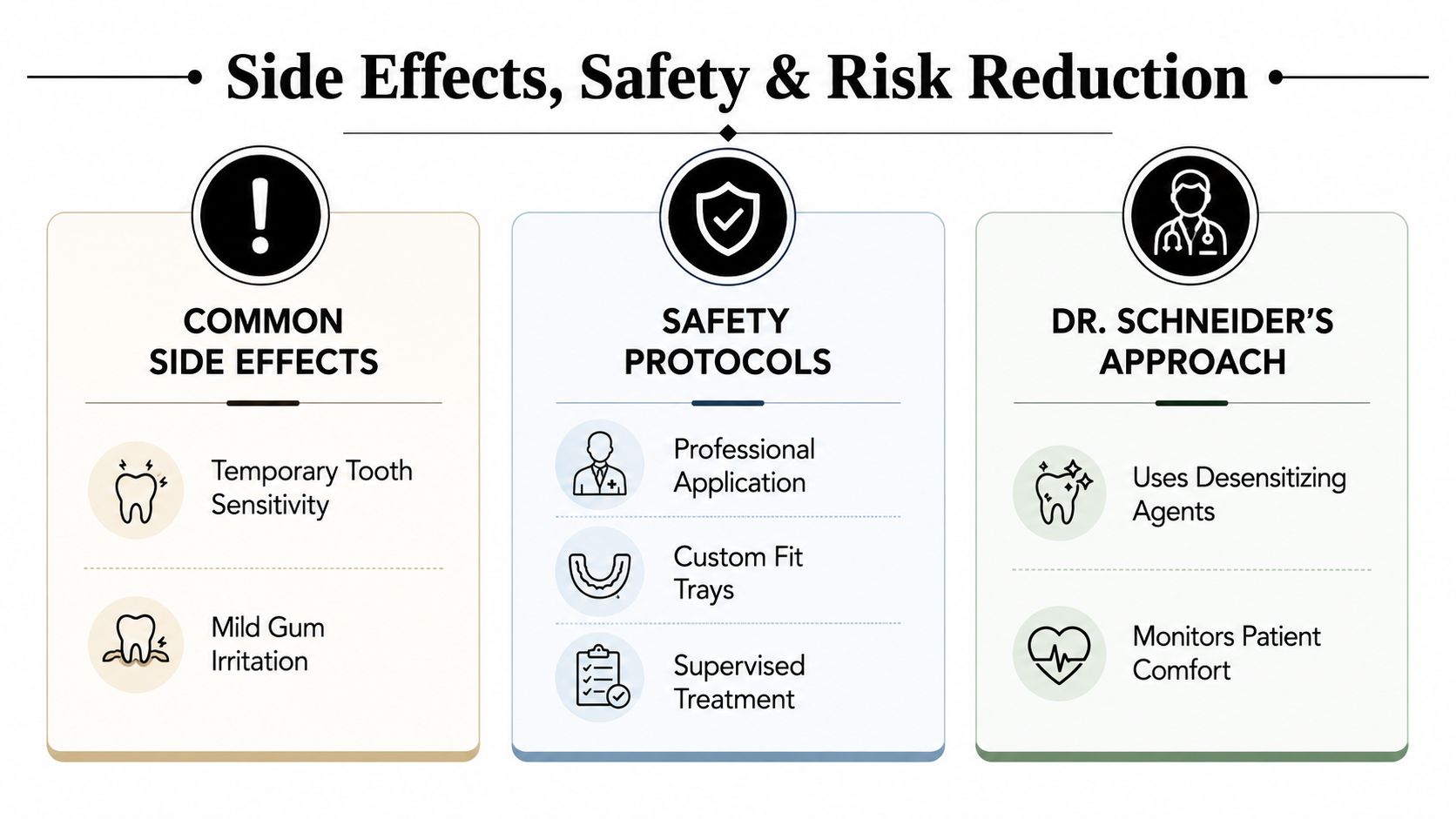
The first question is usually the simplest one. Will it hurt? For many patients, the answer is that temporary tooth sensitivity can show up during or after whitening, and mild gum irritation can happen if gel touches soft tissue. Those effects are usually short-lived, and they are the reason careful technique matters from the start.
Sensitivity is common enough that we plan around it, the same way a good mechanic expects a little resistance before tightening a bolt. The exact reaction varies from patient to patient, because enamel thickness, baseline sensitivity, and the whitening method all play a part. Some people feel only a brief zing with cold water. Others notice tenderness that lasts a little longer and then settles down.
Risk reduction starts before the gel goes on
Prevention begins with isolating the teeth and protecting the gums so the whitening gel stays where it belongs. Dr. Schneider also pays attention to timing, peroxide strength, and whether a patient's teeth already feel irritated before treatment starts. If someone has a history of sensitivity, the plan can be adjusted instead of forcing the same protocol on every smile.
That kind of adjustment matters because whitening should fit the tooth, not the other way around. A patient who comes in already prone to sensitivity may need shorter exposure, a gentler approach, or a pause between steps. Patients who want a clearer plan can also review how to reduce tooth sensitivity after whitening for simple aftercare tips that match what we talk through in the office.
At William M. Schneider, DDS, the visit is explained step by step so nothing feels rushed or unclear. That calm pace helps lower anxiety, which matters because tense patients often feel every sensation more sharply. The office also uses careful technique when other dental work is needed, so the same attention to comfort carries through the entire visit.
Safety is not a guess. It comes from screening the mouth first, shielding the gums, supervising the treatment closely, and listening when a patient says something feels off.
Your Visit at William M. Schneider, DDS in Walnut Creek
The office at 1855 San Miguel Dr., Suite 31, Walnut Creek, CA 94596 is set up for patients who want straightforward care without a lot of friction. You're greeted by a team that understands this is often a first cosmetic visit, not just another cleaning. That means the experience starts with clear expectations, not rushed treatment.
A new-patient whitening appointment typically begins with a dental x-rays and a cosmetic consultation before any whitening gel is applied. That helps the dentist see whether you're a good candidate for chairside bleaching or whether another path would be smarter for your teeth. Dr. Schneider brings more than 25 years of experience, along with training from the University of Minnesota and an AEGD in San Francisco.
One office, many treatment paths
Walnut Creek patients often like the convenience of having preventive, cosmetic, and restorative care in one place. The practice provides:
- Preventive cleanings and exams
- Invisalign clear aligners
- Teeth whitening
- Dental implants
- Crowns and bridges
- Root canals
- Gum disease treatment
- Sleep apnea solutions
That mix matters because whitening doesn't exist in a vacuum. A patient who wants a brighter smile may also need restorative work, a new patient exam, or a conversation about maintenance. When all of that happens in one practice, it's easier to build a plan that fits real life.
If you're comparing a dentist near me with a cosmetic dentist near me, comfort and communication should be part of the decision. Transparent pricing, online appointment booking, accessibility accommodations, and a relaxed environment all lower the barrier for people who've been putting off care. The East Bay patients who choose this office usually want a long-term dental home, not a one-time cosmetic transaction.
Aftercare, Maintenance, and How to Book
The first 48 hours after whitening are the most important for keeping your result bright. Avoid coffee, tea, red wine, dark berries, and tobacco. Stick to lighter foods like chicken, rice, pasta, and water, and use a sensitivity toothpaste if your dentist recommends it. Keep brushing and flossing twice a day so plaque doesn't dull the new shade.
A touch-up plan can help the result last longer, especially if you drink staining beverages or want to keep your smile event-ready. The office can also provide custom take-home trays to extend the result of your in-office visit, which is useful if you want a gradual refresh later without starting from zero. For more on that, see the practice's guide to how to maintain the results of teeth whitening.
If you're ready to talk through your options, call (925) 935-2700 or visit 1855 San Miguel Dr., Suite 31, Walnut Creek, CA 94596 to request a consultation. William M. Schneider, DDS also welcomes anxious patients and can discuss sedation when appropriate.
A CTA for William M. Schneider, DDS.