You've probably noticed the crowding for years, perhaps in photographs, during video calls, or whenever a chipped front edge catches the light. You may have postponed treatment because metal braces felt too visible, you assumed adult teeth couldn't move, or you didn't want another major commitment competing with work and family. Invisalign treatment for adults can offer a discreet alternative, but the right plan depends on your bite, gum health, tooth shape, daily habits, and treatment goals.
At William M. Schneider, DDS, adults in Walnut Creek receive a careful evaluation before choosing clear aligners. Dr. Schneider has more than 25 years of experience treating adult dental concerns, including cosmetic, restorative, and preventive needs. This guide explains what adult Invisalign feels like, where it works well, when attachments or interproximal reduction may be needed, and how a consultation at a Walnut Creek dental office can clarify your options.
Why More Adults in Walnut Creek Are Choosing Invisalign
A 42-year-old Walnut Creek professional may postpone orthodontics through college, marriage, and raising two children. Then a crowded lower tooth becomes harder to clean, an incisal edge chips again, or a smile in a Zoom meeting makes an old concern impossible to ignore. The phone call often comes after years of hesitation, not because the person suddenly cares about appearance, but because the inconvenience of leaving the problem alone has finally outweighed the fear of treatment.
Adults commonly delay straightening their teeth because of cost concerns, appearance, fear of metal brackets, busy schedules, and the belief that orthodontic treatment belongs in adolescence. Teeth can move in adulthood when the supporting gums and bone are healthy, and clear aligners have helped make treatment feel more compatible with professional and family life. Invisalign was introduced in 1999, and by 2023 more than 17 million people worldwide had been treated, including 4.5 million teens, according to ConsumerAffairs' Invisalign statistics overview. Adults therefore represented the majority of cumulative users in that reported total.
A better fit for East Bay routines
Walnut Creek adults often move between downtown lunches, commuting, client meetings, school schedules, and evening responsibilities. Removable aligners can be taken out for meals and oral hygiene, and their low visibility can reduce the self-consciousness associated with traditional brackets. That doesn't mean Invisalign is effortless. It means the appliance can fit into a lifestyle that leaves little room for visible hardware or complicated food restrictions.
Adult treatment has also become more socially familiar. Remote work, video calls, and broader acceptance of orthodontics later in life have made clear aligners less stigmatizing than many patients expect. At Dr. Schneider's office, adults frequently arrive worried that everyone will notice and leave surprised by how discreet the process feels.
A practical observation: Adults rarely need reassurance that their smile matters. They need an honest explanation of what treatment will ask them to do each day and whether the expected result justifies that commitment.
How Invisalign Moves Your Teeth
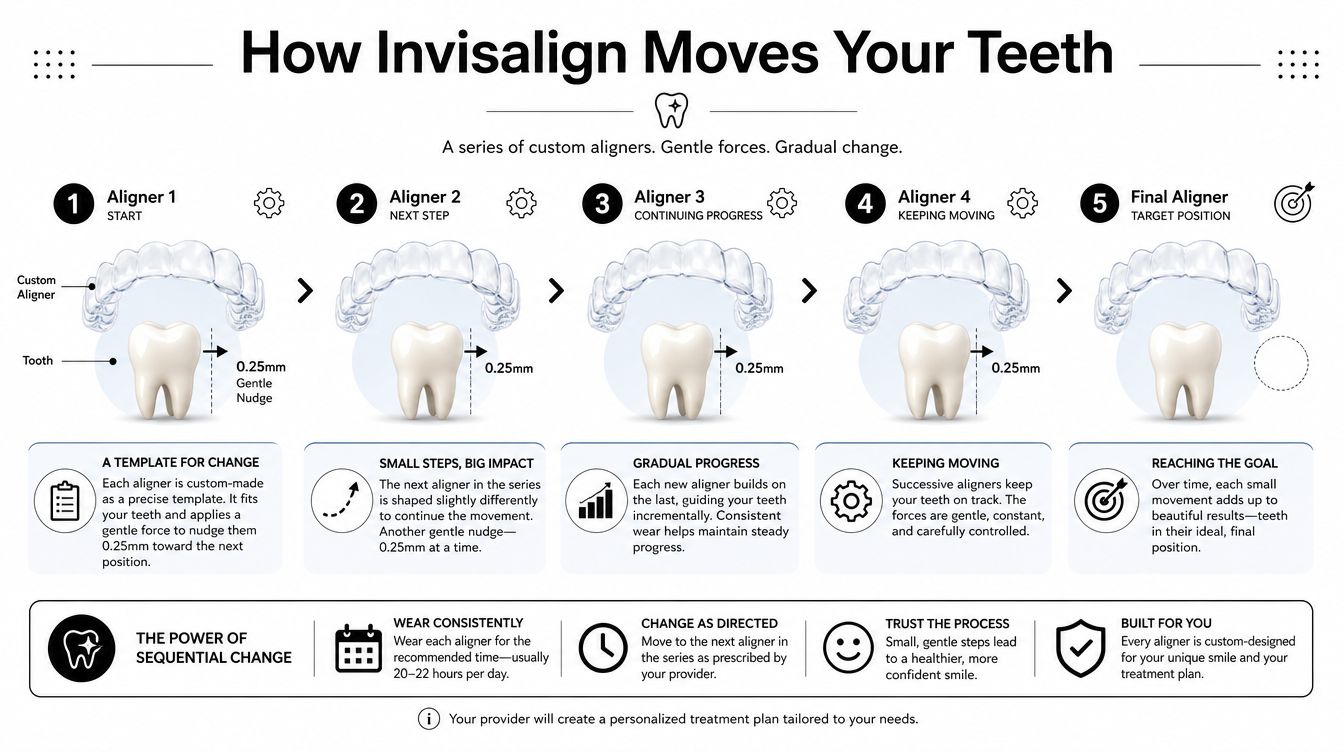
Each aligner is a thin, custom-shaped template for change. It fits your current tooth positions while applying gentle pressure in planned directions. As you move through the series, each tray guides selected teeth toward their next positions, rather than shifting the entire smile at once.
The planning process
At the Walnut Creek office, a digital iTero or comparable 3D scan records your teeth without the discomfort of traditional impression material. The scan, photographs, dental evaluation, and bite records are combined into a staged treatment plan. A digital preview can show the proposed movement before you decide whether to proceed.
The mechanics differ by tooth and by the movement being planned. A 2014 experimental study examining 970 Invisalign aligners reported initial mean moments of approximately 7.3 N·mm for maxillary incisor torque and about 1.0 N for distalization. For premolar derotation, the reported moment was 8.8 N·mm with attachments compared with 1.2 N·mm without them. The peer-reviewed biomechanical study also found that forces declined over wear time, which helps explain the need for staged movements and, in selected cases, attachments.
Attachments and IPR
Attachments are small, tooth-colored composite shapes bonded to selected teeth. They give the aligner a more secure grip for movements such as rotation, tipping, uprighting, or torque. An adult case report describes a vertical rectangular attachment bonded to a molar for uprighting and tipping control. The adult Invisalign attachment case report illustrates why attachments are selected for a specific mechanical need, not automatically placed on every tooth.
Interproximal reduction, or IPR, creates space by carefully reshaping a small amount of enamel between selected teeth. A clinical guide describes typical IPR as approximately 0.25 to 0.5 mm per contact. It is not required in every plan. At Dr. Schneider's office, its use depends on the intended movement, tooth shape, and available enamel.
During the first week, pressure or tightness is common when a new aligner is inserted. Mild tenderness usually settles, while persistent pain, a sharp edge, or an aligner that will not seat calls for a message to the office. Clear aligners can be comfortable, but predictable movement still depends on wearing each tray as directed and reporting fit problems promptly.
Who Makes a Good Adult Invisalign Candidate
Good candidacy starts with the problem being treated, not with the appliance a patient prefers. Adults with mild to moderate crowding, spacing, modest rotations, and orthodontic relapse often respond well to clear aligners. Many patients with selected overbites, crossbites, or open-bite concerns can also be considered, provided the treatment plan can control the required movements.
A 2023 clinical protocol survey found that 97.5% of respondents reported using aligners for adults, and Invisalign was the most popular aligner system among respondents at 81.25%, as reported in the clinical protocol survey. A separate 2025 scoping review found clear aligners promising for adult anterior open-bite correction, while also emphasizing that precise vertical control remains difficult and complex cases may need adjuncts such as mini-screws or elastics. The open-bite review supports a careful case-selection conversation rather than a simple promise that aligners can correct every bite.
Where clear aligners have limits
Traditional braces or combined orthodontic and surgical planning may be more appropriate for severe skeletal discrepancies, large overjets, major vertical tooth displacement, difficult extraction spaces, or teeth that are too short or unusually shaped for predictable aligner retention. Attachments and elastics can expand what aligners accomplish, but they don't eliminate biological and mechanical limits.
Gum health is essential. Active gum disease must be stabilized before orthodontic movement because inflamed supporting tissues can compromise the safety of treatment. A cleaning and exam, dental x-rays when indicated, and a periodontal assessment may be part of the diagnostic process.
The compliance question
Clear aligners are removable, so success depends on using them as prescribed. In a cohort of 2,644 clear-aligner patients, 36.0% were fully compliant, 38.3% fairly compliant, and 25.7% poorly compliant. Only 45.5% reported wearing each aligner for the recommended 22 hours per day, according to the clear-aligner compliance study.
You'll generally need to wear aligners 20 to 22 hours each day, removing them for meals, drinks other than water, and oral hygiene, as described in patient guidance on clear-aligner wear. For a fuller discussion of crowded teeth, review Invisalign for crowded teeth. A diagnostic records visit at the Walnut Creek practice is the only reliable way to determine whether your case is suitable.
Invisalign vs Traditional Braces for Adults
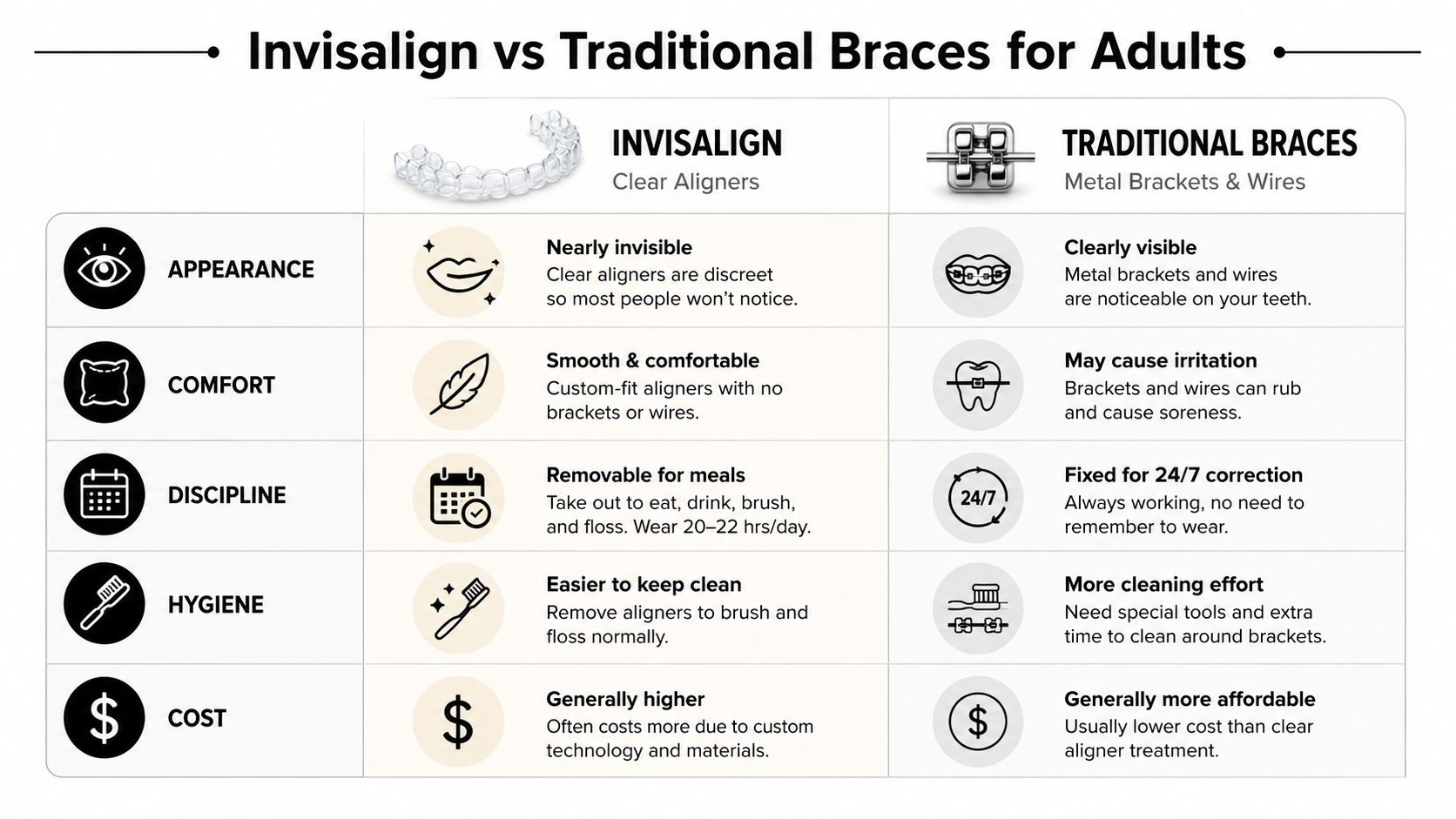
Adults usually compare Invisalign and braces across five practical concerns: visibility, comfort, discipline, treatment capability, and cost. Neither appliance is universally superior. Invisalign offers discretion and removability, while braces provide fixed, continuous control without requiring you to remember to put trays back in.
Appearance is Invisalign's clearest advantage. Clear aligners are difficult to notice in ordinary conversation, although attachments can become visible on certain teeth. Metal braces are obvious, and ceramic braces are less prominent but still include brackets and wires. For a patient whose work involves presentations, sales, public speaking, or frequent video calls, that difference can be meaningful.
Comfort has two sides. Aligners may cause pressure when a new tray is inserted, but their smooth surfaces don't include brackets or wires that can rub the cheeks. Braces can irritate soft tissue, especially early in treatment or after wire adjustments. Both options require an adjustment period, and neither should be described as completely sensation-free.
The trade-offs that affect the result
| Decision factor | Invisalign | Traditional braces |
|---|---|---|
| Appearance | Low visibility during normal conversation | Metal brackets and wires remain visible |
| Eating | Removable for meals | Fixed, with greater food and cleaning restrictions |
| Hygiene | Trays come out for brushing and flossing | Cleaning around brackets and wires requires more technique |
| Compliance | Depends on prescribed daily wear | Fixed appliance doesn't depend on tray wear |
| Complex movements | Attachments and elastics may improve control | Often stronger for severe rotations and major vertical corrections |
Invisalign can handle many mild to moderate alignment concerns, but braces may remain the more predictable choice for severe rotations, vertically displaced teeth, complex extraction cases, or major bite correction. Treatment length depends more on biology, movement complexity, and patient cooperation than on the appliance label alone. An adult who won't reliably wear aligners may achieve a more dependable result with a fixed option.
Cost also requires a written comparison. The final fee can depend on complexity, the amount of treatment, refinement needs, and what the plan includes. A comparison should reflect your actual records rather than a generic online estimate.
What the Invisalign Treatment Timeline Really Looks Like
Adult Invisalign treatment is usually measured in months, not weeks. A 2024 study of 56 adults reported an average of 24 aligners and a mean treatment time of 11.2 months, with a mean patient age of 33 years. Those results come from a specific study group, so they shouldn't be treated as a promise for every Walnut Creek patient. Independent adult guidance commonly places treatment around 12 to 24 months, with complexity influencing the final range, as outlined by Ava Orthodontics.
What happens along the way
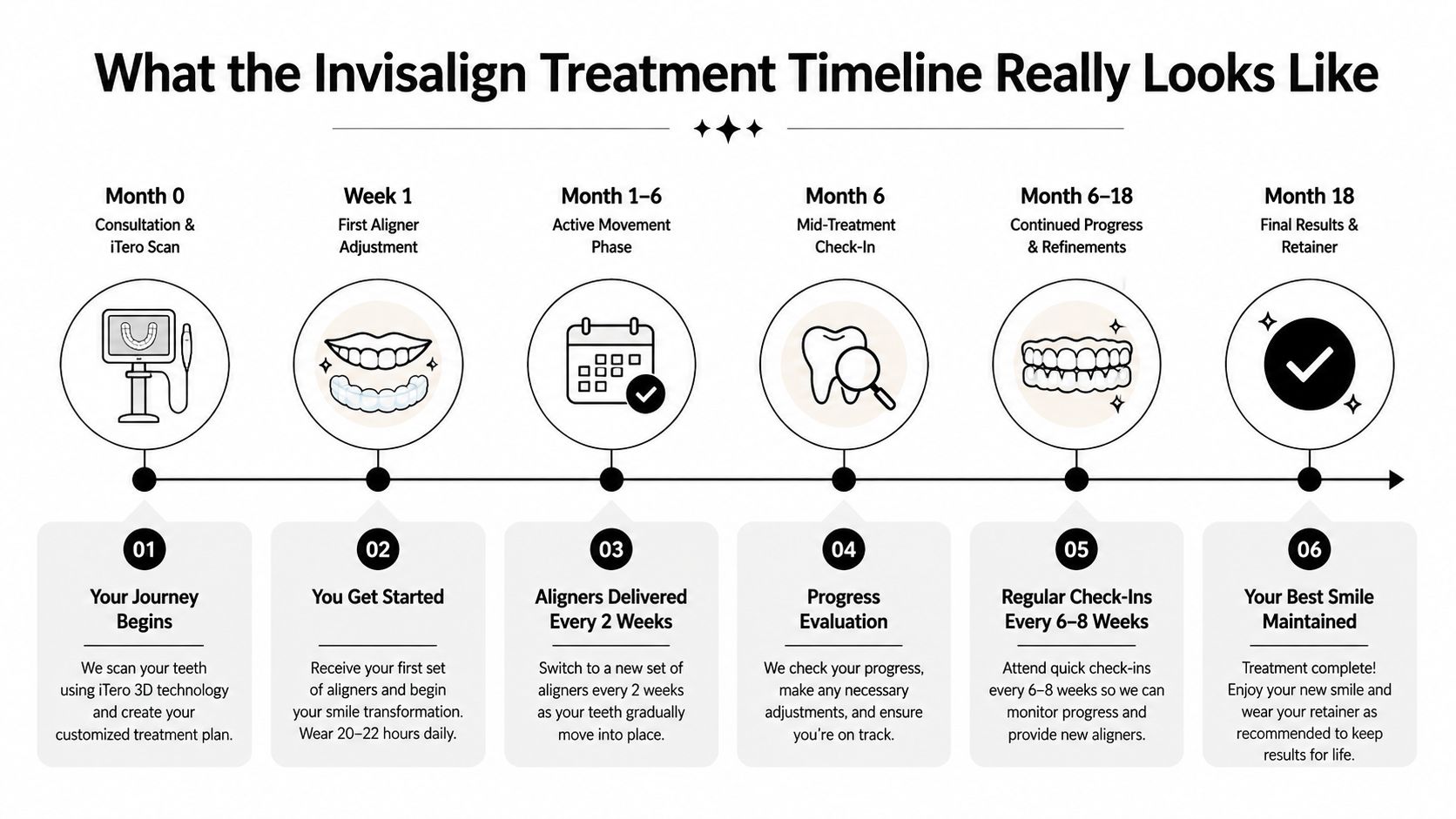
At the first visit, the team evaluates your teeth, gums, bite, and goals, then takes the digital scan and supporting records. The digital preview helps identify where attachments, IPR, elastics, or other design features may be needed. Once your aligners arrive, early appointments focus on fit, attachment placement, hygiene, and whether the prescribed movements are tracking properly.
The first week often includes pressure, extra saliva, and a period of learning how to speak and remove the trays comfortably. Eating and drinking routines change because the aligners come out for meals and hot drinks. Most adults adapt quickly to keeping a case available, rinsing trays, and brushing before reinsertion.
A realistic treatment rhythm
Patients commonly receive a sequence of trays and move through them according to the prescribed schedule. The exact change interval depends on the plan, and many protocols use a range of 7 to 14 days per aligner. Office check-ins may occur every 6 to 8 weeks, allowing the dentist to assess tracking and make adjustments before a small issue becomes a larger delay.
The 2024 adult study's 11.2-month mean illustrates why a straightforward case can finish sooner than a complex bite correction. Refinement trays may be added when the clinical finish requires additional control. At the end of active movement, retainers protect the result. Retention isn't an optional cosmetic afterthought. Teeth remain biologically capable of shifting, so the retainer plan becomes part of long-term care.
Invisalign Cost, Insurance, and Financing for Walnut Creek Adults
Adult Invisalign fees in Walnut Creek can vary substantially. A limited case may fall in the low $4,000s, while full care may reach $7,000 or more, but those figures should be treated as market guidance rather than a quote for your treatment. The verified clinical and patient information supplied for this guide doesn't establish a universal Walnut Creek fee schedule, so the only accurate estimate comes from a written treatment proposal after examination and records.
| Treatment Type | Typical Walnut Creek Fee | Insurance & Financing Notes |
|---|---|---|
| Limited adult Invisalign | Low $4,000s may apply to selected cases | PPO orthodontic benefits, if available, may contribute according to the plan's terms |
| Comprehensive adult Invisalign | $7,000 or more may apply to complex plans | Ask whether refinements and retainers are included |
| Adult orthodontic consultation | Varies by office policy | Request a written estimate and payment schedule before starting |
What changes the fee
The number of aligners is only one consideration. Case complexity, attachments, IPR, elastics, refinements, the length of active treatment, and the retainer arrangement can all affect the total. A lower initial quote may not include every phase of care, so ask specifically about records, attachments, refinement aligners, replacement trays, retainers, and follow-up visits.
Many PPO dental plans treat orthodontic benefits through a lifetime maximum rather than paying the full treatment fee. Coverage varies by contract, age restrictions, waiting periods, exclusions, and whether the plan considers the treatment medically necessary. HSA and FSA funds may be applicable to eligible dental expenses, but you should confirm the rules with your plan administrator.
Making payments predictable
A Walnut Creek consultation should end with clear financial information, not pressure. Ask whether the office offers third-party financing such as CareCredit, in-house membership options for uninsured patients, and monthly arrangements for the balance after insurance. William M. Schneider, DDS provides transparent expectations and personalized treatment planning, but the exact availability and terms of financing should be confirmed directly with the practice.
What to Expect at William M. Schneider, DDS
Your first visit takes place at 1855 San Miguel Drive, Suite 31, Walnut Creek, near downtown Walnut Creek. Bring your insurance card, a list of questions, and recent dental x-rays if another dentist has taken them. Parking and access questions can be addressed when you schedule.
The consultation is diagnostic before it becomes cosmetic. The team may take photographs, dental x-rays when clinically appropriate, and a digital scan instead of using messy impression material. Dr. Schneider evaluates tooth alignment alongside the bite, facial balance, gum condition, existing restorations, tooth wear, and the smile you want to achieve. That broader view matters because straight teeth alone don't guarantee a stable or comfortable result.
Anxiety-aware care
Adults who have avoided dental visits may worry as much about the appointment as the aligners. The practice offers sedation options, including nitrous oxide and oral conscious sedation when appropriate, so patients can discuss their anxiety rather than silently tolerate it. Painless injections, calm explanations, warm blankets, and an unhurried approach can make the first conversation more manageable.
For anxious patients: You can ask about comfort measures before any examination begins. You don't have to wait until you feel overwhelmed.
The treatment coordinator reviews the digital ClinCheck preview, discusses the expected sequence, and explains what attachments, IPR, or refinements could mean for your plan. The team also discusses costs upfront so you can weigh Invisalign against braces or postponement with better information.
Once treatment begins, daily tray care becomes part of your routine. Instructions about cleaning, storage, reinsertion, and what to do if a tray feels loose or sharp should be specific to your plan. The practice's guide to taking care of your Invisalign trays can reinforce those instructions at home.
The office provides general, cosmetic, and restorative dental services, including cleaning and exams, teeth whitening, crowns, bridges, root canals, dental implants, and gum disease care. That can be useful when alignment concerns overlap with worn enamel, an old crown, a missing tooth, or a need for broader restorative dentistry.
Booking Your Invisalign Consultation and FAQs
An Invisalign consultation is primarily a fact-finding visit, not a commitment to start treatment. You can schedule by phone, use the practice's online appointment form, or request a callback. When you contact the office, share your main concern, whether you've had braces before, any existing crowns or veneers, current gum symptoms, and the times of day that work best for you.
The team can prepare more efficiently if you bring your insurance information, recent x-rays, medication details, and a short list of questions. If you're also searching for a dentist near me, a dentist in Walnut Creek, CA, a cosmetic dentist near me, or related care such as dental implants, tooth extraction, or emergency dental services, mention those needs when booking so the visit can be organized appropriately.
Questions adults commonly ask
Can crowns or veneers affect candidacy?
They can affect planning, but they don't automatically rule out Invisalign. The dentist needs to evaluate how the restoration fits, whether the tooth can move safely, and whether the bite may change. Implants are different because an implant doesn't move like a natural tooth, so neighboring teeth and the final bite must be planned around it.
How often will I wear retainers after treatment?
Retainer use follows the dentist's long-term instructions and generally becomes a maintenance routine after active treatment. Teeth can shift without retention, even after a successful result. Ask for a specific schedule and replacement guidance rather than assuming retention ends when the last active aligner is finished.
What happens if I lose an aligner?
Contact the office before moving ahead randomly. Depending on your stage and the fit of the previous or next tray, the team may advise you to wear another aligner temporarily or arrange a replacement. Don't force a tray that no longer fits comfortably.
Can Invisalign help with a mild bite problem?
It may, particularly when the bite issue is linked to tooth position and the required movements are within predictable limits. Complex vertical changes or skeletal discrepancies may need attachments, elastics, braces, or combined care. A scan and bite evaluation provide a more useful answer than a general online checklist.
How long will the result last?
A stable result requires ongoing retention. Your teeth and supporting tissues continue to respond to normal forces over time, so follow-up and retainer use matter. Dr. Schneider can explain what type of retainer is appropriate and how to monitor fit.
Adults with dental anxiety can meet Dr. Schneider and the team, ask about nitrous oxide or oral conscious sedation, and decide after they understand the plan. That makes the consultation a low-risk way to learn whether clear aligners, braces, or another dental solution fits your health and priorities.
If you're considering Invisalign treatment for adults, William M. Schneider, DDS offers digital evaluations, personalized clear-aligner planning, restorative and cosmetic dental care, and sedation-friendly support for anxious patients. Visit William M. Schneider, DDS to request a Walnut Creek consultation and discuss your smile goals with the team.