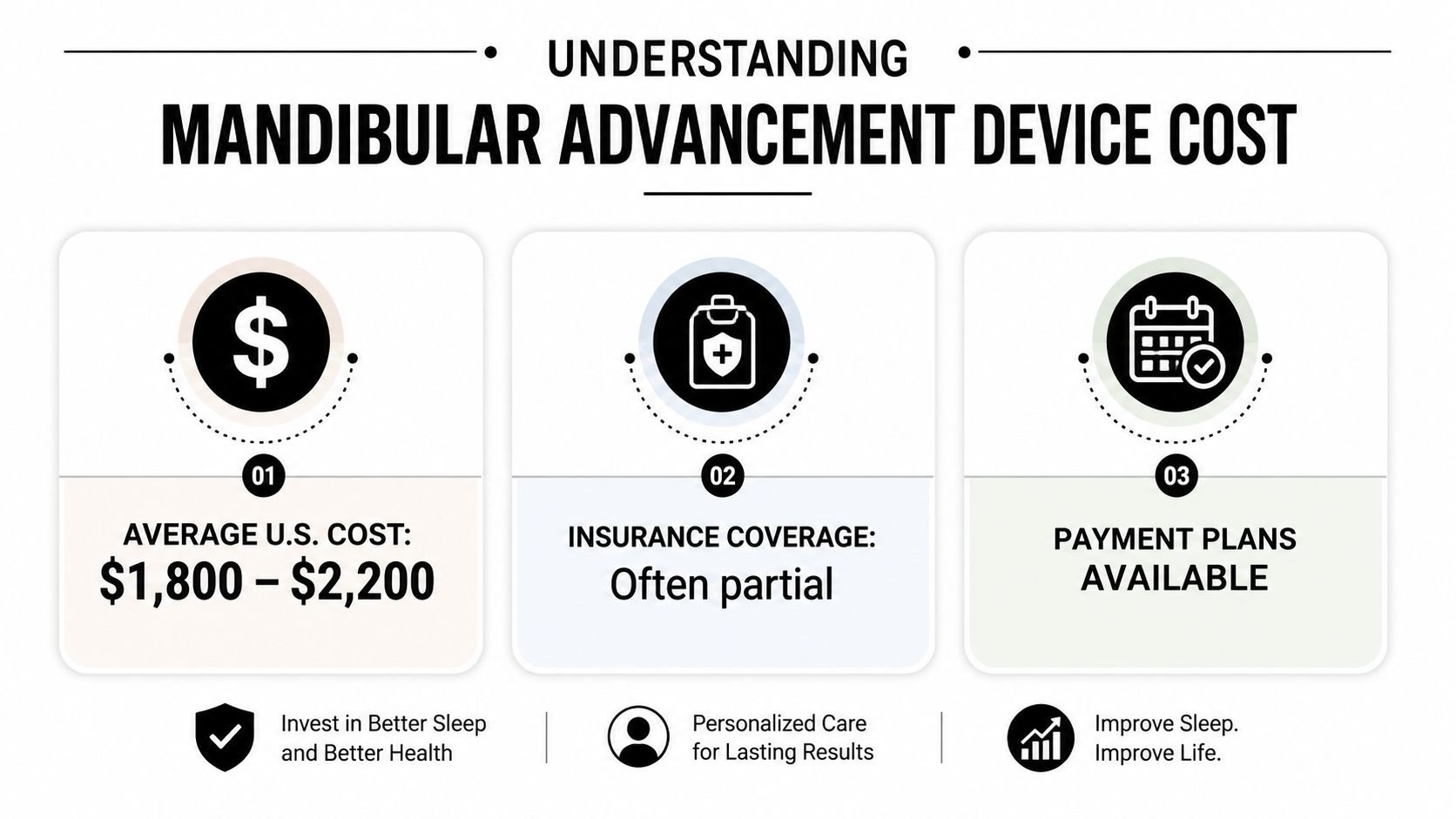
$1,800 to $3,500 is the usual out-of-pocket range for a custom mandibular advancement device, and insurance often helps when CPAP intolerance is documented. The question isn't just what the device costs, it's what you're paying for, and why that number can change so much from one patient to another.
If you've been comparing sleep apnea treatment options in Walnut Creek, it's easy to get stuck on sticker price alone. A custom appliance is part of a medical treatment plan, not a simple retail purchase, so the smarter conversation starts with fit, follow-up, insurance, and whether the device is built for your airway and your bite.
Understanding Mandibular Advancement Device Cost in Walnut Creek
“Why does one oral appliance feel manageable while another feels like a major expense?” That is the question many Walnut Creek patients ask when they start comparing mandibular advancement devices. The answer is that mandibular advancement device cost depends on whether you are looking at a simple appliance or a custom medical treatment plan that includes diagnosis, fitting, and follow-up.
What patients usually pay first
For a custom device in the U.S., a detailed cost guide places the initial consultation at $150 to $300, follow-up titration visits at $50 to $150 each, and the custom MAD itself at $1,500 to $2,500 (U.S. oral appliance therapy cost breakdown). Those pieces add up because the price includes more than the appliance sitting in a case. It includes the clinician's planning, the records needed to make the device fit correctly, and the adjustments that help it work comfortably over time.
A peer-reviewed review table gives a broader medical frame, placing upfront cost in the same general range and noting that ongoing adjustments or replacement can add to the total, with coverage often available when CPAP intolerance is documented (peer-reviewed review table). That matters because the first payment is only part of the budget, the later visits also shape how well the treatment holds up.
Why local expertise matters
At a Walnut Creek practice like William M. Schneider, DDS, the value is in matching the treatment to your mouth, your sleep diagnosis, and your budget in one plan. A custom appliance is not a stock item you pick off a shelf. It needs careful fitting, bite records, and follow-up so the device advances the jaw without creating avoidable soreness or bite changes. That clinical attention is part of what patients are paying for, and it can affect whether the treatment feels worthwhile in daily life.
The office's more than 25 years of experience and East Bay focus matter because sleep apnea appliances depend on careful adjustment, not guesswork. If you want a local example of how a sleep-apnea appliance visit fits into broader care, this Walnut Creek sleep apnea dental appliance page gives useful context.
Practical rule: If a price seems unusually low, ask what is included. Consultation, impressions, adjustments, and follow-up can change the real cost more than the device shell itself.
What Drives the Price of a Custom MAD
A custom mandibular advancement device is priced the way it is because you are paying for more than the plastic shell. At a Walnut Creek practice, the fee reflects the clinical planning that starts before the appliance is made and continues after you take it home. That is where the price begins to separate from an over-the-counter mouthguard.
The parts that build the bill
A 2024 review notes that MADs are often covered by insurance when there is documentation of CPAP intolerance, which shows how closely this treatment is tied to medical records and not just a retail purchase (peer-reviewed review table). That medical pathway adds cost because the process includes diagnosis, documentation, and clinical judgment, not only product selection.
The U.S. pricing example also shows why the total rises beyond the device alone. Initial consultation, titration visits, and the custom MAD all contribute to the total out-of-pocket amount (U.S. oral appliance therapy cost breakdown). In plain terms, the appliance is one part of the bill, while the care around it shapes the rest.
Why custom work costs more than mass production
Custom devices require impressions, bite records, fabrication, and follow-up adjustment. That process takes more time than a shelf product, but it is what helps the appliance fit properly and stay comfortable enough to wear. If the fit is off, the result can be wasted money, sore teeth, or a device that ends up unused.
A lower upfront price can still become the more expensive choice if it doesn't fit well enough to wear consistently.
The same review also notes that MADs have a favorable cost-benefit balance in mild to moderate OSA because adherence is often better than CPAP, which can improve value in daily use even when the sticker price is higher than some over-the-counter devices (peer-reviewed review table). That is the kind of value patients should ask about, not only the number on the first invoice.
OTC Versus Custom Mandibular Advancement Devices
The price gap between a store-bought mouthguard and a custom appliance is real, and the clinical gap matters just as much. A thermoplastic boil-and-bite device can look inexpensive at first, but it usually skips the fitting steps that help a sleep appliance sit comfortably enough to wear through the night.
Side-by-side pricing and fit
Major-market pricing examples show thermoplastic “boil-and-bite” devices at about $40 to $60, semi-customized devices around $200, and fully custom MADs around $1,500 to $2,000 in Australia, with some insurer rebates available for custom appliances (RACGP device pricing overview). In that same pricing context, a U.S. custom SomnoMed Avant is listed at $1,800, and accessory costs can raise the estimated annualized cost to about $1,980 (RACGP device pricing overview).
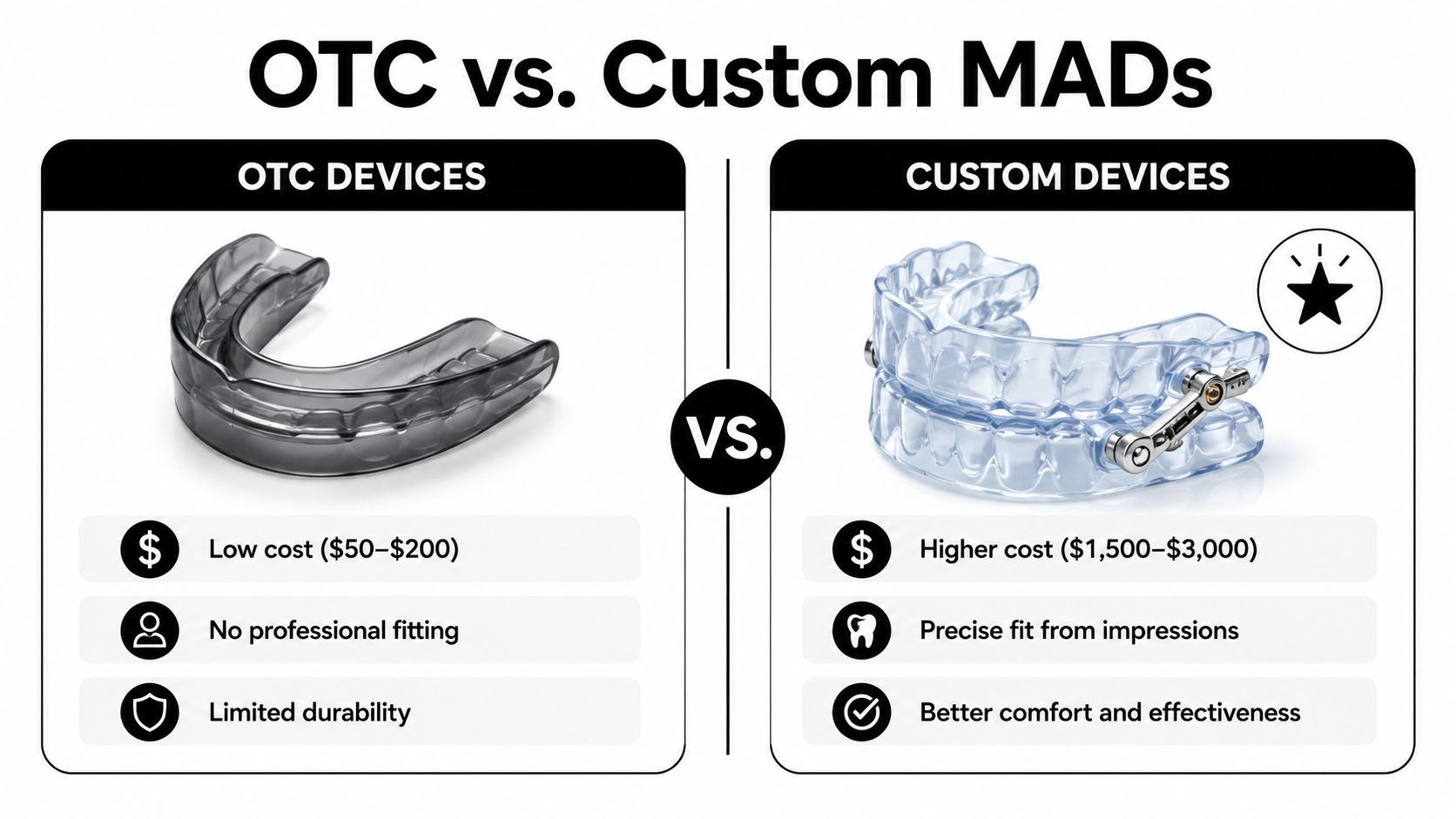
A lower sticker price can hide a weaker fit. That matters because an appliance that feels awkward or creates pressure points is harder to wear consistently, and consistency is where treatment value starts to show up in real life.
What changes between the two
A boil-and-bite appliance is mass-produced. That keeps the purchase price down, but it also reduces fit precision and usually shortens durability. A custom device takes more appointments and lab work, but the result is designed around your teeth and jaw movement.
Here is the point I would want patients in Walnut Creek to hear clearly. If you are only comparing the first price tag, OTC options can seem attractive. If you are comparing comfort, wear time, and the chance of getting a device that matches your bite, custom fabrication usually makes more sense, especially when the treatment is meant to support long-term sleep health.
Insurance Coverage and Financing Your MAD Treatment
Can insurance make a mandibular advancement device more affordable? Yes, but the savings depend on how your plan classifies the treatment and whether your records show the right medical need.
Insurance often changes the final price more than the sticker price does. A device that looks expensive at first can become much more manageable if your benefits apply, while a lower upfront quote can still leave you paying most of the bill yourself.
What insurers usually look for
Many plans want proof that CPAP intolerance was documented before they consider coverage for a mandibular advancement device. That usually means your sleep study, physician notes, and referral records need to line up. If the chart is incomplete, the claim can stall even when the treatment itself is appropriate.
That is why the paperwork matters as much as the appliance. At a local Walnut Creek practice, the goal is not only to fit the device well, but also to make sure the clinical documentation supports the value of the care you are getting.
A good place to start is learning how plan rules affect your share of the bill. If terms like deductibles and premiums feel confusing, understanding premiums and deductibles can make the insurance side easier to discuss before you call your carrier.
What to ask before you commit
- Ask about oral appliance benefits: Find out whether your plan treats the device as medical durable equipment or as a dental item.
- Ask for documentation requirements: Confirm whether your insurer needs proof of CPAP intolerance, a sleep study, or prior authorization.
- Ask about payment options: If coverage is partial or delayed, financing can help spread the cost into manageable monthly payments.
- Ask how the lab and follow-up visits are billed: Some plans cover part of the device but handle office visits, adjustments, or replacement parts differently.
- Ask for an estimate before fabrication starts: A clear estimate helps you compare your expected out-of-pocket cost with your benefit design and any financing terms.
A useful way to think about it is this. Insurance can cover the device itself, but the total value of treatment also includes the fitting, the adjustments, and the chance of getting a device that gets worn. That is where a custom appliance in Walnut Creek can make more sense than a cheaper option that does not fit well.
Transparent billing matters because sleep apnea appliances do not always fit neatly into one benefits bucket. If your plan pays part of the treatment and you handle the rest through financing, the monthly burden may feel more manageable than one large upfront bill, especially when you also want a device that is built for comfort and long-term use. For a more detailed local overview, see our sleep apnea treatment cost guide.
Good insurance timing saves money. Verify benefits before fabrication starts, not after the device is already made.
Comparing MAD Cost to CPAP Therapy
Patients often ask whether a mandibular advancement device costs less than CPAP. The honest answer depends on the care path, the insurance rules, and how long you use the treatment that fits your sleep apnea.
What the economic studies show
A UK-based TOMADO randomized trial and economic analysis found MADs to be cost-effective at £20,000 per QALY within 4 weeks, and the best-performing semi-bespoke device stayed cost-effective below £39,800 per QALY (economic analysis summary). The same analysis reported incremental cost-effectiveness ratios of £6,687/QALY, £1,552/QALY, and £13,836/QALY for different device types versus a comparator, which shows that the value of treatment changes with the device design and how it is made.
A separate European economic evaluation found MAD therapy to be less expensive than CPAP, with costs of €4,511 vs €5,302 and only a small QALY difference of 3.44 vs 3.49. That resulted in an ICER of €15,393 saved per QALY lost. Those figures do not mean every patient will spend less with a MAD, but they do show why the lowest upfront price is not always the best measure of value.
Why sticker price misses the point
A MAD may have fewer ongoing supply needs than CPAP, but the comparison is total treatment value. Comfort, nightly use, and long-term durability all affect whether the device you buy is the device you keep wearing.
For a patient-friendly explanation of how oral appliance therapy can compare with CPAP, see the oral appliance benefits from Pain and Sleep. A local Walnut Creek practice also has to look at fit, follow-up care, and the chance that a custom device will be used consistently, since those factors shape the cost of care just as much as the invoice itself.
The key takeaway is simple. CPAP and MAD therapy are both medical treatments, and the cheaper device on day one is not always the better financial choice over time. For a closer look at local treatment pricing, see our sleep apnea treatment cost guide.
What to Expect at William M. Schneider, DDS
Patients usually call a Walnut Creek dentist about sleep apnea treatment with two questions in mind, what will the visit feel like, and what will it cost in the end? William M. Schneider, DDS addresses both by setting clear expectations, planning care around each patient's needs, and keeping the process calm for people who already feel worn down by sleep problems.
The visit flow
The first visit starts with a consultation and examination. The team checks your oral health, jaw function, and whether a custom appliance is a good fit for your airway and bite. For patients who feel nervous in the dental chair, the practice describes painless injections, clear explanations, and sedation options when appropriate, which can make the appointment feel much easier to handle.
The office also brings more than 25 years of experience, along with Dr. Schneider's education from the University of Minnesota and advanced training in General Dentistry in San Francisco. That background matters because a sleep apnea appliance has to fit the mouth well and work with the bite, not fight it.
What happens after the first visit
After the exam, the team takes impressions and bite records so the device can be made for your mouth. The next phase usually includes titration visits, where the appliance is adjusted so the jaw sits in the right position and the device feels comfortable enough to wear at night. Those follow-up appointments are part of the treatment plan, and they affect both the final price and the final outcome.
Bring your sleep study, your insurance details, and a short list of questions about comfort, adjustment timing, and follow-up care.
If you want a wider view of how treatment costs can shift once service and coverage are part of the picture, the DME Superstore pricing guide is a useful comparison point. In the dental office, the value comes from more than the appliance itself. It also comes from careful fitting, guidance during adjustments, and the chance to catch bite or comfort issues before they become expensive problems.
If you need broader dental services while you are in the practice, the same office also handles preventive cleanings and exams, dental x-rays, restorative dentistry, and cosmetic care. A patient who comes in for sleep apnea help may also ask about tooth extraction, dental implants, or teeth whitening, depending on their overall oral health needs.
Estimating Your Out-of-Pocket Cost and Next Steps
A practical estimate starts with the parts of care you will receive. First comes the device itself, then the consultation, then any fitting or adjustment visits, and finally whatever your insurance applies to the claim. If you want a broader sense of how equipment pricing changes once service and coverage are included, the DME Superstore pricing guide offers a helpful comparison point.
A simple budgeting checklist
- Confirm the device category: A custom appliance usually costs more than a store-bought option, but it is designed for clinical use and a more exact fit.
- Check your insurance rules first: Ask whether your plan covers oral appliances and what records it wants before it will review the claim.
- Add follow-up visits: Adjustment appointments are part of treatment, and they affect the final total.
- Ask about follow-up testing: Some treatment plans include later testing to confirm how the appliance is working.
A useful way to estimate your out-of-pocket share is to start with the full office fee, then subtract any benefits, then add the visits that are not included in the base fee. That gives you a clearer number than guessing from a single appliance price. A custom MAD often falls in the $1,800 to $3,500 range without insurance, and maintenance can add recurring costs over time. Those figures give you a realistic starting point before benefits are applied, but the final number depends on the treatment plan and the level of support built into it.
For a Walnut Creek patient, the next step is simple. Bring your sleep records, your insurance card, and any questions about comfort, adjustment timing, and follow-up care, then ask for a written estimate before treatment begins. William M. Schneider, DDS at 1855 San Miguel Dr., Suite 31 can review your options and help you see how the clinical plan, insurance pathway, and long-term wear all affect your actual cost.
William M. Schneider, DDS offers sleep apnea consultations and custom oral appliance care in Walnut Creek, with a focus on clear explanations and predictable next steps. If you are comparing mandibular advancement device cost and want help understanding fit, insurance, and follow-up care, visit William M. Schneider, DDS to request an appointment and start with a consultation.