A sharp twinge when you sip coffee on the way to work. A chipped front tooth before a meeting. A crown that suddenly feels loose while you're eating dinner in Walnut Creek. Those moments are stressful because they interrupt normal life fast, and they raise bigger questions just as quickly. Is this urgent? Can the tooth be saved? Will treatment hurt?
That's where restorative dental care becomes important. Many patients searching for a dentist near me, an emergency dentist, or a dentist in Walnut Creek, CA aren't looking for abstract dental information. They want clear answers, a practical plan, and treatment that relieves pain while protecting their smile.
Patients at WC Family Dentist often arrive with a mix of symptoms and concerns. Some need a simple filling after a cavity is found during cleaning and exams. Others need help after a cracked tooth, infection, or missing tooth changes the way they chew and speak. Some are also weighing whether they need dental implants near me, a bridge, a crown, or even a tooth extraction when a tooth can't be restored predictably.
The good news is that most restorative dentistry procedures are more straightforward than people expect. With careful exams, digital imaging, gentle numbing techniques, and sedation when appropriate, treatment can feel manageable even if you've been putting it off. For many East Bay patients, the hardest part is not the procedure itself. It's knowing which option makes the most sense.
Introduction to Restorative Dentistry Procedures
Restorative dentistry procedures focus on repairing damaged teeth, replacing missing teeth, and helping your bite work comfortably again. In simple terms, this area of dentistry deals with teeth that are decayed, broken, infected, worn down, or missing.
If you woke up this morning with tooth pain, you're not alone. If you noticed a crack after biting into something hard, that's common too. Patients in Walnut Creek often call with the same practical worries: whether they need same-day care, whether the tooth can be saved, and whether treatment will interfere with work or family schedules.
Restorative care covers a wide range of treatments. A small cavity may need only a tooth-colored filling. A chipped edge might be corrected with bonding. A badly weakened tooth may need a crown. If the inside of the tooth is infected, a root canal may stop pain and preserve the tooth. When a tooth is missing, replacement options can include bridges and implants.
Why people often feel confused
Dental treatment names can sound similar even when they solve different problems. A crown and a filling both repair teeth, but they're used in different situations. A bridge and an implant both replace missing teeth, but they rely on different support. One of the biggest decision points is whether an existing restoration should be repaired or replaced.
Practical rule: The earlier a damaged tooth is evaluated, the more likely treatment can stay conservative.
That's especially important for patients who assume every damaged tooth needs a full replacement, or every missing tooth automatically calls for an implant. In reality, a good restorative plan depends on the condition of the tooth, the gums, the bite, the surrounding bone, and your comfort preferences.
What Walnut Creek patients usually want to know first
Patients want answers to a short list of questions:
- Will this stop the pain: Restorative treatment often addresses sensitivity, pressure pain, pain on biting, or discomfort from infection.
- Can I keep my natural tooth: In many cases, yes. Modern restorative care is designed to preserve healthy tooth structure whenever possible.
- How long will it take: Some procedures are completed in one visit, while others need a temporary restoration, healing time, or a second appointment.
- Will it look natural: Today's materials are designed to blend with your smile, especially for visible teeth.
For patients looking for a cosmetic dentist near me, restorative dentistry also overlaps with appearance. Repairing a tooth often improves both function and how your smile looks.
What Restorative Dentistry Treats and Why It Matters
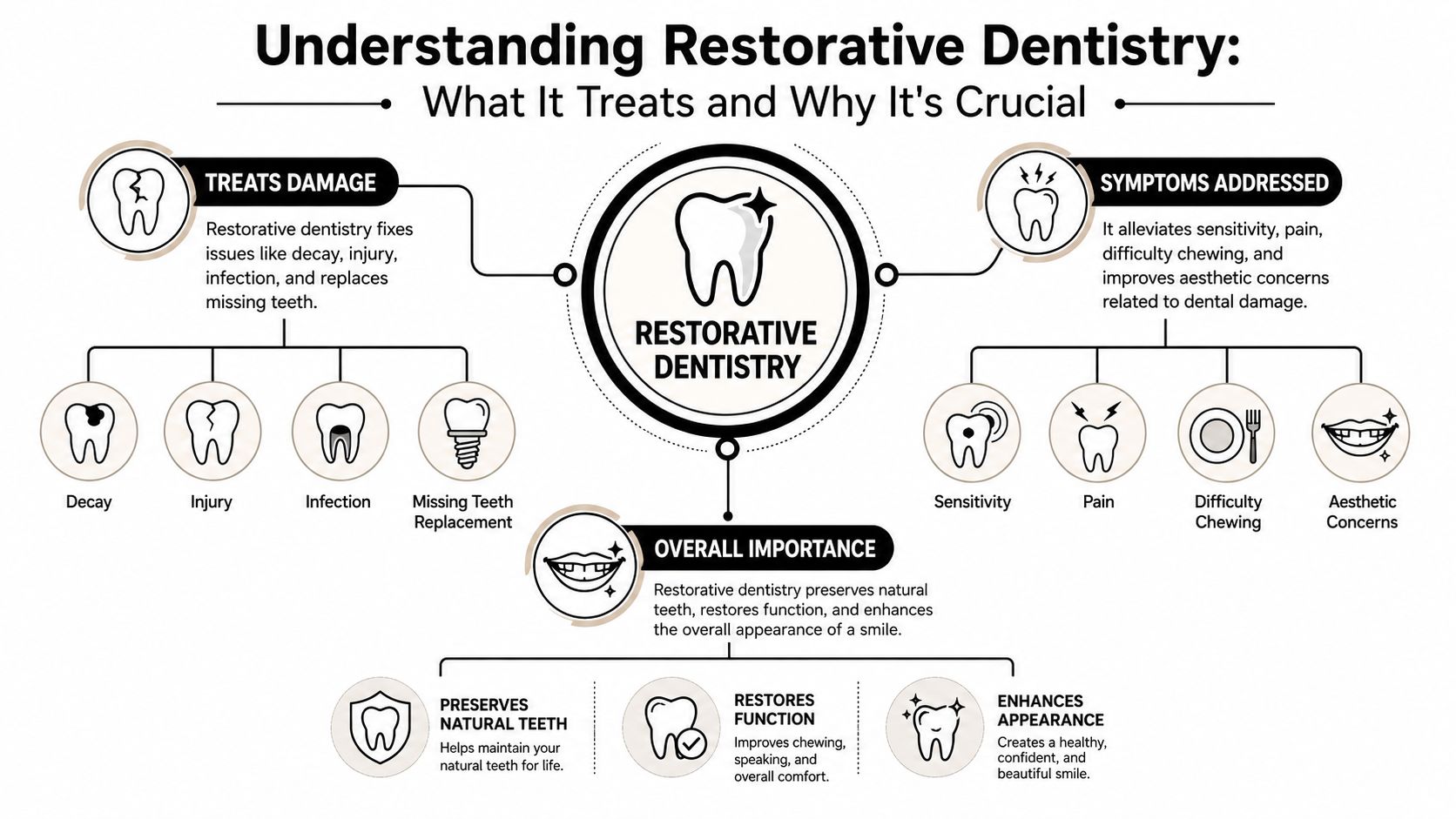
Restorative dentistry treats the everyday problems that make teeth hurt, break down, or stop functioning normally. That includes decay, cracks, fractures, infection, failing dental work, and missing teeth. It also addresses the chain reaction these issues can create. One damaged tooth can affect chewing, shift biting pressure to nearby teeth, and make the whole mouth feel less stable.
By adulthood, more than 90% of Americans have experienced tooth decay requiring restorative treatment, which is why fillings remain one of the most common procedures in dental care, according to statistics on restorative dentistry and tooth decay prevalence.
Common problems restorative care addresses
A cavity usually starts small. If it isn't treated, bacteria continue moving deeper into the tooth. What began as occasional sensitivity can become pain with cold drinks, discomfort while chewing, or a larger fracture if the tooth walls weaken.
Injuries follow a different path. A chipped tooth may be mostly cosmetic, or it may expose sensitive inner tooth structure. A crack may only hurt when you bite a certain way. Some patients notice pain that comes and goes, which can make them delay care even though the tooth is telling us something is wrong.
Missing teeth create another set of problems. They can affect chewing efficiency, speech, and bite balance. The neighboring teeth may drift, and the opposing tooth may begin to move because it no longer has contact.
Symptoms patients shouldn't ignore
Some signs are obvious. Others are easy to dismiss.
- Sensitivity to hot, cold, or sweets: This may point to decay, a crack, recession, or a failing filling.
- Pain when chewing: Often linked to fractures, bite imbalance, infection, or a restoration that no longer seals properly.
- Swelling or lingering toothache: These symptoms can suggest infection and should be evaluated promptly.
- Changes in appearance: Darkening, chipping, worn edges, or gaps from missing teeth can all signal restorative needs.
A tooth doesn't have to hurt constantly to need treatment. Intermittent pain is still a warning sign.
Why timing matters
Restorative dentistry isn't only about fixing damage that already exists. It also helps prevent bigger problems. A small filling is simpler than a crown. A crown is usually simpler than treating a deep infection. Replacing a missing tooth sooner can help preserve how the rest of the bite functions.
This matters for daily life in practical ways. Teeth that don't chew properly can change food choices. Ongoing dental pain can affect sleep, concentration, and mood. People also tend to chew on one side when something hurts, which can overload other teeth.
For Walnut Creek patients balancing busy schedules, the key takeaway is simple. Prompt treatment often means more conservative care, less disruption, and a better chance of preserving natural teeth.
Overview of Common Restorative Dentistry Procedures
Patients often hear a list of treatment names and wonder how they fit together. The easiest way to understand restorative dentistry procedures is to look at what each one repairs, when it's typically used, and how much chair time it usually involves.
One point many guides miss is the choice between repairing an existing restoration and replacing it. Research discussed in this review of repair versus replacement in restorative dentistry found that repaired teeth were less likely over 12 months to need extraction or further treatment than teeth that underwent full replacement. That doesn't mean repair is always the right move, but it does mean conservative treatment deserves real consideration.
The most common options
| Procedure | Indications | Appointment Time |
|---|---|---|
| Filling | Small to moderate cavities, worn areas, minor chips | Often one visit |
| Bonding | Small chips, edge repair, cosmetic reshaping | Often one visit |
| Crown | Cracked, weakened, heavily filled, or broken teeth | Usually two visits, sometimes with a temporary |
| Bridge | Replacing a missing tooth using support from nearby teeth | Usually multiple steps |
| Root canal | Infected or inflamed pulp inside the tooth | Often one or two visits |
| Dental implant | Replacing a missing tooth root and supporting a crown | Surgical and restorative phases over time |
How each treatment works
A filling restores tooth structure after decay is removed. For many patients, this is the first restorative procedure they ever need. Tooth-colored materials are often used for a natural appearance.
Bonding is a more sculpted repair. It's useful for a chipped corner, a small gap, or a spot where a tooth needs reshaping. It's generally conservative because it often removes little to no healthy tooth structure.
A crown covers and protects a tooth that's too compromised for a simple filling. If a tooth has a large crack, a large old filling, or significant structural loss, a crown may help distribute bite forces more safely.
A bridge replaces one or more missing teeth by anchoring to neighboring teeth. For some patients, it's a practical choice when they want a fixed option without surgery.
An implant replaces the missing tooth root and then supports a crown. Patients comparing options can learn more about dental implants in Walnut Creek, CA when a missing tooth needs a long-term replacement plan.
Repair or replace
Dentists don't always need to start over. Sometimes a worn filling, chipped edge on a crown, or localized defect can be repaired rather than fully replaced. That can preserve more healthy tooth structure and reduce treatment time.
Preserving sound tooth structure matters. Once natural tooth is removed, it doesn't grow back.
If the existing restoration has widespread leakage, deep decay underneath, or major fracture lines, replacement may be the safer choice. The right answer depends on the tooth, the restoration, and the forces your bite places on that area.
What to Expect During Restorative Procedures
Most patients feel better once they know what the visit will look like. Restorative appointments are usually calm, structured, and paced step by step. If you're coming in for a cavity, crown, broken tooth, or urgent discomfort, the process is designed to identify the problem clearly first and then treat it as comfortably as possible.
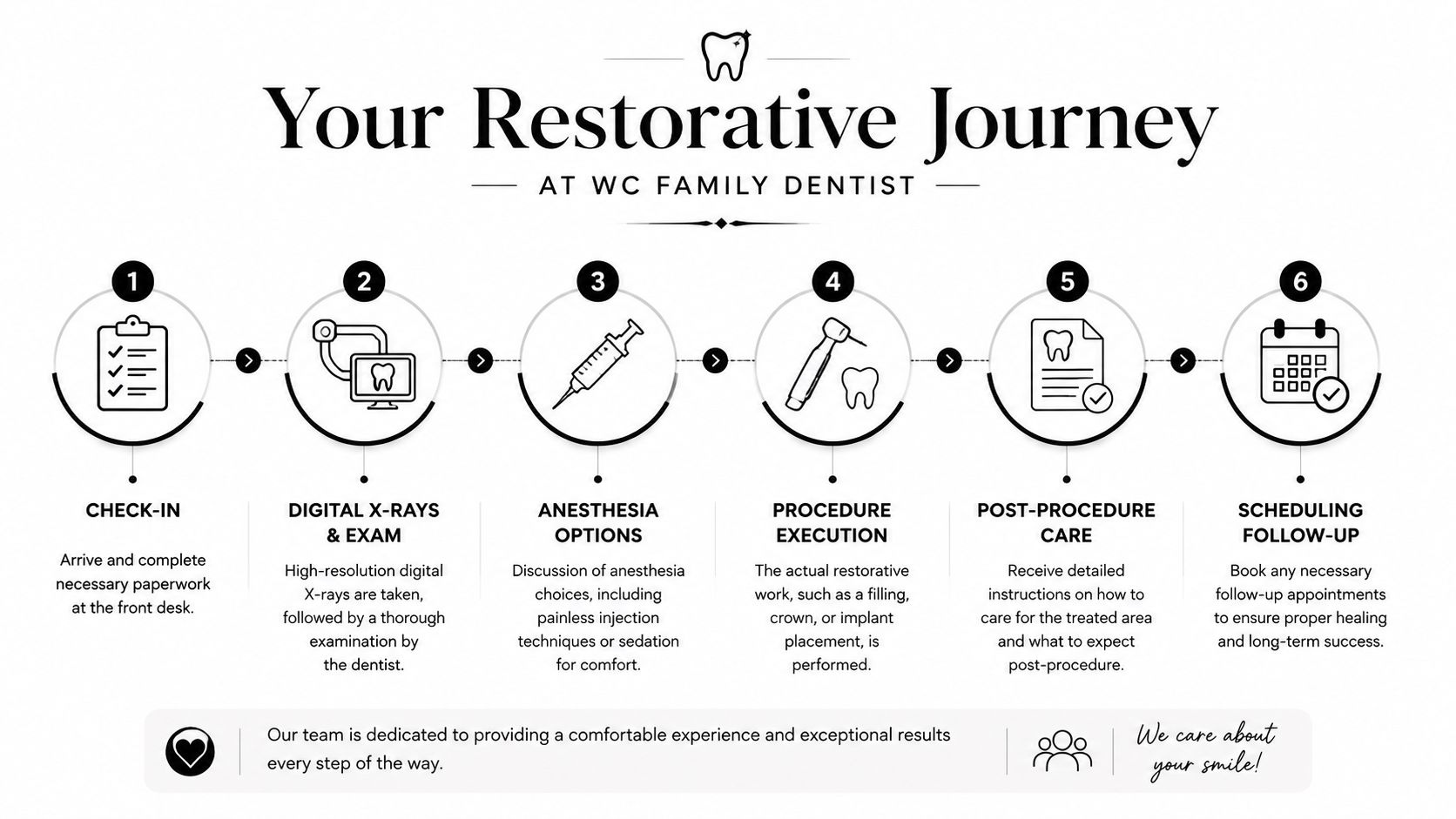
Early in the visit, the team checks in, reviews symptoms, and updates your health information. Digital X-rays and an exam help show whether the problem is limited to the outer tooth, extends deeper, or involves infection. That imaging matters because two teeth can feel similar while needing very different treatment.
Comfort during treatment
Numbing is usually the part anxious patients worry about most. In practice, gentle technique, topical anesthetic, and slow delivery often make local anesthesia much easier than expected. For patients with stronger anxiety or for longer procedures, sedation may be appropriate.
At WC Family Dentist, comfort measures may also include a calm pace, clear explanations before each step, and options that make the environment feel less clinical. Many patients do better when they know they can pause, ask questions, and stay in control throughout the appointment.
What the procedure itself feels like
Once the area is numb, treatment usually feels like pressure, vibration, or water spray rather than pain. A filling visit tends to be shorter and more direct. Crown treatment may involve shaping the tooth, taking an impression or scan, and placing a temporary while the final crown is made. Root canal care focuses on cleaning the inside of the tooth and sealing it to stop infection.
Globally, 8.2% of all teeth have undergone root canal treatment, and 55.7% of adults over age 18 have at least one root canal treated tooth, according to global prevalence data on root canal treatment. That's one reason endodontic care is such a routine part of restorative dentistry, even though patients often think of it as unusual.
A short video can help make the treatment process feel more familiar before you arrive.
After the appointment
Most patients leave with specific home instructions based on the procedure. You may be told to wait until numbness wears off before chewing, avoid sticky foods around a temporary crown, or expect mild sensitivity for a short period. If a case is completed in stages, a follow-up visit is scheduled before you leave.
Common next steps include:
- Monitoring the bite: A new filling or crown may need a small adjustment if it feels high.
- Protecting the area: Temporary restorations need a little extra care until the final one is seated.
- Watching symptoms: Mild tenderness can be normal, but increasing pain or swelling should be reported promptly.
Benefits Risks Recovery and Cost Considerations
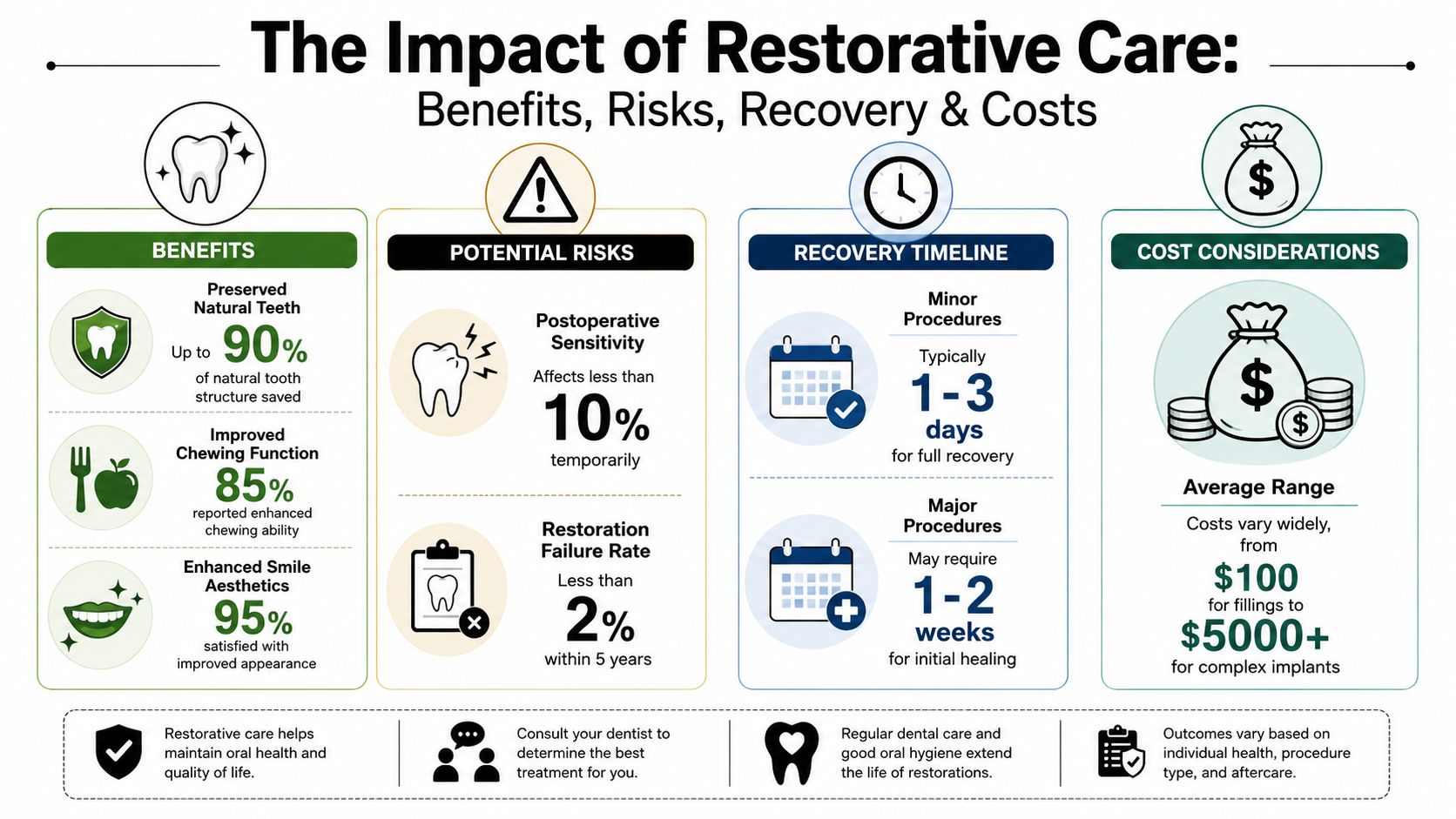
Restorative treatment does more than fill a hole in a tooth. It helps patients chew comfortably, speak normally, and avoid the daily distraction of dental pain. It also protects the surrounding teeth and the bite from further breakdown.
For many people, the biggest benefit is preservation. Saving a natural tooth usually keeps chewing more familiar and treatment more conservative over time. Restoring a damaged area early can also reduce the chance that a small problem turns into a bigger one involving infection, fracture, or tooth loss.
Benefits patients notice quickly
Some improvements are immediate. Once decay is removed and a filling seals the tooth, cold sensitivity may decrease. When a cracked tooth is protected with a crown, biting can feel more stable. Replacing a missing tooth may improve confidence in both eating and smiling.
Patients often value these practical outcomes most:
- Pain relief: Treatment can remove infected or damaged tissue and reduce sensitivity.
- Better function: Restored teeth help you bite and chew more evenly.
- Natural appearance: Modern materials are designed to blend with your smile.
- Long-term protection: Restorations support remaining tooth structure and help prevent further breakdown.
The broader field continues to grow because these needs are so common. The global restorative dentistry market was estimated at USD 22.4 billion in 2024 and is projected to reach USD 34.8 billion by 2030, with a 7.7% CAGR from 2025 to 2030, according to Grand View Research's restorative dentistry market analysis.
Risks and how dentists reduce them
No dental procedure is risk-free, and patients deserve honest expectations. A filling can be followed by temporary sensitivity. A crown may need a bite adjustment. A root canal treated tooth may later need a crown if it's structurally weak. Any restoration can wear, chip, or fail over time depending on the material, the bite, oral hygiene, and habits like clenching.
Technique matters. In composite resin restorations, incremental placement with light-curing for 40 seconds per 2 mm layer is important to reduce polymerization stress, improve contour, and lower the risk of marginal leakage, as explained in clinical guidance on general dentistry restorative technique. Details like that are one reason modern restorative outcomes depend on careful execution, not just the material chosen.
What patients should know: A restoration succeeds best when the tooth is treated well, the bite is balanced, and home care stays consistent.
Recovery by procedure type
Recovery varies more by procedure type than by pain tolerance. A small filling usually allows patients to return to normal routines quickly, though the tooth may feel a little different for a short period. Bonding is similar.
Crowns often involve two phases. After the preparation visit, a temporary crown protects the tooth until the final one is delivered. During that period, patients usually avoid very sticky foods on that side. Once the final crown is cemented, the bite may feel new for a short time but should settle comfortably.
Bridges have a similar adjustment phase because neighboring teeth are involved. Implant treatment takes longer because healing occurs between steps. That doesn't necessarily mean daily discomfort, but it does mean the treatment plan unfolds over time. In the United States, approximately 2.3 million implant-supported crowns are made annually, reflecting how commonly implants are used as a restorative option, according to AAP facts and figures on implant-supported crowns.
Cost conversations and planning ahead
Costs vary by diagnosis, material, tooth location, and treatment complexity. A small filling is very different from a crown, bridge, implant, or full-mouth reconstruction. Because of that, it's more helpful to think in terms of treatment categories rather than one flat price for “restorative dentistry.”
A practical treatment discussion usually includes:
- What problem is being solved: Decay, fracture, infection, missing tooth, or failing old dental work.
- Whether a conservative option exists: Repair, bonding, or a smaller restoration may be possible in some cases.
- How many visits are involved: Time affects both logistics and total treatment planning.
- Insurance and payment details: Benefits differ widely, so an office review is important before starting.
For patients choosing between options, the least expensive treatment today isn't always the most economical path long term. A restoration that predictably protects the tooth may reduce repeat treatment and avoid larger costs later. That's why a clear diagnosis matters more than chasing the shortest estimate.
Choosing Your Restorative Dentist in Walnut Creek
Choosing a restorative dentist isn't just about finding someone close by when you search dentist near me or emergency dentist. It's about finding a practice that diagnoses carefully, explains options clearly, and matches treatment to your specific tooth, bite, and comfort level.
Experience matters, but so does decision-making. A strong restorative evaluation looks at decay, cracks, gum health, bite forces, old dental work, and what can realistically be preserved. That's especially important when patients assume implants are always the default answer for a missing tooth.
Why personalized planning matters
Clinical factors can limit implant treatment. Clinical guidance on resin-bonded bridges and implant constraints notes that lack of alveolar development and proximity to nerves can complicate or prevent implant placement, which makes non-surgical alternatives valid in many cases. In everyday terms, bone shape, nearby anatomy, and the position of adjacent teeth can change what's possible.
That's why restorative planning should include more than “replace the tooth.” It should ask whether a bridge, a resin-bonded option, or another approach would be safer, simpler, or more conservative.
What to look for in Walnut Creek
Useful criteria include:
- Clear diagnostics: Digital imaging, careful exams, and treatment explanations in plain language.
- Comfort support: Gentle injections, calming communication, and sedation when appropriate.
- Range of services: Restorative, preventive, cosmetic dentistry, and emergency care under one roof can simplify treatment.
- Practical access: Online scheduling, straightforward financial conversations, and a convenient local office.
Patients looking into restorative dentistry near Walnut Creek should also pay attention to whether the office discusses repair versus replacement, not just the most extensive option.
William M. Schneider, DDS has more than 25 years of experience and provides restorative care, sedation options when appropriate, digital diagnostics, and personalized treatment planning for Walnut Creek and the East Bay. For many patients, that combination matters as much as the procedure itself.
The right dentist doesn't just name a procedure. They explain why that option fits your tooth, your anatomy, and your goals.
Frequently Asked Questions
Can I eat right after a crown appointment
It depends on whether you have a temporary crown or the final crown in place, and whether you're still numb. Most patients should wait until numbness wears off before chewing. With a temporary crown, it's smart to avoid sticky or very hard foods on that side.
How long will a filling last
There isn't one universal timeline. It depends on the size of the filling, where it's located, your bite, oral hygiene, and habits like grinding or clenching. Small fillings in low-stress areas often behave differently from large fillings on heavy-chewing molars.
Do you offer sedation for anxious patients
Yes, sedation may be available when appropriate. Many anxious patients also do well with gentle numbing techniques, a slower pace, and clear communication during treatment.
What if I think I need a tooth extraction
Not every painful or damaged tooth needs to come out. An exam and dental X-rays help determine whether the tooth can be restored with a filling, crown, or root canal, or whether tooth extraction is the healthier option.
If you're dealing with tooth pain, a broken tooth, missing teeth, or older dental work that no longer feels secure, William M. Schneider, DDS provides restorative care for Walnut Creek, CA and nearby East Bay patients. Schedule an appointment to get a clear diagnosis, review your options, and move forward with treatment that supports comfort, function, and a healthy smile.