If you're helping a parent, spouse, or yourself keep up with dental care later in life, the questions usually aren't cosmetic first. They're practical. Why does a tooth suddenly feel sensitive near the gumline? Why does the mouth feel dry all the time? Why does an old crown or bridge seem harder to clean now than it used to be?
Those are common concerns for older adults in Walnut Creek and across the East Bay. Oral health changes with age, but that doesn't mean discomfort, tooth loss, or repeated dental problems are inevitable. Good senior dental care is less about doing more of the same and more about adjusting care to fit realities of aging, medications, medical history, mobility, and comfort.
Many families also run into a second layer of stress. They aren't just looking for a dentist in Walnut Creek, CA. They're looking for a practice that can explain options clearly, move at a comfortable pace, and help them make sensible choices about cleanings and exams, restorative dentistry, tooth extraction, dental implants, or emergency dentist needs without pressure.
Your Trusted Partner for Senior Dental Care in Walnut Creek
A familiar situation in Walnut Creek starts subtly. Someone who has taken reasonable care of their teeth for years begins to notice small changes that are harder to ignore. Cold water catches at the gumline. An older bridge traps food. Dry mouth interrupts sleep. Daily brushing still happens, but keeping the mouth comfortable no longer feels straightforward.
Caregivers often see a different version of the same problem. A parent may say very little until chewing becomes difficult or a denture starts slipping. A new prescription can leave the mouth dry, sore, or more likely to develop decay. Problems that seem minor at first can affect meals, speech, and willingness to socialize.
Senior dental care requires a different mindset. Older adults are often dealing with several factors at once, including gum recession, existing crowns or bridges, arthritis that makes brushing harder, medication side effects, and health conditions that limit treatment choices. Good care accounts for the full picture, not just the tooth that hurts.
Care that respects comfort and complexity
Dental care later in life should make daily living easier. That may mean preserving natural teeth for as long as they can function well, adjusting a denture so eating feels more stable, or choosing a simpler treatment plan because medical history, healing time, or budget matters. In practice, the right choice is not always the most extensive one. It is the one a patient can tolerate, maintain, and feel good about.
I have found that the first complaint is not always the whole story. A patient may book a visit for sensitivity and turn out to have dry mouth, a worn filling, and a home care routine that no longer fits their dexterity. Slowing down, reviewing medications, and understanding what is realistic at home often changes the treatment plan for the better.
In Walnut Creek, many seniors and families want steady care from a local office that can follow changes over time. They want clear explanations, reasonable options, and an environment that does not add stress to an already complicated health situation.
A local option for ongoing senior care
William M. Schneider, DDS provides general, restorative, and cosmetic dental care in Walnut Creek with attention to comfort, communication, and long-term planning. For seniors, that can mean reviewing older dental work, addressing soreness before it turns into an emergency, and choosing care that fits mobility, anxiety level, and insurance limitations as well as oral health needs.
That kind of relationship matters. Senior patients rarely need rushed decisions or pressure. They need thoughtful care from a practice that understands how oral health, overall health, cost, and access often intersect later in life.
Understanding Common Oral Health Concerns for Seniors
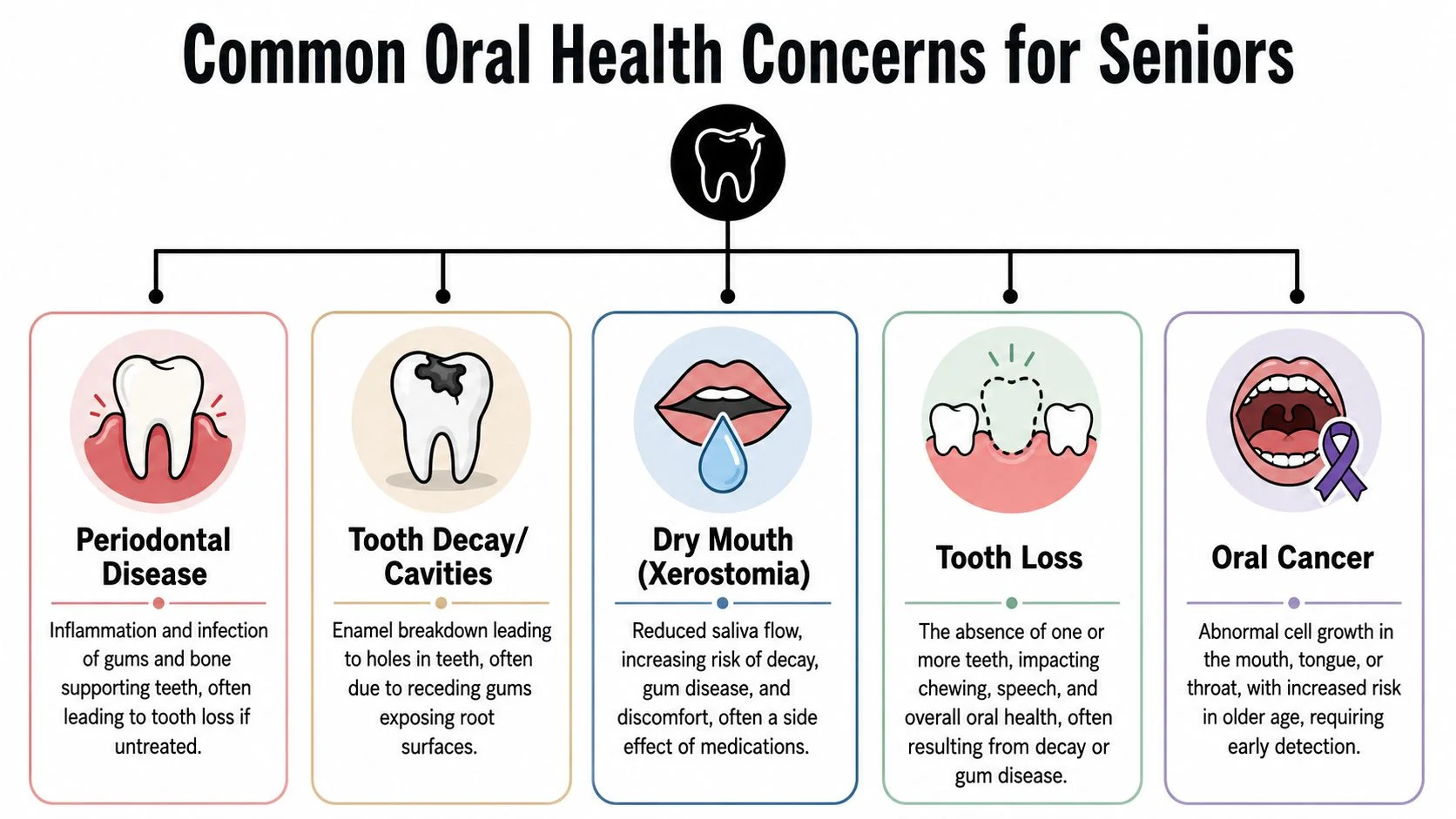
Older adults are keeping their natural teeth longer than previous generations, which is good news. It also means more seniors are managing aging teeth and aging gums rather than full tooth loss alone. According to oral health data on seniors and tooth retention, about 7 in 10 seniors have gum disease, roughly 1 in 5 has untreated tooth decay, and about 50% of people over 75 have root decay affecting at least one tooth.
Gum disease can stay quiet for a long time
Gum disease often doesn't begin with severe pain. That's part of the problem. Early signs may include bleeding when brushing, puffiness along the gumline, bad breath, or teeth that seem a little harder to floss. In older adults, gum disease can also hide around crowns, bridges, and areas where dexterity makes cleaning harder.
As gums and supporting bone break down, teeth can loosen or shift. Many patients think they just have "weak teeth" when the actual issue is infected supporting tissue.
A useful way to think about it is this. Teeth are like fence posts. The visible part matters, but the stability comes from what holds them underneath.
Root decay becomes more common with gum recession
Root decay is a classic senior dental problem because the roots of teeth often become more exposed over time. Unlike the crown of the tooth, the root surface doesn't have the same level of protection. Once that area is exposed, cavities can spread faster.
If the exposed root is the foundation of the tooth, a cavity there is like damage at the base of a house. It may start small, but it can undermine the whole structure quickly if it isn't treated.
Signs can include:
- New sensitivity: Especially to cold, sweets, or brushing near the gumline
- Food trapping: Areas that suddenly catch food more often
- Dark or softened spots: Sometimes noticed by a dentist before the patient feels pain
Dry mouth changes everything
Dry mouth, also called xerostomia, is one of the biggest drivers of dental trouble in older adults. Saliva protects the mouth. It helps wash away food particles, buffers acids, and lowers cavity risk. When saliva decreases, the mouth loses a major defense system.
Many seniors notice dry mouth after medication changes. Others feel it most at night, when wearing dentures, or when they wake with a sticky or burning sensation. The practical effect is simple. A dry mouth is a cavity-friendly mouth.
A mouth that feels only mildly dry can still behave like a high-risk environment for decay.
Tooth loss is no longer the whole story
Tooth loss still matters, but it no longer defines senior oral health the way it once did. Many older adults now have a mix of natural teeth, older fillings, crowns, bridges, implants, or dentures. That creates a more complex mouth to maintain.
This is why "I still have most of my teeth" doesn't automatically mean everything is healthy. Retaining teeth is valuable. Keeping those teeth functional, comfortable, and clean is the next challenge.
Preventive Home Care and Nutrition for a Healthy Smile
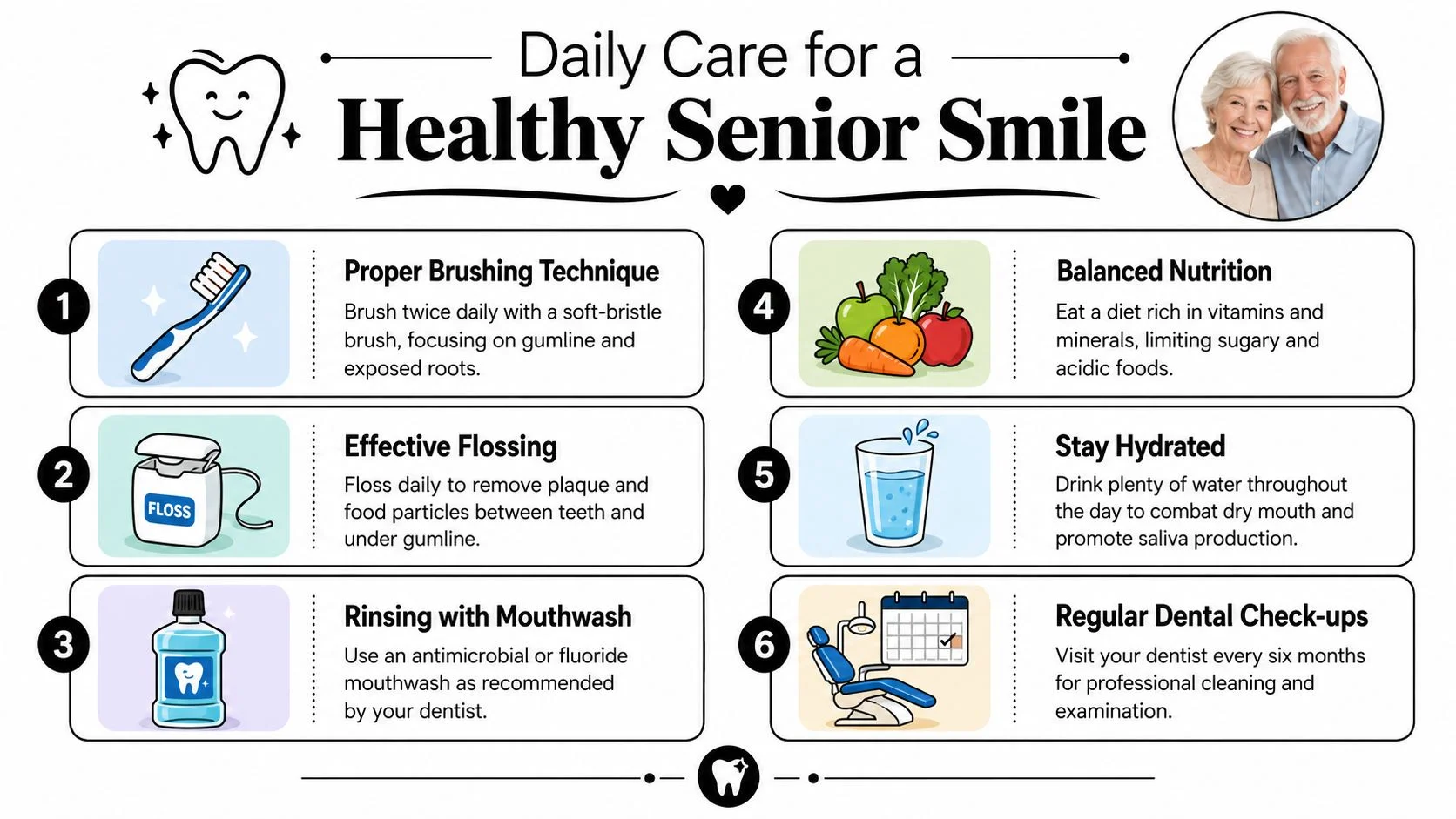
Home care has to match the patient, not the other way around. A routine that works for a healthy younger adult may fail completely for someone with arthritis, dry mouth, tremor, memory changes, or a full set of crowns and bridgework. The goal is not perfection. The goal is a routine you can realistically keep doing.
Research on older adults and cavity prevention notes that seniors are a high-risk group for caries, and expert guidance supports 5000 ppm fluoride toothpaste for patients who need stronger prevention, especially when dry mouth, reduced dexterity, or caregiver dependence increase plaque retention and root caries risk. That recommendation appears in clinical guidance for oral health care in older adults.
Make the tools easier to use
A toothbrush is only effective if you can control it. For many seniors, a manual brush with a thin handle isn't the best choice anymore.
A practical toolkit often includes:
- Electric toothbrush: Helpful when hand strength, shoulder movement, or dexterity are limited
- Floss handles or threaders: Useful around bridges and wider spaces
- Water flosser: Often easier for patients who struggle with traditional floss
- Prescription fluoride toothpaste: Especially important if there's dry mouth, root exposure, or a history of repeat decay
If a patient relies on a caregiver, the setup matters. Keep products visible, simple, and in the same place each day. Complicated routines usually fall apart.
Focus on the vulnerable areas
Older adults often miss the same zones again and again. Along the gumline. Around the edges of crowns. Behind lower front teeth. Around clasps on partial dentures. Under bridgework.
Try this sequence:
- Brush the gumline first: Angle the bristles where the tooth meets the gum
- Clean around restorations carefully: Crowns and bridges need edge cleaning, not just surface cleaning
- Use fluoride last: If a prescription toothpaste is recommended, use it exactly as directed
- Clean dentures outside the mouth: Over a towel or sink with water in it, so a dropped denture is less likely to crack
Practical rule: The best home routine is the one a patient can repeat comfortably every day without confusion or strain.
Nutrition and hydration matter more than people think
Frequent sipping of sweet drinks, hard candies for dry mouth, and constant snacking can keep teeth under steady acid attack. That's especially hard on exposed roots.
Helpful habits include:
- Choose water often: It supports moisture and helps rinse the mouth
- Pick less sticky snacks: Softer sweets that cling to teeth can linger around exposed roots and dental work
- Include balanced meals: Regular meals tend to be easier on teeth than all-day grazing
- Ask before using dry mouth products: Some are useful, but they should fit the patient's needs and dental risk
Even an excellent home routine doesn't replace professional cleaning and exams. It does make those visits more productive, more comfortable, and less likely to turn into emergency treatment.
Restoring Your Smile with Dentures Implants and Bridges
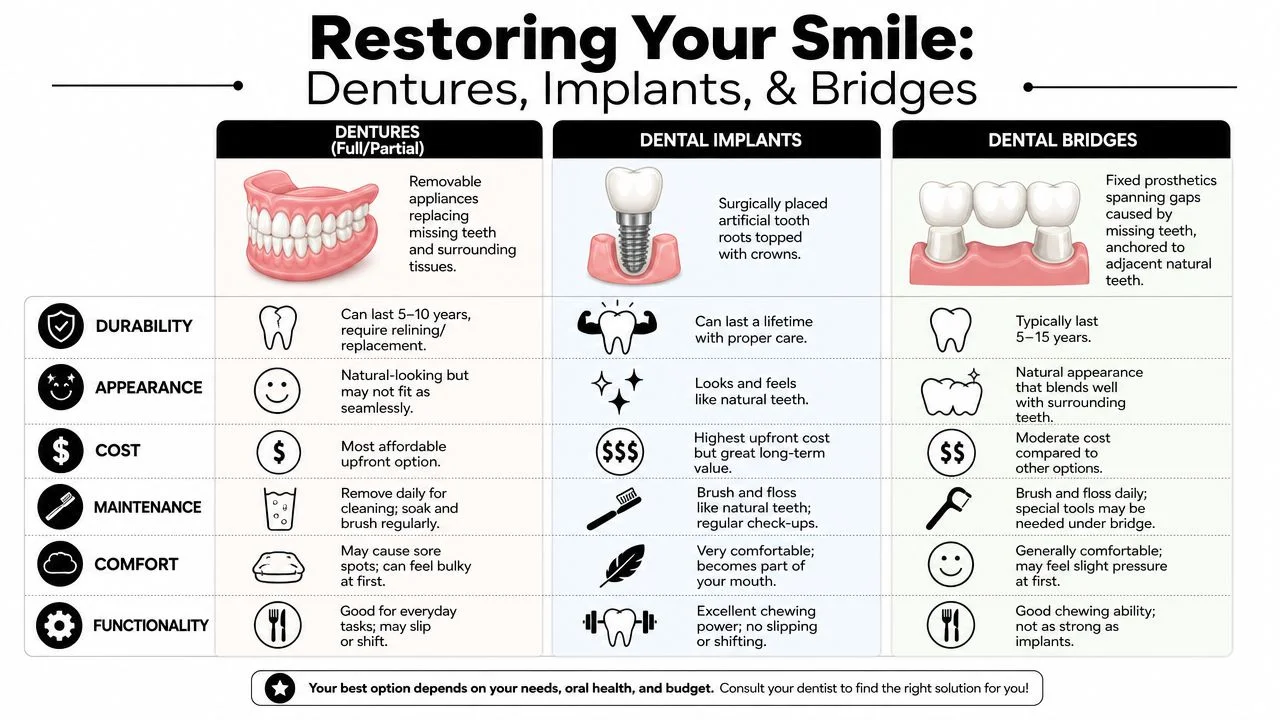
When teeth are missing, the right replacement depends on more than the gap itself. It depends on chewing goals, comfort, bone support, hand dexterity, budget, and whether the patient wants something removable or fixed. Seniors often do best when the options are compared plainly rather than presented as one-size-fits-all solutions.
How dentures bridges and implants differ
| Option | Best fit for | Main advantage | Main trade-off |
|---|---|---|---|
| Dentures | Multiple or full missing teeth | Removable replacement for larger tooth loss | May move during eating and require adjustments |
| Bridges | One or several missing teeth with neighboring support | Fixed option that doesn't come out | Requires support from nearby teeth |
| Dental implants | Patients who want a stable tooth replacement | Feels more like a natural tooth and supports function | Requires surgical planning and healing |
Dentures can be a practical answer, especially when many teeth are missing or when a faster removable solution is needed. For some patients, they're the right first step. For others, they become frustrating because of movement, sore spots, or difficulty chewing certain foods.
Bridges work well when the surrounding teeth are suitable for support. They stay in place and can restore appearance and chewing predictably. The trade-off is that they depend on adjacent teeth and need careful cleaning underneath.
Why many seniors ask about implants
Dental implants near me is a common search for a reason. Patients usually aren't chasing technology. They want stability. They want to bite into food without worrying that a denture will shift. They want fewer removable parts to manage every day.
Implants can support a single crown, help anchor a bridge, or improve denture stability. From a lifestyle standpoint, the biggest difference is confidence. A fixed solution often feels more secure during meals, conversation, and social events.
Later in the process, some patients also want to understand temporary replacement options. Dr. Schneider's office provides information on the immediate dentures process for cases where timing after extractions matters.
Here is a short overview that helps visualize one restorative pathway:
What works in real life
The "best" option is the one a patient can wear, clean, afford, and live with comfortably.
Consider these real-world questions:
- Can you manage a removable appliance every day? Some patients do very well with dentures. Others dislike taking teeth in and out.
- Are neighboring teeth healthy enough to help? That matters for bridge planning.
- Do you want the most fixed feel possible? If so, implants may be worth discussing.
- Is treatment being phased? Many senior cases are handled in steps rather than all at once.
A careful restorative plan should improve function first. A natural look matters, but eating comfortably and speaking clearly usually matter more in daily life.
How Your Overall Health and Medications Affect Your Mouth
Senior dental care can't be separated from general health. Many older adults are managing diabetes, heart conditions, arthritis, osteoporosis, cognitive changes, or several prescriptions at the same time. Each of those factors can change treatment timing, healing, home care ability, and cavity or gum risk.
Public health guidance on oral health for older adults stresses that dental care should be coordinated with a patient's medical needs, especially when chronic disease, multiple medications, caregiver support, or communication challenges are involved. That emphasis appears in the ASTDD guidance on improving oral health for older adults.
Why your medical history changes the dental plan
A complete medical history is not paperwork for paperwork's sake. It tells the dental team how to treat you safely and sensibly.
Examples include:
- Diabetes: Gum tissues may respond differently, and healing can require closer attention
- Arthritis: Brushing and flossing methods may need to be modified
- Cognitive decline: Instructions often need to be simplified and coordinated with a caregiver
- Multiple prescriptions: Side effects can affect saliva, tissues, comfort, and appetite
Patients sometimes assume the dentist only needs to know about medications related to the mouth. In reality, the full list matters.
Medications often show up first as mouth symptoms
A very common pattern in older adults is this. The medication is necessary and helpful, but the mouth becomes drier, more irritated, or harder to keep clean. The patient may not connect those symptoms to the medication at all.
Dry mouth can make plaque stickier. It can make dentures less comfortable. It can make swallowing and speaking harder. It also changes how quickly root decay can develop. That is why a new medication list can completely change preventive recommendations.
For patients who want a broader explanation of how oral conditions connect with total health, Dr. Schneider's office also discusses the link between gum health and overall wellness.
Bring an updated medication list to every dental visit. Small prescription changes can affect your mouth more than people expect.
Caregivers are often part of the treatment team
For some seniors, independence in oral care changes gradually. A spouse may start helping with reminders. An adult child may schedule appointments and track symptoms. In assisted living or memory care, staff may become part of the routine.
That changes the dental conversation. Instructions need to be clear, realistic, and easy to repeat at home. A perfect plan on paper is useless if the patient or caregiver can't carry it out.
A strong dental visit for an older adult often includes:
- A review of current health conditions
- A medication update
- A discussion of who helps with daily care
- A treatment plan that matches the patient's stamina and priorities
This is one of the biggest differences between routine adult dentistry and thoughtful senior care. The mouth isn't treated in isolation.
What to Expect at Your Dental Visit in Walnut Creek
For many seniors, the hardest part of getting care is getting started. Sometimes the concern is pain. Sometimes it's embarrassment about how long it's been. Sometimes it's logistics, especially if walking, transferring, or arranging transportation has become more difficult.
Challenges with mobility and transportation are a real barrier for older adults, particularly for those who are homebound or have trouble traveling consistently. Practical senior care often starts with finding a clinic that understands those access issues, as noted in this overview of dental access barriers and solutions for seniors.

The visit should feel organized and unhurried
A good first appointment doesn't rush straight into treatment unless there's an urgent problem. It begins with conversation. What hurts. What feels different. What medications have changed. What dental work is already in the mouth. What the patient wants to keep, fix, replace, or avoid.
That often includes:
- A review of symptoms: Sensitivity, chewing trouble, dry mouth, sore gums, denture fit, or broken teeth
- A clinical exam: Looking at teeth, gums, restorations, bite, and areas that are hard to clean
- Dental X-rays when needed: To check for decay, bone loss, infection, or problems below the surface
- A clear discussion of next steps: Cleaning and exams, restorative dentistry, cosmetic concerns, tooth extraction, or emergency dentist care if needed
Comfort matters as much as the procedure
Older adults often tell the dental team two things. They don't want surprises, and they don't want pain.
That means explanations should be simple and direct. If there are several options, each one should be laid out in plain language. If treatment is likely to take more than one visit, patients should know why. If anxiety is part of the picture, that should be addressed openly.
At this Walnut Creek office, patients can expect a gentle approach, clear communication, and options for reducing stress during care, including sedation when appropriate. Many anxious patients also greatly care about seemingly small details, such as whether injections are handled gently and whether the team allows enough time for questions. Those details matter.
If dental fear has kept you away, say so at the start. It changes how the appointment should be paced.
Accessibility and planning make follow-through easier
For seniors and caregivers, a successful visit doesn't end when the chair reclines back up. It ends when the home plan makes sense and the next step is manageable.
That might mean coordinating a follow-up at a time of day when energy is better, discussing how to clean around a bridge, reviewing denture care, or spacing treatment in shorter appointments. It may also mean planning around transportation support and physical comfort, not just calendar availability.
When those details are respected, patients are much more likely to keep coming back for the care that protects comfort and function.
Navigating Insurance and Scheduling Your Appointment
A common Walnut Creek call sounds like this: a senior has a sore tooth or a denture that no longer fits, but the first question is not about treatment. It is whether the visit will be affordable, covered, and manageable with the rest of their medical appointments.
That concern is reasonable. Many older adults still do not have routine dental coverage through traditional Medicare, and dental benefits often vary widely between Medicare Advantage plans, retiree plans, supplemental coverage, and private insurance. Before any treatment starts, the practical questions need clear answers.
Why timing affects both cost and choices
In my experience, waiting usually reduces flexibility. A small area of decay may be handled with a filling. Months later, that same tooth may need a root canal, an extraction, or replacement options that take more time and money. The same pattern shows up with sore gums under a denture, cracked teeth, and dry mouth related decay.
An exam does not commit you to major treatment.
It gives you a current diagnosis, a sense of urgency, and a chance to compare options while more of them are still available. For seniors balancing heart conditions, diabetes, blood thinners, mobility limits, or caregiver schedules, that planning matters.
What to ask before you book
A good front desk conversation should lower stress and help you prepare. Ask questions that affect real decision-making:
- What will happen at the first visit? Ask whether the appointment is focused on an exam, X-rays, urgent pain relief, denture evaluation, or treatment planning.
- What insurance information should you bring? Have the plan name, member ID, and subscriber details ready so the team can review benefits as accurately as possible.
- How are costs explained? Ask whether estimated out-of-pocket amounts are discussed before treatment is scheduled.
- Can the office work around medical needs? Mention blood thinners, joint replacements, oxygen use, wheelchair access, memory concerns, or a need for shorter visits.
- What is the main goal of this appointment? Be direct if the priority is pain, chewing, replacing missing teeth, or getting established with a dentist after years away.
For many seniors, the easiest first step is to bring a caregiver into that phone call. That helps with medication lists, transportation planning, and insurance details that are easy to miss.
William M. Schneider, DDS sees many of the issues that make senior scheduling harder in real life, including phased treatment, questions about benefits, and the need to plan care around comfort and medical complexity. If you or a loved one needs senior dental care in Walnut Creek, call the office at 1855 San Miguel Dr., Suite 31, Walnut Creek, to schedule a visit and ask those practical questions before you come in.