If you have older silver fillings, you may have had the same moment many patients in Walnut Creek have. You catch a glimpse of a dark filling in the mirror, or your hygienist mentions an old restoration, and suddenly the questions start. Is it safe? Should it stay? Should it come out? Is this something I need to worry about now?
Those questions are reasonable. Online information about silver dental amalgam often swings between reassurance and fear, which leaves patients stuck in the middle. What usually helps most isn't another argument on the internet. It's a careful exam, a clear explanation, and a dentist who can look at your specific tooth, your health history, and your goals.
Considering Your Silver Fillings A Walnut Creek Dentist Explains
A common situation goes like this. A patient comes in for a cleaning and exam, hasn't had pain, and assumes everything is fine. Then we review digital images, look at a molar with an older silver filling, and the patient asks whether it should be replaced solely because it's silver.
That question deserves a calm answer. Some silver fillings are still doing their job. Others need attention because the tooth has changed around them, the filling has worn down, or decay has started at the edges. The color alone doesn't tell the full story.

The real question isn't yes or no
Patients often arrive looking for a simple verdict. Keep them all, or replace them all. Dentistry usually doesn't work that way.
A better approach is to ask:
- Is the filling intact: Is it still sealed and functioning well?
- Is the tooth healthy: Is there decay, a crack, sensitivity, or bite stress?
- What matters most to you: Appearance, longevity, comfort, cost, or reducing metal restorations?
Those answers shape the recommendation far better than fear-driven headlines.
Practical rule: A silver filling should be judged by its condition and the condition of the tooth around it, not just by how old it looks.
Local care matters more than generic advice
For Walnut Creek families and busy East Bay professionals, this topic often overlaps with other needs. You may be searching for a dentist near me, a dentist in Walnut Creek, CA, or even help with a broken tooth, tooth extraction, cosmetic dentistry, or an emergency dentist after a filling fractures. In real life, silver fillings aren't a stand-alone topic. They're part of your overall dental health.
That's why personalized care matters. A back molar with a large old restoration may need a different solution than a small visible filling on a front-side tooth. Some patients want a cosmetic update. Others just want to know whether they can safely leave things alone.
What usually lowers anxiety is simple. You get a straightforward exam, honest answers, and a treatment plan that matches your goals instead of pushing a one-size-fits-all solution.
What Exactly Are Silver Amalgam Fillings
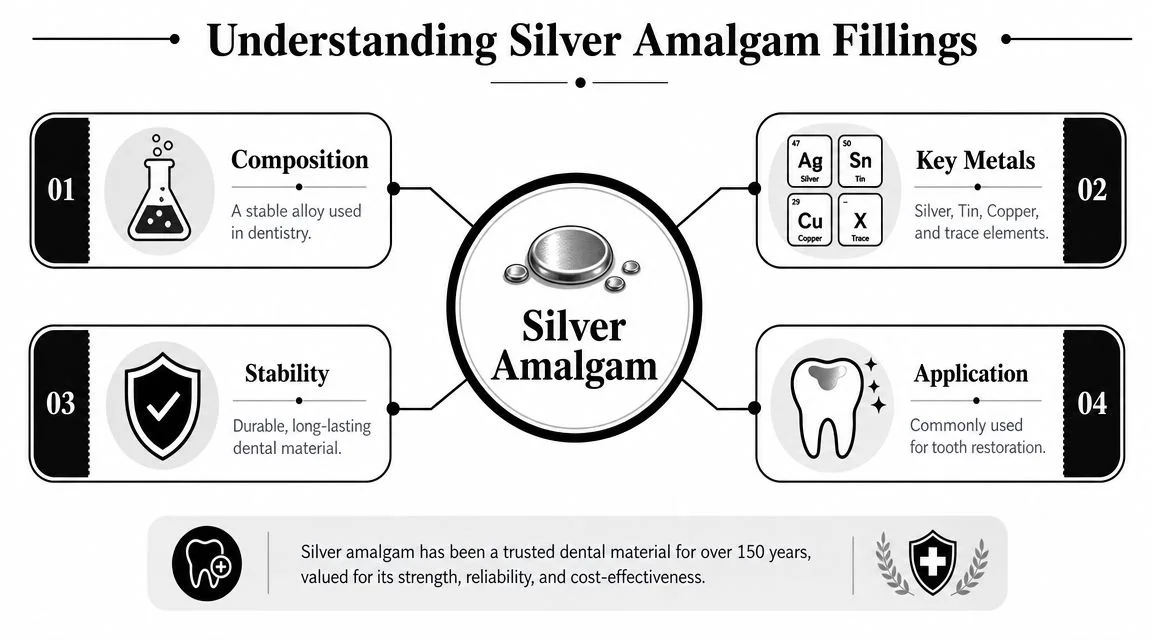
Silver dental amalgam is a long-used restorative material in dentistry. It has been used for over 150 years, and it is made from about 50% liquid elemental mercury plus a powdered alloy of silver, tin, and copper, according to the American Dental Association overview of dental amalgam. That same ADA resource notes that in the United States, amalgam use in posterior fillings declined from 21.5% in 2017 to 5.7% in 2022.
Patients sometimes hear the ingredient list and assume the material inside the tooth behaves like the separate ingredients by themselves. That isn't how it works. A simple way to think about it is baking. Flour, eggs, and sugar are separate ingredients before they go into the oven. After baking, they form something new. Amalgam works in a similar way as a set dental material. The ingredients are combined into a stable filling used to restore a damaged tooth.
Why dentists used it for so long
Silver amalgam became common for practical reasons. It performed well in back teeth, especially where chewing forces are heavy. For many years, it was a standard option for restoring molars because it held up well in load-bearing areas.
Here are the main reasons it was widely used:
- Durability in back teeth: It earned a long reputation for strength in heavily used molars.
- Affordability: It was often a practical restorative choice.
- Clinical familiarity: Dentists used it for generations, so it became a routine part of restorative dentistry.
What patients usually notice about it
Little thought is given to silver fillings until one of three things happens. They see the dark metallic color when they laugh or yawn. A dentist points out wear or leakage. Or they start reading about mercury and want a more informed answer.
Silver fillings were placed because they solved a problem. The question today is whether they are still the right solution for that tooth now.
That distinction matters. A restoration can be old without being urgent. It can also look acceptable on the surface and still need treatment because the surrounding tooth is weakening. The right next step isn't guessing. It's evaluating the filling, the tooth, and your priorities together.
The Evidence on Amalgam Safety and Health Concerns
This is the part most patients care about most. They want a direct answer about mercury.
The current position from major regulators is more measured than many online discussions suggest. The U.S. FDA states that available evidence does not show mercury from dental amalgam causes adverse health effects in the general population, while also identifying people who may be more susceptible, including pregnant women, children under six, and people with neurological or kidney disease, as described on the FDA page on dental amalgam fillings.
The same FDA resource notes estimated mercury absorption of up to 3 micrograms per day from amalgam, which is below the WHO tolerable dose of 30 micrograms per day.
Why this topic feels more alarming than it often is
Patients hear the word mercury and understandably connect it with danger. In a dental filling, though, the conversation is more specific. The question isn't whether mercury can be harmful in some forms or exposures. The question is what the evidence shows for dental amalgam in typical use.
For the general population, the FDA says the available evidence does not show adverse health effects from amalgam. That doesn't mean every patient should stop asking questions. It means the discussion should be grounded in actual risk categories, not panic.
Who should have a closer conversation
If you fall into a higher-susceptibility group, it's reasonable to discuss alternatives before placing a new filling and to review older restorations carefully. That conversation is also appropriate if you have health concerns and want your dental treatment choices to reflect them.
A thoughtful consultation usually focuses on:
- Your medical history: Pregnancy status, kidney disease, or neurological conditions can affect material decisions.
- Your age or your child's age: Younger children deserve extra care in treatment planning.
- Whether the filling is stable or failing: Safety concerns and structural concerns are not always the same issue.
What matters most: A stable filling in a healthy tooth is a different situation from a broken filling in a tooth that already needs treatment.
What not to do
The least helpful approach is making a removal decision based on fear alone. Removing a filling is still a dental procedure. It should have a clear clinical reason or a clearly discussed personal reason. If your concern is mercury, talk through it openly. If your concern is appearance, that is valid too. Patients don't need to defend their preferences. They just need a plan that makes sense medically and practically.
Modern Alternatives to Silver Amalgam Fillings
Most patients replacing older silver fillings today ask about tooth-colored composite or ceramic restorations. Each option can work well, but they don't solve the same problem in the same way. The best choice depends on the size of the restoration, the location of the tooth, your bite, and whether your priority is aesthetics, conservation of tooth structure, or long-term reinforcement.
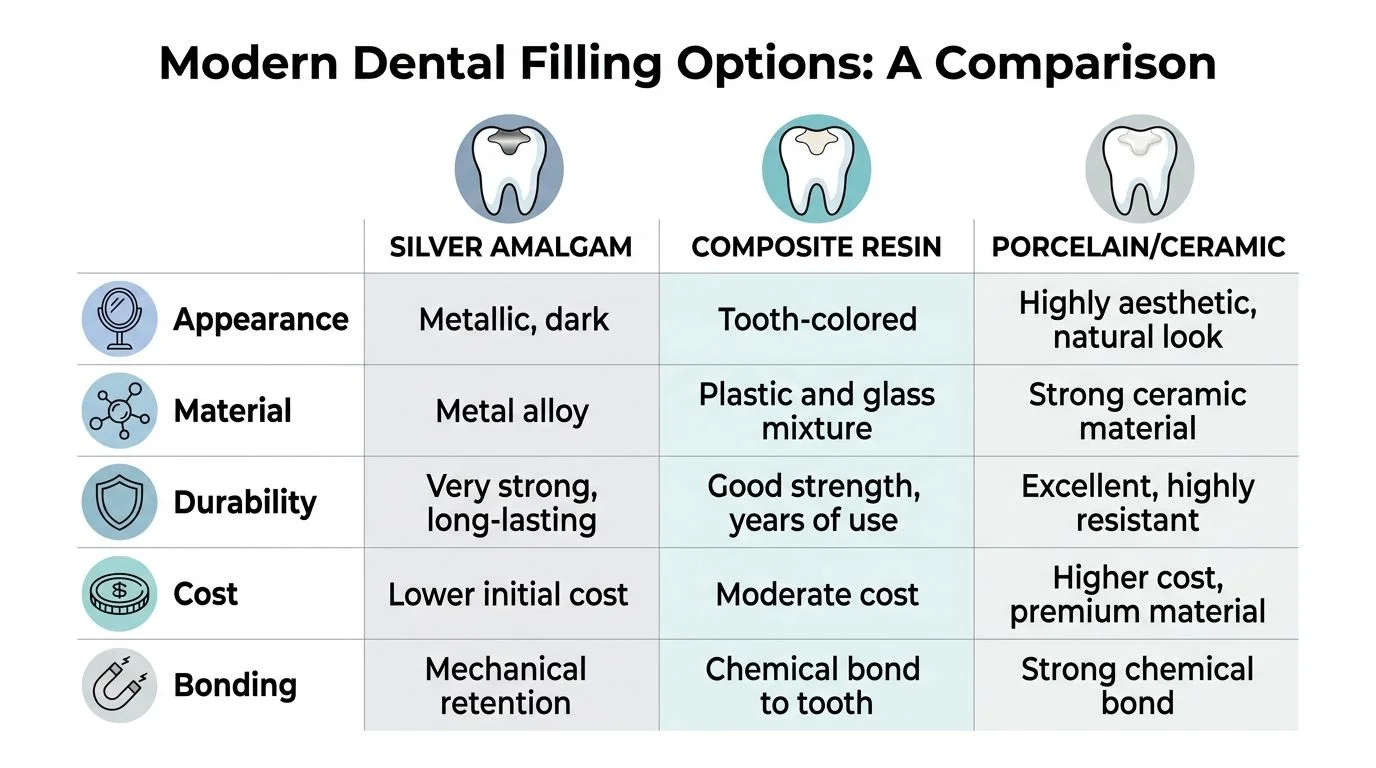
How the main options compare
| Feature | Silver Amalgam | Composite Resin | Ceramic (Porcelain) |
|---|---|---|---|
| Appearance | Metallic and dark | Tooth-colored | Natural-looking and highly aesthetic |
| Material | Metal alloy | Resin with strengthening filler particles | Ceramic material |
| Typical use | Historically common in back teeth | Common for small to moderate restorations | Useful when more coverage or strength is needed |
| Tooth bonding | Does not rely on tooth-colored bonding approach | Bonds to tooth structure | Typically bonded as a more advanced restoration |
| Cost approach | Often lower initial cost | Moderate | Usually higher |
| Cosmetic value | Low | Good | Excellent |
A short video can help you visualize the differences patients often consider before choosing a filling material.
Composite for a natural look
Composite resin is the material many people think of when they search for a cosmetic dentist near me. It blends with the tooth, so it doesn't create the dark metallic look of older restorations. It also fits well into modern conservative dentistry because it can often preserve more natural appearance.
Patients who want to learn more about this option can review how a tooth-colored filling can support oral health.
Ceramic when the tooth needs more than a simple filling
Ceramic is a different category. It is often part of a larger restorative plan when a tooth needs more support or a more extensive rebuild. If a tooth has a large failing filling, visible cracks, or substantial structure loss, a ceramic restoration may make more sense than placing another direct filling.
A filling material shouldn't just match your color preference. It should match the stress that tooth handles every day.
What tends to work and what doesn't
Composite often works well when patients want aesthetics and the tooth can be restored predictably with a bonded filling. Ceramic often works well when the tooth needs greater coverage and a stronger long-term rebuild.
What doesn't work is choosing only by trend. Some patients assume newer always means better. In practice, success comes from matching the material to the tooth, not chasing the most fashionable option.
When to Consider Replacing Your Amalgam Fillings
Many older silver fillings do not need automatic replacement. That matters. A filling should be replaced because there is a sound reason to do it, not because the internet made you uneasy for a weekend.
The broader direction of dentistry is changing. A recent review describes a gradual phase-down of amalgam tied to a shift toward mercury-free alternatives and improved resin materials, while also noting that the decision to replace a filling depends on its clinical condition and the patient's goals and that removal can create a short-term peak in mercury vapor exposure, as discussed in this review on the pathway to mercury-free dentistry.
Replace it when the tooth is telling you something
There are clear situations where a conversation about replacement is appropriate. If a filling is breaking down or the tooth around it is changing, waiting can make the repair more complicated.
Common reasons to evaluate replacement include:
- New decay at the margin: A filling can still be present while the tooth develops a new cavity around it.
- A crack or fracture: Sometimes the issue is the filling. Sometimes it's the tooth itself.
- Sensitivity or pain when biting: That can point to leakage, fracture, or bite-related stress.
- A rough or open edge: Old restorations can wear and lose their seal.
If you're unsure whether what you're feeling could be a cavity, signs that may point to decay can help you know when to schedule an exam.
Elective replacement is different
Some patients don't want dark metal restorations anymore. That's a valid reason to talk. Cosmetic goals matter. So do personal comfort and peace of mind.
Still, elective replacement deserves the same careful planning as necessary replacement. The question isn't just whether you want the filling out. The question is what the tooth will need after it comes out.
A useful decision filter
If you're trying to decide what to do, these three questions usually help:
- Is there a clinical problem right now
- Am I trying to improve appearance
- Will replacement leave the tooth stronger, or does it create a larger restoration than I need
If a silver filling is stable and the tooth is healthy, monitoring may be the most sensible option. If the tooth is compromised, replacing it can be the better preventive choice.
What doesn't help is pressure. A careful dentist should be able to explain why a filling should stay, why it should go, or why more imaging is needed before making that call.
Your Amalgam Consultation at Our Walnut Creek Office
When patients come in to discuss older fillings, the appointment usually starts with a full look at the tooth rather than a quick opinion from across the room. That means an exam, appropriate dental x-rays, and close visual inspection to see whether the restoration is intact, whether decay is hiding at the edges, and whether the surrounding tooth structure is strong enough to keep carrying chewing pressure.
For many people, that first visit also answers a bigger question. Is this just about a filling, or is it part of a broader restorative plan that could involve crowns, cosmetic dentistry, or even treatment after a fracture becomes an urgent problem?

What the visit usually includes
At William M. Schneider, DDS, an amalgam consultation can be part of a new patient exam, routine cleaning and exams, or a problem-focused visit when a tooth is bothering you. The process is straightforward and patient-centered.
A typical visit may include:
- Review of symptoms and concerns: Are you worried about appearance, mercury, sensitivity, or a broken tooth?
- Clinical examination: The tooth, bite, and nearby restorations are evaluated.
- Digital imaging when needed: This helps detect concerns that aren't visible at the surface.
- Treatment discussion: You review whether monitoring, a tooth-colored filling, or a larger restoration makes the most sense.
If removal is needed
Patients often worry that taking out a silver filling is automatically risky. The better way to think about it is that removal should be done deliberately. If replacement is appropriate, protective steps during the procedure can help reduce unnecessary exposure and keep treatment controlled.
That may include practical measures such as isolation of the tooth, water during removal, and high-volume suction. The exact technique depends on the case, the tooth, and the treatment being performed.
You shouldn't leave a consultation feeling rushed or cornered. You should leave knowing what the tooth needs, what your options are, and what can wait.
What patients can expect emotionally
A good consultation should lower stress, not add to it. If you have dental anxiety, questions about mercury, or concern about cost and timing, say so early. Those concerns are part of treatment planning. They aren't side issues.
Many patients who search for a dentist near me aren't only looking for technical skill. They're looking for someone who will explain things clearly, respect hesitation, and offer practical next steps. That's especially true when the topic involves long-standing fillings, cosmetic decisions, or uncertainty about whether treatment is urgent.
If you're in Walnut Creek, CA and want a clear answer about your silver dental amalgam fillings, schedule a consultation with William M. Schneider, DDS. You'll get a careful exam, straightforward guidance, and a personalized plan based on the condition of your teeth, your comfort level, and your goals for long-term oral health.