You went to bed at a reasonable hour. You were in bed long enough. Yet you woke up tired again, and by midafternoon you were reaching for more coffee, losing focus in meetings, or feeling irritable for no clear reason. If your partner has mentioned loud snoring, pauses in breathing, or sudden gasping at night, that pattern deserves attention.
Many people who search for a sleep apnea treatment center near me are in exactly that position. They know something is off, but they don't know where to start, and they don't love the idea of sleeping with a large machine if there's another option. In Walnut Creek, that conversation often starts in the dental chair because the mouth, jaw, and airway are closely connected.
Tired of Being Tired? Your Local Sleep Apnea Solution in Walnut Creek
A common story sounds like this. Someone assumes they're just stressed, getting older, or sleeping lightly. Their spouse notices the snoring first. Then come the restless nights, the dry mouth in the morning, the headaches, the brain fog, and the creeping feeling that a full night's sleep no longer feels restorative.
Why so many people miss it
Sleep apnea is far more common than is widely realized. Obstructive sleep apnea affects approximately 936 million adults aged 30 to 69 globally, and the American Academy of Sleep Medicine says 80 to 85% of the 22 million Americans who have it remain undiagnosed according to the AASM overview on the rising prevalence of sleep apnea.
That means many people in Walnut Creek and across the East Bay are living with a treatable condition without knowing it. They may think they snore. They may blame work stress. They may focus on being tired during the day without connecting it to interrupted breathing at night.
A more comfortable local path
For many adults, the biggest hesitation isn't whether they need help. It's whether treatment will feel disruptive, uncomfortable, or hard to keep up with. That concern is valid.
Practical rule: The best sleep apnea treatment is the one you can actually use consistently.
Dental sleep care matters because some patients do better with a custom oral appliance than with a mask-based approach. A dentist trained in airway-related care can look at your bite, jaw position, tongue space, and oral health, then help coordinate the next step toward diagnosis and treatment. That can make the process feel much less intimidating.
People who are also looking for a dentist in Walnut Creek, CA, or searching for a long-term dental home often appreciate having routine dental care, cleaning and exams, restorative treatment, and sleep-related care connected in one familiar office. If you already value clear explanations, a gentle approach, and a practical plan, that same style of care matters just as much when you're trying to sleep better.
What this means for you
If you've been searching for a sleep apnea treatment center near me, you don't necessarily need to start with a hospital-like experience. You may be able to begin with a local dental evaluation that focuses on comfort, function, and a realistic treatment path.
Snoring isn't always harmless. Constant fatigue isn't something you should have to push through. Better sleep may be closer, and simpler, than you think.
Understanding Sleep Apnea and Its Impact on Your Health
Obstructive sleep apnea, or OSA, happens when the airway narrows or collapses during sleep. A simple way to think about it is a soft drinking straw. When the walls stay open, air moves freely. When the straw gets pinched, airflow drops or stops. During sleep, the tongue, soft palate, and throat tissues can do something similar.
When that happens, your body has to keep fighting for air. You may not remember waking up, but your brain often has to briefly pull you out of deeper sleep again and again just to restart breathing.
Signs patients and partners notice
Some signs are obvious. Others are easy to dismiss for years.
- Loud snoring that happens most nights
- Pauses in breathing noticed by a spouse or family member
- Gasping or choking during sleep
- Morning headaches or dry mouth
- Daytime fatigue even after plenty of time in bed
- Trouble concentrating at work or while driving
- Mood changes such as irritability or low patience
The dental side matters too. The shape of the jaw, the size of the tongue space, tooth wear from nighttime clenching, and other oral findings can point toward airway problems. That's one reason a dentist may be the first clinician to suspect sleep apnea in a patient who came in for routine oral health care.
Why it isn't just a snoring problem
Sleep apnea affects much more than noise at night. According to the National Heart, Lung, and Blood Institute, about 50% of people with OSA also have high blood pressure, and their stroke risk is three times higher than in people without sleep apnea, as described by the NHLBI sleep apnea overview.
Sleep apnea doesn't just interrupt sleep. It interrupts oxygen flow, sleep quality, and the body's overnight recovery.
That connection is why untreated OSA can affect how you feel during the day and how your body functions over time. Patients often come in focused on snoring or exhaustion. What worries clinicians more is the hidden strain the condition can place on blood pressure, cardiovascular health, and daily safety.
Why early action matters
Many people wait because they don't want a label or a complicated process. But sleep apnea usually doesn't improve because you ignore it. If anything, the pattern often becomes more obvious over time.
If your sleep feels broken, your energy is unreliable, or someone has told you that your breathing looks abnormal at night, it's worth getting evaluated. The sooner you identify the problem, the sooner you can move toward a treatment plan that fits your life and protects your overall health.
How Do You Know If You Have Sleep Apnea? The Diagnosis Process
The diagnosis process is usually much simpler than people expect. Most patients don't need to guess. They need a test that measures what happens while they sleep, including breathing interruptions and oxygen changes.
Two main ways to get tested
There are two common paths.
| Test type | What it involves | Why patients choose it |
|---|---|---|
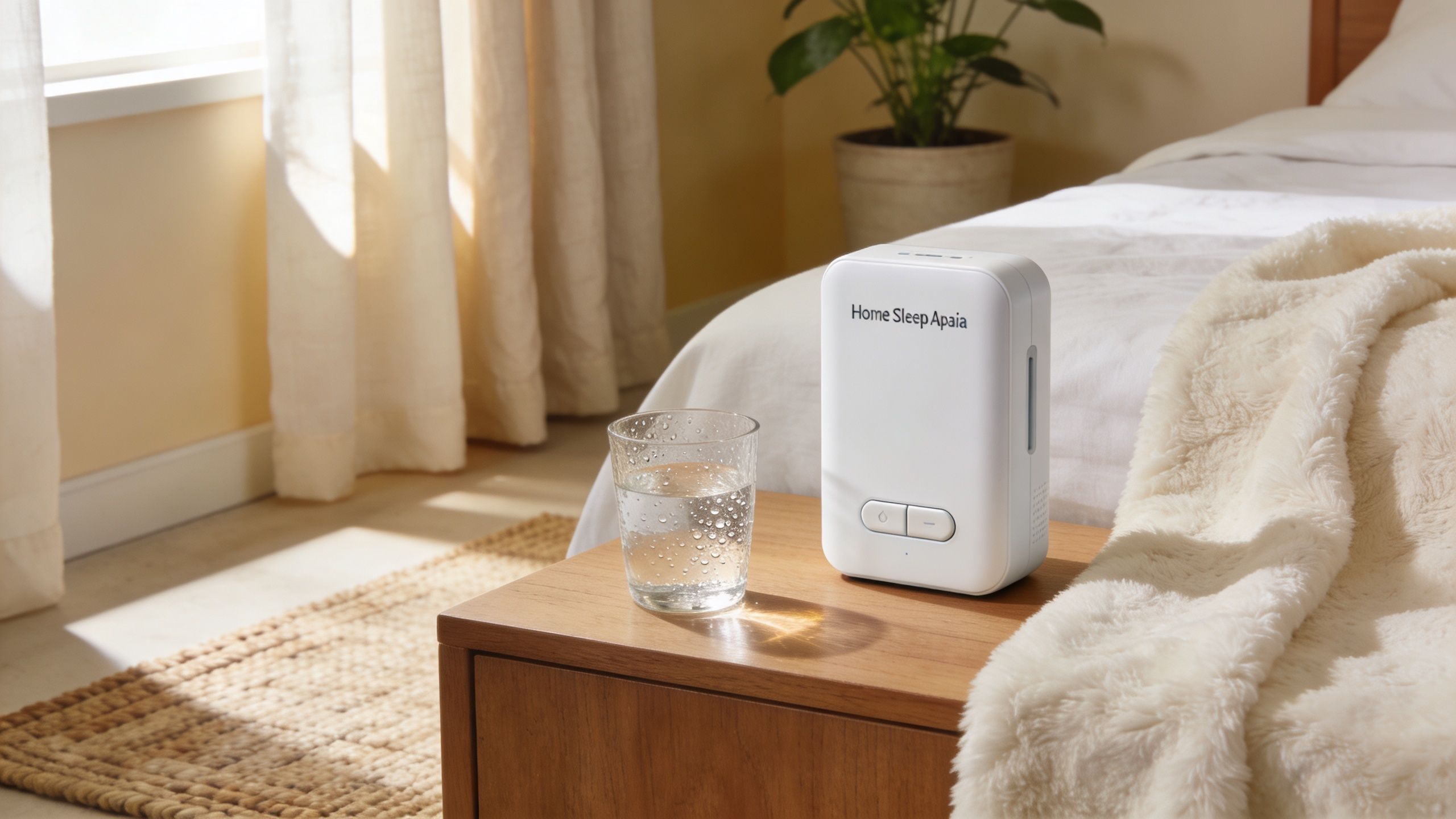
| Home sleep apnea testing | You sleep in your own bed using a small monitoring device | Easier, familiar, and often a practical first step |
| In-lab polysomnography | You sleep in a monitored sleep lab with more detailed tracking | Useful when a more complex evaluation is needed |
For many adults, home sleep apnea testing validates 70 to 80% of OSA cases and usually costs about $200 to $500, compared with more than $1,000 for an in-lab polysomnogram, according to the Sleep Foundation guide to home sleep apnea testing.
That matters because convenience often determines whether people move forward. If the first step feels manageable, they're much more likely to get answers.
What the test is looking for
A sleep study isn't judging how well you sleep. It's checking whether your body is breathing normally through the night.
It may track things like:
- Breathing pauses and reductions in airflow
- Oxygen levels while you're asleep
- Heart rate patterns during the night
- Body position and how that may affect breathing
- Snoring and respiratory effort
If you've been wondering whether your snoring is normal or something more serious, a helpful starting point is this article on chronic snoring and whether it may signal sleep apnea.
Why many patients start with a dental office
A dental office can be a practical entry point because patients often already trust their dentist, and airway issues frequently overlap with oral anatomy. If someone has a narrow arch, crowded tongue space, jaw positioning concerns, or oral signs related to poor nighttime breathing, those details can help shape the next step.
That doesn't replace formal diagnosis. It helps guide it.
If you're avoiding evaluation because a sleep lab sounds overwhelming, home testing often removes that barrier.
For a lot of people in Walnut Creek, that's the moment the process becomes realistic. You're not committing to everything at once. You're taking the first clear step.
A short overview can make that easier to visualize:
What happens after diagnosis
Once sleep apnea is confirmed, treatment depends on severity, symptoms, and what you are willing to use. That is where a lot of frustration begins for patients who are told there is only one path forward.
There isn't. CPAP is important, but it isn't the right fit for everyone. For many people with mild to moderate OSA, or for those who struggle with mask therapy, an oral appliance becomes a very relevant conversation.
Comparing Sleep Apnea Treatments CPAP vs Oral Appliance Therapy
A common Walnut Creek scenario goes like this: someone is diagnosed with sleep apnea, starts CPAP with good intentions, then struggles with the mask, the tubing, or the feeling of forced air. After a few difficult nights, the machine stays on the nightstand more than the face. That is often the point when a dental treatment becomes the more realistic path.
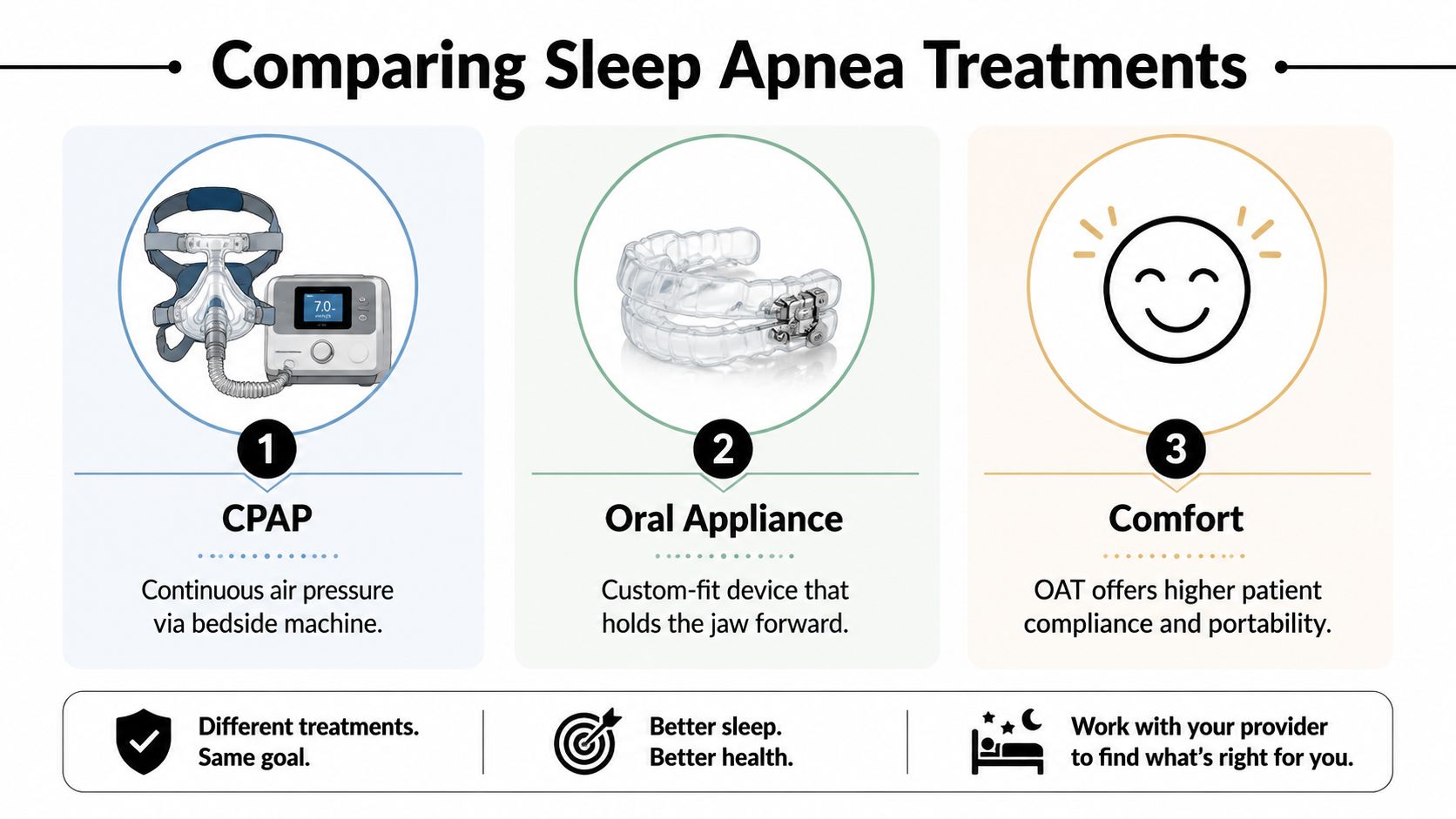
CPAP remains an important medical therapy. It keeps the airway open with pressurized air delivered through a mask, and many patients do very well with it, especially in more severe cases. But treatment has to fit real life, not just the prescription.
What patients often experience with CPAP
The usual concerns are practical ones. Masks can feel bulky. Air pressure can dry the mouth or nose. Some patients feel confined once the mask is on, and some pull it off during sleep without noticing.
Those are not minor complaints. They often decide whether treatment becomes a habit.
Where oral appliance therapy fits
Oral Appliance Therapy, or OAT, uses a custom dental device worn during sleep to bring the lower jaw forward and help keep the airway open. No mask. No hose. No machine by the bed.
For many patients with mild to moderate obstructive sleep apnea, or for patients who have not done well with CPAP, that difference matters. Oral appliances are small, quiet, and easy to travel with. They also tend to feel more familiar because they resemble other custom dental devices, which helps many patients stick with treatment. You can learn more about how your dentist can help treat your sleep apnea if you want a clearer picture of where dental care fits.
Side-by-side treatment trade-offs
| Factor | CPAP | Oral Appliance Therapy |
|---|---|---|
| How it works | Uses continuous air pressure through a mask | Repositions the lower jaw to support airway opening |
| Sleep setup | Bedside machine, mask, tubing | Small custom dental appliance |
| Noise | Machine noise may bother some patients | Silent |
| Travel convenience | Less convenient for many travelers | Easy to pack and carry |
| Comfort concerns | Mask fit, pressure, dryness, claustrophobic feeling for some | Jaw adjustment period for some patients |
| Best fit | Often used broadly across OSA treatment plans | Often a strong option for mild to moderate OSA or CPAP intolerance |
Why adherence changes the outcome
The best sleep apnea treatment is the one you will use consistently.
That distinction is important. Patients benefit from the treatment they use, not just the one they were prescribed. A 2023 meta-analysis in Sleep Medicine Reviews reported higher adherence with oral appliance therapy than CPAP after one year, as noted in the Sleep Medicine Reviews journal listing.
In practice, I see that same pattern. A treatment that feels manageable at home usually has a better chance of becoming part of nightly routine.
Clinical reality: Comfort often determines whether treatment succeeds over time.
What works and what doesn't
What tends to work:
- Custom fitting rather than over-the-counter devices
- Gradual adjustment so the jaw is advanced carefully
- Follow-up visits to improve comfort and effectiveness
- Choosing the right patient for the right treatment
What tends not to work:
- A generic boil-and-bite device bought online
- Ignoring jaw comfort during the adjustment period
- Treating diagnosis as optional
- Assuming one treatment fits every person
William M. Schneider, DDS evaluates oral anatomy, dental health, and bite stability to determine whether an appliance is likely to work well and remain comfortable. That matters because oral appliance therapy is not just about making a device. It is about making a device that a patient can wear, tolerate, and use long enough to improve sleep and protect long-term health.
For many patients, OAT is not the better option because it is newer. It is the better option because it fits their life well enough to be used every night.
Your OAT Consultation at Our Walnut Creek Dental Office
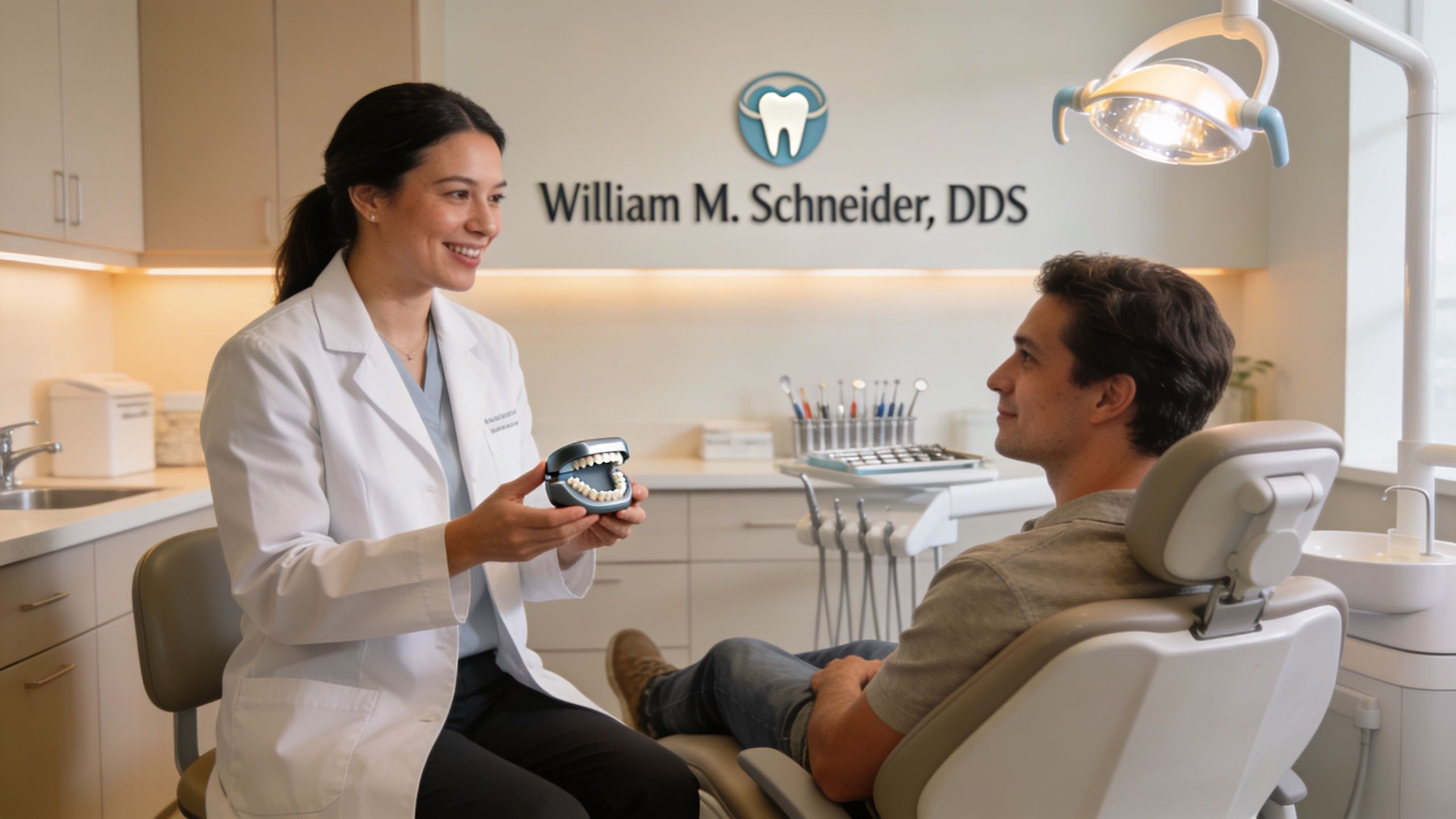
Patients often feel better once they understand what the appointment is like. A sleep apnea consultation at a dental office shouldn't feel rushed or mysterious. It should feel calm, clear, and personalized.
What happens at the first visit
The first step is a conversation about your symptoms and sleep history. That usually includes snoring, daytime fatigue, waking with a dry mouth, headaches, or whether a partner has noticed breathing pauses.
Then comes an oral examination. The dentist checks the bite, jaw position, airway-related anatomy, tooth wear, gum health, and whether an oral appliance is likely to fit comfortably and function well. Since oral appliance therapy depends on a stable, healthy foundation, your general dental condition matters.
How the appliance is designed
If oral appliance therapy is appropriate, the next step is gathering precise records. In many modern offices, that means digital scans rather than messy traditional impressions. The appliance is then custom made to fit your mouth.
The function is mechanical but straightforward. Custom-fit oral appliances work by gently advancing the mandible by 5 to 12 mm, increasing the pharyngeal area by 20 to 30%, which can improve nighttime oxygen saturation by 4 to 6%, according to Stanford Health Care's sleep medicine information.
That small movement can make a meaningful difference when the airway is narrowing during sleep.
What the fitting and adjustment period feels like
Most patients don't put the appliance in and wake up to a perfect result on night one. There is usually an adjustment period. That's normal.
Some people notice:
- A few nights of awareness because the appliance is new
- Mild jaw stiffness in the morning that often settles as the fit is refined
- Progressive improvement as the device is adjusted carefully over time
A good OAT process isn't just about delivery. It's about follow-up. The appliance may need small adjustments to improve comfort and effectiveness, and those details matter.
A well-made oral appliance should feel intentional, not improvised. Precision matters.
If you'd like a closer look at the dental role in this process, this page explains how your dentist can help treat your sleep apnea.
Why patients appreciate this setting
People who choose a local dental office for sleep apnea care often appreciate the setting for the same reasons they value a trusted family dentist. The environment is familiar. Questions get answered in plain language. If you're anxious about dental visits, a compassionate office approach makes a difference.
That can matter just as much as technology. Patients who already come in for preventive care, dental x-rays, cosmetic concerns like teeth whitening or a cosmetic dentist near me, or restorative treatment often prefer to address sleep-related care in the same place where they already feel known and comfortable.
Frequently Asked Questions About Sleep Apnea Treatment
Will insurance help cover an oral appliance?
Often, yes. Many medical insurance plans, including Medicare, may help cover a custom oral appliance for sleep apnea when it is prescribed after a sleep study and billed as durable medical equipment, according to the ADA resource on dental sleep medicine and insurance-related considerations.
Coverage depends on your specific plan, deductibles, and documentation requirements. Before treatment starts, our office can help you review the practical details so you know what to expect. Oral appliance therapy is often more accessible than patients assume.
Is an oral appliance as effective as CPAP?
It depends on the diagnosis, the severity of the apnea, and what you can realistically use night after night. CPAP is still the right option for some patients, especially in more severe cases. Oral appliance therapy is often an excellent choice for patients with mild to moderate obstructive sleep apnea, or for those who have CPAP but struggle to keep using it.
In practice, adherence matters. A treatment only helps if you can tolerate it consistently. For many patients in Walnut Creek, that is where a custom dental appliance has a real advantage in comfort and day-to-day use.
Does the appliance feel bulky or painful?
Usually, no. A custom appliance is smaller and more discreet than many patients expect.
There can be an adjustment period. Some patients notice pressure, tooth awareness, or mild jaw stiffness at first. Those effects are often manageable and improve as the appliance is adjusted carefully to fit your bite and your airway goals.
If discomfort continues, it should be evaluated, not ignored. In many cases, the issue is not that oral appliance therapy failed. The fit may need refinement.
Can a dentist really help with sleep apnea?
Yes, after the condition has been properly diagnosed. Dentists are well-positioned to identify airway concerns, coordinate with your physician or sleep specialist, and provide custom oral appliance therapy for patients who are good candidates. We also monitor how the appliance affects your teeth, jaw joints, bite, and long-term comfort.
That dental follow-up matters because treatment is not only about reducing snoring. It also needs to remain comfortable, stable, and practical to use over time.
What should I do next if I think I have sleep apnea?
Start with an evaluation. If you snore heavily, wake up tired, or feel sleepy during the day, it makes sense to get answers rather than wait and hope it improves.
The next step may be home sleep testing, referral for a formal sleep evaluation, or a discussion about oral appliance therapy once a diagnosis is confirmed. William M. Schneider, DDS sees many patients who want a local, comfortable place to start that process in Walnut Creek, with clear guidance and treatment that feels manageable in real life.