You wake up tired even after a full night in bed. Your partner says your snoring is getting worse. Maybe they've noticed pauses in your breathing, or you've woken up with a dry mouth, a headache, or that sudden panicked feeling that you weren't getting enough air.
That pattern can be unsettling. It can also be easy to dismiss for months or years because it happens at night, when you're not fully aware of it.
If you're searching for a sleep apnea treatment dentist in Walnut Creek, you're probably not just looking for information. You're looking for relief, answers, and a path that feels manageable. In our Walnut Creek office, patients often tell us they want something practical. They want to sleep better, feel more alert, and stop worrying about what untreated snoring or interrupted breathing may be doing to their health.
Your Local Walnut Creek Dentist for Better Sleep
A lot of people arrive at this point gradually.
At first, it's “I'm just stressed.” Then it becomes falling asleep on the couch, struggling through afternoon meetings, or hearing from a spouse that the snoring has become impossible to ignore. Some patients come in because they're worried about sleep apnea. Others come in because they're exhausted and want to know if a dental solution could help.
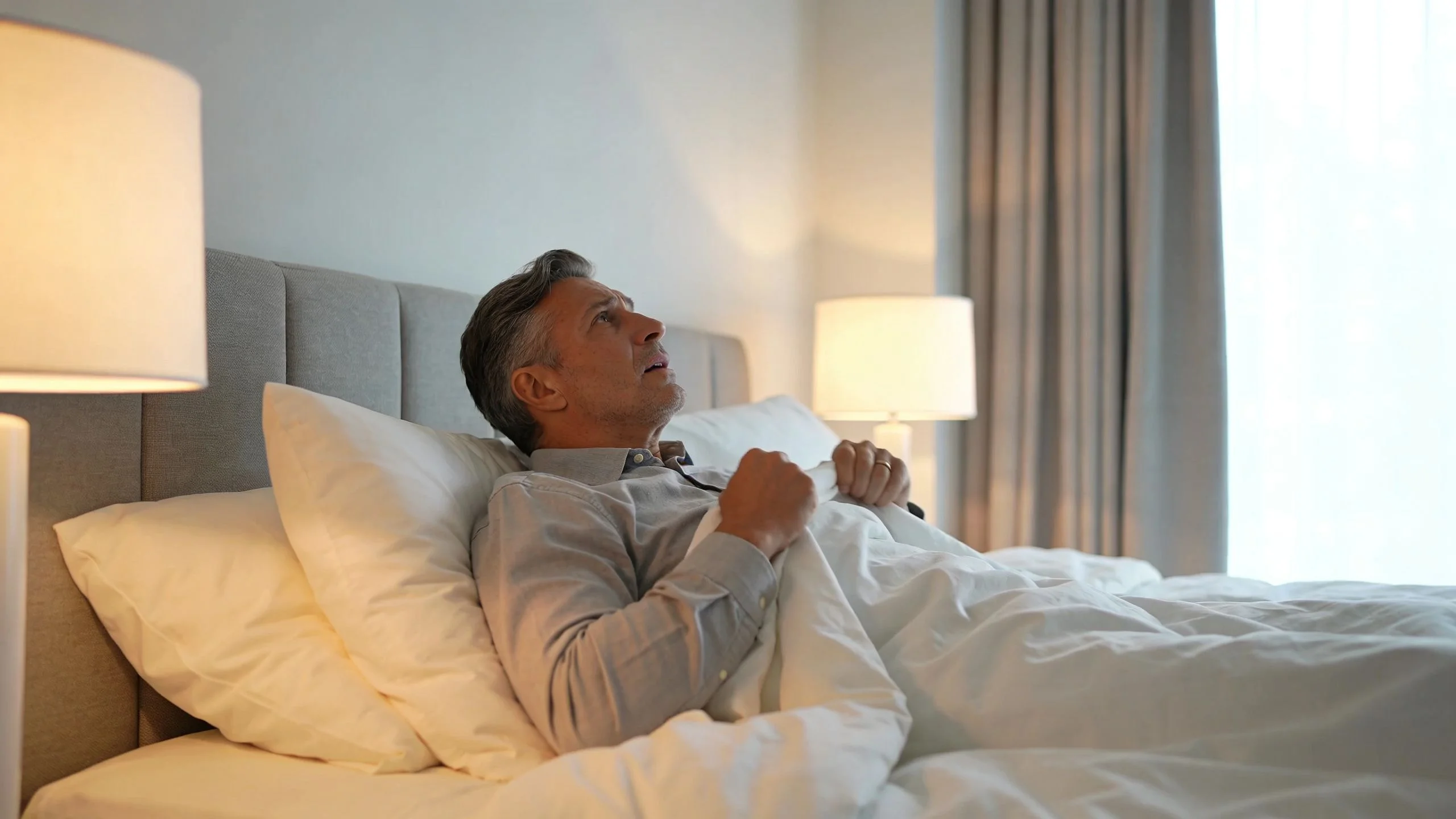
What many patients in Walnut Creek are experiencing
Sleep apnea rarely feels like just one symptom. It tends to show up as a cluster of problems that start affecting daily life:
- Morning fatigue: You slept for hours but still feel unrefreshed.
- Snoring that's hard to ignore: Often noticed first by a partner or family member.
- Interrupted sleep: Waking up suddenly, restless tossing, or gasping sensations.
- Daytime brain fog: Trouble concentrating at work, while driving, or during routine tasks.
For many people in Walnut Creek and the East Bay, that's the moment dental sleep medicine starts to make sense. They're not necessarily looking for a machine by the bedside. They're looking for a treatment option that fits real life.
A good sleep apnea conversation starts with how you feel, not just with a device.
A dental office can be part of the answer
Dentists don't diagnose obstructive sleep apnea. That part belongs with a sleep physician. But once a diagnosis is made, a dentist trained in oral appliance therapy can play a major treatment role.
That's where local, coordinated care matters. In a general dental practice, patients already trust the office with preventive visits, dental x-rays, new patient exams, restorative dentistry, and ongoing oral health. Sleep apnea treatment can fit into that same careful, long-term approach, especially when the treatment involves the teeth, bite, jaw, and airway.
For some patients, the next step isn't a dramatic overhaul. It's a clear consultation, a proper referral if needed, and a better understanding of whether an oral appliance could help them sleep more safely and comfortably.
What Is Obstructive Sleep Apnea
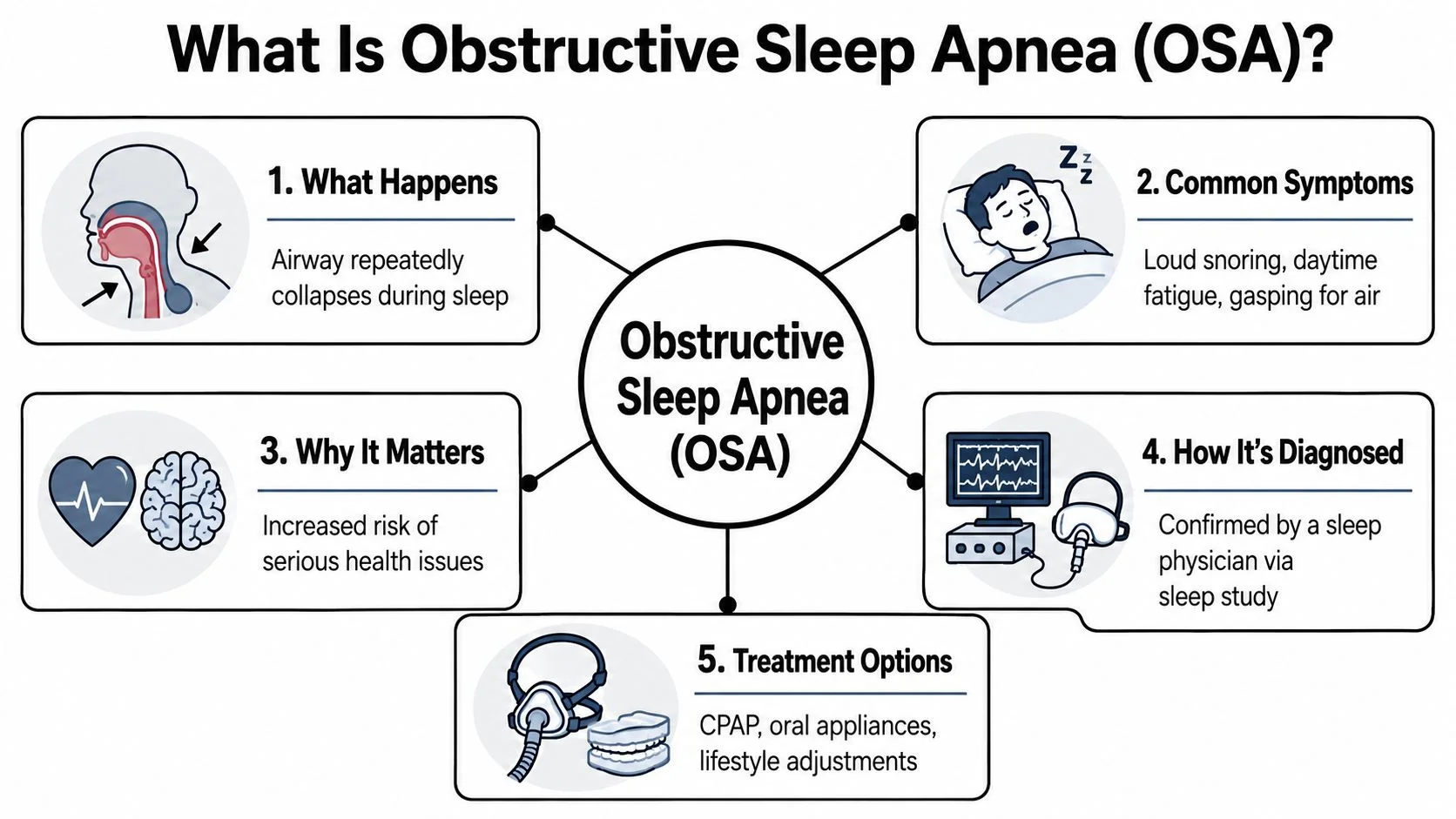
Obstructive sleep apnea, or OSA, happens when the airway repeatedly narrows or collapses during sleep. The easiest way to picture it is to think of your throat like a soft tunnel. When the muscles relax too much at night, that tunnel can partly close. Air has a harder time moving through, and breathing becomes disrupted.
That disruption may last only a short time, but it can happen again and again through the night. Even if you don't fully wake up each time, your sleep gets fragmented.
What it feels like in real life
Many people know OSA because of the snoring. But snoring is only part of the story. Obstructive sleep apnea can also look like:
- Loud snoring
- Pauses in breathing noticed by someone else
- Waking up gasping or choking
- Dry mouth in the morning
- Morning headaches
- Daytime sleepiness or mental fog
- Irritability and poor concentration
Sometimes patients say, “I don't think I wake up much, so can it still be sleep apnea?” Yes, it can. A person may not remember the brief arousals that keep pulling them out of deep, restorative sleep.
If you're trying to sort out whether your snoring may be part of a bigger problem, this page on chronic snoring and sleep apnea warning signs is a helpful place to start.
Why it matters beyond snoring
OSA matters because breathing interruptions affect more than sleep quality. They reduce normal airflow and can strain the body over time. Patients often come in thinking the issue is just noise at night, but untreated sleep apnea can affect energy, mood, and overall health.
Practical rule: If snoring comes with fatigue, headaches, gasping, or witnessed pauses in breathing, it deserves a real evaluation.
How sleep apnea is confirmed
This is a common point of confusion. A dentist can notice patterns that suggest sleep-disordered breathing, but a dentist doesn't diagnose OSA independently.
Diagnosis is confirmed by a sleep physician, usually with sleep testing. That distinction matters because the right treatment depends on the actual severity and type of breathing problem. Once that diagnosis is established, the treatment team can decide whether CPAP, oral appliance therapy, or another approach makes the most sense.
The Dentist's Role in Sleep Apnea Treatment
A sleep apnea treatment dentist has an important job, but it's not the first job in the process.
The diagnosis comes from a sleep physician. The dental role begins once obstructive sleep apnea has been identified and oral appliance therapy is being considered or prescribed. That team approach protects patients and leads to better decision-making.
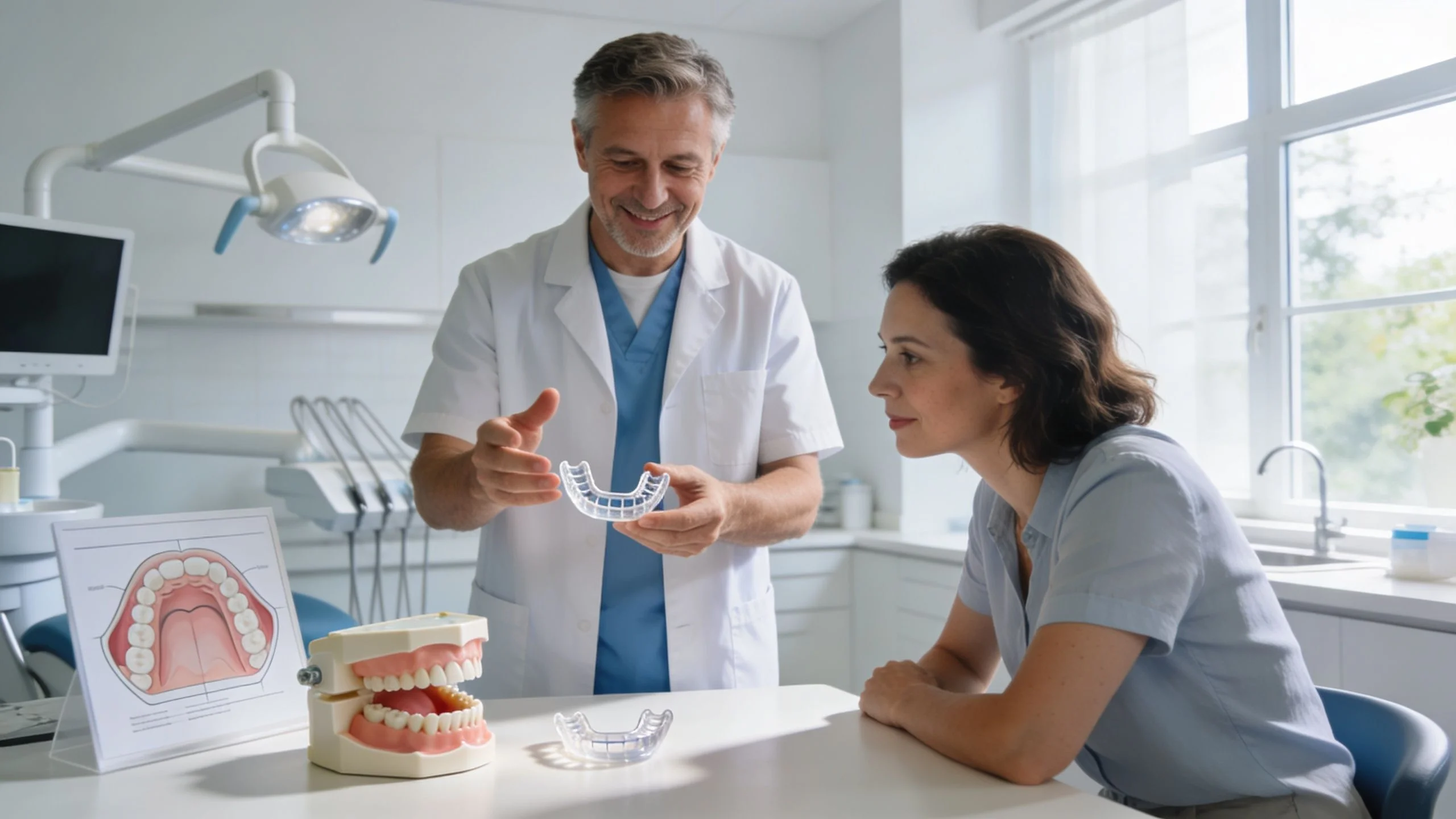
Why dentists are involved at all
The mouth, jaw position, bite, tongue posture, and surrounding tissues all affect the airway. Dentists spend their careers studying and managing this anatomy. That makes dental professionals uniquely useful when treatment involves a device worn over the teeth that changes jaw position during sleep.
A major milestone came with the 2015 joint guideline from the American Academy of Sleep Medicine and the American Academy of Dental Sleep Medicine, which recognized oral appliance therapy provided by trained dentists as a treatment choice for people diagnosed with obstructive sleep apnea, with the sleep physician confirming the diagnosis and the dentist evaluating oral anatomy, selecting the appliance, adjusting it, and monitoring side effects in collaboration with the physician, as summarized in this Practical Neurology overview of dental sleep medicine.
That shift helped clarify something patients often don't hear clearly enough. A dentist is not stepping outside dentistry here. The dentist is treating the dental and airway mechanics of a medically diagnosed condition.
What that collaboration looks like
In practical terms, coordinated care often includes:
- Physician diagnosis: The sleep doctor determines whether you have OSA.
- Dental evaluation: The dentist checks your oral anatomy, bite, jaw comfort, and whether an appliance is realistic for you.
- Custom appliance management: The dentist fits and adjusts the device.
- Follow-up communication: The treatment team may coordinate on comfort, symptom improvement, and next steps.
Patients usually find this reassuring once it's explained. It means nobody is guessing. Each provider handles the part they're trained to manage.
A brief overview of the treatment approach may help make that partnership easier to picture:
Why this approach builds trust
Some offices talk about an appliance as if it were a simple retail product. It isn't. A proper oral appliance for sleep apnea is a medical and dental treatment that needs diagnosis, selection, adjustment, and monitoring.
The safest path is also the most responsible one. Diagnosis by a physician, treatment management by a trained dentist, and follow-up over time.
That's one reason patients looking for a dentist in Walnut Creek, CA often appreciate a practice that takes a broad view of health. The same office that helps with dental care, cosmetic dentistry, restorative dentistry, emergency dentist visits, and routine exams can also help coordinate a more comfortable path for sleep-related breathing treatment when appropriate.
Oral Appliance Therapy A Comfortable CPAP Alternative
For many adults with obstructive sleep apnea, the main dental treatment is a custom, titratable oral appliance called a mandibular advancement device, or MAD.
This device is worn while you sleep. It looks somewhat like a specialized mouthguard, but it does something much more specific. It gently holds the lower jaw forward. That forward position also moves the tongue and soft palate forward, helping enlarge the upper airway and reduce collapse during sleep, as described in the AASM and AADSM guideline review on oral appliance therapy.
How the device works
If your airway behaves like a soft tunnel, the oral appliance helps keep that tunnel more open. It doesn't blow air. It changes position.
That mechanical difference matters because some patients tolerate a repositioning device more easily than a bedside machine. A custom-fitted appliance is also designed for your mouth rather than chosen off the shelf.
Why custom and titratable matters
Guidelines recommend a custom, titratable device fitted by a qualified dentist. “Custom” means it's made for your teeth and bite. “Titratable” means it can be adjusted in small increments.
Those small adjustments are important. If the jaw isn't advanced enough, the airway may not improve enough. If it's advanced too aggressively too quickly, the device may be uncomfortable. The goal is an effective balance between airway support and comfort.
Oral Appliance Therapy vs. CPAP at a Glance
| Feature | Oral Appliance Therapy (OAT) | CPAP Machine |
|---|---|---|
| How it works | Repositions the lower jaw to help keep the airway open | Uses pressurized air through a mask to keep the airway open |
| What it feels like | Similar to wearing a custom dental device during sleep | Involves wearing a mask connected to a machine |
| Noise | Quiet | Machine and airflow may be noticeable |
| Travel convenience | Small and portable | Less convenient to pack and set up |
| Fit | Custom-made by a qualified dentist | Mask fit is adjusted from available mask options |
| Best use case | Often considered for mild to moderate OSA and for some people who can't tolerate CPAP | Often used across OSA treatment, especially when maximum airway support is needed |
| Follow-up needs | Requires dental monitoring and appliance adjustments | Requires medical equipment use and ongoing therapy management |
What patients usually care about most
Most treatment decisions don't come down to theory. They come down to daily use.
Patients often ask questions like:
- Will I wear it every night?
- Can I travel with it easily?
- Will it bother my partner?
- Can I sleep on my side?
- Will it feel less intrusive than a mask?
Those are fair questions. Comfort and consistency matter because a treatment only helps when it's used.
What the evidence tells us
Oral appliance therapy has meaningful clinical results. In one summary of mandibular advancement device outcomes, about 70% of people with OSA had a reduction in severity of more than half, 54% reached an apnea-hypopnea index below 10, 21% achieved at least a 50% reduction in initial AHI while still remaining above 10, and 45% saw snoring reduced, according to this summary of oral appliance success rates.
That doesn't mean it's right for everyone. It means there's a solid reason oral appliance therapy has become an established part of care.
The right comparison is personal, not ideological
CPAP remains an important treatment, and for some people it is the better option. Oral appliance therapy isn't about proving one treatment “wins.” It's about finding a treatment you can use consistently and safely based on your diagnosis, anatomy, and tolerance.
William M. Schneider, DDS provides custom oral appliance therapy for patients in Walnut Creek who have been diagnosed with sleep apnea and need a dental treatment option that can be fitted, adjusted, and monitored over time.
Your Sleep Apnea Treatment Journey in Walnut Creek
Patients usually feel better once they understand the process. Sleep apnea treatment with an oral appliance isn't mysterious, and it shouldn't feel rushed.
The path is structured. Each step answers a specific question. Do you have diagnosed OSA? Are you a candidate for an appliance? Does the fit work well for your teeth and jaw? Are adjustments improving symptoms without creating bite problems?
Step one begins with the right evaluation
If you already have a diagnosis from a sleep physician, bring that information to your consultation. If you don't, the first step may be coordinating referral and evaluation so the medical side is handled correctly.
At the dental visit, the conversation usually includes your symptoms, sleep history, snoring concerns, prior CPAP experience if any, jaw comfort, and oral health. This is also a good time to bring up other dental needs. Patients often appreciate being able to address broader concerns in one trusted office, whether that's routine cleaning and exams, restorative care, or even planning for future needs like tooth extraction or dental implants near me searches they've been putting off.
What happens after you're approved for an appliance
Once oral appliance therapy is appropriate, the next steps are straightforward:
- Records are taken. This may involve dental impressions or a digital 3D scan, along with a bite registration.
- Your appliance is fabricated. The device is made to fit your specific mouth.
- You return for delivery. The fit is checked carefully, and you'll learn how to wear and care for it.
That appointment is important, but it's not the finish line.
Treatment works best when the appliance is adjusted over time, not handed over and forgotten.
Follow-up is part of the treatment
Effective oral appliance therapy is a monitored process, not a one-time fitting. After a custom device is made from impressions or 3D scans, follow-up visits are used to titrate, or gradually adjust, the appliance while also watching for side effects like bite changes, as explained in the Cleveland Clinic overview of oral appliance therapy follow-up care.
That's one of the biggest reasons to work with a dentist who understands the long-term side of this treatment. A comfortable start is good. A stable bite and sustained benefit over time is better.
If cost is one of the questions keeping you from taking the first step, this page on sleep apnea treatment cost and what affects it can help you understand the basics before your visit.
What patients can expect from the office experience
In Walnut Creek, patients generally want the same thing from sleep apnea care that they want from any dental visit. They want clarity, comfort, and a plan.
You should expect:
- Clear explanations: What the device does, what it doesn't do, and how follow-up works.
- Comfort-focused care: A careful fitting process and room to discuss concerns.
- Ongoing reassessment: Adjustments based on how you feel and how the treatment is performing.
- Coordination when needed: Communication with the diagnosing physician when appropriate.
For patients who found CPAP frustrating or intimidating, this step-by-step process often feels much more approachable.
Is Oral Appliance Therapy Right for You
This is the question that matters most. Not “Is it popular?” Not “Is it easier than other options?” The core question is whether it fits your diagnosis, anatomy, symptoms, and treatment goals.
Oral appliance therapy is a strong option for many people, but it isn't universal.
You may be a good candidate if
Oral appliance therapy is primarily recommended for mild to moderate obstructive sleep apnea, or for some people with severe OSA who cannot tolerate CPAP, according to the Ontario Dental Association overview of when dental appliances may be appropriate.
That usually makes it worth discussing if any of these sound familiar:
- You've been diagnosed with mild or moderate OSA
- You've tried CPAP and can't tolerate it
- You want a quieter, travel-friendly treatment
- Your snoring is significant and tied to confirmed OSA
- You're willing to come in for adjustments and monitoring
Reasons someone may need a different plan
Some patients aren't ideal candidates for an oral appliance. The issue may be the severity of OSA, the condition of the teeth and gums, jaw limitations, or other medical considerations that make another treatment more appropriate.
That's why an honest consultation matters. Responsible care sometimes means confirming that an appliance is a good fit. Other times it means telling a patient that another route is safer or more effective.
“Am I a candidate?” is exactly the right question to ask. It shows you're thinking about treatment the right way.
Questions about cost and insurance
Most patients also want to know what treatment will cost and whether insurance may help. Those are reasonable concerns, and they're easier to sort through once your diagnosis and treatment pathway are clear.
Coverage can depend on your plan and how the treatment is categorized. The most helpful first step is usually a consultation, where the office can review the clinical side of candidacy and help you understand the practical side next.
What to do next
If you've been searching for a dentist near me, cosmetic dentist near me, or even an emergency dentist, you may not have expected sleep apnea treatment to be part of a dental office conversation. But for the right patient, it can be an important part of protecting both oral health and overall health.
The first move doesn't have to be complicated. Start with a consultation. Bring your questions. Bring your sleep study if you have one. Bring your frustration if you've already tried CPAP and hated it.
You don't need to figure this out alone.
If you're ready to find out whether oral appliance therapy may be right for you, schedule a consultation with William M. Schneider, DDS. Our Walnut Creek office helps patients take the next step with clear guidance, coordinated care, and a practical plan for better sleep.