You wake up, open your mouth, and your jaw feels tired before the day even starts. Maybe your temples ache. Maybe one tooth has turned oddly sensitive, or a partner has told you they hear grinding at night. A lot of people in Walnut Creek live with those symptoms for months before they realize they're not random.
That pattern often points to bruxism, the habit of clenching or grinding your teeth, usually during sleep. A teeth grinding night guard can be a very effective way to protect your smile, but the right answer isn't just buying a piece of plastic and hoping for the best. The primary goal is to find out what your mouth needs, protect your teeth now, and watch for bigger issues that may be connected to the grinding.
If you're searching for a dentist in Walnut Creek, CA, or even typing dentist near me because the pain is getting hard to ignore, it helps to know there's a clear path forward. Good care starts with a careful diagnosis, then moves into a custom solution that fits your bite, your symptoms, and your long-term dental health.
Stop Jaw Pain and Headaches in Walnut Creek
A common story goes like this. You assume you slept badly, but the same soreness keeps showing up. Your jaw feels tight in the morning. You get dull headaches that seem to start around the temples. Cold drinks sting a little more than they used to. Then one day, during a cleaning and exams visit, your dentist points out wear on the edges of your teeth.
Grinding can be surprisingly destructive because it often happens when you're not aware of it. During the day, you may notice clenching when you're stressed at work or sitting in traffic. At night, your teeth can take repeated force for hours. What patients feel first is often the muscle fatigue, but what concerns a dentist is the damage building on enamel, fillings, crowns, and the bite itself.
Symptoms patients often notice first
- Morning jaw soreness that improves slowly as the day goes on
- Temple headaches or pressure near the cheeks
- Tooth sensitivity without an obvious cavity
- Chipped edges or flattened teeth
- Interrupted sleep from clenching, jaw tension, or facial discomfort
What matters most: if your teeth or jaw hurt in a repeated pattern, don't assume it will settle down on its own.
In practice, the most reassuring thing for patients is learning that this problem is treatable. A night guard doesn't need to feel intimidating. When it's selected properly and fitted well, it can reduce the daily wear on your teeth and make mornings much more comfortable.
That's especially important if you already have restorations, cosmetic dentistry, or older dental work you want to protect. Grinding can stress crowns, veneers, fillings, and implants just as much as natural teeth. For some people, a night guard becomes part of a broader plan that also includes cleanings, dental x-rays, bite evaluation, restorative dentistry, or help with related sleep concerns.
Understanding Bruxism The Cause of Your Teeth Grinding
Bruxism means involuntary grinding or clenching of the teeth. Many people do it during sleep and have no idea until a dentist sees the signs. The American Dental Association notes that a 2021 survey found more than 70% of dentists noticed signs of teeth grinding and clenching, and it also says that people who smoke or drink alcohol or coffee are twice as likely to grind their teeth as those who do not, which shows how common and behavior-linked this issue can be (ADA guidance on teeth grinding).

Why it happens
Sometimes stress is the obvious trigger. Patients may clench during busy work periods, family stress, or poor sleep. In other cases, the pattern is less simple. A bite imbalance, tension in the jaw muscles, or a sleep-related issue may all play a role.
That's why a quick online purchase doesn't replace a real exam. If you want a broader look at self-care and professional options, this guide on how to stop grinding teeth at night is a helpful next step.
What a dentist looks for
Grinding leaves clues. Some are easy to see, and some show up only after a careful exam.
- Flattened chewing surfaces that suggest repeated friction
- Tiny fractures or chipped enamel along the biting edges
- Tooth wear near fillings or crowns
- Muscle tenderness when the jaw is examined
- Changes in sensitivity that patients may not connect to grinding at first
Many people with bruxism don't know they're doing it. The first diagnosis often happens in the dental chair, not the bedroom.
A professional evaluation matters because not every sore jaw is just “teeth grinding.” Gum problems, cracked teeth, TMJ-related irritation, and sleep-related airway issues can overlap. A dentist who treats the whole picture can tell the difference between mild wear that needs monitoring and a more serious pattern that needs protection now.
For patients in Walnut Creek, that diagnostic step is where real relief begins. Once you know whether the problem is active grinding, clenching, a bite issue, or a combination, treatment becomes much more precise.
How a Custom Night Guard Protects Your Smile
A custom night guard works because it changes what happens when your teeth meet during sleep. Instead of upper and lower teeth grinding directly against each other, the guard becomes the contact surface. That simple change can spare enamel, protect restorations, and reduce strain on the jaw.
What it actually does
Think of the guard as a protective barrier. It doesn't stop your jaw muscles from trying to clench, but it does help prevent the direct tooth-on-tooth contact that causes visible wear and fractures.
That difference matters. A lot of dental damage from bruxism is cumulative. One rough night may not seem important, but repeated contact over time can wear grooves into enamel, stress old fillings, and create cracks that eventually need restorative care.
What it does not do
A night guard is not a cure for the underlying habit. Guidance on night guards for teeth grinding and related sleep concerns explains that a guard is primarily a defensive barrier rather than a cure for bruxism, and it also notes that mouth guards may be used in snoring and obstructive sleep apnea care. That overlap matters because some patients need more than a guard alone.
Here's a short video that helps visualize how these appliances work in real life.
Clinical reality: if a guard protects your teeth but your jaw pain keeps escalating, the next step is more evaluation, not just wearing it longer.
A good custom guard can still make a major difference. It can lower the daily damage load on your teeth, reduce pressure on the jaw joint area, and preserve cosmetic and restorative work you've already invested in. For many adults, that makes it one of the most practical preventive devices in dentistry.
Over-the-Counter vs Custom-Fit Night Guards A Dentist's View
Patients often ask whether a drugstore night guard is “good enough.” Sometimes an over-the-counter guard can serve as a short-term stopgap. But it's important to understand what it can't do.
A generic boil-and-bite appliance is made to fit many mouths. Your mouth is not generic. Your bite has specific contact points, tooth positions, and jaw movements. If the fit is bulky, loose, uneven, or unstable, you're less likely to wear it consistently, and it may not distribute pressure in a healthy way.
The thickness and material question
For most bruxism cases, night guards are typically designed in the 1 mm to 3 mm range. Lighter grinding is often managed with 1 mm to 1.5 mm guards, while heavier grinding may call for 2 mm to 3 mm designs. In more severe cases, a hard acrylic occlusal guard is commonly used and is reported to last 2 to 3 years or more (professional night guard overview).
That level of customization is where dentist-made appliances stand apart. Thickness is not just a comfort choice. It affects durability, wear resistance, and how the appliance handles force.
Side-by-side comparison
| Feature | Over-the-Counter Guard | Custom-Fit Guard (from Dr. Schneider) |
|---|---|---|
| Fit | Approximate fit based on self-molding | Made to your specific teeth and bite |
| Comfort | Often bulky or inconsistent | Designed for better day-to-day wearability |
| Material choice | Limited, one-size approach | Chosen based on grinding severity and bite needs |
| Protection level | May offer basic short-term separation | Built for more precise, stable protection |
| Adjustment | No professional bite refinement | Professionally checked and adjusted |
| Long-term planning | Product purchase | Part of a monitored dental care plan |
When custom matters most
A custom appliance is especially important if you have any of the following:
- Existing dental work such as crowns, veneers, bridges, or implants
- Stronger clenching patterns that can wear through softer materials
- Jaw symptoms including popping, stiffness, or morning fatigue
- Unclear diagnosis where grinding may overlap with another issue
If you also snore, feel unrested, or suspect nighttime breathing problems, it's worth learning how sleep apnea treatment with a dentist can fit into the bigger picture.
What works best is matching the appliance to the patient, not forcing the patient to adapt to a generic device. That's the difference between buying a product and receiving care.
Your Custom Night Guard Process at Our Walnut Creek Office
You wake up with a sore jaw, a dull headache, and teeth that feel tender. The next step should feel clear, not complicated. At our Walnut Creek office, the process is designed to answer two questions early: what is causing the strain, and what type of guard will protect your teeth comfortably over time.
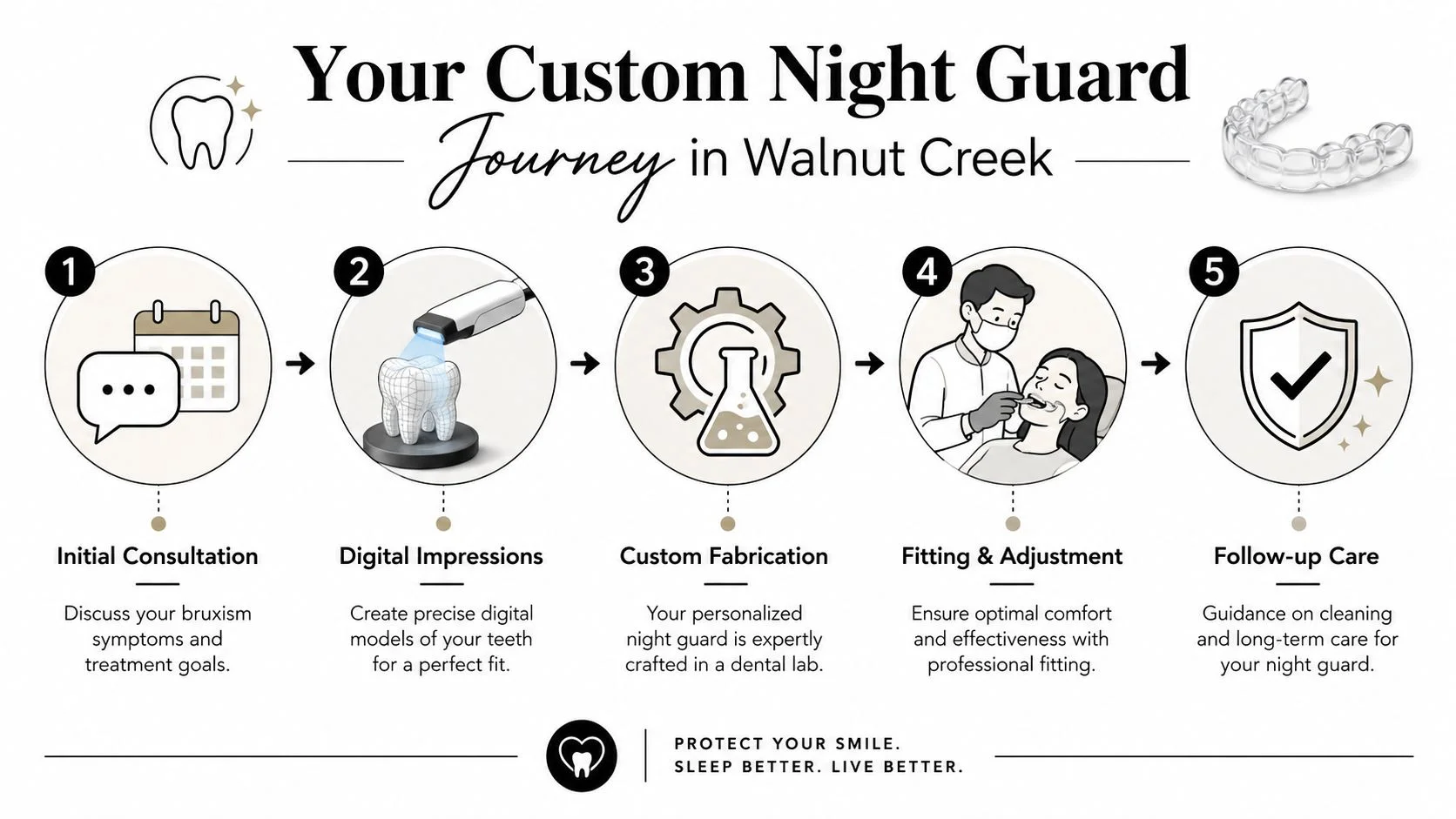
Your first visit is about diagnosis, not just ordering an appliance. The exam looks at wear patterns, small fractures, jaw muscle tenderness, bite changes, and the condition of any crowns or fillings. If something does not fit the pattern of routine grinding, we slow down and investigate it. That may include x-rays or a broader review of your oral health so a cracked tooth, gum problem, or failing restoration is not missed.
After that, we record your teeth with precision. Many patients appreciate digital impressions because they are cleaner and easier than traditional molds, especially if gagging or dental anxiety has been an issue in the past. Accurate records matter. A night guard only works well if it matches your teeth and bite closely.
Fabrication comes next. The lab makes the appliance based on the findings from your exam and the goals of treatment. A patient with light wear and mild symptoms may do well with a guard that prioritizes comfort. A stronger clencher often needs a thicker, more durable design that can hold up to heavier force.
The delivery visit is where a custom guard becomes real treatment. We check how fully it seats, whether it feels stable, and how your bite lands when it is in place. Small adjustments can make the difference between a guard you wear and one that ends up in a drawer.
At that appointment, we usually focus on four practical points:
- making sure the guard fits fully without rocking
- smoothing any area that feels sharp, bulky, or irritating
- adjusting the bite so contact feels even and controlled
- reviewing cleaning, storage, and nightly use
A good night guard should feel secure and manageable within the first few nights.
Long-term care matters just as much as the initial fit. Teeth can shift. Dental work can change. Grinding patterns can intensify during stressful periods. For that reason, the guard should be checked during routine dental visits so we can look for wear, confirm the fit, and decide whether any adjustment or replacement is needed.
William M. Schneider, DDS provides this kind of ongoing care in Walnut Creek. Patients benefit from having the night guard, routine exams, and any restorative follow-up coordinated in one place. That continuity helps protect your teeth now and makes it easier to respond if your symptoms, bite, or dental needs change later.
Cost Insurance Care and Lifespan of Your Night Guard
Most patients want the same practical answers. Is it worth it. Will insurance help. How long will it last. Those are fair questions.
A custom night guard is best viewed as preventive dental care. It helps protect natural teeth and existing restorations from repeated damage. That matters because repairing cracked teeth, replacing crowns, or restoring worn enamel is usually far more involved than protecting those structures early.
Why this is a standard appliance
Night guards are not a niche product. Market reporting projects the global market for night guards for teeth grinding at $1.38 billion by 2025, with North America holding the largest share in one estimate, which shows that this is a standard preventive dental category with broad adoption in major dental markets (night guard market projection).
That doesn't tell you what your own plan will cover, but it does reinforce an important point. Dentists recommend these appliances because they solve a common, real problem.
Insurance and care tips
Insurance coverage varies by plan, diagnosis, and documentation. The most useful approach is to ask your dental office to review your benefits before treatment begins. Patients appreciate knowing what to expect up front, especially if they're comparing a night guard with other needs like a crown, tooth extraction, dental implants, or cosmetic dentist services.
To get the most life from your appliance:
- Rinse after use with cool or lukewarm water
- Clean it gently with a soft brush and non-abrasive cleanser
- Store it in a case so it stays protected and dry
- Bring it to checkups so your dentist can inspect wear and fit
How long it lasts
Lifespan depends on how hard you grind, what material is used, and whether the guard still fits your bite. Some appliances hold up for years. Others need earlier replacement if the grinding force is high or dental changes alter the fit.
What matters most is not squeezing every last month out of an old appliance. It's making sure the guard is still doing its job safely and comfortably.
Schedule Your Bruxism Consultation in Walnut Creek Today
If you're waking up with jaw pain, headaches, tooth sensitivity, or signs of wear, it's worth getting answers now. A properly fitted teeth grinding night guard can protect your smile, reduce stress on your teeth and jaw, and help prevent more complicated problems later.
The first step is a focused dental evaluation. That visit can show whether you're dealing with active grinding, clenching, cracked enamel, pressure on restorations, or a related issue that needs a different kind of treatment. For some patients, the solution is straightforward. For others, it becomes part of a larger plan that may include preventive care, restorative dentistry, cosmetic treatment, or emergency dentist support if damage has already occurred.
If you've been searching for a dentist near me or a dentist in Walnut Creek, CA who can help with both the discomfort and the long-term protection side of bruxism, local care makes the process easier. You don't have to keep guessing why your jaw hurts in the morning or whether a store-bought guard is enough.
New patients are welcome at the office located at 1855 San Miguel Dr., Suite 31, Walnut Creek, CA 94596. If you're in Walnut Creek or the greater East Bay and want a clear diagnosis, comfortable care, and a custom solution built for your bite, this is a good time to book that consultation.
If you're ready to protect your teeth and get relief from nighttime grinding, contact William M. Schneider, DDS to schedule a consultation. The office welcomes patients in Walnut Creek and the East Bay for preventive, restorative, cosmetic, and sleep-related dental care, with convenient online appointment options and a patient-centered approach.