A cracked tooth can turn an ordinary meal into a careful exercise. You may feel a sharp edge when biting into an apple, notice sensitivity to cold, or see a gap in your smile that wasn't there before. When you need a dentist near me, a dentist in Walnut Creek, CA, or an emergency dentist after sudden damage, understanding your options can make the next decision feel much easier.
Dental crowns and bridges are established forms of restorative dentistry that help rebuild damaged teeth and replace missing ones. They can improve chewing, protect vulnerable tooth structure, and restore a natural-looking smile. At a Walnut Creek dental office, your recommendation should reflect your bite, gum health, remaining tooth structure, appearance goals, timeline, and whether alternatives such as dental implants near me or a partial denture make more sense.
Recognizing When You Need Restorative Dental Care
A Walnut Creek patient might bite into an apple and feel a sudden crack. Another person may notice a visible space while looking in the mirror, then realize that chewing has become uneven. A damaged or missing tooth can affect more than appearance. It may cause sensitivity, make certain foods difficult to eat, or leave neighboring teeth vulnerable to shifting and excess pressure.
A tooth with decay, a large old filling, a fracture, or damage after a root canal may no longer have enough healthy structure for a simple filling. A missing tooth creates its own concerns, especially when the surrounding teeth begin taking on forces they weren't designed to handle. Prompt evaluation can also help identify problems before discomfort becomes an urgent dental visit.
Practical rule: Pain isn't the only reason to seek an examination. A crack, loose restoration, new sensitivity, or visible gap deserves professional attention.
A crown protects and rebuilds a tooth that remains in place. A bridge fills a space left by one or more missing teeth. Both are long-established fixed restorations. A clinical survey from Matsumoto Dental College tracked 11,425 crowns and 2,385 bridges fabricated for 5,588 patients over a 14-year period from January 1973 to December 1986, demonstrating how routinely these restorations have been used in prosthodontic care (clinical survey of crowns and bridges).
Modern restorative dentistry gives patients more choices than the old “metal or white” discussion suggests. Tooth-colored ceramics, zirconia, porcelain-fused-to-metal restorations, digital scanning, and careful bite planning allow a dentist to tailor treatment to the individual. Walnut Creek patients can discuss these options locally rather than trying to decide from a material label alone.
Understanding How Crowns and Bridges Work
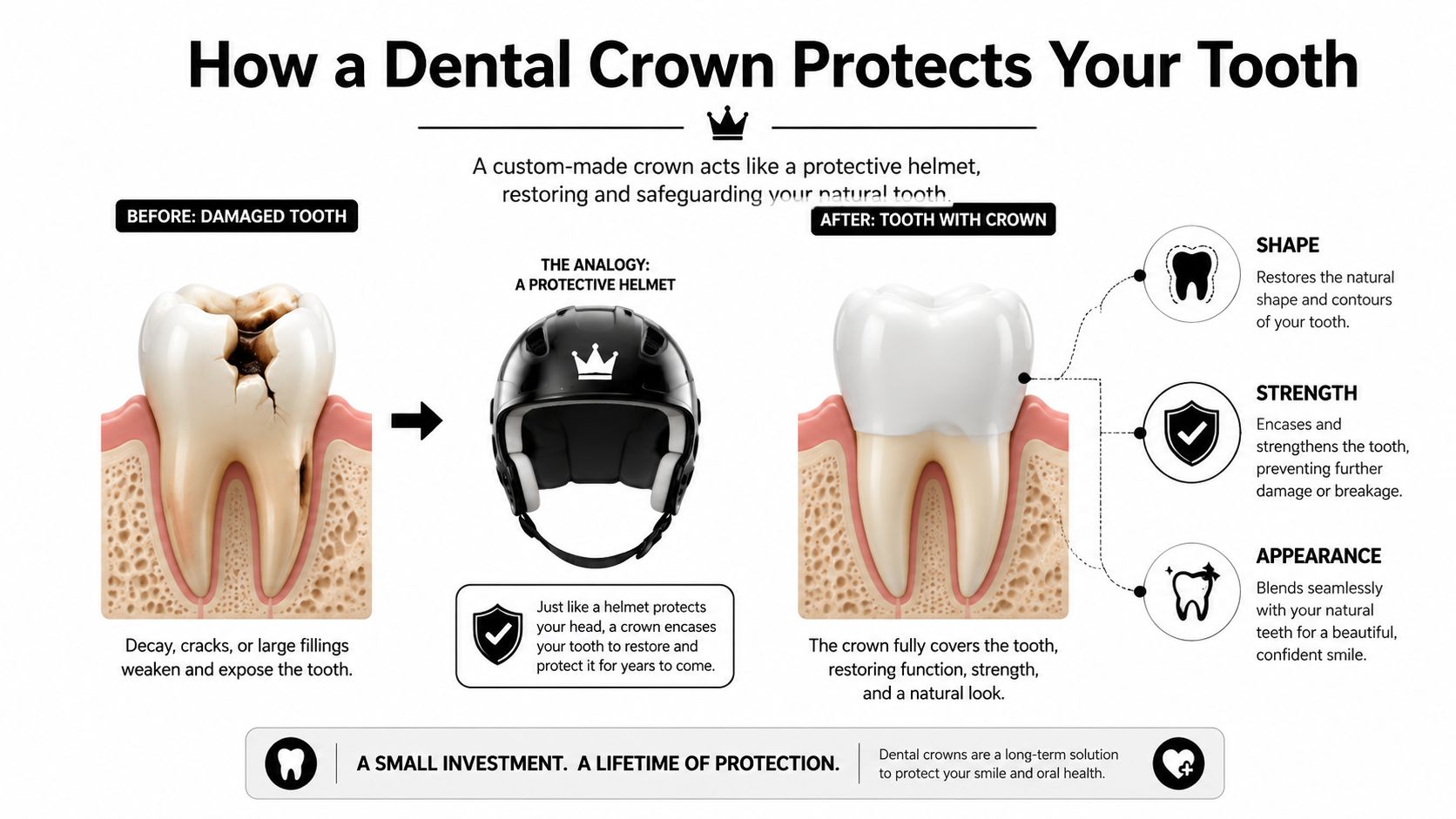
A dental crown is like a custom-fitted helmet for a damaged tooth. The dentist prepares the tooth, then places a restoration over the visible portion above the gumline. The crown restores the tooth's shape and protects the remaining structure during daily biting and chewing.
Crowns may be appropriate for a severely decayed tooth, a cracked tooth, a heavily filled tooth, or a tooth weakened after root canal treatment. They can also improve the shape or color of a tooth when cosmetic dentistry is part of the treatment plan. A crown isn't a removable cover. Once fitted and cemented, it functions as a fixed part of the smile.
A bridge addresses a different problem. Think of a small suspended bridge: the neighboring teeth, called abutments, act as supporting pillars, while a replacement tooth, called a pontic, spans the gap. Conventional bridges use crowns over prepared adjacent teeth. Some bridges are cantilever designs, supported from one side when the anatomy allows it. Maryland bonded bridges use a replacement tooth attached with wings that bond to the backs of neighboring teeth, often making them more conservative in selected situations.
The choice depends on the location and size of the space, the condition of the neighboring teeth, the bite, and the health of the gums and supporting bone. A bridge can be especially practical when adjacent teeth already need crowns. An implant-supported restoration may be considered when preserving those neighboring teeth is a priority.
Crowns and conventional bridges are fixed, unlike removable partial dentures. They can feel stable during speaking and eating, but they still require careful brushing, cleaning between teeth, and professional monitoring. A dentist should confirm that the supporting teeth can safely carry the restoration before treatment begins.
Choosing the Right Materials for Your Restoration
Material selection should match the tooth's job, position, bite, and appearance. A visible front tooth may need lifelike translucency and careful shade matching. A back molar must tolerate repeated chewing forces. Your dentist also considers available space, gum display, metal sensitivity, cleaning needs, grinding habits, and budget.
All-ceramic and all-porcelain restorations can closely imitate natural enamel. Their appearance suits visible teeth and patients who want a restoration that blends into the smile. The design and ceramic type still matter, especially for a high-load bridge or a patient who grinds.
Zirconia is a strong ceramic available in framework and full-contour forms. The ADA materials guidance and clinical considerations describes both forms as alternatives to porcelain-fused-to-metal and full-metal restorations, with reported flexural strength of 1000–1400 MPa. Newer translucent zirconia can look more natural, though the appropriate formulation depends on the tooth, bite, and restoration design.
Porcelain-fused-to-metal, or PFM, uses a metal substructure covered by porcelain. It remains a dependable choice when strength and a tooth-colored surface must work together. Gum changes may eventually reveal a darker line near the margin.
Gold alloy crowns have a long clinical history. They can suit selected back teeth when durability and tissue compatibility matter more than a tooth-colored appearance. No material is universally superior. The right choice is the one that fits the tooth's anatomy, function, and your priorities.
| Material | Best For | Strength | Aesthetics | Relative Cost |
|---|---|---|---|---|
| All-ceramic or all-porcelain | Visible teeth and cosmetic priorities | Depends on design and ceramic | High translucency and natural appearance | Varies |
| Zirconia | Posterior teeth and selected bridges | High, with zirconia flexural strength reported at 1000–1400 MPa | Ranges from highly translucent to more opaque | Varies |
| PFM | Situations requiring a metal substructure and porcelain surface | Reliable clinical option | Natural-looking, with possible gumline shadow | Varies |
| Gold alloy | Selected back teeth and specific bite conditions | Excellent durability | Metallic appearance | Varies |
Digital workflows and modern ceramics are increasingly common in crown and bridge treatment. A 2025 analysis reported that zirconia held 75.10% of crown-and-bridge material share, while CAD/CAM systems held 64.10% of technology share. These figures describe market activity, not a prescription for your tooth. Your examination, bite, supporting tissues, and long-term maintenance needs remain the deciding factors.
What to Expect During Your Crown or Bridge Appointment
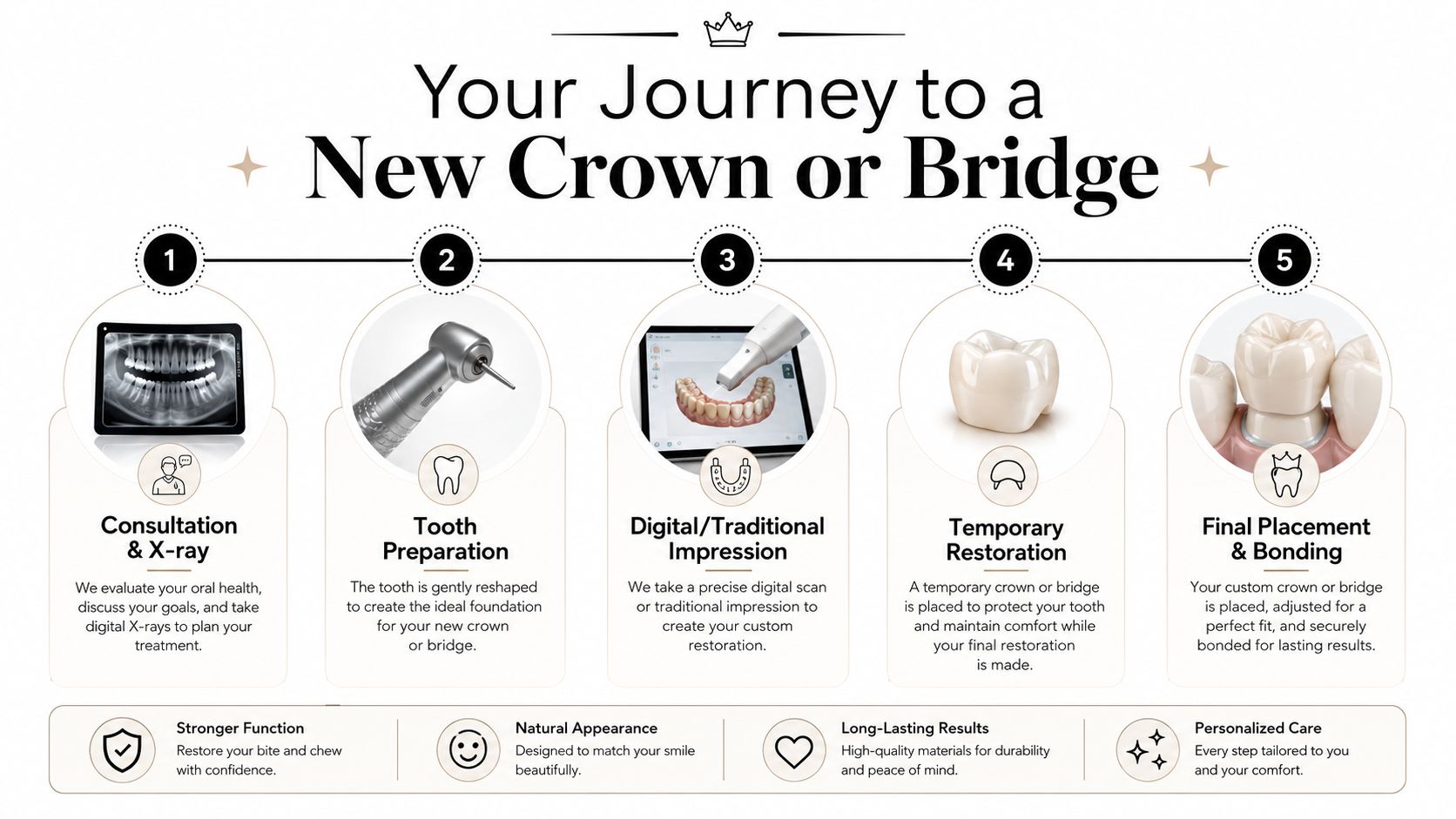
You may arrive with a cracked tooth, trouble chewing, or uncertainty about whether a crown is enough. The appointment begins by connecting those concerns to the tooth's condition and your treatment goals. The dentist examines the tooth, gums, bite, and nearby structures. Dental X-rays may show the roots, bone, existing restorations, or decay hidden from view.
If the tooth cannot support a crown, the discussion may shift to root canal treatment, extraction, an implant, or a partial. The recommendation should match the remaining tooth structure and the way you use your teeth.
Preparing the tooth
Local anesthesia numbs the area while the dentist removes damaged structure and reshapes the tooth. The preparation creates room for the crown without making your bite feel bulky. For a bridge, the supporting abutment teeth are shaped so their crowns can hold the replacement tooth between them.
The team records the prepared area with a digital intraoral scanner or a traditional impression. A scanner avoids a tray filled with impression material, but the appropriate method depends on the restoration and laboratory workflow.
Wearing the temporary
A temporary crown or bridge covers and protects the prepared area while the laboratory makes the final restoration. Follow the office's instructions. Do not pull floss upward through a temporary bridge, because that motion can dislodge it. Call if it feels loose or your bite feels uneven. Many patients wear a temporary for two to three weeks, depending on laboratory timing and the clinical plan.
The laboratory matches the final restoration to the planned shade, contour, contacts, and translucency. At placement, the dentist checks its appearance, fit, contacts, and bite. Adjustments come before permanent cementation.
A common plan includes two visits spaced a few weeks apart, though complex treatment may need more. Mild sensitivity can occur after preparation or placement and may settle temporarily. Persistent pain, increasing sensitivity, swelling, or a high bite warrants a call to the dental office.
How Long Crowns and Bridges Last
If a crown or bridge is placed today, the goal is dependable function for years, not a lifetime guarantee. Many restorations last five to ten years, while some remain serviceable for twenty or thirty years when the supporting teeth, bite, hygiene, diet, and maintenance are favorable (general guidance on crown and bridge lifespan). The material matters, but so do grinding forces, gum health, and the condition of the teeth holding the restoration.
Long-term crown studies provide useful context for that decision. Reported five-year survival is about 95% for metal-ceramic crowns and 91% for all-ceramic crowns. At approximately 18 years, survival was 75% for crowns on vital teeth and 79% for crowns on non-vital teeth (long-term clinical crown outcomes). These are group results, not a personal forecast. A crown on a heavily restored tooth with significant grinding faces a different outlook from one supported by a strong, well-maintained tooth.
Bridge design also changes expected longevity because more than one structure carries the chewing load. A meta-analysis reported five-year survival of 93.8% for conventional tooth-supported fixed dental prostheses, 91.4% for cantilever bridges, and 87.7% for resin-bonded bridges. At ten years, survival was 89.2%, 80.3%, and 65%, respectively (bridge survival meta-analysis).
| Restoration Type | Average Lifespan | Key Longevity Factors |
|---|---|---|
| Single crown | Commonly five to ten years, with some lasting twenty or thirty years | Tooth vitality, material, hygiene, bite, grinding, and maintenance |
| Conventional bridge | Commonly five to ten years, with survival influenced by design and abutments | Span length, abutment strength, margins, hygiene, and bite |
| Cantilever bridge | Survival depends strongly on support design | One-sided loading, abutment condition, and occlusal forces |
| Resin-bonded bridge | Longevity depends on bonding and case selection | Enamel support, moisture control, bite, and maintenance |
For practical guidance on maintenance and replacement, see how long crowns last. Regular cleanings and exams can reveal decay at restoration margins, gum inflammation, wear, or changes in supporting teeth while treatment remains more manageable.
Comparing Bridges to Implants and Other Alternatives
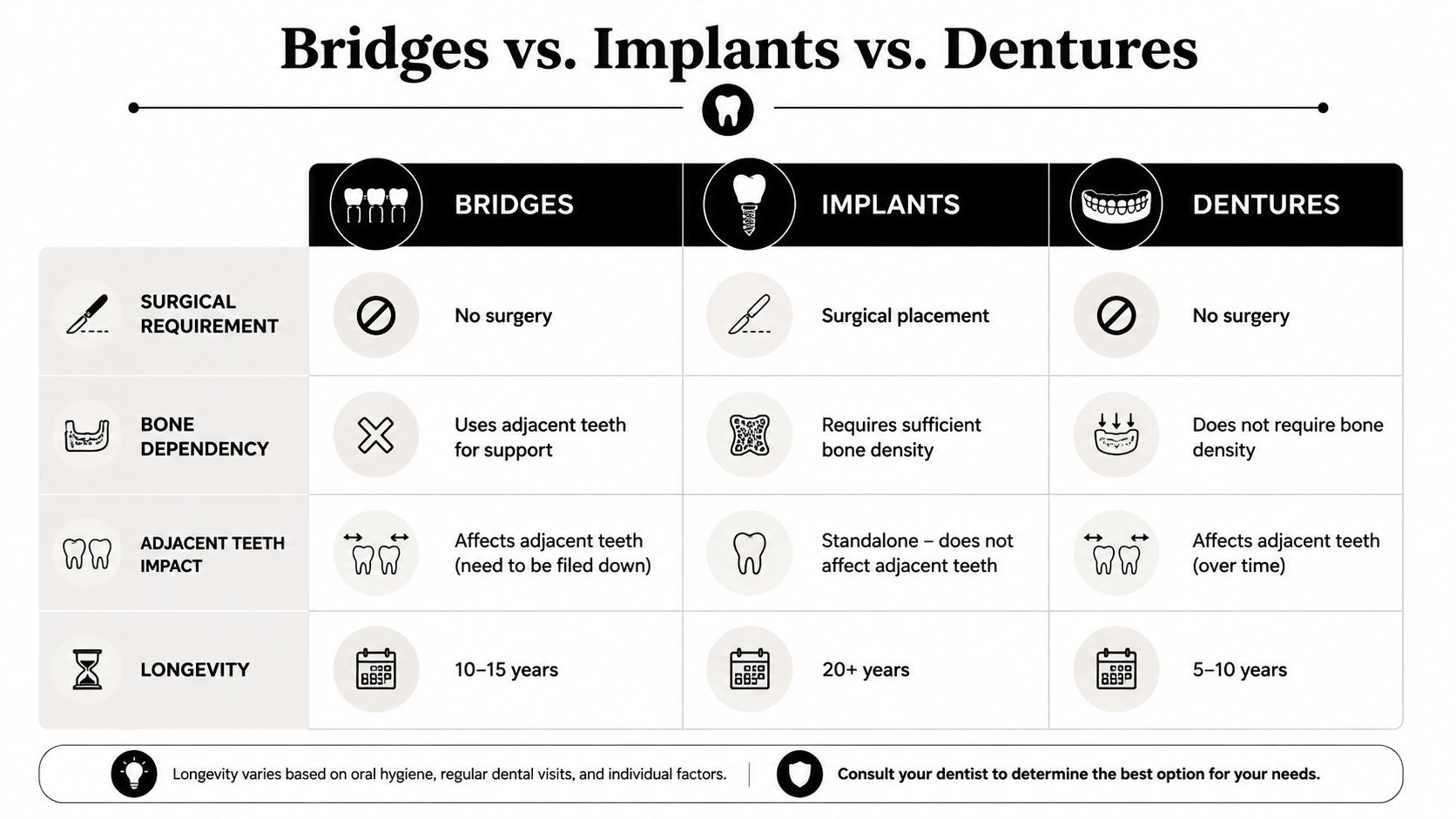
Choosing a replacement for a missing tooth isn't a contest with one universal winner. A bridge, implant, or removable partial can each be reasonable depending on anatomy, the condition of neighboring teeth, treatment preferences, timing, and finances.
A conventional bridge doesn't require implant surgery and can often restore a gap through a shorter treatment pathway. It does require preparation of adjacent teeth, which may be sensible when those teeth already have large fillings, cracks, or a need for crowns. It may be less appealing when the neighboring teeth are healthy and untouched.
An implant is placed into the jaw and supports a crown or bridge without using neighboring natural teeth as the primary supports. The dentist must evaluate bone, gums, bite, and overall health. Implant treatment can involve a longer process and may require additional planning when available bone is limited. Patients considering dental implants near me should ask about surgical steps, healing, maintenance, and the complete treatment sequence.
A removable partial denture can offer a non-surgical, removable way to replace missing teeth. It may suit someone seeking a transitional or budget-conscious option, or someone whose anatomy makes a fixed restoration difficult. The tradeoff is that it can feel less like a natural tooth and must be removed and cleaned as directed.
Questions that shape the recommendation
- Are the neighboring teeth already compromised? A bridge may combine replacement and crown treatment efficiently.
- Are the neighboring teeth healthy? An implant may preserve their existing structure, if the patient is a suitable candidate.
- Is surgery acceptable? A conventional bridge or partial avoids implant placement.
- What does the bite require? Span length, support, and chewing forces affect bridge design.
- What timeline fits your life? A bridge may offer a more direct route, while implant treatment requires a staged plan.
- What maintenance feels realistic? Fixed and removable restorations have different cleaning routines.
The bridge versus implant treatment comparison can help you prepare for a consultation. The strongest decision is the one that respects your oral health and priorities rather than choosing based on a single price or material.
Protecting Your Investment with Proper Aftercare
A crown or bridge succeeds through the daily habits that support it. Brush around the gumline and restoration margins with fluoride toothpaste, and clean every surface rather than focusing only on the visible front. A bridge needs special attention beneath the pontic, where food and plaque can collect.
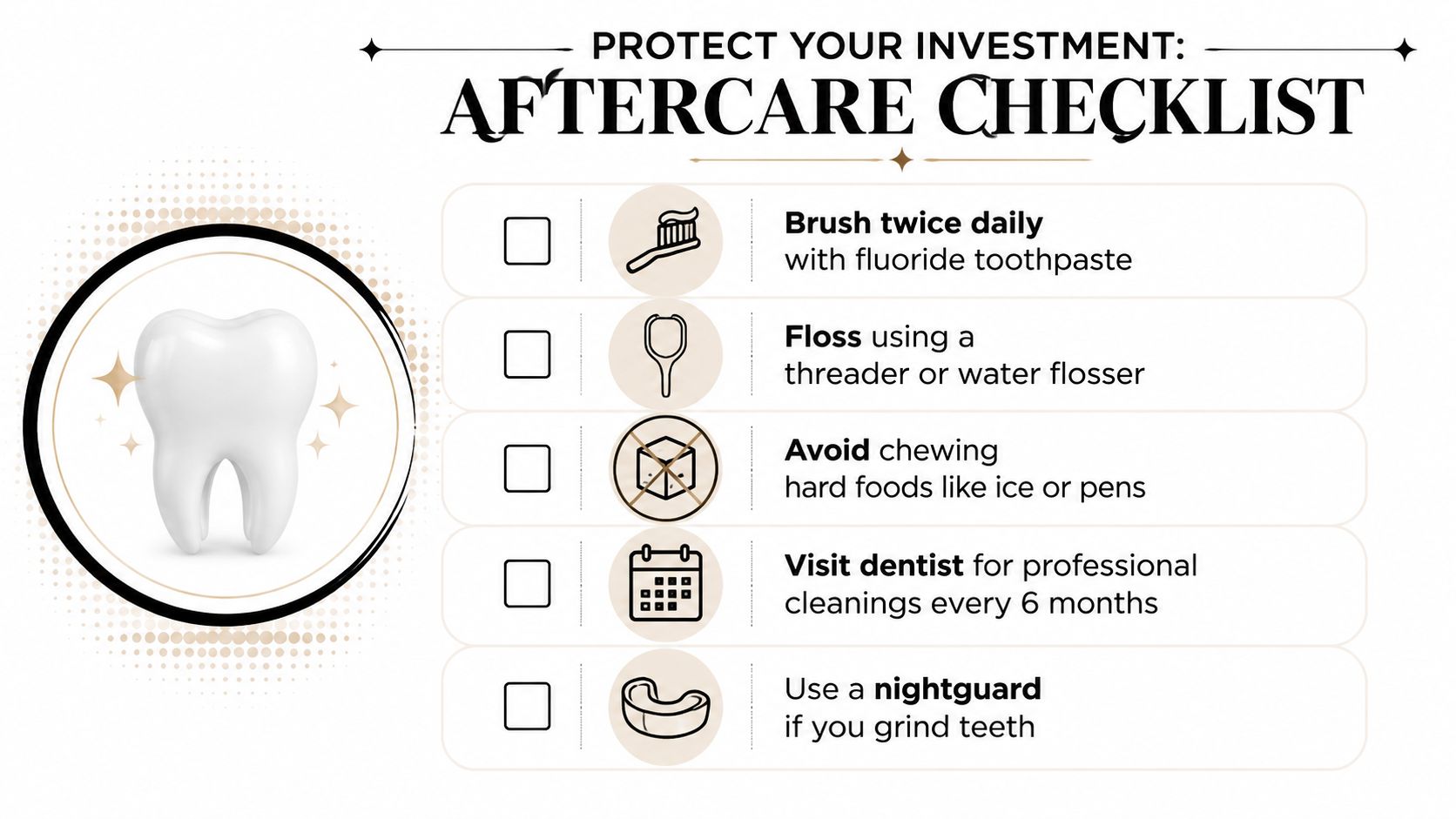
- Clean under the bridge: Use a floss threader or water flosser to reach beneath the pontic and around the abutments.
- Protect natural tooth structure: Fluoride rinses can help protect adjacent teeth from decay when your dentist recommends them.
- Avoid damaging habits: Chewing ice, pens, or other hard objects can stress porcelain and zirconia.
- Address grinding: A night guard may reduce damaging forces for patients who clench or grind.
- Keep recall visits: Routine professional cleaning and examination allow the dentist to check margins, bite wear, gum health, and the supporting teeth.
The NHS notes that conventional bridges can achieve strong long-term results, with about 80% lasting ten years or longer with relatively minor complications (NHS dental treatment guidance). That outcome still depends on case selection and maintenance.
Call earlier if you notice sensitivity, looseness, a visible gap, swelling, a change in your bite, or food repeatedly catching around the restoration. A Walnut Creek dental team can assess the concern before the crown or bridge becomes more difficult to repair.
Schedule Your Restorative Consultation in Walnut Creek
If you're unsure whether you need a crown, bridge, implant, partial, root canal, or tooth extraction, start with an examination rather than guessing from online photos. A consultation should be a low-pressure conversation about your symptoms, oral health, appearance goals, budget, and the result you want to maintain.
At William M. Schneider, DDS, digital imaging and intraoral scanning support clear treatment planning for Walnut Creek and East Bay patients. The practice provides general, cosmetic, and restorative care, including crowns, bridges, dental implants, root canals, preventive cleaning and exams, teeth whitening, and emergency dental services. Patients can ask questions, review alternatives, and receive a plan with understandable expectations and cost information.
If anxiety or uncertainty has delayed care, mention it when you schedule. The team offers a compassionate approach, painless injections, clear explanations, and sedation options when appropriate. Convenient online scheduling, along with early morning and evening availability, can make it easier for working professionals and families to arrange a visit.
Walnut Creek residents who are searching for a dentist near me, a cosmetic dentist near me, or a provider for restorative treatment can call the office or request an appointment online. A timely evaluation can protect a weakened tooth, replace a missing one, and help you choose a restoration that fits both your smile and your life.
William M. Schneider, DDS offers personalized crown, bridge, implant, and restorative consultations for patients in Walnut Creek and the East Bay. Visit William M. Schneider, DDS to learn about your options and request an appointment for thoughtful, comfortable dental care.