If you're reading this with a reminder text open on your phone and a knot in your stomach, you're not overreacting. A lot of adults put off care because the thought of sitting in a dental chair makes their chest tighten before they ever leave home. Some feel embarrassed that it's been a while. Others are worried they'll be judged, rushed, or pushed into treatment they don't understand.
That pattern matters because dental anxiety rarely stays neatly contained to one appointment. It tends to show up days before a visit, then turn into a cancellation, then into more time passing, and then into a larger dental problem that feels even harder to face. For patients in Walnut Creek looking for a dentist near me, an emergency dentist, or a calmer place to restart care, understanding those symptoms is often the first step toward breaking the cycle.
A Gentle Dentist for Your Anxiety in Walnut Creek
A common story goes like this. You mean to schedule a cleaning and exam. You even pick a day. Then the appointment gets closer and your body starts reacting before your mind can talk you out of it. Your hands get sweaty. Your heart starts pounding. You tell yourself you'll reschedule when work is less busy, or after the holidays, or once that sore tooth settles down.
Those reactions are more common than many people realize. Cleveland Clinic explains that about 36% of people in the U.S. have a fear of dental treatment, and 12% have an extreme fear. It also notes that symptoms can include heart palpitations, sweating, and trembling, which means this isn't just “being nervous.” It can be a real physical stress response.
When fear feels bigger than the appointment
Some patients avoid routine visits for months. Others come in only when they need an emergency dentist for pain, a tooth extraction, or a broken filling. By then, the problem often feels heavier emotionally than it did at the start.
Practical rule: If your body reacts to the idea of dental care before you even arrive, take that seriously. That's useful information, not a character flaw.
In Walnut Creek, the right dental office for an anxious patient doesn't start by assuming you only need better willpower. It starts by slowing down, listening carefully, and making the visit feel manageable from the first conversation forward.
A different kind of dental experience in Walnut Creek
For people searching for a dentist in Walnut Creek, CA who understands fear, comfort isn't a luxury add-on. It's part of treatment. That includes clear explanations, gentle pacing, and options for patients who need more help relaxing. If you're specifically looking for a painless dentist near me, that's often a sign you're not just shopping for convenience. You're looking for a practice that understands what it's like to dread the visit before it begins.
That is the standard patients should expect from a local dental home. Whether you need new patient exams, dental X-rays, restorative dentistry, cosmetic dentistry, or help with a tooth that's been bothering you for too long, anxiety should be addressed as part of care, not treated like an inconvenience.
What Dental Anxiety Symptoms Look and Feel Like
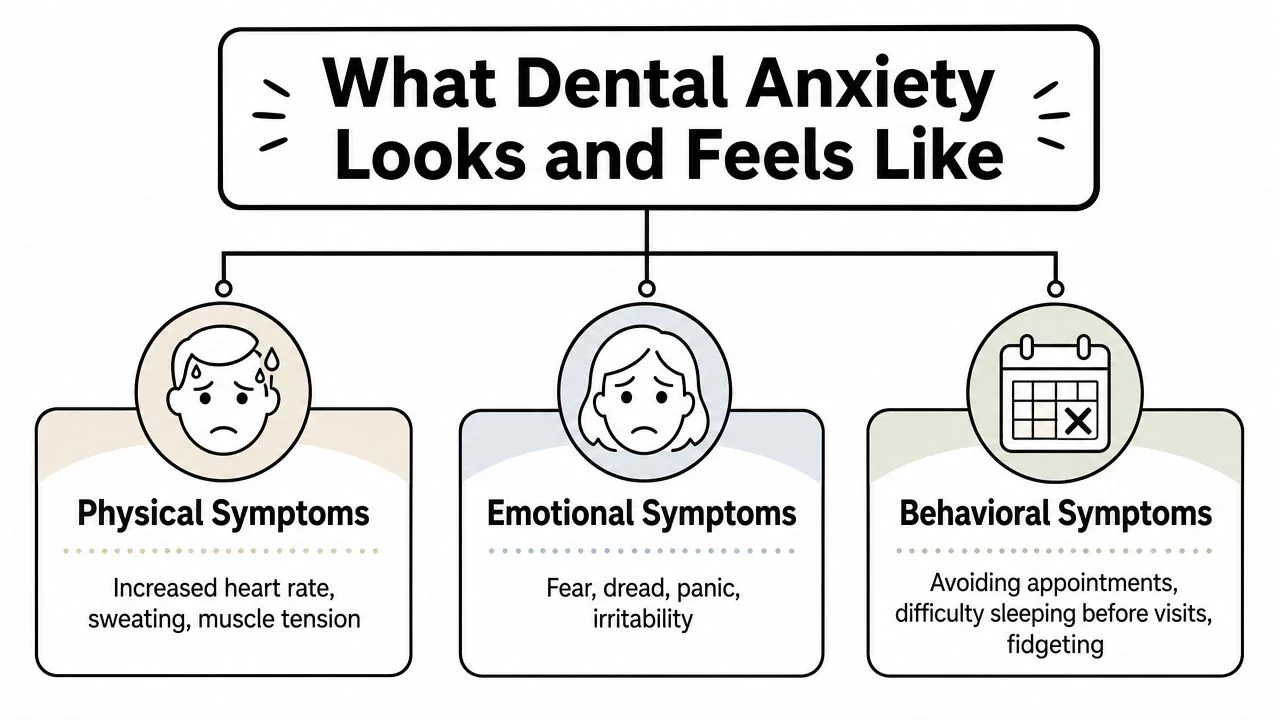
Dental anxiety symptoms usually fall into three groups. Some show up in the body. Some affect mood and thoughts. Others change behavior long before you ever sit in the chair.
The body often reacts first
DentaI anxiety can produce measurable autonomic symptoms such as a racing heart and sweating, which are signs of the sympathetic stress response. In simple terms, your body shifts into a fight-or-flight state. That's why some patients feel tense, shaky, nauseated, or short of breath even during a routine cleaning.
When that stress response kicks in, concentration also gets harder. Patients may have trouble listening, making decisions, or remembering what was explained because their body is focused on perceived threat, not calm problem-solving.
Symptoms often show up in more than one category
| Common Symptoms of Dental Anxiety | ||
|---|---|---|
| Physical Symptoms | Emotional Symptoms | Behavioral Symptoms |
| Racing heart, sweating, trembling, nausea, dizziness, shortness of breath, muscle tension | Fear, dread, panic, irritability, embarrassment, feeling overwhelmed | Avoiding appointments, delaying treatment, fidgeting, trouble sleeping before visits, canceling at the last minute |
That mix matters. A patient may not say, “I have dental anxiety,” but their pattern tells the story. They haven't had a cleaning in years, they lose sleep before a consultation, and they reschedule every time treatment gets close.
Physical symptoms don't mean you're weak. They mean your nervous system has learned to associate dental care with danger.
Why naming the symptoms helps
Once patients can recognize their own pattern, the problem becomes easier to manage. Instead of thinking, “I'm just bad at going to the dentist,” they can see the actual sequence. Anticipation builds, the body reacts, avoidance follows, and oral health slips further.
That understanding is useful whether you're coming in for a basic exam, discussing teeth whitening with a cosmetic dentist near me search in mind, or returning after a long gap for restorative care. The symptoms may look different from person to person, but they follow a recognizable pattern, and that means they can be addressed in a practical way.
The Cycle of Dental Fear and Worsening Oral Health
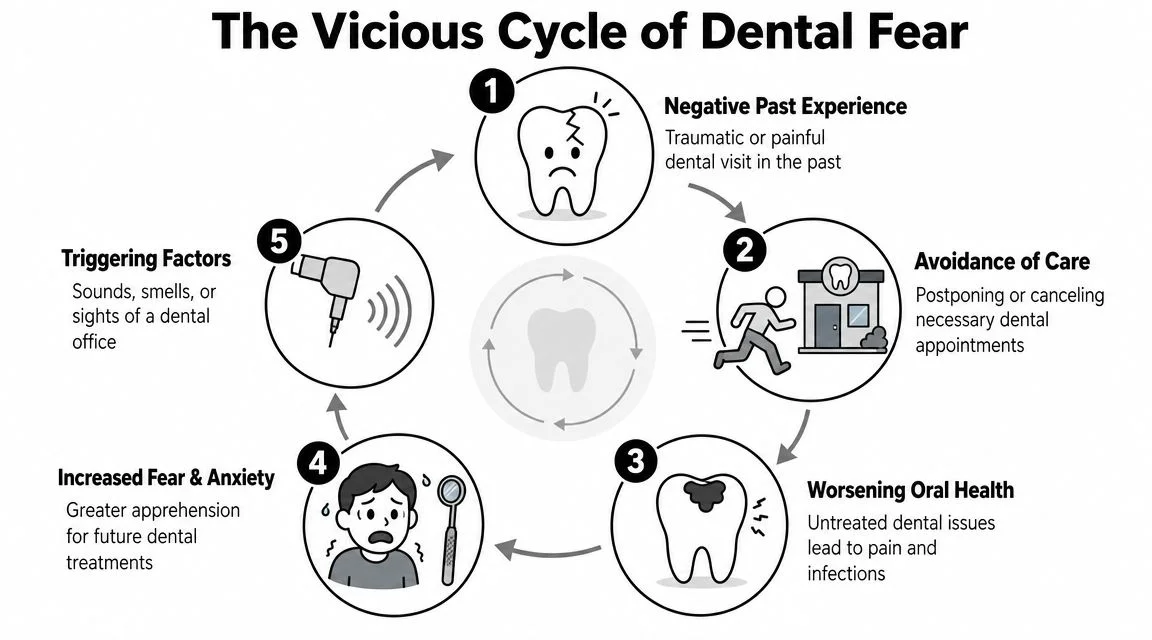
Dental fear usually doesn't begin out of nowhere. Many patients can point to a trigger. It might be a painful memory, a sense of losing control, the sound of instruments, a strong gag reflex, or embarrassment about how long it's been since their last exam. What starts as dread then changes how the person uses dental care. Instead of prevention, they shift into postponement.
Fear tends to attach to specific procedures
A broad dislike of the dentist is only part of the picture. A 2024 review in BMC Oral Health noted that oral surgery triggered anxiety in 58.7% of anxious respondents, while prosthetic or restorative treatments caused anxiety in 15.2%. That helps explain why some people can tolerate a checkup but delay a crown, root canal, tooth extraction, or treatment planning for dental implants near me searches they've already made.
If a patient expects a procedure to be difficult, they often wait until symptoms force the issue. By then, options may be more complex than they would have been earlier.
How avoidance changes oral health
The cycle often looks like this:
A problem starts small
A cavity, cracked filling, or gum irritation may not seem urgent.The appointment gets delayed
Anxiety turns one postponement into several.Symptoms worsen
Pain, swelling, infection risk, or visible damage can develop.Treatment becomes more involved
What might have been handled with conservative care can grow into restorative dentistry, tooth extraction, or replacement planning.Fear gets reinforced
The patient now expects future visits to be harder.
That is why anxiety deserves attention early. Not because every delayed visit leads to a crisis, but because the pattern itself tends to move care in the wrong direction.
The longer someone waits, the more likely they are to need treatment at the exact moment they feel least ready for it.
Why this matters for adults returning to care
Adults returning after a long gap often carry two burdens at once. They are worried about the dental problem itself, and they are worried about being judged for waiting. In a healthy office culture, neither concern should be brushed aside.
A Walnut Creek patient looking for a dentist near me after years away doesn't need a lecture. They need a practical plan that reduces uncertainty, stabilizes urgent problems, and breaks treatment into steps they can handle.
Red Flags That Your Dental Anxiety Needs Attention
Not every anxious patient has a dramatic panic response in the chair. Some people function well at work, handle other medical visits just fine, and still find themselves unable to follow through with dental care. That quieter pattern still matters.

Signs that the problem is affecting daily life
Recent patient-experience research notes that dental anxiety can show up as persistent worry, trouble sleeping before appointments, and last-minute cancellations. In other words, you don't need a full panic attack for the anxiety to be significant.
Watch for these red flags:
You lose sleep before visits
If your mind keeps rehearsing the appointment the night before, the fear is already affecting your routine.You cancel when the appointment gets close
Repeated rescheduling is one of the clearest signs that anxiety is shaping your behavior.You wait until pain forces action
If you only seek care when something becomes urgent, fear may be controlling access to treatment.You feel dread for days in advance
Anticipatory stress is a real symptom pattern, not simple reluctance.You avoid discussing your teeth
Shame, withdrawal, or irritability can be part of the same cycle.
When it stops being “just nerves”
Mild nervousness often improves once the appointment starts. More serious anxiety keeps affecting choices, sleep, comfort, and follow-through. That's the point where a more supportive dental setting becomes part of the solution.
If fear repeatedly keeps you from getting the care you know you need, the anxiety deserves treatment planning too.
For many adults in Walnut Creek, this is the moment they start searching for a dentist in Walnut Creek, CA who understands delayed care, emergency visits, and the emotional weight of starting over. That search is worth acting on. The sooner the pattern is addressed, the easier it is to protect teeth, gums, and your own peace of mind.
Comfortable Dental Care with Sedation in Walnut Creek
The most effective approach to dental anxiety isn't telling patients to tough it out. It is building care around predictability, communication, and the right level of support. Some people feel better once they know what will happen and have a clear stop signal. Others need a stronger tool because their anxiety is severe enough to interfere with treatment.
What actually helps anxious patients
At the chairside level, several things tend to work well:
Clear explanations before anything starts
Patients usually do better when they know what sensation to expect and what happens next.Control during the visit
Agreeing on breaks or a hand signal can reduce the feeling of being trapped.Shorter, staged appointments
For some patients, smaller steps are far more realistic than trying to finish everything at once.Matching treatment intensity to anxiety level
A routine cleaning may need a different approach than a tooth extraction, root canal, or restorative dentistry appointment.
William M. Schneider, DDS provides general, cosmetic, and restorative dental care in Walnut Creek with sedation available when appropriate, which gives anxious patients a practical path to complete needed treatment rather than continuing to delay it.
When sedation becomes part of the plan
Clinical guidance notes that severe anxiety may require sedation options such as nitrous oxide or conscious sedation, especially when anxiety causes functional impairment or treatment avoidance. That distinction matters. Sedation isn't for every patient, and it isn't a substitute for trust and good communication. But when fear is blocking care, it can be the difference between ongoing avoidance and finally moving forward.
If you'd like a plain-language overview, this page on how dental sedation works is a useful place to start.
A few practical trade-offs are worth knowing:
- Nitrous oxide often suits patients who want help relaxing during treatment but still want a lighter level of support.
- Oral conscious sedation may be more appropriate when anxiety is stronger and a patient needs a deeper sense of calm.
- Sedation doesn't replace diagnosis. You still need an exam, a plan, and a team that communicates well.
- Not every visit needs the same approach. A patient might want sedation for one procedure and not for a cleaning or follow-up.
This short video gives a better feel for the practice environment and approach to care.
Care should stay comfortable across services
Anxiety-aware care matters across the full range of dentistry. Patients may need help getting through routine cleanings and exams, dental X-rays, cosmetic dentistry consultations, crowns, gum treatment, emergency visits, or planning for dental implants. The right comfort approach lets people receive the care they need without feeling forced into an experience they can't manage.
Your First Anxiety-Free Visit with Dr Schneider
The hardest part is often the step before the appointment. Calling. Sending the message. Admitting you've been putting this off. Once that first contact happens, the visit should feel simpler, not harder.
What the first appointment should feel like
A new patient visit in Walnut Creek should begin with conversation, not pressure. If you've been delaying care, you should be able to say that openly. If you're worried about pain, embarrassment, or needing extensive restorative dentistry, those concerns should be part of the discussion from the start.
A calm first visit usually includes a few basics:
A nonjudgmental check-in
The team listens for what you're worried about, not just what procedure you might need.A clear look at your current oral health
New patient exams, dental X-rays when needed, and a straightforward review help remove guesswork.A paced treatment conversation
You should understand what is urgent, what can wait, and what options you have.Your consent before anything moves forward
No one should rush you into treatment you don't understand.
Starting over after years away is still starting. That counts.
A practical first step for Walnut Creek patients
For some patients, the first visit is an exam and conversation. For others, there may be an urgent issue such as pain, infection concerns, or a broken tooth that needs prompt attention. In either case, it helps when the plan is broken into manageable next steps instead of being presented as one overwhelming list.
That matters whether you're looking for a dentist near me for ongoing family dental care, a cosmetic dentist near me for smile improvements, or an emergency dentist because something suddenly hurts. Patients do better when they can see the path clearly.
Getting back into care without shame
A lot of adults assume the team will focus on how long it's been since their last cleaning. A better approach is to focus on what happens next. The point of the first visit isn't to revisit every reason you delayed care. It's to establish comfort, identify needs, and help you move forward safely.
At 1855 San Miguel Dr., Suite 31, patients in Walnut Creek and nearby East Bay communities can begin with a conversation that respects both sides of the problem: your oral health needs and the anxiety that may have kept you away. When those are addressed together, care feels possible again.
If dental anxiety symptoms have been keeping you from scheduling care, William M. Schneider, DDS offers a calm, practical place to begin in Walnut Creek. Reach out to discuss your concerns, ask about comfort options, and schedule a visit that moves at a pace you can handle.