If you're reading this with a tooth that throbs when you lie down, stings when you sip coffee, or feels sore when you chew, you're probably not wondering about dental vocabulary. You want to know one thing. Will this pain stop, and what happens during treatment?
That's exactly why people search for what is a root canal procedure, especially when they need an emergency dentist or a dentist near me in Walnut Creek, CA. The name can sound intimidating, but the purpose is straightforward. A root canal removes irritation or infection from inside a tooth so the tooth can stay in place and feel comfortable again.
For many patients, the hardest part is not the treatment itself. It's the uncertainty before it. When you understand what a root canal does, why it's recommended, and how modern dental care focuses on comfort, the procedure becomes much less mysterious. If you're looking for a dentist in Walnut Creek, CA for tooth pain, restorative dentistry, or urgent dental care, it helps to know what to expect before you walk through the door.
When a Root Canal Is the Best Solution for Tooth Pain
A root canal is usually recommended when trouble has reached the inside of the tooth, where a regular filling can't solve the problem. To picture this, think of a tooth like a house. The hard outer layers are the walls and roof. Deep in the center is a small living space called the pulp, where the tooth's nerves and blood vessels are located.
When that inner space becomes inflamed or infected, the tooth often sends a very clear message. It hurts. Sometimes the pain is sharp and sudden. Sometimes it's a deep, aching pressure that won't let up.
What the tooth is telling you
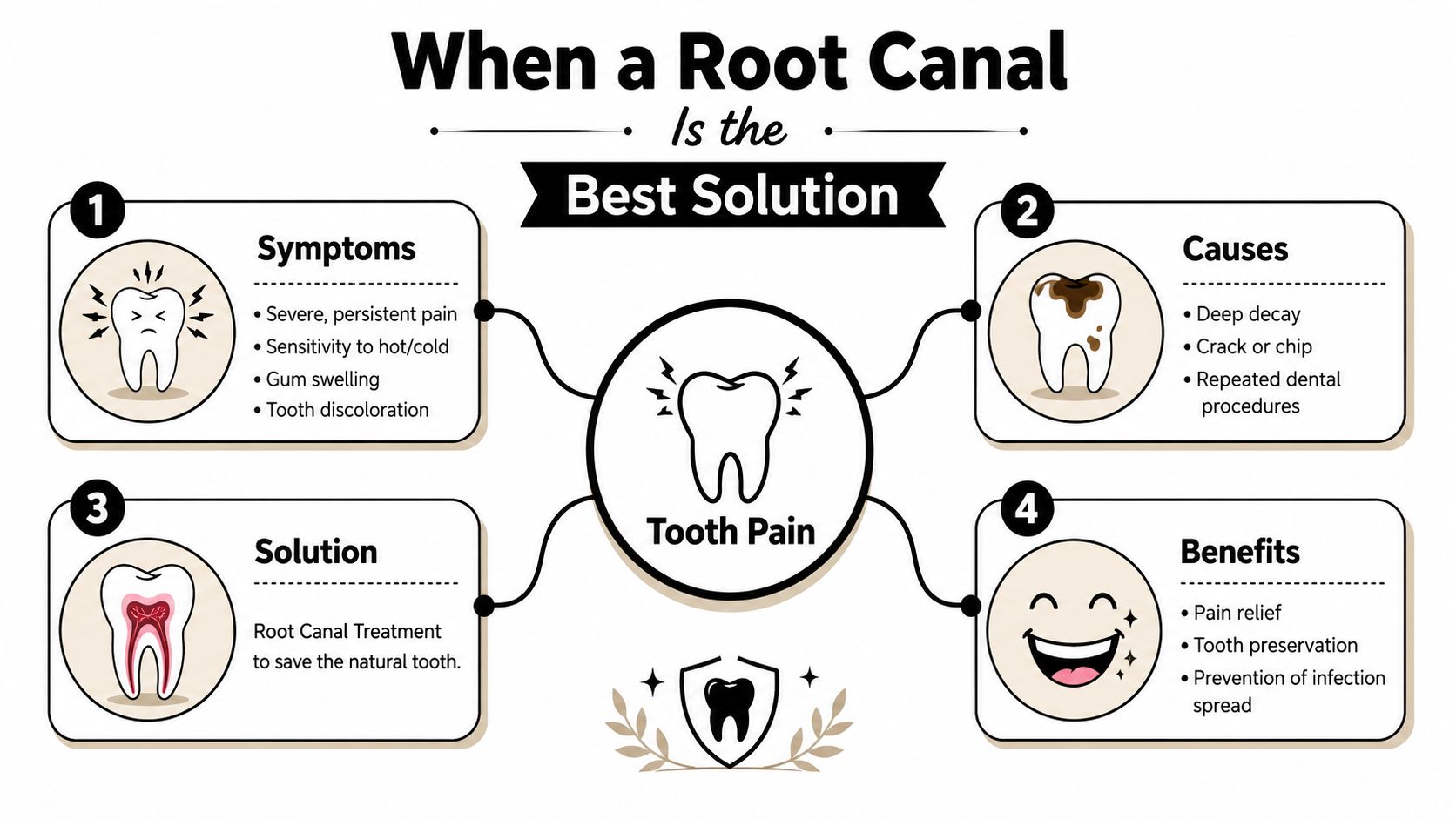
Several symptoms can point to a problem in the pulp:
- Persistent toothache that doesn't fade on its own
- Hot or cold sensitivity that lingers after the drink or food is gone
- Pain when biting or chewing
- Gum swelling near one tooth
- A darker or discolored tooth
- Tenderness in the area that feels different from ordinary sensitivity
These symptoms don't always mean the same thing, but they often signal that the issue is deeper than the enamel surface.
Why a filling may not be enough
A cavity near the outside of a tooth can often be repaired with a filling. But if decay, a crack, or repeated dental work has irritated the pulp, the problem sits in a place a filling can't reach. In that situation, sealing the top of the tooth without treating the inside would be like painting over a leak instead of fixing the pipe.
That's why dentists recommend a root canal for certain cases. The goal isn't to give you a bigger procedure than you need. The goal is to save the natural tooth and remove the source of the pain.
Practical rule: If tooth pain wakes you up, lingers, or comes with swelling, it deserves prompt evaluation.
Patients in Walnut Creek who are dealing with these symptoms often need timely care, especially if they're searching for an emergency dentist, tooth extraction options, or guidance about whether the tooth can still be saved. If you want a simple breakdown of warning signs, this guide on how to know if you need a root canal can help you understand when the problem may have moved beyond a routine filling.
Common reasons this happens
| Cause | What it means in plain language |
|---|---|
| Deep decay | A cavity traveled far enough inward to irritate the pulp |
| Crack or chip | Bacteria can enter through the damaged area |
| Trauma | A tooth can become inflamed even if damage isn't obvious right away |
| Repeated procedures | A tooth that has been worked on multiple times may become sensitive inside |
For people looking for dental care in Walnut Creek, CA, this is often the moment when restorative dentistry becomes the best path forward. A root canal isn't about losing a tooth. It's often the treatment that helps you keep it.
The Root Canal Procedure Step-by-Step at Our Office
Most anxiety comes from not knowing what will happen. Once the process is broken into small steps, it starts to feel much more manageable. Modern root canal treatment is careful, methodical, and designed around patient comfort.
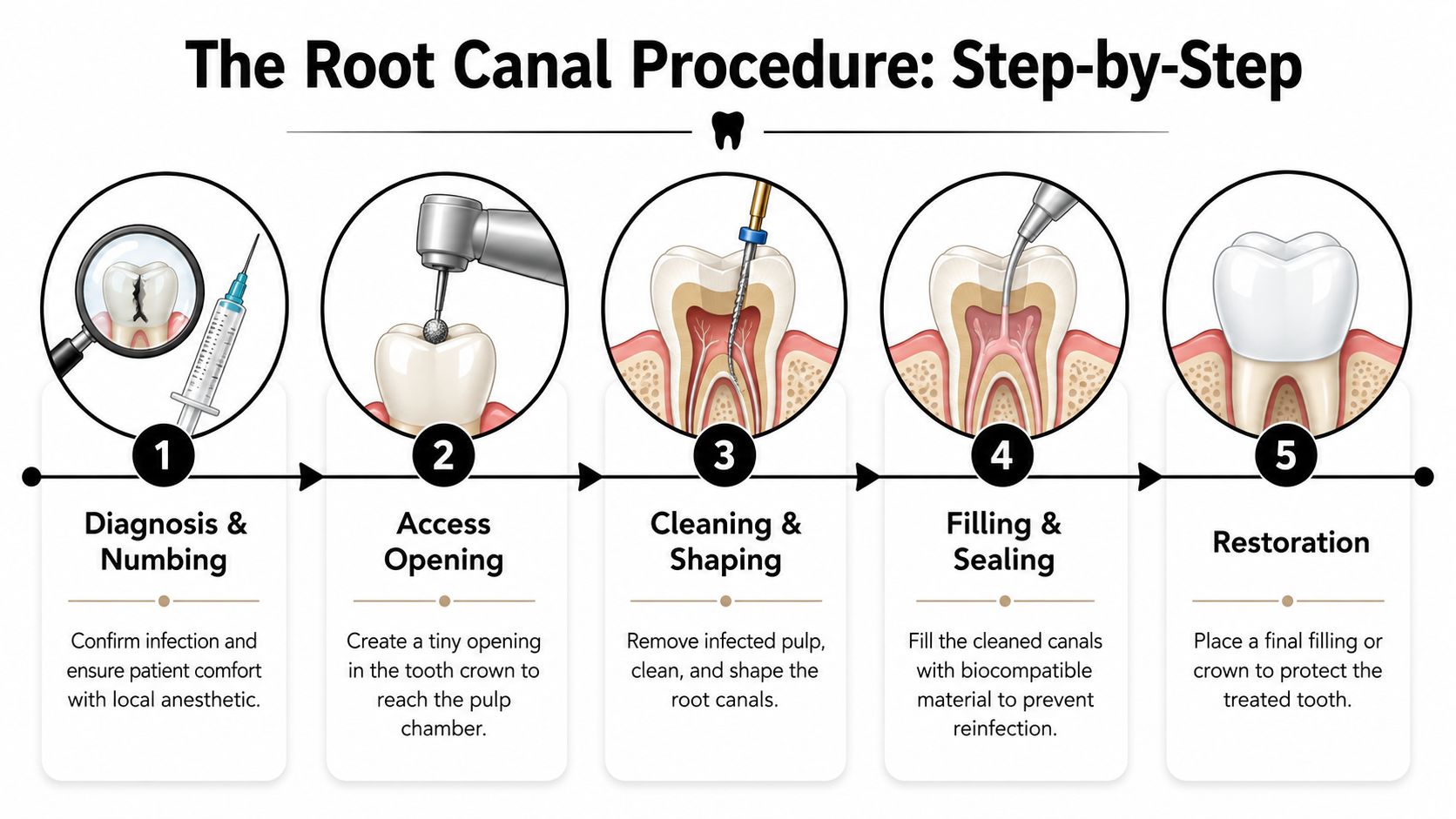
To make the process easier to visualize, here's a simple overview.
The visit begins with comfort and clarity
First, the dentist examines the tooth and uses dental x-rays to look at what's happening below the gumline. This helps confirm whether the pulp is inflamed or infected and whether root canal treatment is the right fit.
Then the area is thoroughly numbed. This is the step anxious patients care about most, and for good reason. The goal is simple. You should be comfortable before any treatment begins.
What happens during the procedure
Here is the sequence in plain language:
- The tooth is numbed fully so you don't feel pain during treatment.
- A small opening is made in the top of the tooth to reach the inside.
- The unhealthy pulp is removed from the inner chamber and root canals.
- The canals are cleaned carefully and shaped so they can be sealed.
- The inside is filled and sealed to help protect against future infection.
- A temporary filling may be placed until the final restoration is completed.
A short visual explanation can also make the process feel more familiar before your visit.
Why each step matters
Every step has a purpose. The opening gives access to the part of the tooth causing the problem. Cleaning removes inflamed or infected tissue. Sealing closes the space so bacteria are less likely to return.
Patients are often surprised by how uneventful the appointment feels once they're numb. Many say the experience is closer to having a deep filling than the frightening stories they've heard.
Most root canals feel far less dramatic than the toothache that made treatment necessary.
This approach is part of modern restorative dentistry in Walnut Creek, CA. It fits naturally alongside services like cleaning and exams, new patient exams, dental x-rays, crowns, and emergency dental services. If you've been searching for a dentist near me because one tooth has become impossible to ignore, understanding the sequence can take a lot of fear out of the appointment.
Your Comfort Is Our Priority Pain and Sedation
The most common question about root canals is also the most emotional one. Does it hurt? In modern dental care, the treatment itself is designed to be comfortable. What patients usually feel before the appointment is the tooth pain from the infection or inflammation, not the root canal.
That distinction matters. The procedure is meant to relieve the source of the pain, not add to it.
How numbness makes the procedure manageable
Local anesthetic is used to numb the tooth and the surrounding area before treatment begins. Once the tooth is fully numb, you may notice pressure or movement, but sharp pain shouldn't be part of the experience. If you're anxious, this is important to hear clearly. You are not expected to just tolerate discomfort.
Many patients who have avoided treatment because of fear are especially relieved to learn that gentle injections and calm communication can change the entire experience.

Sedation can help if dental visits make you nervous
For some people, numbness alone isn't the whole answer. The sounds, the anticipation, and the feeling of being in the chair can be the hardest part. That's where sedation dentistry may help.
Depending on your needs, a dentist may recommend options that help you feel very relaxed during treatment. Sedation doesn't mean losing control. For many patients, it means the visit feels calmer, easier, and less mentally exhausting. If you'd like to learn more, this page on how dental sedation works explains the basics in plain language.
Signs you may benefit from extra comfort support
- You delay appointments from fear and tend to wait until pain becomes severe
- You've had a difficult past dental experience that still affects you
- You have a strong gag reflex or trouble sitting comfortably for treatment
- You feel panic during dental care even when you know you need help
For anxious patients looking for a dentist in Walnut Creek, CA, comfort isn't a bonus. It's part of good treatment. The same applies whether you need a root canal, tooth extraction, cosmetic dentistry, or routine cleaning and exams.
What helps most: Knowing you can raise a hand, ask questions, and be listened to throughout the visit often lowers anxiety before treatment even starts.
A good dental experience is built on trust. When a patient feels informed, numb, and supported, a root canal becomes much more approachable than its reputation suggests.
What to Expect After Your Root Canal Treatment
Most patients feel relieved after a root canal because the deep internal irritation has been treated. That said, it's normal for the area to feel tender for a short time afterward. The tooth and surrounding tissues may be a little sore, especially when chewing.
This kind of soreness is usually different from the original toothache. Instead of the intense, hard-to-ignore pain that brought you in, it often feels more like bruised or tired tissue that settles with time.
What recovery usually feels like
You may notice:
- Mild tenderness around the treated tooth
- Sensitivity when biting for a short period
- Awareness in the jaw if you kept your mouth open for a while
- Gradual improvement as the area calms down
Over-the-counter pain relief is often enough for this stage, if your dentist says it's appropriate for you. Many people return to their normal routine quickly, with just a few simple precautions.

Smart aftercare at home
A few habits make recovery smoother:
- Chew on the other side until your dentist says the tooth is ready for full function
- Keep the area clean by brushing and flossing gently but consistently
- Take medications as directed if anything was prescribed
- Call the office if something feels off such as swelling that worsens or a bite that feels uneven
A root canal removes infection from inside the tooth, but the tooth still needs outside protection to stay strong long term.
Why the final crown matters
After a root canal, many teeth need a dental crown or another permanent restoration. This is especially common for back teeth, which handle strong chewing forces every day. A treated tooth can become more vulnerable to cracking if it isn't properly protected.
The crown acts like a fitted helmet for the tooth. It helps restore strength, shape, and function so you can chew comfortably again. This is one reason root canals and restorative dentistry often go hand in hand. In a Walnut Creek dental office, the full plan may include the root canal first and the final crown soon after.
If you've been looking for a dentist near me who offers both emergency treatment and long-term repair, this complete approach matters. It doesn't just stop pain. It helps you keep using your natural tooth with confidence.
Root Canal Alternatives and Success Rates
When a tooth needs root canal treatment, patients often ask if there's another option. In most cases, the main alternative is tooth extraction. That choice may be appropriate in some situations, but it changes the treatment plan in a big way because removing a tooth creates a new problem. You then have to decide whether and how to replace it.
That's why saving the natural tooth is often preferred when possible. Your own tooth already fits your bite, supports normal chewing, and keeps neighboring teeth where they belong.
Comparing root canal treatment and extraction
| Option | Main advantage | Main tradeoff |
|---|---|---|
| Root canal | Keeps your natural tooth in place | Usually needs final restoration afterward |
| Tooth extraction | Removes the problem tooth entirely | Leaves a gap unless replaced |
If a tooth is extracted and not replaced, nearby teeth can begin to shift over time. Biting can feel different. Cleaning the area may become more complicated. Some patients later need a bridge, denture, or dental implants near me search because they want the function and appearance of the missing tooth restored.
Why preserving the tooth often makes life simpler
A root canal keeps the original root structure in the jaw. That can make daily life feel more normal after healing because you're still chewing with your own tooth, not adjusting to a space or planning a separate replacement.
Extraction may still be the better path if the tooth is severely damaged, fractured in a way that can't be repaired, or affected by advanced problems below the gumline. In those cases, restorative options such as a bridge or implant may be discussed.
Saving a repairable natural tooth is usually the most conservative option.
As for success rates, root canal therapy is widely regarded as a predictable treatment with a high rate of long-term success. Because no verified statistics are being cited here, it's better to say this plainly and accurately. Dentists perform root canals every day because the procedure has a strong track record when the tooth is properly treated and restored.
How to decide between the two
A patient usually needs three pieces of information:
- Can the tooth be saved with a solid long-term restoration?
- What will the tooth need afterward such as a crown?
- What happens if the tooth is removed and what replacement choices follow?
For patients comparing root canal treatment with tooth extraction in Walnut Creek, CA, the key issue isn't just today's pain. It's what leaves you with the healthiest, most functional smile in the future. In many cases, that means preserving the tooth whenever it can be predictably restored.
Schedule Your Consultation with a Trusted Walnut Creek Dentist
Tooth pain has a way of taking over your day. It interrupts sleep, makes meals stressful, and can leave you wondering whether the problem will suddenly get worse. If that's where you are, getting answers from a local dentist is the next sensible step.
A root canal is often the treatment that relieves pain while preserving your natural tooth. It's not something to fear or postpone until the discomfort becomes unbearable. With modern techniques, clear communication, dental x-rays, and a comfort-focused approach, treatment can feel much more manageable than many people expect.
When it's time to call
You shouldn't try to guess your way through symptoms like these:
- A lingering toothache that keeps returning
- Sensitivity that hangs on after hot or cold foods
- Pain while chewing
- Swelling near a tooth
- A tooth that looks darker than the others
These are good reasons to seek help from an emergency dentist or schedule a prompt exam with a dentist in Walnut Creek, CA.
What a local visit can include
A visit for tooth pain may involve a conversation about your symptoms, a close exam, and dental x-rays to see what's happening inside the tooth. From there, the dentist can explain whether the best next step is a root canal, a crown, a filling, or in some cases a tooth extraction.
If you're also looking for a long-term dental home, this kind of visit can connect you with broader care that supports your smile over time, including cleaning and exams, cosmetic dentistry, teeth whitening, restorative dentistry, and even discussions around dental implants or cosmetic dentist near me concerns if appearance is also part of the picture.
Walnut Creek patients often want two things at once. Relief now, and a trusted place to return for future care. That combination matters, especially for anyone who feels nervous in the dental chair or has been putting treatment off.
A calm environment, gentle treatment, and experienced care can make it easier to take action before a painful tooth turns into a larger problem.
If you're ready to stop wondering and start feeling better, contact William M. Schneider, DDS to schedule a consultation. With more than 25 years of experience, a welcoming office in Walnut Creek, compassionate care for anxious patients, and convenient online appointment options, the practice makes it easier to get the root canal treatment, emergency dentist support, restorative dentistry, or ongoing dental care you need for a healthy, pain-free smile.