You're sitting at the kitchen table in Walnut Creek, avoiding the side of your mouth where a tooth is missing. Maybe chewing has become awkward, or you've started covering your smile in photographs. Perhaps a recent tooth extraction left you wondering whether a bridge, denture, or dental implant is really necessary. These decisions can feel personal, expensive, and confusing, especially when every option sounds like the right answer.
The most appropriate tooth replacement options depend on your remaining teeth, gums, jawbone, health, priorities, and comfort with treatment. At William M. Schneider, DDS, patients receive an honest evaluation rather than an automatic recommendation for the most involved procedure. Whether you searched for a dentist near me, dentist in Walnut Creek, CA, or dental implants near me, the first step is understanding what your mouth needs.
Why Missing Teeth Feel Like More Than a Cosmetic Problem
A missing tooth can affect an ordinary day in ways that are easy to overlook. You might avoid crunchy foods, chew on one side, pause before speaking, or smile with your lips closed during a conversation at a Walnut Creek café. A front tooth often changes confidence immediately, while a back tooth may seem less urgent until chewing becomes uneven or neighboring teeth begin to move.
Gaps can also make cleaning more difficult. Food may collect around altered spaces, and the teeth beside the gap can become harder to brush and floss effectively. The jawbone beneath an empty tooth socket also changes after extraction. Without intervention, one peer-reviewed review reports that as much as 40% of bone height and 60% of bone width may be lost during the first 6 to 12 months, while total bone volume loss may reach 40% to 60% within 2 to 3 years (review of post-extraction bone changes).
That doesn't mean every gap requires immediate replacement. It does mean you deserve a careful assessment before assuming that waiting has no consequences.
Practical rule: A missing tooth deserves a conversation, not an automatic procedure.
Dr. Schneider's practice helps Walnut Creek patients separate appearance concerns from functional concerns and urgent problems from decisions that can be staged. A thorough exam may include dental X-rays, an evaluation of gum health, and an assessment of the teeth around the gap. If anxiety is part of the picture, the team can also discuss comfort measures and sedation options when appropriate. You can read more about the long-term effects of missing teeth before scheduling an evaluation.
Dental Implants as the Modern Standard
Dental implants have changed the way dentists approach tooth replacement. Instead of resting on the gum or relying on neighboring teeth, an implant uses a post placed in the jawbone to support a crown, bridge, or denture. This creates an independent foundation for the restoration and can preserve treatment flexibility when the surrounding teeth are healthy.
The biological process behind this stability is osseointegration, in which bone forms a functional connection with the implant surface. Modern implant dentistry grew from Per-Ingvar Brånemark's discovery of osseointegration in 1952 and his placement of the first titanium implant in a human patient in 1965, milestones described in a global review of tooth loss and implant-based replacement (Global Burden of Disease and implant dentistry review).
Implants became increasingly common in the United States. Among adults with missing teeth, implant use rose from about 0.7% in 1999 to 2000 to 5.7% in 2015 to 2016, according to a clinical overview of tooth replacement patterns (U.S. tooth replacement statistics). That adoption reflects the appeal of a fixed restoration that doesn't require reducing healthy adjacent teeth.
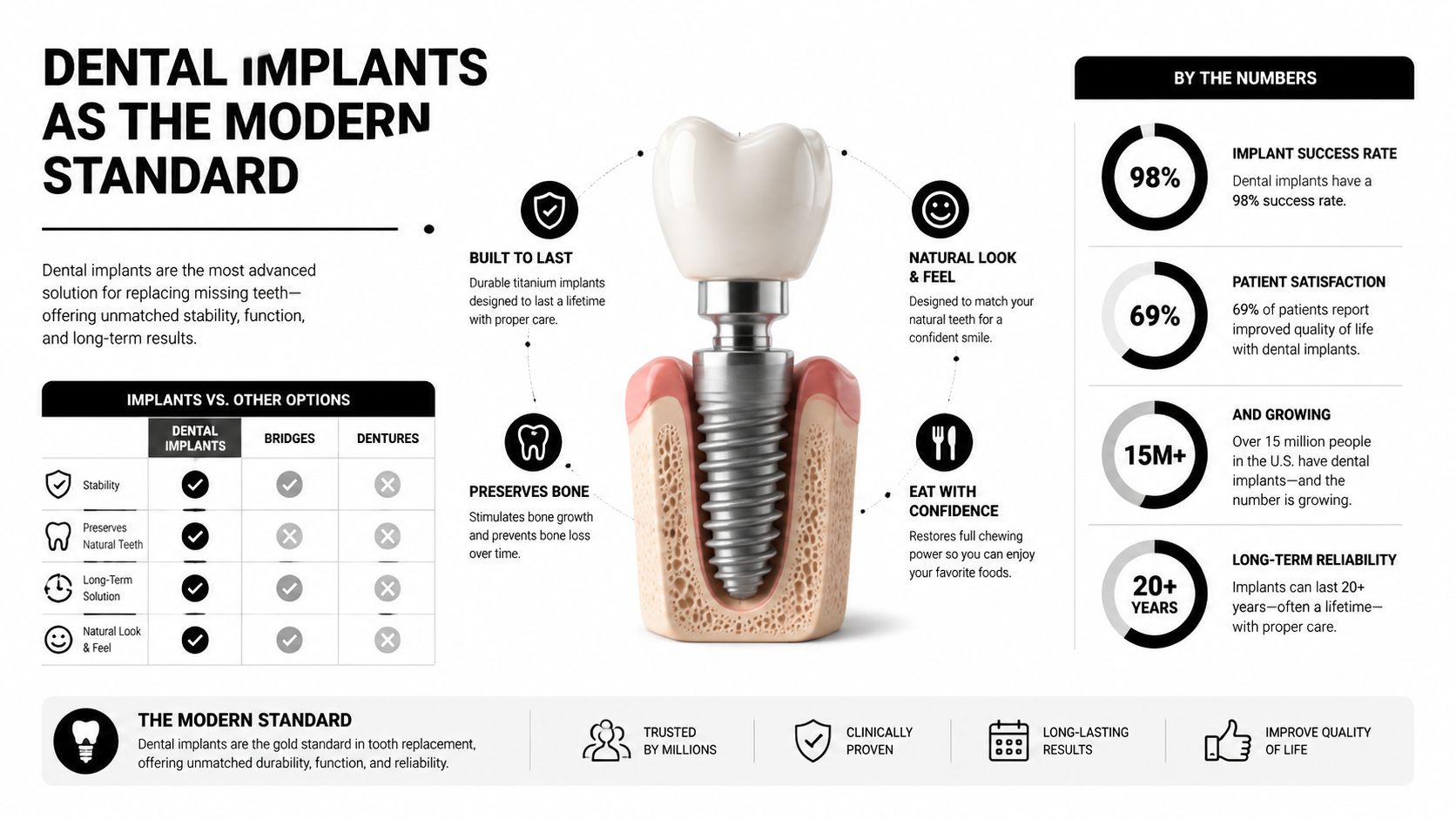
What implant treatment involves
Treatment begins with an examination and imaging to evaluate the available bone, gums, bite, and nearby anatomy. If a tooth needs removal, Dr. Schneider may discuss whether socket preservation or another staged approach is appropriate. Socket preservation can reduce, but doesn't eliminate, post-extraction changes. A systematic review reported reductions in vertical mid-buccal bone loss ranging from 0.39 millimeters to 3.88 millimeters compared with normally healed sockets in the aesthetic zone (socket preservation evidence).
Healing time varies. One evidence summary reports that by about 12 weeks, most implants in healthy patients have reached sufficient integration for full functional loading, although compromised bone and challenging locations can require longer healing (osseointegration timeline and influencing factors). The final crown or other restoration is planned around your bite, appearance, and ability to keep the area clean.
Implants aren't automatically suitable for everyone. Gum disease, insufficient bone, medical conditions, and treatment preferences all matter. The practical question isn't whether implants are modern. It's whether they're appropriate for your mouth and your goals. You can review how long dental implants last before discussing your individual outlook with a dentist.
Fixed Bridges Versus Implant-Supported Options
A fixed bridge replaces a missing tooth without requiring a removable appliance. In a traditional bridge, the replacement tooth is attached to crowns on neighboring teeth. An implant-supported restoration uses an implant or implants as the foundation instead, so the adjacent teeth don't carry the same structural role.
The evidence is more nuanced than a simple claim that one approach always wins. A Canadian health technology assessment reported 6-year implant success of 95% and survival of 97%, compared with 80% success and 82% survival for bridges in the reviewed evidence (Canadian assessment of surgical dental interventions). The same assessment also summarized evidence showing approximately 96.8% 5-year survival for implants supporting single crowns, compared with fixed partial dentures in the 84% range.
However, carefully selected short-span bridges can perform very well. A meta-analysis of 3-unit fixed dental prostheses found no significant difference in annual prosthesis survival, reporting 96.4% per year for implant-supported designs and 97.4% per year for tooth-supported bridges. Supporting abutment survival was 99% and 98.7% per year, respectively (3-unit fixed dental prosthesis meta-analysis).
| Feature | Fixed Bridge | Implant-Supported |
|---|---|---|
| Foundation | Prepared neighboring teeth | Dental implant or implants |
| Removable | No | No, unless supporting an overdenture |
| Effect on adjacent teeth | Neighboring teeth may need preparation | Healthy neighboring teeth can remain independent |
| Bone stimulation at the missing root site | Doesn't replace the root | Implant provides a root-like foundation |
| Cleaning | Requires careful cleaning under the bridge | Requires brushing, flossing, and professional maintenance |
| Best fit | A suitable gap with strong supporting teeth | Suitable bone, healthy tissues, and preference for an independent restoration |
What changes the recommendation
A bridge may make sense when the teeth next to the gap already have large fillings, crowns, or structural damage. Connecting them to a replacement tooth can address several restorative needs at once. A bridge may also suit someone who wants a fixed option without implant surgery or who needs treatment completed on a shorter clinical schedule.
An implant-supported option may be more attractive when the neighboring teeth are healthy and you want to avoid preparing them. It can also support several missing teeth with an implant-supported bridge rather than one implant for every tooth. The decision should include cleaning ability, bite forces, bone condition, gum health, timeline, and long-term maintenance, not survival data alone.
Understanding Removable Denture Solutions
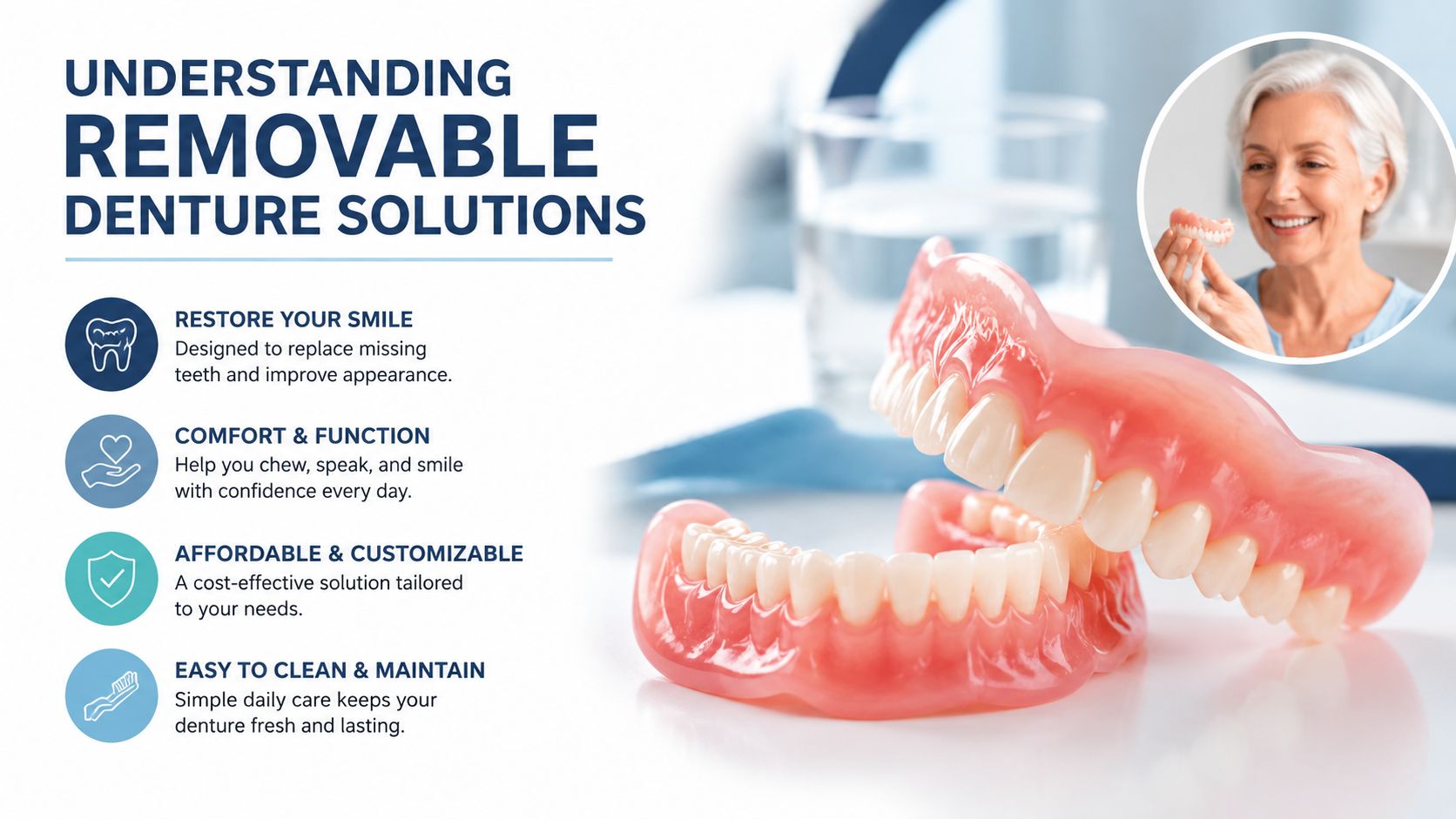
Removable dentures remain useful, dignified tooth replacement options. A partial denture replaces several missing teeth while using the remaining teeth and gum tissues for support. A complete denture replaces all teeth in an upper or lower arch. Both can restore the visible shape of the smile and provide practical chewing support without implant surgery.
Patients often worry that dentures will look obvious or feel bulky. Modern denture materials and careful design can produce a more natural appearance, but adaptation still takes patience. Speech may feel different at first, and certain foods may require a slower, more deliberate approach. Removing the appliance for cleaning helps protect the gums and remaining teeth.
Choosing among removable designs
Traditional acrylic partial dentures can replace multiple teeth and may work well as an interim or longer-term solution. Flexible partial dentures can offer a different appearance and feel, although the right material depends on the design and the condition of the remaining teeth. A complete denture may be appropriate after extensive tooth loss, particularly when surgery isn't desired or medical considerations make implants less suitable.
Implant-retained overdentures occupy a middle ground. The denture remains removable, but implants provide additional retention and reduce movement during speaking and eating. This can be especially helpful when a lower denture feels unstable. The implants still require maintenance, and the appliance must be removed and cleaned as directed.
Daily care matters
A removable appliance doesn't replace the need for routine dental care. Keep it clean, follow instructions for overnight wear, and attend cleaning and exam visits so the dentist can check the gums, bite, clasps, and remaining teeth. Dentures can lose their fit as the mouth changes, so adjustments or relining may become necessary.
The right denture plan should account for your work schedule, meals, speech needs, dexterity, and willingness to manage a removable appliance. For some Walnut Creek patients, a denture offers the most practical path. For others, it serves as a temporary stage while they address gum disease, healing, or future implant planning.
When Not Replacing a Missing Tooth Makes Sense
Replacing every missing tooth isn't always the safest or most useful choice. A British Dental Journal treatment-planning review states that, without a compelling reason, particularly in older adults, not replacing a missing tooth may be preferred (British Dental Journal treatment-planning review).
That recommendation challenges the assumption that a gap automatically requires a bridge, denture, or implant. If the missing tooth doesn't affect eating, speech, appearance, comfort, or the stability of the bite, observation may avoid surgery, preparation of neighboring teeth, appliance maintenance, and other treatment demands. This is especially relevant when a patient has health limitations, limited tolerance for procedures, or priorities that make extensive rehabilitation less valuable.
Situations that deserve careful observation
A dentist may discuss no replacement when the space is stable and the surrounding teeth are healthy. The decision becomes less straightforward if adjacent teeth are drifting, the bite is changing, the gap affects appearance, or chewing has become uncomfortable. A missing tooth in a highly visible area may also carry a different importance than one in a less noticeable location.
Short implants may provide a minimally invasive alternative in selected patients with reduced bone height, potentially avoiding bone augmentation and its added burden. The British Dental Journal review also discusses this option, but suitability still depends on anatomy and careful planning.
A thoughtful recommendation may be treatment, staged treatment, or no treatment. The examination should explain why.
Dr. Schneider's patient-focused approach gives you room to ask what happens if you wait, what risks require monitoring, and what future options might be preserved. An honest second opinion can be valuable when you've been told that replacement is automatic.
Making the Right Choice for Your Lifestyle
The best tooth replacement options fit both your mouth and your life. A single missing tooth beside healthy neighbors leads to a different discussion than several failing teeth, an unstable lower denture, or a gap that causes no functional problem. Your dentist should connect the clinical findings to practical questions, including how quickly you need a result, how much maintenance you'll accept, and how invasive treatment can be.
Start with the condition of your foundation. Healthy gums and strong supporting teeth may make a bridge practical. Adequate bone and a willingness to undergo a staged procedure may support an implant. Extensive tooth loss, medical considerations, or a preference for non-surgical care may point toward a partial or complete denture. A stable, symptom-free gap may justify observation.
Use these questions during your consultation
- Function: Which option will help me chew and speak comfortably?
- Neighboring teeth: Will the treatment require preparing teeth that are currently healthy?
- Bone and gums: Do I need periodontal treatment, extraction, socket preservation, or additional planning first?
- Maintenance: Can I clean under a bridge or remove and care for a denture consistently?
- Timeline: Do I need a fixed restoration soon, or can treatment be staged?
- Comfort: What local anesthesia, anxiety support, or sedation options are available when appropriate?
- Future flexibility: If I choose a simpler option now, will it preserve later treatment choices?
Cost should be discussed as part of the complete plan rather than as a single advertised figure. Imaging, tooth extraction, gum care, temporary restorations, laboratory work, placement, and follow-up may all affect the treatment pathway. William M. Schneider, DDS provides general, cosmetic, and restorative services, including crowns, bridges, dental implants, and care for gum disease, so patients can discuss related needs within one treatment plan.

Schedule Your Consultation with Dr. Schneider Today
A consultation turns a general internet search into a decision based on your actual mouth. At Dr. Schneider's Walnut Creek office, the evaluation can address the missing tooth, remaining teeth, gums, bite, jawbone, appearance, and comfort concerns together. Dental X-rays and other appropriate diagnostic tools help clarify whether an implant, bridge, denture, staged plan, or observation makes sense.
Patients often arrive after searching for a cosmetic dentist near me, an emergency dentist, or a practice that can handle a tooth extraction and the next restorative step. The right sequence matters. Infection, pain, or a failing tooth may need attention before replacement planning, while routine cleaning and exams can help protect the teeth that will support a bridge or partial denture.
Dr. Schneider brings more than 25 years of clinical experience to treatment planning. His training includes education at the University of Minnesota and advanced training in General Dentistry in San Francisco. The practice uses clear explanations, transparent expectations, convenient online scheduling and payments, accessibility accommodations, and a compassionate environment designed to reduce dental anxiety. Sedation options are available when appropriate.
The office is located at 1855 San Miguel Dr., Suite 31, Walnut Creek, CA, serving Walnut Creek and the broader East Bay community. You don't need to arrive knowing which treatment you want. Bring your questions about durability, maintenance, appearance, healing, tooth extraction, or the possibility of leaving the space alone. A careful dentist should explain what each option can accomplish and what it asks of you in return.
If you're dealing with pain, swelling, a broken restoration, or a recently lost tooth, contact the office promptly rather than waiting for the problem to worsen. If the situation isn't urgent, schedule a new patient exam or restorative consultation so you can make a calm, informed choice.
William M. Schneider, DDS offers personalized planning for dental implants, fixed bridges, removable dentures, tooth extraction, and restorative care in Walnut Creek. Visit William M. Schneider, DDS to request a consultation and discuss the tooth replacement option that fits your health, comfort, and daily life.