A routine adult cleaning in Walnut Creek typically runs roughly $85 to $200 without insurance, while the full first visit with an exam and X-rays commonly lands around $150 to $450. The cleaning itself is only one line on the bill, and that difference is what most patients really need to understand before booking a dentist in Walnut Creek, CA.
You may be sitting at home comparing search results for “dentist near me,” trying to decide whether a low advertised cleaning price is real. One office lists a basic cleaning, another promotes a new-patient special, and a third doesn't publish fees at all. The practical answer is simple: ask what the complete appointment includes, whether you need dental X-rays, and what your insurance will cover.
For Walnut Creek and the broader East Bay, local overhead can put fees toward the upper end of national ranges. Your gum health matters even more. A healthy-mouth prophylaxis is priced very differently from periodontal scaling and root planing, and neither should be confused with a visit for tooth extraction, an emergency dentist appointment, dental implants near me, or cosmetic dentistry such as teeth whitening.
Why the Price on the Website Is Not the Price You Pay
A Walnut Creek patient clicks through three dental websites and sees cleaning offers around $99. The price looks manageable, so the appointment is booked. At check-in, the office explains that the offer covers only the cleaning, not the new-patient examination or diagnostic images. The final bill reaches $312, which feels like a bait-and-switch even when every charge is legitimate.
That happens because advertised prices often refer to adult prophylaxis, CDT D1110, for an established patient with a recent exam and current records. A first visit may add a full oral exam, commonly D0150, along with bitewing radiographs, commonly D0274. A returning patient may instead receive a periodic exam, D0120, or a limited exam when a specific concern needs attention.
Practical rule: Before you reserve a “cleaning,” ask for the estimated total for the cleaning, exam, and recommended X-rays together.
Insurance creates another layer. Many dental plans treat routine preventive cleanings generously, often covering them at 100%, and frequently limit that benefit to two cleanings per calendar year. Deep periodontal treatment is different because it's therapeutic care rather than routine prevention. Dental insurance coverage commonly distinguishes preventive cleanings from periodontal treatment.
An insured patient may see a zero-dollar preventive cleaning line, while an uninsured patient receives the office's full unbundled charges. The same office visit can therefore produce very different patient portions.
Walnut Creek also has East Bay cost pressures. Rent, trained hygienist wages, infection-control procedures, digital sensors, and equipment maintenance all contribute to the fee. A very low advertised price may be a loss leader that excludes the exam and radiographs needed to assess cavities, gum disease, existing restorations, and oral-health risks. The right comparison isn't the cheapest headline. It's the clearest all-in estimate.
The Four Types of Dental Cleanings and What Each One Treats
Not every “cleaning” treats the same problem. A Walnut Creek dentist chooses the procedure after reviewing gum measurements, bleeding, deposits, X-rays, and your treatment history.
Routine adult prophylaxis
D1110 is the standard adult cleaning for a mouth with generally healthy gum tissue, limited calculus, and no indication for periodontal therapy. The hygienist removes plaque and hardened deposits above and around the gumline, polishes the teeth, and reviews home care. It's the service people mean when they search how much does a dental cleaning cost.
Without insurance, the U.S. cash benchmark is commonly $75 to $200, with independent summaries placing many averages around $104 to $130. The D1110 pricing range reflects routine cleaning only and may exclude an exam or radiographs.
Child prophylaxis
D1120 applies to primary dentition and is priced for children rather than adults. A child may also receive fluoride varnish when the dentist considers it appropriate. Young patients can still develop tartar and gingival inflammation, especially around crowded teeth, orthodontic appliances, or inconsistent brushing.
Gingivitis scaling
D4346 is used for generalized gingival inflammation when the patient needs more than routine prophylaxis but doesn't have the bone loss associated with periodontitis. Pregnancy-related changes, braces, heavy plaque, and skipped appointments can increase inflammation. Bleeding during brushing is a reason to schedule an exam, not a reason to assume you need deep cleaning.
Scaling and root planing
D4341 covers scaling and root planing for four or more teeth in a quadrant, while D4342 covers one to three teeth in a quadrant. This treatment addresses periodontal pockets, deposits below the gumline, bleeding on probing, and bone changes visible on radiographs. The CDT structure explains why deep cleaning is billed by quadrant rather than as one flat mouth-wide fee.
| Cleaning Type | CDT Code | When It's Needed | Typical Walnut Creek Price |
|---|---|---|---|
| Adult prophylaxis | D1110 | Healthy gums and routine preventive care | About $85 to $200 for the cleaning itself |
| Child prophylaxis | D1120 | Primary dentition and routine pediatric hygiene | Varies by office and services included |
| Gingivitis scaling | D4346 | Inflammation without established bone loss | Requires an individualized office estimate |
| Scaling and root planing | D4341 or D4342 | Periodontal pockets and disease requiring subgingival treatment | Billed per quadrant and priced above routine prophylaxis |
These ranges aren't diagnoses. A Walnut Creek dental team should examine your mouth before assigning a cleaning code. If you have swelling, severe pain, a loose tooth, or a broken restoration, search for an emergency dentist rather than booking a routine hygiene visit.
What Is Actually Included in a Cleaning Visit
A new-patient hygiene appointment usually has several distinct parts. The cleaning is important, but the exam tells the dentist whether routine cleaning is appropriate in the first place.
The first line may be an oral exam, D0150. The dentist reviews your medical history, checks the teeth and gums, screens the mouth for suspicious changes, evaluates the jaw joint and muscles, and records existing fillings, crowns, bridges, or implants. A returning patient may need a periodic exam, D0120, while a focused problem may call for a limited exam, D0140.
The next charge may involve imaging. Four bitewing X-rays, D0274, help identify decay between back teeth and evaluate bone levels near the crowns. A periapical image, D0220, focuses on one symptomatic tooth. A full-mouth series, D0210, or a panoramic image, D0330, may be appropriate when the dentist needs a broader diagnostic view, although the choice depends on your history and current findings.
For a plain-language explanation of the hygiene process, see what a dental cleaning includes.
The hygiene portion
The hygienist may use an ultrasonic scaler and hand instruments to remove calculus, then polish with a prophy cup and floss around contact points. Fluoride varnish, commonly D1206, may be offered for children or patients with sensitivity and higher cavity risk. The appointment should finish with home-care guidance and a recommended recall interval.
Why the bill contains more than procedure time
The office also pays for instrument sterilization, barrier protection, personal protective equipment, documentation, equipment upkeep, and clinical staff time. Those costs aren't separate surprises in most offices. They're part of delivering a safe, properly documented examination and cleaning.
Ask whether the quoted fee covers only D1110 or includes the exam and X-rays. That one question will tell you far more than a large “new patient cleaning” banner.
Routine Cleaning Versus Deep Cleaning and the Cost Gap Between Them
A first-visit bill can look very different from a cleaning-only quote. Routine cleaning treats generally healthy gums and removes deposits above the gumline. Scaling and root planing treats periodontal disease below the gumline, where ordinary prophylaxis cannot address the problem. The clinical need should determine the fee.
Deep cleaning is billed by quadrant. In the East Bay, one quadrant may cost roughly $200 to $400, so treatment across four quadrants can total approximately $800 to $1,600 without insurance. Consumer pricing guidance also identifies $180 to $295 per quadrant for periodontal scaling and root planing. Your written estimate should state how many quadrants need treatment and whether the fee includes local anesthesia or other services.
The higher charge reflects additional instrumentation, longer appointments, possible local anesthesia, and careful work beneath the gumline. A dentist may recommend treatment after periodontal charting finds deeper pockets, bleeding, deposits below the gums, or bone loss on X-rays. Ask to see the measurements and images before agreeing. Price alone is not evidence that deep cleaning is appropriate.
| Cleaning Type | CDT Code | Walnut Creek Range | When It Is Needed |
|---|---|---|---|
| Routine adult cleaning | D1110 | About $85 to $200 | Preventive care for generally healthy gums |
| Scaling and root planing | D4341 or D4342 | Roughly $200 to $400 per quadrant, or $800 to $1,600 for four quadrants | Periodontal disease requiring treatment below the gumline |
| Periodontal maintenance | D4910 | Often about $115 to $225 per visit | Ongoing care after periodontal therapy |
After periodontal treatment, D4910 periodontal maintenance is a separate category. It is not a discounted routine cleaning. The dentist and hygienist monitor treated areas, remove recurrent deposits, and check whether disease is returning.
The key question is simple: “Which measurements support this code, and what will I owe after the exam, X-rays, and insurance estimate?” That answer is more useful than a website's isolated cleaning price.
How Insurance, Membership Plans, and Payment Options Change Your Bill
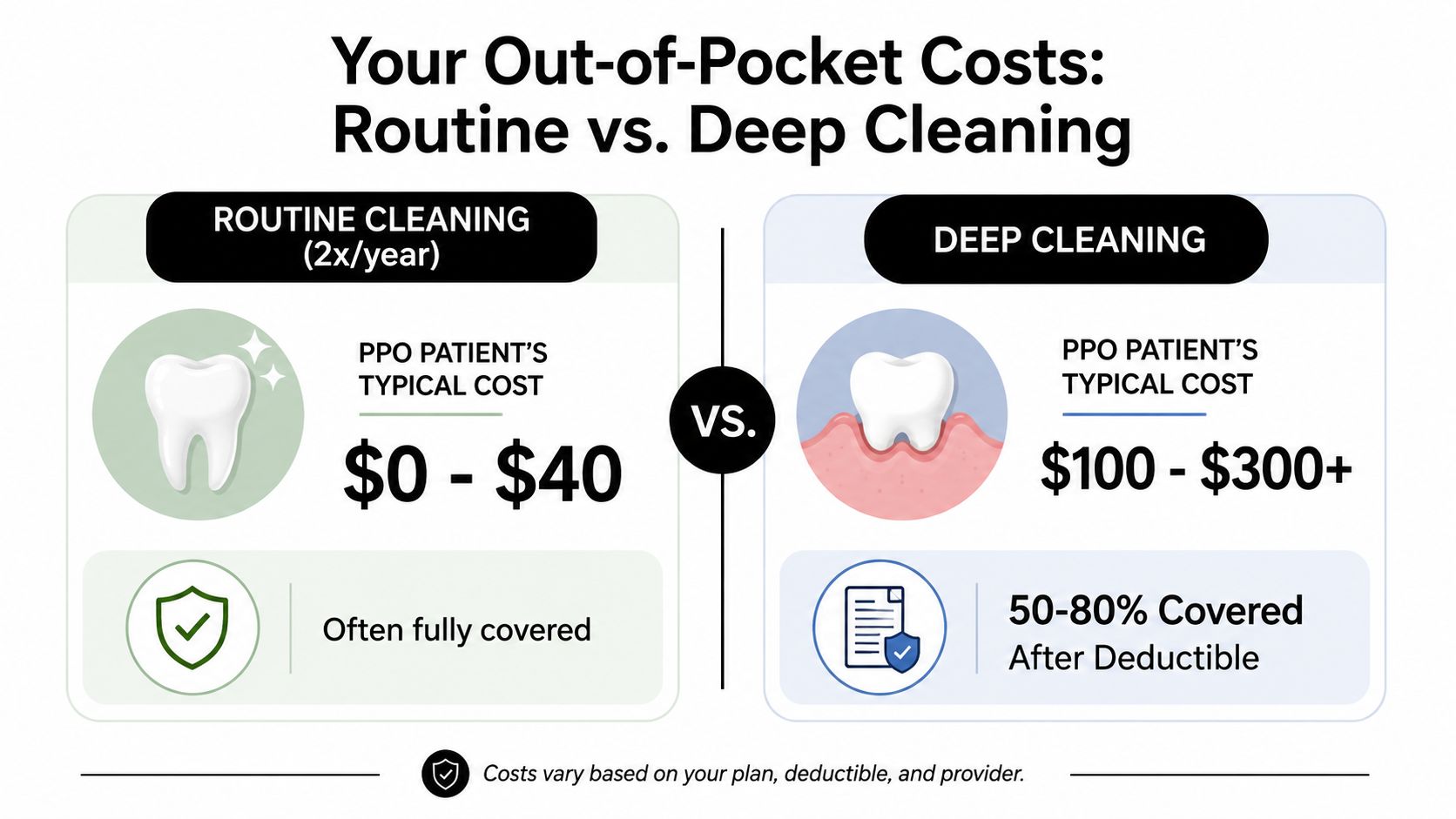
In Walnut Creek, the bill that matters is usually the first-visit total, not the advertised cleaning fee. That visit may include a routine cleaning, periodic exam, and bitewing X-rays. A PPO patient may owe $0 to $40 for a covered cleaning when the office is in network and the appointment falls within the plan's preventive frequency limits. Your deductible, carrier, network status, and coverage for the exam or X-rays can change that total.
Deep cleaning uses a different benefit. Plans commonly treat periodontal services separately from preventive care, and coverage may be 50% to 80% after the deductible, leaving a substantial balance when several quadrants need treatment. Preventive and periodontal services are commonly handled differently by dental plans.
Read the estimate before treatment
Ask for a written estimate before sitting in the chair. It should list the cleaning, exam, and X-ray codes, the insurance allowance, deductible, and expected patient portion. A preventive benefit may exclude a third annual visit, while periodontal patients may need maintenance more often.
Without insurance, compare the full first-visit price. Some Walnut Creek practices offer in-house membership plans that reduce preventive cleanings to roughly $89 to $130 per visit for members. Others provide prepayment discounts or staged payments. Larger periodontal cases may qualify for CareCredit or Cherry financing, subject to approval and provider terms.
Review dental payment plan options before treatment begins. Ask what happens if insurance pays less than estimated, and get the payment schedule in writing. A clear conversation prevents an unexpected balance.
What Drives Dental Cleaning Prices in Walnut Creek and the East Bay
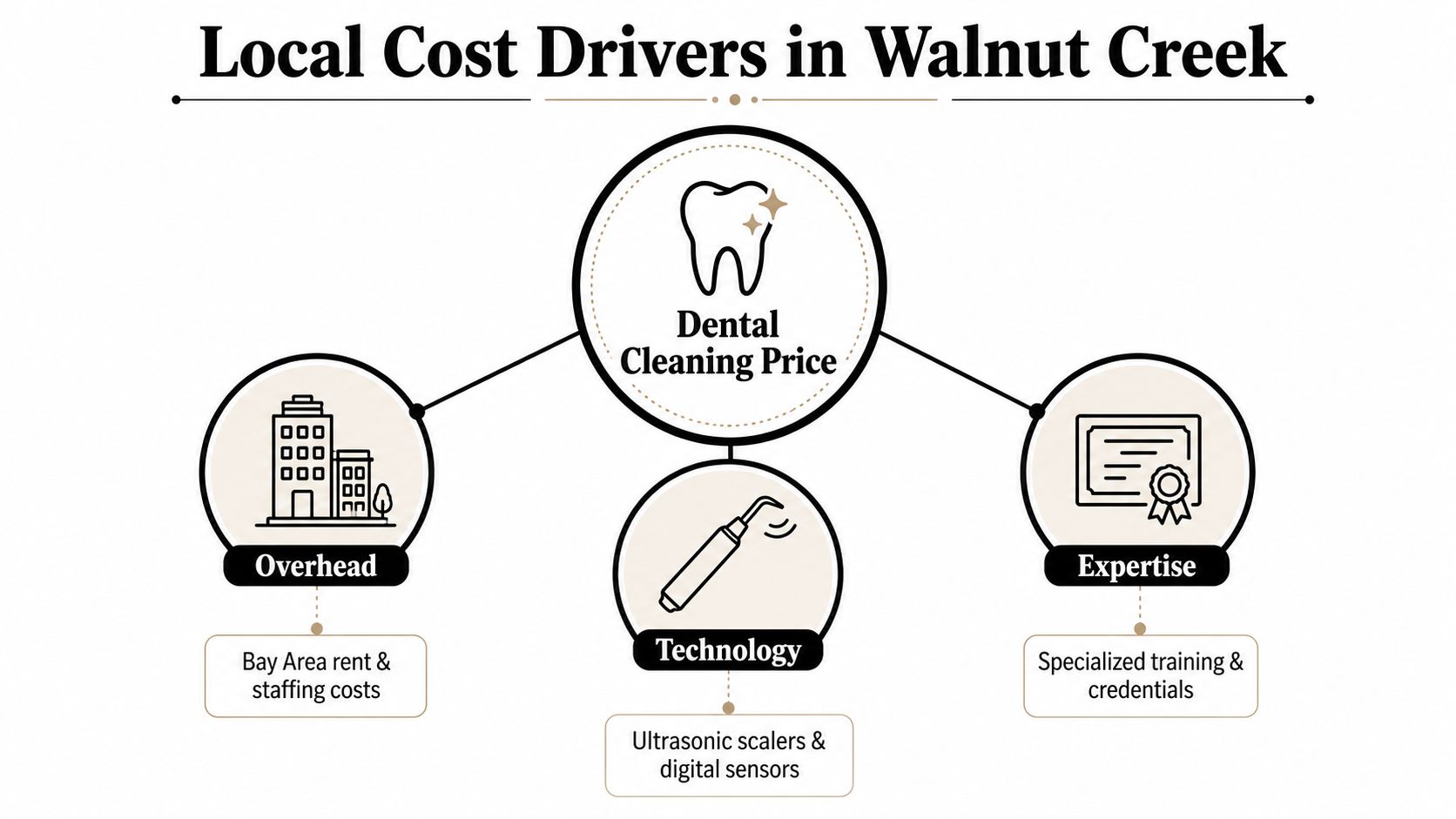
The fee reflects more than the minutes a hygienist spends with a patient. Walnut Creek offices operate within East Bay commercial and staffing conditions, and those overhead costs influence the price of preventive care.
Technology also matters. Ultrasonic scalers can help remove hardened deposits efficiently, while digital sensors support diagnostic imaging with a modern workflow. The office must purchase, maintain, disinfect, and replace this equipment. Skilled hygienists and dentists also need appropriate training to distinguish routine deposits from findings that call for periodontal treatment.
Your own mouth is the largest variable. A patient who attends preventive visits and has stable gums may need a straightforward prophylaxis. Someone who has postponed care, has heavy calculus, smokes, takes medications that affect the mouth, or notices persistent bleeding may require a more involved evaluation. Adding an exam, bitewings, fluoride, or another image changes the total even when the cleaning procedure stays the same.
A useful budgeting model is to start with the local prophylaxis fee. If the gums are healthy, expect one routine cleaning charge. If periodontal treatment is needed, the total can be roughly two to four times higher, depending on the number of quadrants and the office's fee schedule. Insurance then reduces the covered portion according to your plan rather than applying one universal discount.
For a national comparison, Cigna cites about $104 for an adult cleaning, while CareCredit reports a national average of $203 with a range of $50 to $350. The difference between those estimates shows why office quotes, geography, and bundled services matter.
Why Preventive Cleanings Are the Smartest Dental Dollar in Walnut Creek
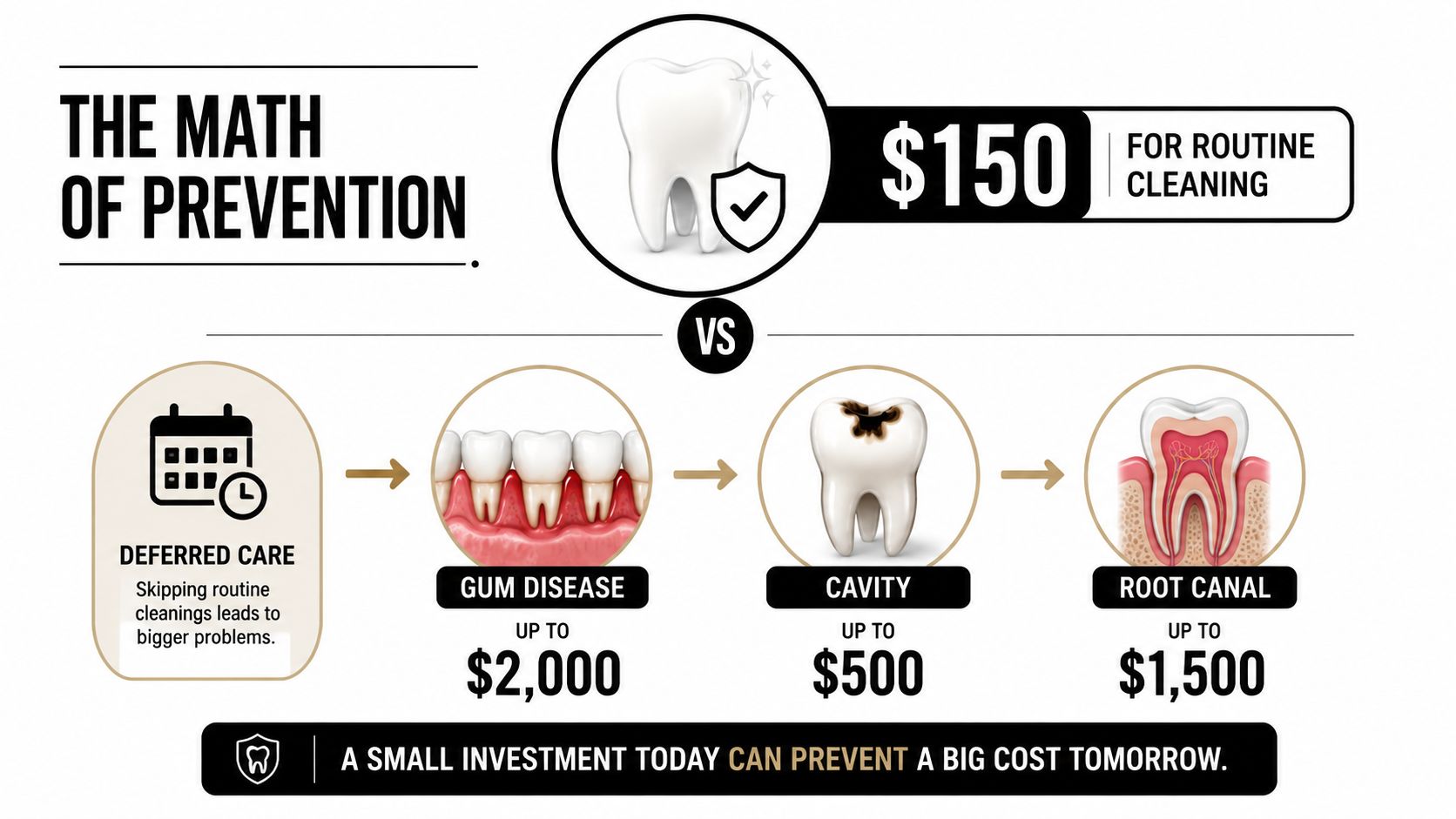
A routine cleaning is one of the most sensible healthcare purchases you can make because it gives the dentist a chance to remove deposits and identify problems while treatment is still manageable. A $150 preventive visit is easier to budget than a major restorative appointment, especially when the visit includes a useful examination rather than a cosmetic polish alone.
Delayed care can move the treatment conversation from prevention to restoration. A filling, root canal, crown, extraction, implant, or periodontal procedure requires more time and planning than a routine hygiene visit. If a tooth cannot be saved, the path may involve tooth extraction followed by restorative dentistry or a dental implant near me. Those decisions should never be made solely on price, but postponing evaluation rarely makes the underlying problem simpler.
Regular cleanings also support more than appearance. Removing calculus supports healthier gums, while the exam can identify decay, failing restorations, bite concerns, suspicious oral changes, and symptoms that warrant prompt care. Patients who have sensitivity, swelling, bad taste, bleeding, or persistent pain should request an evaluation instead of relying on a cleaning alone.
Preventive care isn't a promise that you'll never need treatment. It gives you the best chance to find treatment while the problem is smaller, clearer, and easier to plan.
If you're considering cosmetic dentistry, teeth whitening, Invisalign, crowns, or implants, start with a healthy foundation. A dentist should assess cavities and gum health before beginning elective smile treatment. That protects the result and prevents cosmetic goals from distracting from urgent disease.
A cleaning is therefore not an isolated expense. It's an appointment that helps protect chewing function, comfort, appearance, and long-term choices. If you're dealing with sudden pain or trauma, use an emergency dental service rather than waiting for the next preventive slot.
Questions to Ask Before Your Next Cleaning Appointment
Call the office before your appointment and ask for the complete estimate. You don't need to understand every billing code, but you should know whether the quoted amount covers the service you need.
Insurance and billing
- Confirm preventive benefits: Ask whether your plan covers D1110 and how many routine cleanings it allows during the calendar year.
- Check network status: Confirm whether the Walnut Creek office is in network with your carrier and whether your benefits use a different allowance out of network.
- Request the patient portion: Ask for an estimate before the exam, X-rays, or cleaning begin, including any deductible or copay.
Health updates
Tell the dental team about new medications, blood thinners, joint replacements, pregnancy, allergies, and significant medical diagnoses. These details may change the cleaning approach or require coordination with your physician. Don't stop a medication on your own.
What the visit includes
Ask whether the exam, bitewing X-rays, and oral cancer screening are included or billed separately. If you're a first-time patient, ask whether a panoramic image is clinically necessary or whether the dentist can use a more limited set of images.
Follow-up care
If the hygienist finds deeper tartar or inflammation, request a written treatment plan with the relevant CDT codes. Ask whether scaling and root planing would be scheduled by quadrant, how many visits are recommended, and what the estimated patient portion will be.
Uninsured patients should ask whether the practice has an in-house membership plan with a flat annual fee and whether preventive services are included or discounted. If periodontal treatment becomes necessary, ask about interest-free payment arrangements and the exact terms before accepting care.
Bring a photo ID, your insurance card, and a current list of medications. Also write down sensitivity, bleeding, pain, a chipped tooth, or any concern you want the dentist to address so the visit doesn't focus only on the cleaning.
William M. Schneider, DDS provides preventive cleanings and exams in Walnut Creek, along with personalized care for gum disease, restorative needs, cosmetic dentistry, tooth extraction, dental implants, and dental anxiety. Visit William M. Schneider, DDS to request an appointment and receive a clear estimate for your cleaning, examination, and any recommended X-rays before treatment begins.