If you’ve recently been told you have gum disease, you may be feeling a mix of concern, confusion, and urgency. Many patients in Walnut Creek first notice bleeding when brushing, tenderness around the gums, or a bad taste that doesn’t seem to go away. Then they hear unfamiliar terms like “periodontal pockets” or “deep cleaning,” and the whole situation starts to feel overwhelming.
The good news is that gum disease is treatable, and modern care is more targeted than many people expect. One option you may hear about is Arestin, a locally placed antibiotic used along with deep cleaning to help control infection below the gumline. If you’ve been searching what is arestin and whether it’s worth doing, this guide will give you a practical answer.
Fighting Gum Disease in Walnut Creek What Is Arestin?
A patient comes in expecting a routine cleaning, then learns the gums around a few teeth are infected and need more than a standard visit. That shift catches people off guard. In my office, the first questions are usually the same. Will this hurt? Can we stop it early? Will I still have my teeth long term?
Those are the right questions to ask.
Arestin is a locally placed antibiotic used with scaling and root planing to treat certain areas of gum infection. It is FDA-approved for use in periodontal pockets in patients with adult periodontitis. For many patients, the value is not just what the medication is. Its main value is whether adding it to treatment improves healing in the specific sites that are at higher risk of staying inflamed after a deep cleaning.
Gum disease often develops subtly, so people are surprised by the diagnosis. Bleeding when brushing, tenderness, gum recession, and persistent bad breath are common clues, but some patients have very few symptoms until deeper damage has already started. That is why a careful exam matters. If you are comparing options for periodontal disease treatment in Walnut Creek, the goal is to protect the bone and gum attachment that keep teeth stable over time.
Arestin works best as part of a thoughtful plan, not as a stand-alone fix. In practice, that means identifying which pockets are likely to benefit, cleaning the root surfaces thoroughly, and giving patients clear instructions afterward so the medication has the best chance to do its job. Some patients are excellent candidates. Others will do well with deep cleaning alone, or may need a different approach depending on pocket depth, home care, smoking history, or how advanced the infection is.
Good periodontal treatment is rarely about doing the most. It is about doing what gives you the best chance of controlling the infection now and keeping it controlled months from now.
Understanding Periodontal Pockets and How Arestin Works
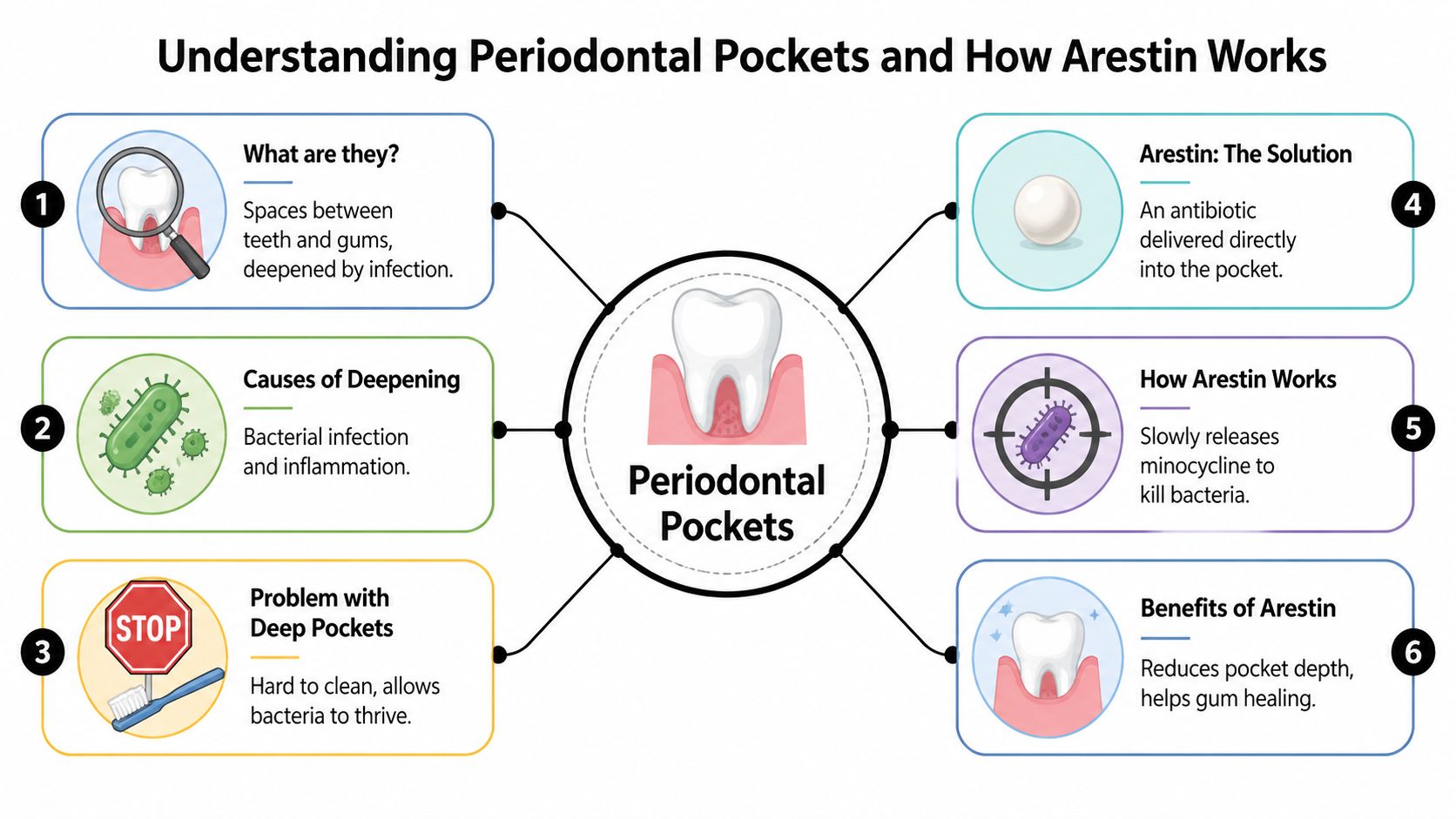
A healthy gumline fits snugly around each tooth. When gum disease develops, inflammation and infection can cause the gum tissue to loosen away from the tooth. That creates a space, often called a periodontal pocket, where bacteria can collect deeper than your toothbrush or floss can easily reach.
One way to think about it is a garden bed. Scaling and root planing is the careful weeding. It removes built-up plaque, tartar, and contaminated material from the root surface below the gumline. But in some areas, bacteria can remain tucked into the pocket even after a very thorough cleaning.
Here’s a visual overview of that process.
What Arestin actually is
Arestin is made of tiny microspheres that carry 1 mg of minocycline, an antibiotic used to suppress harmful bacteria associated with periodontal disease. It’s placed directly into selected gum pockets after scaling and root planing, where it stays in the area and releases medication gradually.
The practical advantage is local delivery. Instead of sending medicine through your whole body, the antibiotic is applied where the infection is active. That’s why patients often hear it described as “site-specific” treatment.
If you want a broader primer on the disease itself, this overview of periodontal disease treatment can help connect the diagnosis to the treatment plan.
Why dentists use it with deep cleaning
Arestin works best as a partner to mechanical cleaning, not as a replacement for it. The deep cleaning disrupts and removes the bulk of the bacterial buildup. The medication then helps suppress residual bacteria in those deeper sites during healing.
Clinical evidence from the FDA-approved prescribing label for ARESTIN shows that Arestin microspheres deliver 1 mg of minocycline and that, when used with scaling and root planing, the approach produced a 22% greater reduction in probing pocket depth at 9 months compared to scaling and root planing alone.
That doesn’t mean every pocket responds the same way. It means the treatment has a clear role when the goal is to improve results in sites that need more than cleaning alone.
Later in the same visit, many patients find it helpful to watch a short explanation of how local antibiotic therapy fits into periodontal care.
What it targets under the gums
The infection involved in periodontitis isn’t just “food stuck near the gums.” It involves bacterial species that thrive in low-oxygen spaces beneath inflamed tissue. Arestin is designed to act against periodontal pathogens, including Porphyromonas gingivalis.
For patients, the takeaway is straightforward:
- Deep pockets are hard to clean at home because the problem extends below what daily brushing can handle.
- Deep cleaning removes the deposits attached to the teeth and roots.
- Arestin adds localized antibacterial support in selected pockets while the area heals.
- The goal is better healing conditions so the gums can tighten and stabilize around the teeth.
Key Benefits of Arestin Treatment for Gum Health
Patients usually care less about the product category and more about the outcome. Will this help save teeth, settle inflammation, and reduce the chance of needing more involved treatment later? In the right case, Arestin can support all of those goals.
Here are the benefits that matter most in real practice:
Targeted delivery where it counts. Arestin is placed directly into periodontal pockets instead of being taken as a pill. That local approach helps focus treatment at the infected site rather than exposing the whole body to the medication.
Useful after a thorough deep cleaning. Some pockets respond well to scaling and root planing alone. Others benefit from added local antimicrobial support, especially where bacterial recolonization is a concern.
No removal appointment. The material is bioresorbable, so it doesn’t need to be retrieved later. That keeps treatment simpler and more comfortable.
Quick placement. Once the area has been cleaned, applying the medication is a small part of the visit. Patients are often relieved that it doesn’t feel like a separate major procedure.
Supports tooth preservation. The bigger picture is keeping gum disease from advancing. When infection and inflammation continue unchecked, patients can eventually face loose teeth, tooth extraction, or restorative treatment such as dental implants near me searches later on.
Practical rule: The best use of Arestin is not “everyone gets it.” The best use is placing it only in pockets where added local therapy has a clear purpose.
There are trade-offs. Arestin isn’t a magic fix for poor home care, skipped maintenance visits, or heavy tartar buildup that hasn’t been thoroughly cleaned first. It also doesn’t replace restorative dentistry when a tooth is already structurally failing. But when the issue is active periodontal infection in selected sites, it can be a smart, conservative step that helps patients avoid bigger problems.
That’s one reason it fits naturally into complete dental care alongside cleaning and exams, dental x-rays, restorative work, and long-term gum maintenance.
Who Is a Candidate for Arestin Therapy in Walnut Creek
A common Walnut Creek scenario goes like this. A patient comes in after being told they have gum disease, agrees to deep cleaning, and then asks a very reasonable question: “Do I need anything more than that?” The answer depends on what we see in the periodontal chart, how the gums are responding, and whether certain pockets need added site-specific treatment.
Arestin is generally considered for adults with diagnosed periodontitis who are receiving scaling and root planing. In practice, that means there are areas below the gumline where harmful bacteria have gained a foothold and routine cleaning is not enough. As noted earlier, it is used as an adjunct to deep cleaning, not as a substitute for it.
Pocket depth matters, but it is not the only factor. Sites in the 4 to 5 mm pockets range and deeper may be candidates if they also show ongoing inflammation, bleeding, or other signs that the area needs closer control. Mild gingivitis alone usually does not call for Arestin.
Patients who may benefit most
Arestin may make sense if several of these apply:
- You’ve been diagnosed with adult periodontitis
- You’re already having scaling and root planing
- Specific pockets remain active or concerning on exam
- A localized antibiotic approach is preferred over starting with a systemic antibiotic
The best candidates are often patients who want a conservative way to improve results in selected areas while protecting teeth over the long term. I also look closely at whether the patient is likely to keep periodontal maintenance visits, because the long-term outcome depends on follow-up, not just what is placed in the pocket that day.
When it may not be the right choice
Arestin is not the right fit for every patient or every site. It may be avoided if you have a known allergy to minocycline or other tetracycline-class antibiotics. Pregnancy and nursing also call for caution because this class of medication has important safety considerations.
Clinical judgment matters here. A deep pocket around a tooth with a crack, failing restoration, or heavy residual buildup may need a different plan first. If home care is inconsistent or maintenance has been delayed for a long time, I address those issues directly, because no local antibiotic can carry the full burden on its own.
That is why a careful diagnosis comes first. We look at pocket measurements, bleeding, bone support, medical history, and your ability to care for the area after treatment. Patients usually appreciate that approach because it answers the bigger question, not just “Am I a candidate today?” but “What gives me the best chance of keeping these teeth healthy years from now?”
The Arestin Application Process at Our Walnut Creek Dental Office
For many patients, the most stressful part is not the treatment itself. It’s not knowing what the appointment will feel like. The actual process is usually much more straightforward than people expect.
A periodontal visit often starts with the same basics as other dental care. Your gums are examined, measurements are reviewed, and any needed dental x-rays or charting help identify which areas are active and which are stable. If the diagnosis supports it, scaling and root planing is scheduled or completed.
What the visit feels like
The deep cleaning phase is the part that does the heavy lifting. That’s where plaque, tartar, and bacterial deposits are removed from below the gumline. Depending on your needs, the area may be numbed so the visit is comfortable.
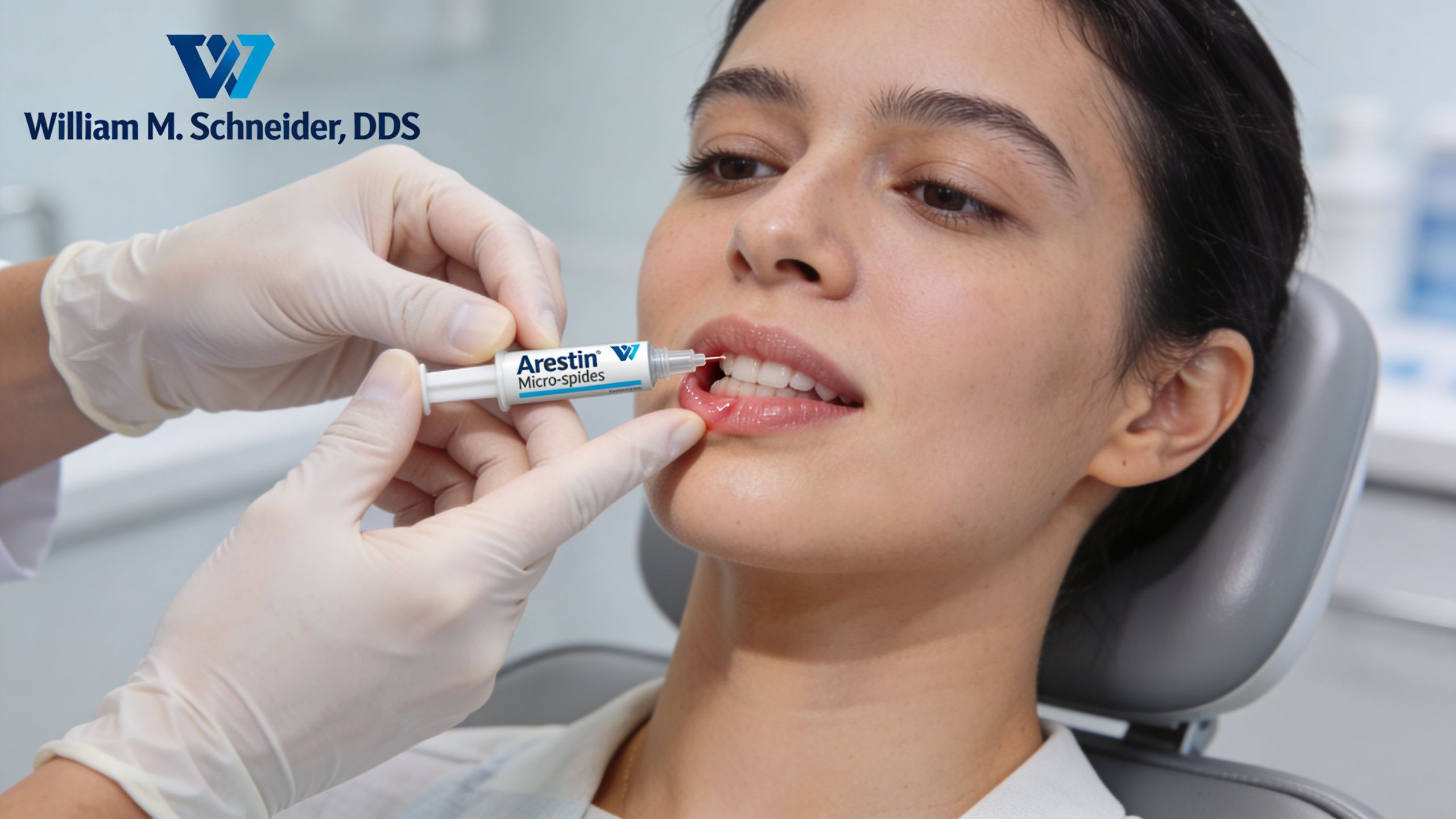
After the roots are cleaned, Arestin is placed into selected pockets. Patients are often surprised by how brief this step is. It doesn’t involve stitches, and it doesn’t feel like surgery. The medication is delivered directly into the pocket by a dental professional.
What helps anxious patients
If you tend to avoid the dentist because of fear, tell the team before treatment starts. That matters for everything from pacing the appointment to discussing comfort options. Some patients do very well with simple reassurance and breaks. Others prefer additional support.
A calm environment, clear explanation, and gentle technique usually make the biggest difference. For patients who need more help, sedation options may be available when appropriate. That can be especially useful if you’ve been postponing treatment and are also searching for an emergency dentist because gum problems have started to flare or become painful.
Most patients tolerate Arestin placement well because the work that matters most has already been done during the cleaning phase.
Aftercare Instructions and Ensuring Long-Term Success
Aftercare makes a real difference. Once Arestin has been placed, the goal is to leave the treated area undisturbed so the medication can remain where it was intended to work.
The practical guidance is simple but important. According to Cleveland Clinic guidance on minocycline periodontal powder, patients should avoid flossing treated sites for about 10 days, and tenderness can occur in 5 to 10% of cases. The same guidance also notes that avoiding certain foods for 48 hours can help reduce complications.
Arestin aftercare do's and don'ts
| Action | Guideline |
|---|---|
| Brushing | Continue brushing gently unless your dentist gives different instructions for a specific area |
| Flossing at treated sites | Avoid flossing treated areas for about 10 days |
| Food choices in the first 48 hours | Choose softer foods and avoid foods that could disturb the material |
| Hard, crunchy, or sticky foods | Skip them during the early healing period |
| Touching the treated area | Leave it alone and don’t probe it with fingers or picks |
| Tenderness | Mild soreness can happen, so monitor the area and call if symptoms seem unusual |
What patients often ask after treatment
A common question is whether the medication can “come out.” In most cases, patients don’t need to check or inspect the area. The better approach is to follow instructions and let the site heal. If something feels clearly wrong, contact the office rather than trying to clean aggressively around it yourself.
Another question is whether normal oral hygiene should stop completely. It shouldn’t. You still need overall plaque control. You’re just protecting the treated sites from direct disruption while the medication does its job. Good home care everywhere else still matters.
For daily guidance beyond the immediate post-op window, these oral hygiene best practices can help you maintain healthier gums between professional visits.
Arestin works best when patients treat it as one part of periodontal therapy, not a shortcut around home care.
Long-term success takes maintenance
Honest expectations are important. Arestin can improve healing in selected pockets, but it doesn’t “cure” gum disease forever after one appointment. Periodontitis is a condition that needs monitoring and maintenance.
That means your long-term result depends on several things working together:
- Thorough initial treatment through scaling and root planing
- Consistent home care with brushing and proper hygiene habits
- Regular periodontal maintenance rather than waiting for symptoms
- Timely re-evaluation so persistent pockets can be managed early
What doesn’t work is doing the antibiotic placement and then disappearing for long stretches without maintenance. Gum disease usually returns to the same vulnerable areas when plaque control slips and recall visits are delayed.
Arestin Alternatives and Insurance Considerations
Patients often ask whether Arestin is the only option. It isn’t. Depending on the case, a dentist may consider deep cleaning alone, a systemic antibiotic, another local antimicrobial approach, or a broader periodontal plan that includes ongoing maintenance and re-evaluation.
The reason Arestin is often chosen is its local delivery. It’s placed at the site that needs help rather than prescribed broadly. That can make it a thoughtful option when the goal is focused treatment after scaling and root planing.
How it compares in real decision-making
Arestin is a strong choice when a patient has specific pockets that need added support. Deep cleaning alone may be enough in less involved cases. Systemic antibiotics may be considered when a patient’s condition calls for a wider approach, but they aren’t automatically the best first answer for localized pockets.
A practical point from this discussion of Arestin and long-term planning is that Arestin plus scaling and root planing shows a significant 0.5 to 1.0 mm greater pocket depth reduction at 9 months versus scaling and root planing alone, while long-term success still depends on a complete treatment plan.
That trade-off is worth understanding. Arestin can improve site-specific outcomes, but it doesn’t remove the need for maintenance, bite evaluation, restorative care, or referral when a case is more advanced.
What about insurance and cost
Cost depends on how many sites are treated. Some patients need only a few isolated areas addressed. Others need more extensive periodontal therapy.
Insurance coverage varies by plan and by how the procedure is coded and documented. The best next step is usually not guessing from online estimates. It’s having the office review your benefits and explain what your plan may cover, what it may not, and what your out-of-pocket responsibility is likely to be before treatment begins.
That kind of clarity matters whether you’re looking for a dentist in Walnut Creek, CA, exploring restorative dentistry, or trying to avoid bigger future expenses tied to advanced periodontal problems.
Schedule Your Periodontal Health Consultation in Walnut Creek
If your gums bleed, feel tender, or have been diagnosed with pockets that need treatment, it’s worth acting sooner rather than later. Gum disease can be managed well when it’s treated with the right combination of deep cleaning, local therapy when indicated, and steady follow-up care.
Arestin is one of the useful tools available for patients who need more than routine cleaning and less than invasive treatment. The key is knowing when it helps, what it can realistically do, and how to support the result after you leave the office.

If calling during the workday is difficult, many patients appreciate practices that make communication easier. Resources like this overview of an answering service for dentists explain how modern dental offices can stay responsive when patients have treatment questions outside normal call windows.
If you’ve been searching what is arestin, dentist near me, or help for bleeding gums in Walnut Creek, the right next step is a professional exam and a clear plan.
If you’re ready to protect your gums and keep your smile healthy for the long term, schedule a consultation with William M. Schneider, DDS. The office is located at 1855 San Miguel Dr., Suite 31, Walnut Creek, CA, and welcomes patients looking for preventive care, gum disease treatment, cosmetic dentistry, restorative dentistry, and comfortable long-term dental care. Call the office to arrange your visit and get a personalized evaluation of whether Arestin, deep cleaning, or another treatment approach is right for you.