If you're dealing with a cracked tooth, worn-down enamel, missing teeth, or dental work that keeps failing, daily life can start to feel smaller. You may avoid crunchy foods, chew on one side, cover your mouth when you laugh, or put off photos because your smile doesn't feel like you anymore. Many people in Walnut Creek and the East Bay live with those workarounds far longer than they should.
The good news is that you don't have to guess your way through it. Thoughtful, modern dental care can rebuild comfort, appearance, and function in a way that feels personal to your life, not generic. If you've been searching for a dentist near me, a dentist in Walnut Creek, CA, an emergency dentist, or help with restorative dentistry, it helps to understand what advanced care looks like in a real practice.
Restore Your Smile and Confidence in Walnut Creek
A lot of people first think about advanced restorative dentistry after something small becomes impossible to ignore. A filling breaks while eating dinner. A back tooth starts hurting every time cold water hits it. An old crown loosens before an important meeting. A missing tooth that seemed manageable at first starts changing the way you chew and speak.
In Walnut Creek, those concerns aren't just cosmetic. They affect how comfortably you eat, how clearly you talk, and how confident you feel when you're with family, coworkers, or friends around town. Dental damage can also place extra stress on nearby teeth and on your bite, which often leads to new problems if nothing is done.
When a dental problem starts affecting your whole day
Patients often describe the same pattern:
- Eating gets complicated because one side of the mouth feels weak or sensitive.
- Smiling feels guarded because damaged or missing teeth draw attention.
- Old dental work becomes unpredictable and creates worry before travel, events, or workdays.
- Small pain turns into constant awareness that makes it hard to relax.
That kind of stress can wear on you. It also makes many people search for practical answers such as tooth extraction, dental implants near me, or a cosmetic dentist near me, even when what they really need is a complete plan that looks at the whole mouth.
Care that feels local, personal, and steady
At Dr. Schneider's office in Walnut Creek, the patient journey begins with listening. Before any treatment is recommended, your concerns, your goals, and your day-to-day challenges matter. Some people want to stop pain. Some want to replace missing teeth. Others want a stronger bite and a smile that looks more natural again.
Practical rule: The right restorative plan doesn't start with a procedure. It starts with understanding what isn't working in your mouth and what you want life to feel like after treatment.
That matters because advanced restorative dentistry isn't just about repairing a tooth. It's about helping you chew comfortably, protect the teeth you still have, and feel confident that your dental care is moving you toward long-term health.
For families and professionals looking for a dentist in Walnut Creek, CA, this kind of care can feel like a turning point. You stop reacting to one dental problem at a time and start rebuilding your smile with intention.
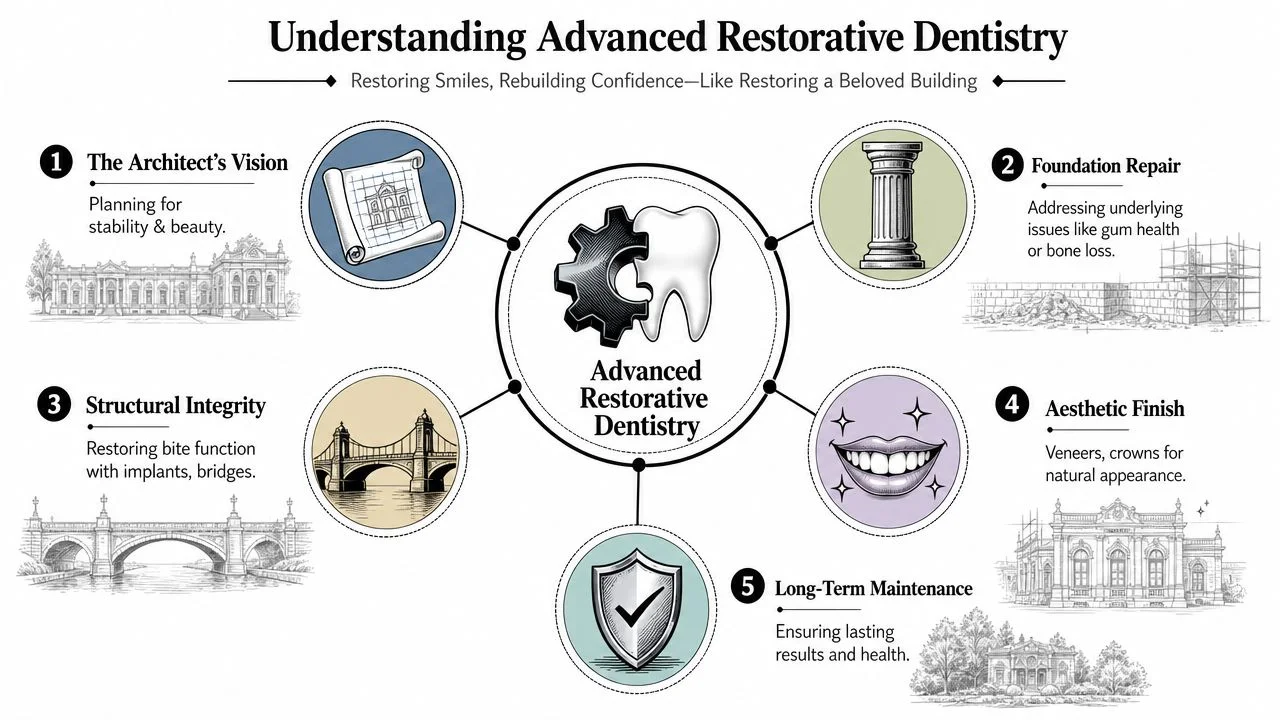
Understanding Advanced Restorative Dentistry
You come into Dr. Schneider's Walnut Creek office with more than one concern. A tooth in the back is missing. Two older crowns feel uneven when you chew. One front tooth has started to chip. In a situation like that, treating one tooth at a time can feel like repairing one loose floorboard while the whole room is shifting.
Advanced restorative dentistry is the area of care that looks at the full picture first. Instead of asking only, "How do we fix this one tooth?" it asks, "How do we help your whole mouth work comfortably and stay stable over time?"
Your mouth functions as a connected system. Teeth meet in a certain pattern. Gums and bone support each tooth. Old fillings, crowns, bridges, and missing teeth can change how pressure is distributed when you bite. When one part is weakened, another part often starts doing extra work.
More than a simple repair
Basic treatment often focuses on a single problem, such as a cavity or a chipped edge. Advanced restorative treatment is used when several factors need to be considered together so the repair lasts and feels right in daily life.
At Dr. Schneider's practice, that broader view may include:
- Bite balance so a new restoration fits with the way your teeth come together
- Tooth strength when cracks, large fillings, or wear have reduced support
- Missing teeth that may allow neighboring teeth to drift or tilt
- Gum and bone support because healthy foundations help restorations succeed
- Natural appearance so the repaired teeth match your smile, speech, and face
A helpful way to understand this is to picture your bite like the legs of a table. If one leg is short, the table may still stand, but it wobbles and places strain on the others. Your mouth can adapt in a similar way for a while. Over time, that strain can show up as wear, sensitivity, breakage, or jaw fatigue.
Why the word advanced matters
Here, "advanced" refers to the planning and coordination involved. It does not mean you should expect something frightening or unusually aggressive. It means the care is designed with more detail because your needs are more connected.
For some Walnut Creek patients, that means rebuilding support around a missing tooth before placing a crown elsewhere. For others, it means deciding whether a heavily worn tooth can still be protected or whether a stronger option would serve them better long term. If tooth loss is part of your situation, learning about dental implants in Walnut Creek can help you see how replacement teeth fit into a larger restorative plan.
The goal is clarity. You should understand what is being treated, why the sequence matters, and how each step supports the next one.
Restorative care works best when it improves comfort now and protects your oral health over the years ahead.
What problems it can address
Advanced restorative dentistry is often used when the issue is larger than a small cavity or a minor cosmetic change. Common examples include:
| Concern | How it affects you |
|---|---|
| Missing teeth | Chewing becomes uneven, and neighboring teeth may shift |
| Broken or heavily filled teeth | The tooth may weaken and become harder to protect |
| Bite wear | Teeth can flatten, chip, and become sensitive |
| Repeated dental failures | Old restorations may no longer support healthy function |
| Multiple issues at once | Treatment needs to be sequenced carefully |
In plain language, this kind of dentistry helps rebuild your smile with a plan that makes sense for your life here in Walnut Creek. You are not just getting a repair. You are getting a path toward stronger chewing, a healthier bite, and a smile that feels dependable again.
Your Options for Advanced Smile Restoration
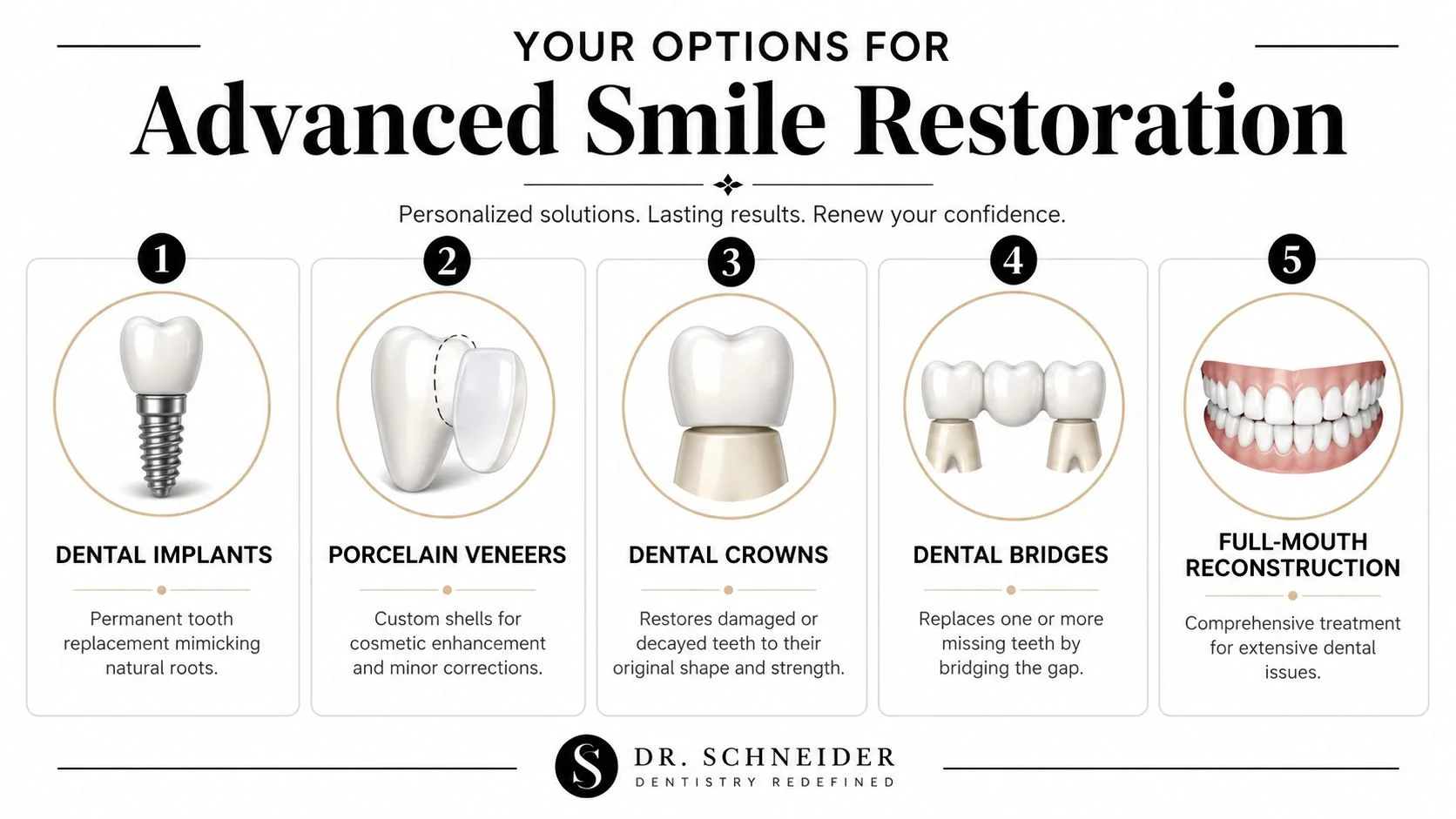
Not every smile needs the same kind of repair. One patient may need to replace a single missing tooth. Another may need to strengthen several worn teeth and close spaces that make chewing difficult. That's why treatment options should match the specific problem you're dealing with.
At Dr. Schneider's Walnut Creek practice, advanced smile restoration can involve a single focused treatment or a coordinated plan that combines several services over time. The key is understanding what each option solves.
Dental implants for missing teeth
If you've been searching for dental implants near me, you're probably looking for a replacement that feels secure and natural. A dental implant replaces the root area of a missing tooth and supports a restoration above it. That makes it very different from a removable option.
An implant is often a strong choice when you want to:
- Replace one missing tooth without relying on neighboring teeth for support
- Stabilize your bite so chewing feels more even
- Support long-term function with a fixed solution
- Improve confidence when speaking and smiling
Some patients can move directly into implant planning, while others need preparatory care first. If you'd like to explore treatment details, dental implants in Walnut Creek, CA are one restorative option within a broader treatment plan.
Crowns when a tooth needs protection
A crown covers and protects a tooth that has been weakened by decay, fracture, or large prior dental work. Patients sometimes think a crown is only for appearance, but its main job is often structural.
A crown may be recommended when:
| Situation | Why a crown helps |
|---|---|
| A tooth is cracked | It helps hold the tooth together during function |
| A filling is too large | There may not be enough remaining structure for another filling |
| A tooth had root canal treatment | The tooth often needs added protection afterward |
| A worn tooth has lost shape | A crown can restore form and chewing surface |
A well-planned crown should fit your bite, support daily use, and blend naturally with nearby teeth.
Bridges for an open gap
A dental bridge replaces one or more missing teeth by spanning the space. For the right patient, that can restore appearance and chewing more quickly than leaving the area untreated.
A bridge is often considered when the teeth next to the gap already need crowns or when a patient prefers a fixed non-removable option but isn't pursuing implants. The main benefit is practical. It closes the space so food doesn't trap as easily and helps restore a more complete bite.
If a gap has been there for a while, don't assume it's only a cosmetic issue. Missing teeth can change how the rest of your mouth works.
Veneers and cosmetic refinement
Not every restoration is about major structural damage. Some patients in Walnut Creek ask about improving front teeth that are chipped, uneven, or discolored while also preserving a natural look. In those cases, porcelain veneers may be part of the conversation.
Veneers are more often associated with cosmetic dentistry, but they can also play a role in a larger restorative plan when the front teeth need modest reshaping or visual balance. The goal is to improve the smile in a way that still fits your face and bite.
Full-mouth rehabilitation for complex cases
Some mouths need more than one isolated repair. If you've had years of grinding, failing dental work, tooth loss, or shifting bite pressure, a piecemeal approach may not be enough. Full-mouth rehabilitation brings the whole system back into balance.
This type of care may combine several treatments, such as crowns, bridges, implants, bite adjustment, and staged planning over multiple visits. It is especially helpful when patients say things like:
- "I can't find a comfortable place for my bite."
- "Several teeth are wearing down at once."
- "Old work keeps breaking."
- "I want to fix this properly instead of one emergency at a time."
Bone grafting when support is limited
Some implant patients hear that they may need bone grafting and immediately worry that something is wrong. Usually, it means the foundation needs reinforcement before a stable replacement tooth can be placed.
Bone grafting may be discussed if a tooth has been missing long enough that the area no longer offers ideal support. In practical terms, it's a way to prepare the site so future treatment has a healthier base.
How related services fit in
Advanced restorative care sometimes overlaps with other important services. A painful broken tooth may need urgent evaluation by an emergency dentist before the final restoration plan is made. A severely damaged tooth might require tooth extraction if it can't be saved. Ongoing support also matters, including cleaning and exams, dental x-rays, and new patient exams that help track the health of your restorations over time.
The best option isn't the one with the most technology or the biggest reputation. It's the one that solves your specific problem, protects your oral health, and fits the way you live.
How Digital Workflows Create Precise Results
A common Walnut Creek patient story goes like this. You know something is off with a tooth, or maybe several teeth, but what worries you most is whether the fix will feel right when you chew, smile, and speak. At Dr. Schneider's office, digital workflows help answer that concern early, before treatment is underway, by giving a clearer map of your teeth, bite, and supporting structures.
That clearer map matters because restorative dentistry is not only about replacing what is damaged. It is also about making sure the new work fits the rest of your mouth. A crown that looks good but hits too hard when you bite can create a new problem. An implant that is well placed on a scan is more likely to support a tooth that feels stable in daily life.
What digital planning changes for patients
Digital tools let your dentist study details that are hard to judge by sight alone. They can show tooth shape, spacing, bite relationships, and the condition of the bone and nearby structures. The process works a bit like creating a blueprint before remodeling a home. The more accurate the blueprint, the fewer surprises during construction.
For many patients, one of the biggest day to day benefits is comfort. Digital impressions often reduce the need for traditional putty molds, which can be unpleasant if you have a sensitive gag reflex or feel anxious in the chair. If you want a better sense of how these images guide diagnosis and planning, this page on digital dental imaging in Walnut Creek explains what your dentist is looking for and how those details shape treatment.
CAD/CAM and modern materials
Digital workflows also connect the planning stage to the making of the restoration itself. With CAD/CAM systems, the information gathered from scans and impressions can be used to design crowns, bridges, and other restorations with close attention to fit and bite. Instead of relying only on hand-shaped estimates, your dentist and lab work from detailed digital records.
Patients usually notice the difference in practical ways:
- A more accurate fit, which can reduce the amount of bite adjustment needed
- A more comfortable process in cases where digital impressions replace traditional molds
- Better coordination when several teeth, implants, or older restorations must work together
- Material choices that are selected for your situation, appearance goals, and chewing needs
Newer restorative materials also give dentists more options than they had years ago. Some are chosen for strength in high-pressure chewing areas. Others are chosen because they blend more naturally with nearby teeth. Dr. Schneider uses that information to create a restoration that is customized to your mouth, not a one-size-fits-all answer.
Why precision supports comfort
Precision helps restorations disappear into daily life. That is the goal most patients care about. You want to eat without second-guessing where your teeth meet. You want your crown to feel like part of your mouth, not like a small object sitting on top of a tooth.
A well-planned restoration works like a well-fitted shoe. If the fit is off even a little, you notice it over and over. If the fit is right, you stop thinking about it.
That is why digital workflows matter in advanced restorative dentistry. They help Dr. Schneider make decisions based on a fuller picture of your mouth here in Walnut Creek, so the final result supports comfort, appearance, and long-term function.
What to Expect During Your Treatment Process
For many people, the hardest part of advanced dental care is not the treatment itself. It's the uncertainty before it starts. Patients often wonder how many visits they'll need, whether treatment will hurt, and how they'll manage work, family life, and healing.
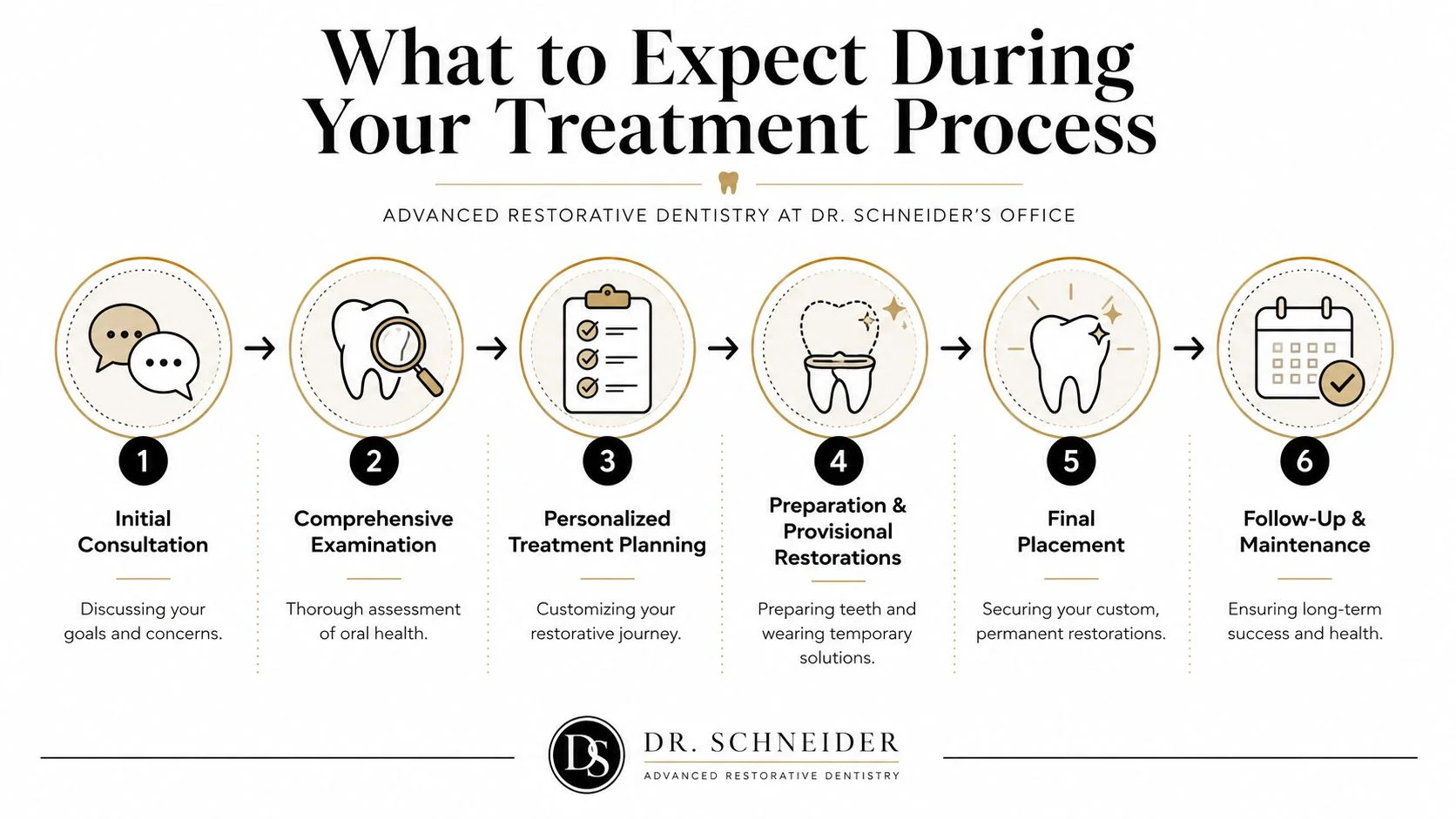
The process is usually much less mysterious once it's broken into steps. This is often how the journey feels from the patient side.
A simple overview can help before the details.
Your first visit and exam
The first appointment is usually a conversation as much as an examination. You'll talk about what's bothering you, whether that's pain, a broken tooth, missing teeth, trouble chewing, or concerns about appearance. If you're new to the office, this is also where new patient exams, dental x-rays, and a full review of your oral health help build the foundation for a personalized plan.
Your dentist will look at more than the obvious problem. The condition of the gums, older restorations, bite patterns, and supporting structures all influence what treatment makes sense.
Planning your restorative roadmap
Once the exam is complete, the next step is deciding what should happen first. If you're in pain, immediate relief may come before long-range cosmetic or restorative goals. If a tooth can't be saved, tooth extraction may need to happen before replacement options are finalized. If you're dealing with several concerns, treatment is usually sequenced so each step supports the next one.
Patients often feel relieved at this stage because the problem becomes more concrete. Instead of "my whole mouth feels like a mess," you get a roadmap.
That roadmap may include:
- Stabilizing urgent problems such as infection, fracture, or severe discomfort
- Preparing the mouth through cleaning, gum care, or removal of hopeless teeth
- Protecting weakened teeth with restorations such as crowns
- Replacing missing teeth with bridges or implants where appropriate
- Refining the final result so the bite feels comfortable and the smile looks natural
Comfort during treatment
Many people avoid care because they expect discomfort. That's especially common for patients who had difficult dental visits in the past. A compassionate restorative process should account for that from the beginning.
At this office, patient comfort is part of treatment planning, not an afterthought. That can include local anesthesia, gentle techniques, clear communication during appointments, and sedation options when appropriate for anxiety or longer procedures.
Here is a short video that helps patients get more familiar with the experience:
Some patients need the details to feel comfortable. Others feel better with a simple overview. A good treatment process makes room for both.
Temporary restorations and final placement
In more involved cases, you may wear temporary restorations while your final ones are being made. Patients sometimes worry that temporary teeth mean the result is uncertain. Usually, the opposite is true. Temporaries can help test comfort, appearance, and bite before the permanent restorations are placed.
Once the final crowns, bridges, implant restorations, or other restorations are ready, your dentist checks fit, contacts, bite, and appearance carefully. This part should feel collaborative. If something feels off, even slightly, say so. Fine adjustments matter.
Recovery and long-term maintenance
Healing depends on the type of treatment you receive. A crown appointment feels different from implant placement, and a full-mouth rehabilitation has its own timeline. What stays consistent is the need for aftercare.
Your long-term success depends on habits and follow-up:
- Keep regular cleaning and exams so small issues are caught early
- Use home care consistently around crowns, bridges, and implants
- Wear any recommended appliance if grinding or clenching threatens the restorations
- Report changes early if your bite feels uneven or a restoration feels loose
Advanced restorative dentistry works best when treatment and maintenance stay connected. The goal isn't just to finish a case. It's to keep your mouth healthy and comfortable for the long haul.
The William M Schneider DDS Difference
Choosing a dentist for complex restorative care is personal. You're not just choosing a procedure. You're choosing the person and the environment that will guide you through decisions about comfort, appearance, function, and long-term health.
For many patients in Walnut Creek, trust comes down to three things. Experience, communication, and the feeling that the office sees you as a person instead of a chart.
Experience that supports careful decision making
Dr. Schneider brings more than 25 years of experience to all aspects of dental care, along with advanced training in General Dentistry through an AEGD program in San Francisco after dental education at the University of Minnesota. That background matters because restorative decisions often require judgment, not just technique.
A tooth isn't always treated solely by crowning or extraction. A missing tooth isn't always replaced in a single manner. Careful dentistry means weighing what will be healthiest and most sustainable for you.
A gentler experience for anxious patients
A lot of adults still carry tension from past dental visits. They brace for pain, feel embarrassed about how long they've waited, or worry they'll be pressured into treatment they don't understand. A private practice environment can make a real difference here.
Patients at this office often appreciate:
- Painless injection techniques that help reduce fear around numbing
- Clear explanations so you know what is happening and why
- A calm, relaxing setting that feels less rushed
- Sedation options when appropriate for patients who need extra support
Local care with continuity
Walnut Creek patients often want more than a quick fix. They want a long-term dental home where routine care, emergency needs, cosmetic goals, and restorative treatment all connect. That continuity matters when you're managing older dental work or planning treatment over time.
William M. Schneider, DDS provides preventive, cosmetic, and restorative services in one practice, including cleanings and exams, crowns, bridges, implants, root canals, Invisalign, teeth whitening, and care for gum disease and sleep apnea. For patients, that means the treatment plan can stay grounded in the bigger picture of oral health instead of feeling fragmented.
Good restorative dentistry doesn't only repair teeth. It restores ease. You should be able to eat, smile, and come to appointments without carrying constant worry.
For someone looking for a dentist in Walnut Creek, CA, an emergency dentist, or a practice that can handle both everyday care and more advanced needs, that consistency can be reassuring. You're building a relationship with a local office that knows your history and can help protect the results over time.
Answers to Your Advanced Restorative Dentistry Questions
Is advanced restorative dentistry painful
Most patients are surprised that treatment is more comfortable than they expected. Modern numbing techniques, a gentle pace, and clear communication make a big difference. If you have significant dental anxiety, sedation options may also be available when appropriate. The most important thing is to tell your dentist what worries you most, because comfort planning should be part of your care from the start.
How do I know if I need restorative treatment or cosmetic treatment
The answer depends on what problem you're trying to solve. Cosmetic treatment focuses mainly on appearance. Restorative treatment focuses on repairing damage, replacing missing teeth, and improving function. In many real-world cases, the two overlap. A crown may strengthen a tooth and improve how it looks. Veneers may improve appearance while also correcting minor wear or shape concerns.
How much will treatment cost
There isn't one flat price because no two mouths need the same plan. Cost depends on the condition of the teeth and gums, how many restorations are needed, whether treatment happens in phases, and whether preparatory procedures are required. A consultation is the best way to get a clear, personalized estimate. If you're comparing options, ask which treatment best protects your long-term oral health, not just which one has the lowest immediate fee.
How long do crowns, bridges, or implants last
Longevity depends on the restoration, your bite forces, your home care, and whether you keep up with maintenance visits. Restorations generally perform best when the surrounding gums stay healthy, the bite remains stable, and small issues are addressed early. If you clench or grind, protective appliances may also help preserve your dental work.
Am I a candidate for dental implants
Many adults are, but candidacy depends on your overall oral health, the condition of the site, and the amount of support available in the jaw. Some patients are ready for implant treatment right away. Others may need preparatory care such as gum treatment, healing time after extraction, or bone grafting.
What if I haven't been to the dentist in a long time
You're not alone, and you shouldn't let that stop you from coming in. A lot of patients return to care after years away because a broken tooth, pain, or missing teeth finally push the issue to the top of the list. A good first visit should focus on where you are now and what needs to happen next, not on making you feel judged.
If you're ready to stop managing around damaged or missing teeth and start moving toward a healthier, stronger smile, William M. Schneider, DDS welcomes patients from Walnut Creek and the East Bay for personalized restorative care. Whether you need help with a painful tooth, are considering dental implants, or want a clear plan for full-mouth rehabilitation, scheduling a consultation is the best next step.