You bite into something firm and feel a sharp jolt. Cold water lingers against one tooth, or an intermittent ache makes you wonder whether a visible line has become a serious problem. If you're searching for a dentist near me or an emergency dentist in Walnut Creek, CA, the first question is usually simple: can you cap a cracked tooth?
Often, yes. A cracked tooth may be capped when the crack remains within the clinical crown, the visible part of the tooth above the gumline. The right answer still depends on the crack's depth, the condition of the pulp, and how much healthy tooth structure remains. William M. Schneider, DDS provides evaluation and restorative care for patients seeking a dentist in Walnut Creek, CA, with treatment planned around preserving comfort, function, and natural tooth structure.
Can You Cap a Cracked Tooth in Walnut Creek CA
A crown, often called a cap, fits over the damaged tooth and helps hold the remaining structure together during normal biting. A cracked tooth can often be capped when the crack is confined to the clinical crown. Modern endodontic guidance also associates full-coverage coronal restoration with favorable outcomes after root canal treatment. The American Association of Endodontists summarizes a 2-year study in which endodontically treated cracked teeth restored without a crown had a 20% survival rate, compared with a 94% survival rate for teeth restored with a crown (AAE guidance on cracked teeth).
That doesn't mean every tooth with a line automatically needs an immediate crown. A faint craze line may need observation, while a tooth that hurts when you release your bite may need prompt stabilization and a more protective restoration. A crack that extends into the root or leaves too little tooth above the gumline may require a different restorative plan, including possible tooth extraction and replacement with dental implants near me.
A Walnut Creek example
Suppose a Walnut Creek professional notices cold sensitivity in a back tooth but has no swelling and can chew carefully. Dr. Schneider may examine the tooth, test the pulp, evaluate the bite, and use dental x-rays and light-based inspection to understand the crack. If the tooth remains structurally restorable, a temporary crown, onlay, or definitive crown may protect it while the treatment plan becomes clear.
Someone with swelling, severe spontaneous pain, fever, or a loose tooth needs faster attention. An emergency dentist can determine whether the pulp is inflamed, infected, or still healthy enough for conservative care. Cracked teeth don't heal like skin, so avoiding the problem doesn't repair the underlying weakness.
Practical rule: Sharp pain on biting or sensitivity that keeps returning deserves a dental examination, even if the tooth looks mostly normal.
A timely visit at 1855 San Miguel Dr. can replace uncertainty with a diagnosis and a sequence of manageable steps. If you're looking for a dentist near me in Walnut Creek, schedule an exam before the crack has more opportunity to spread.
Understanding Cracked Teeth and How They Affect Your Smile
A tooth crack is a break or separation within enamel, dentin, or deeper tooth tissue. A useful comparison is a cracked windshield. The glass may still hold together, but pressure and vibration can make the line extend. A tooth experiences repeated chewing pressure, so the location and depth of the crack matter more than its appearance alone.
The crack can hurt because the two sides of the tooth may flex slightly under pressure. That movement can irritate the pulp, the living tissue containing nerves and blood vessels. When pressure is released, the crack may shift back, creating the classic symptom of pain when you let go of a bite rather than when you first bite down.
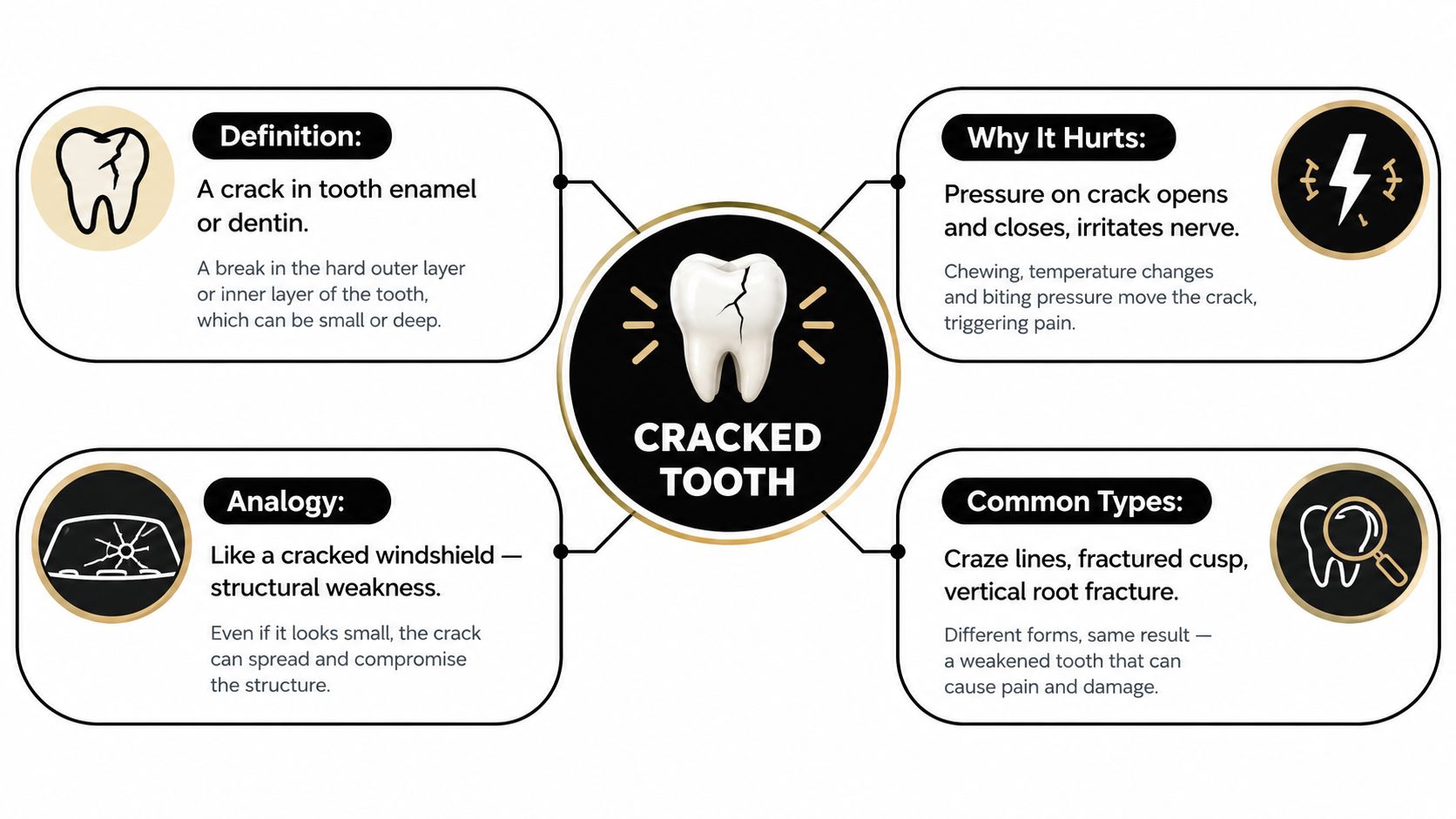
Crack types in plain language
- Craze lines: Tiny enamel lines that often don't cause symptoms or threaten the tooth's structure.
- Fractured cusp: A piece of a chewing surface breaks away, sometimes around a large filling. The pulp may remain unaffected.
- Cracked tooth: A line travels from the chewing surface toward the root. The tooth may still be treatable, but the crack needs careful evaluation.
- Split tooth: The tooth has separated into distinct segments. A crown alone may not be able to reunite or preserve all of the pieces.
- Vertical root fracture: The crack begins in or travels through the root. This pattern can carry a poorer prognosis and may lead to extraction.
Enamel is the hard outer layer. Dentin lies beneath it and contains tiny channels that can transmit temperature changes toward the nerve. If the crack reaches the pulp, inflammation can cause lingering sensitivity, spontaneous aching, or discomfort that becomes harder to localize.
Symptoms worth reporting
Tell a Walnut Creek dentist whether your pain occurs with biting, release, cold, heat, or no trigger at all. Intermittent symptoms can be just as important as constant pain because cracks may open only under certain forces. Swelling, a bad taste, gum tenderness, or facial swelling raises the urgency and may require emergency dental services.
Protecting a cracked tooth also protects everyday well-being. Pain can affect eating, sleep, concentration, and willingness to smile. A careful diagnosis helps separate a harmless enamel line from a structural problem that needs restorative dentistry.
When a Crown Can Save a Cracked Tooth
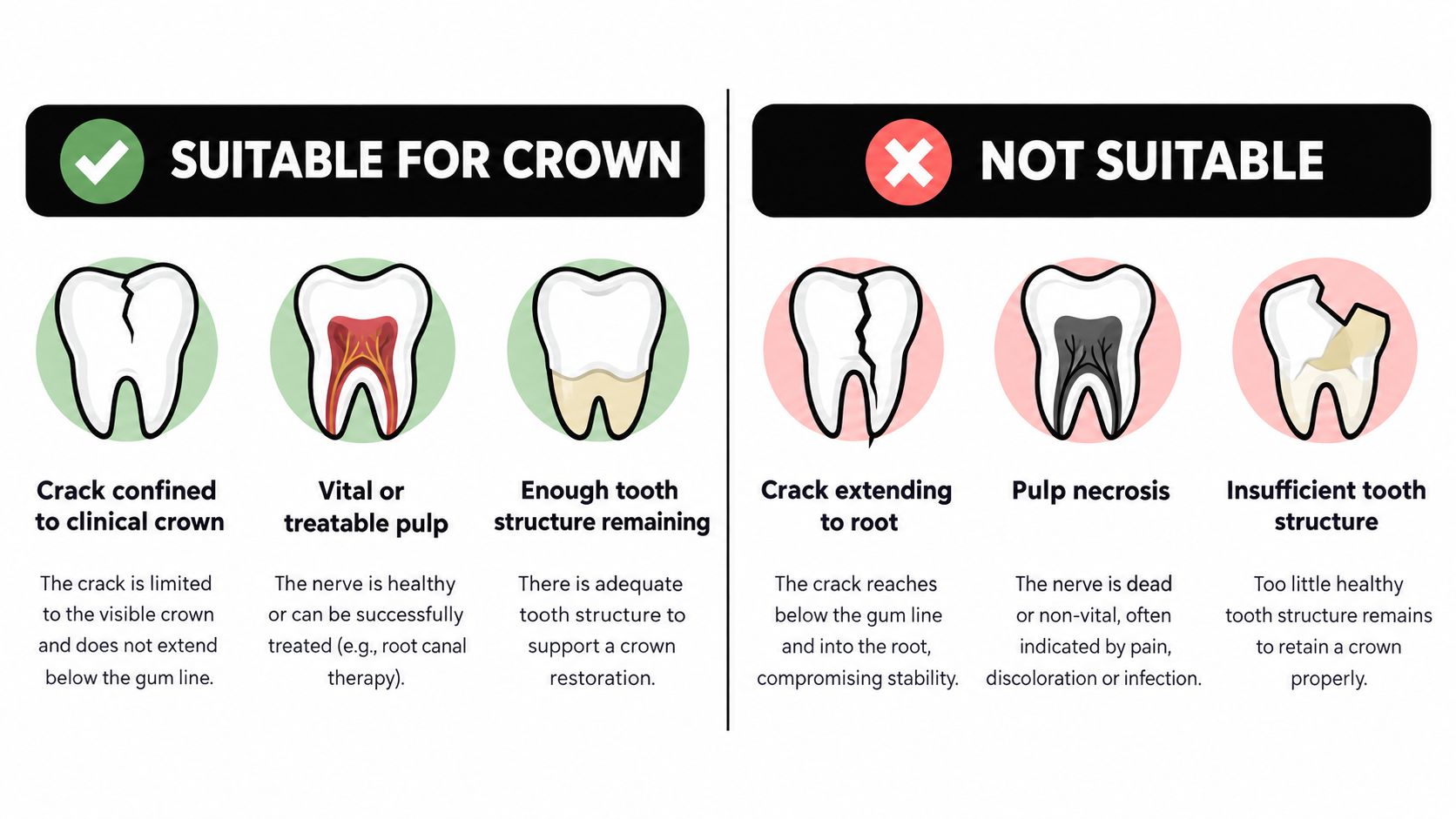
The central decision isn't whether a crown can cover the tooth. It's whether the tooth has enough healthy structure and a favorable crack pattern for that coverage to stabilize it. A crown is more likely to help when the crack is confined to the clinical crown, the pulp is vital or treatable, and the dentist can create a secure foundation.
A full crown covers the visible tooth and protects the cusps, the raised parts that absorb chewing forces. Cuspal coverage matters because a direct filling may repair a missing area without preventing the remaining cusps from flexing apart. An onlay can cover selected cusps while preserving more tooth structure, which may make it appropriate for some vital, symptomatic cracked teeth. Observation can also be reasonable for select asymptomatic cracks, according to a 2024 systematic review (systematic review of cracked-tooth treatment).
Comparing the main choices
| Treatment Option | Best For | Key Limitation |
|---|---|---|
| Full crown | A restorable tooth with a spreading crown crack, weakened cusps, or a tooth treated with root canal therapy | Requires reshaping the tooth and may remove more structure than an onlay |
| Onlay | Some symptomatic vital cracked teeth where selected cusps need coverage | May not protect the entire tooth when the crack pattern is extensive |
| Direct restoration | Minor damage or narrowly spreading cracks with limited symptoms | Without cuspal coverage, it may leave the tooth vulnerable to pulpal complications and further structural failure |
| Observation | Select asymptomatic cracked teeth after professional diagnosis | Doesn't stabilize a crack that is progressing or causing significant symptoms |
| Extraction and replacement | A tooth with an unfavorable root crack or insufficient restorable structure | Removes the natural tooth and may require replacement planning |
The AAE states that cracked teeth require a crown as part of treatment, while also noting that not all cracked teeth require root canal therapy. A temporary crown may be appropriate while symptoms settle in cases of reversible pulpitis (AAE clinical guidance). That distinction prevents two common mistakes: assuming every cracked tooth is hopeless, or assuming every cracked tooth needs immediate root canal treatment.
For a broader explanation of indications, read when a dental crown may be needed. William M. Schneider, DDS can assess whether restorative dentistry, a dental crown, an onlay, or a replacement plan involving dental implants near me best fits the tooth's condition.
What to Expect During Diagnosis and Crown Treatment
A cracked-tooth appointment begins with listening. You'll describe when the pain occurs, whether cold sensitivity lingers, and whether you've noticed grinding, clenching, an old filling, or an injury. During a new patient exam, Dr. Schneider reviews your dental history and examines the tooth, neighboring teeth, gums, and bite.
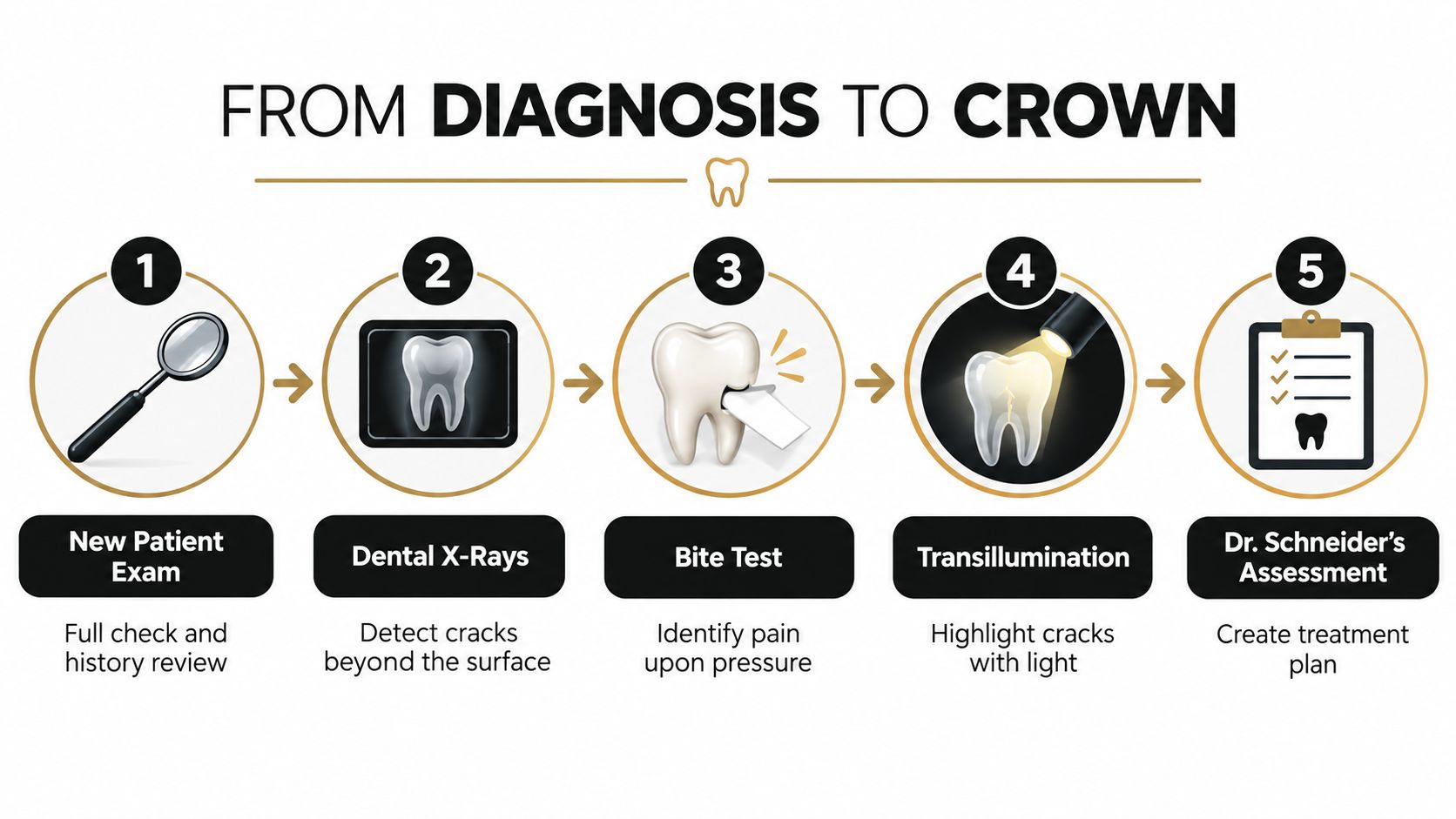
Diagnosis comes before the cap
Dental x-rays help evaluate the tooth and surrounding bone, although a crack may not appear directly on an image. A bite test can identify the specific cusp that hurts under pressure. Transillumination sends a bright light through the tooth, sometimes making a crack easier to see by changing how light passes through the enamel and dentin.
Pulp testing helps determine whether the nerve is healthy, reversibly inflamed, irreversibly inflamed, or no longer vital. The findings guide the sequence. A vital tooth may need protective cuspal coverage without root canal therapy, while a tooth with irreversible pulp damage may need root canal treatment before the permanent crown.
Stabilization and placement
If the tooth needs protection while symptoms are monitored or treatment is completed, the dentist may smooth a rough edge, adjust a high bite spot, or place a temporary crown. Cleveland Clinic describes a dental crown as a cap over a cracked tooth and notes that providers may adjust rough edges and high bite areas before placing a porcelain or ceramic crown (Cleveland Clinic fractured tooth information).
For definitive treatment, the tooth is prepared to receive the restoration. Digital impressions or other modern impression methods record the shape, and the laboratory or office system uses that information to create a crown that fits the bite and neighboring teeth. A porcelain crown can restore the tooth's contour while matching the surrounding smile.
You can read more about what a dental crown procedure involves. At 1855 San Miguel Dr., care includes explanations before each step, painless injections when appropriate, and sedation options for suitable patients with dental anxiety.
Prognosis Risks and How Quickly to Seek Care
The sooner a dentist evaluates a symptomatic crack, the sooner the tooth can be protected from ordinary chewing forces. Timing doesn't guarantee that every tooth can be saved, but it gives the dentist a better opportunity to identify the crack before it reaches an unfavorable area or the pulp becomes severely compromised.
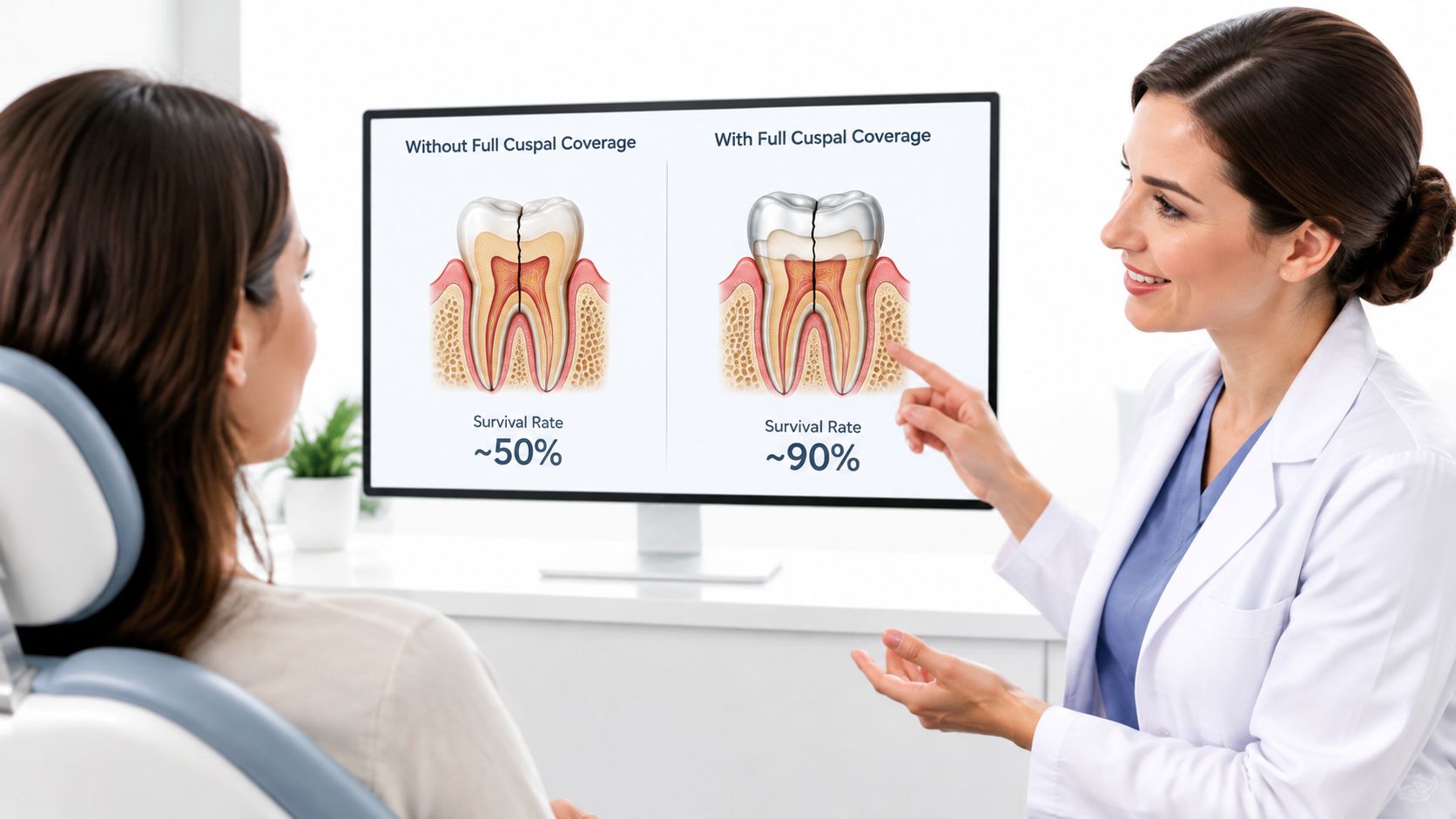
Evidence supports the protective role of full coverage. A review of cracked-tooth treatment found that restorations with cuspal coverage had no reported failures over 7 years, while restorations without cuspal coverage had a mean annual failure rate of 6% (history and review of dental trauma). The same review reported pulp survival rates of 81% to 100% at 1 to 3 years in studies using crowns and overall tooth survival of 96% to 100% over as long as 5 years. These findings describe study results, not a promise for an individual tooth.
Signs that need urgent attention
Contact an emergency dentist promptly if you have:
- Rapidly increasing pain: Especially pain that starts without chewing or prevents sleep.
- Swelling: Swelling in the gum, cheek, or face can signal infection or significant inflammation.
- Fever or feeling unwell: These symptoms should be reported rather than managed only at home.
- A loose or displaced piece: A mobile fragment can worsen the injury during eating.
- Trouble swallowing or breathing: Seek urgent medical attention for these symptoms.
Until you're examined, choose softer foods and chew on the opposite side. Don't test the tooth repeatedly, bite ice, or place unapproved substances inside the crack. Follow medication-label directions and ask a healthcare professional or pharmacist about pain relief if you have medical conditions, take other medicines, or aren't sure what's safe.
A deep crack below the gumline, an unhealthy pulp, or inadequate remaining tooth structure can reduce the chance of successful crowning. A Walnut Creek dentist can explain those limits and discuss whether treatment should focus on stabilization, root canal therapy, extraction, or replacement.
Cost Insurance and Your Visit With William M Schneider DDS
The cost of capping a cracked tooth depends on the examination findings and the treatment sequence. A crown may not be the only service involved. If the pulp needs root canal therapy, or if the tooth can't be restored and requires extraction followed by an implant, the overall plan changes.
Dental insurance often handles restorative treatment according to the individual policy, waiting periods, deductibles, annual limits, exclusions, and coverage category. The dental office can review available benefits and explain what the plan may contribute, but your insurer makes the final determination. Ask for a written estimate that separates the exam, dental x-rays, temporary restoration, root canal treatment if needed, crown, and any replacement procedure.
A visit designed around clarity
William M. Schneider, DDS offers general, cosmetic, and restorative dental care in Walnut Creek, including cleaning and exams, crowns, root canals, bridges, dental implants, Invisalign, and teeth whitening. Patients seeking a cosmetic dentist near me can also discuss appearance-focused care, but a painful crack should first receive a structural and pulpal evaluation.
The practice serves Walnut Creek and the broader East Bay community from 1855 San Miguel Dr., Suite 31. New patients can expect transparent treatment planning, convenient online appointments and payments, modern technology, meticulous infection control, accessibility accommodations, and a friendly environment shaped around comfortable care.
More than 25 years of experience informs the practice's approach, supported by Dr. Schneider's University of Minnesota education and advanced training in General Dentistry in San Francisco. Painless injections, clear explanations, and sedation options when appropriate can make the process easier for patients who feel nervous about dental treatment.
Patients without insurance should still ask about payment arrangements and staged care. The most useful first step is a focused examination, because the appropriate restoration cannot be selected reliably from symptoms or a photograph alone.
Protect Your Smile and Schedule Your Consultation Today
A cracked tooth can affect more than one spot in your mouth. It can change how you chew, make cold drinks uncomfortable, disturb sleep, and create uncertainty about whether a natural tooth can be preserved. Appropriate coverage can restore the tooth's shape and function, while diagnosis of the pulp determines whether root canal treatment is needed.
Capping is often possible, but the cap may be a full crown, an onlay, or a temporary restoration while the tooth is monitored. The decision should reflect crack depth, symptoms, pulp health, bite forces, and the amount of remaining tooth structure. That individualized approach avoids treating every crack as identical.
Timely dental care also supports the rest of your mouth. Stabilizing a weakened tooth can make eating more comfortable, reduce the risk of further breakage, and help you maintain a healthy, bright smile. If the tooth can't be saved, a thoughtful plan may include tooth extraction and dental implants rather than leaving a gap untreated.
Walnut Creek families and professionals can seek evaluation, preventive cleaning and exams, cosmetic services, and restorative treatment in one local setting. If you're searching for a dentist near me, an emergency dentist, or a dentist in Walnut Creek, CA, don't wait for biting pain to become constant. Schedule a consultation so you can understand your options and choose the next step with confidence.
William M. Schneider, DDS offers cracked-tooth evaluations, dental crowns, root canal care, and other restorative services for patients in Walnut Creek and the East Bay. Visit William M. Schneider, DDS to request a consultation and take the first step toward comfortable care and long-term protection for your smile.