You bite into a piece of toast and feel a sharp jolt from one back tooth. Or you notice that an old dark spot has grown, a filling has cracked, or cold drinks now trigger pain that lingers. These symptoms don't always mean you need a crown, but they do mean the tooth deserves a careful examination.
A dental crown is a custom cap that covers and protects a weakened tooth, restoring its shape, strength, and ability to chew. The right question isn't just, “Can this tooth receive a crown?” It's when do you need a dental crown, and when would a filling, onlay, bonding, or monitoring preserve more healthy tooth structure?
For patients searching for a dentist near me, a dentist in Walnut Creek, CA, or an emergency dentist for a cracked tooth, William M. Schneider, DDS provides evaluations focused on the actual condition of the tooth. The aim is straightforward, preserve the natural tooth when possible, protect it when necessary, and avoid treatment that doesn't match the clinical need.
Recognizing the Signs You May Need a Crown
A patient may arrive after noticing pain only when chewing on one side. Another may have no pain at all, but see a broken corner, a failing filling, or a tooth that has become darker. These situations can look similar from the outside while requiring very different treatment.

Symptoms that deserve timely attention
A crown may be considered when a tooth has lost enough structure that normal biting forces could split or weaken it further. Contact a Walnut Creek dental office promptly if you notice:
- Pain when biting: Pressure-related pain can occur with a crack, deep decay, or a weakened tooth.
- Temperature sensitivity: Hot or cold sensitivity may indicate exposed or damaged internal tooth structure, especially when the discomfort lingers.
- Visible damage: A fractured cusp, chipped wall, or broken restoration can leave the tooth unable to support another ordinary filling.
- A large or failing filling: Older restorations can leave thin walls of tooth that flex under chewing.
- A darkened tooth: Discoloration may be cosmetic, but it can also accompany trauma, decay, or internal changes that need evaluation.
Not every chip needs full coverage. A small enamel defect may respond well to smoothing or bonding, while a deeper fracture can require a crown to hold the remaining tooth together. The distinction depends on what remains below the visible surface, not just on how uncomfortable the tooth feels today.
Practical rule: Pain that disappears doesn't prove the problem has healed. A crack or weakened tooth can become quieter while still becoming more vulnerable.
A new patient exam, visual inspection, and dental x-rays can show whether the tooth is stable enough for conservative care. If you're in Walnut Creek or the surrounding East Bay and aren't sure whether you need a crown, a second opinion can help you compare “need now” with “can safely wait.”
Clinical Reasons Dentists Recommend Crowns
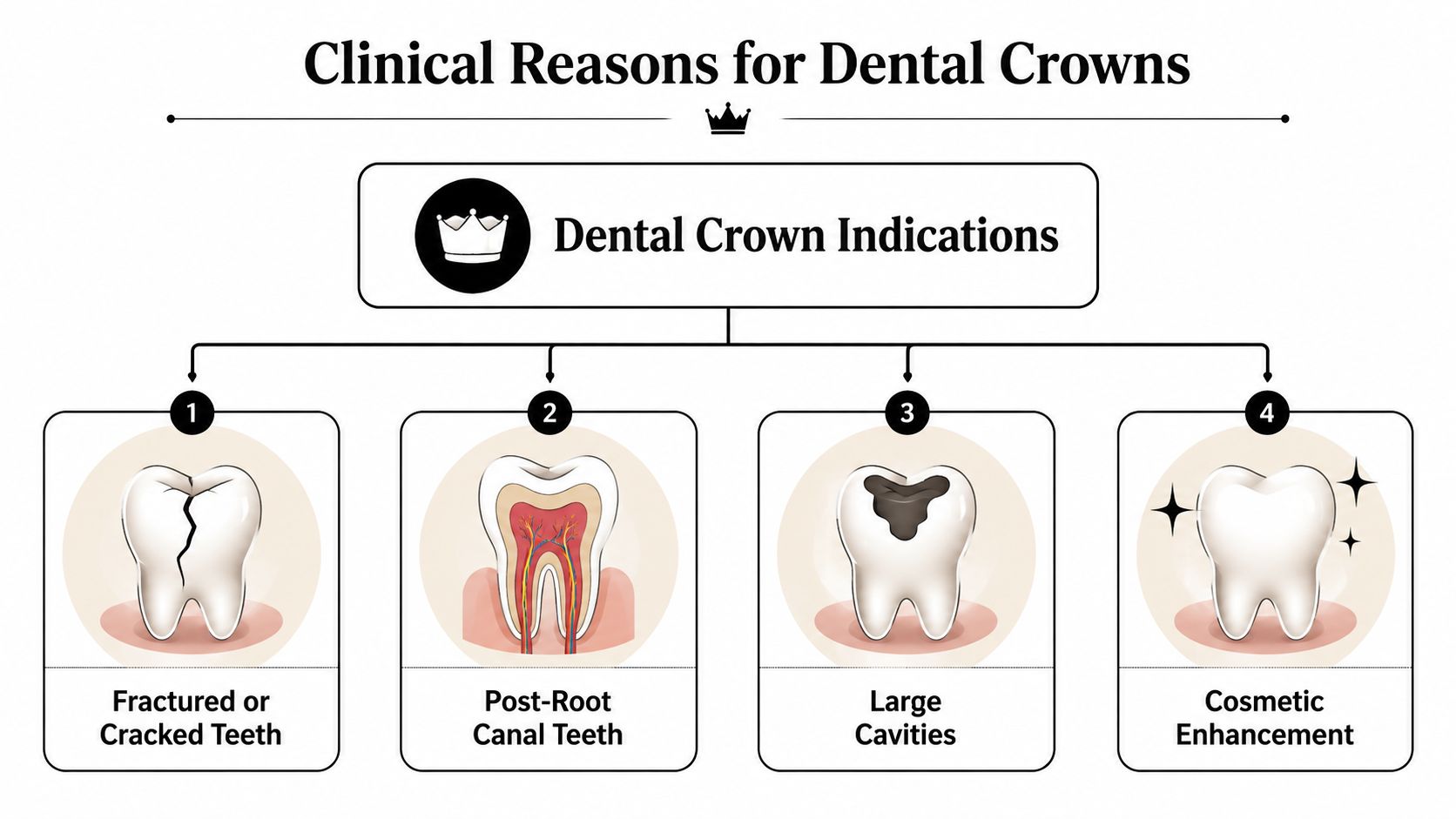
A crown becomes reasonable when the remaining tooth can no longer handle normal chewing safely with a filling or bonding alone. The clinical threshold is structural: how much sound tooth remains, whether its walls are splitting or flexing, and whether delaying protection could allow a repairable tooth to fracture. A major U.S. dentist survey published in 2016 received responses from 1,777 of 2,132 eligible dentists, an 83% response rate. Dentists most often ranked a fractured or cracked tooth, endodontic therapy, and a broken restoration among the leading reasons to recommend a single-unit crown (survey of dentists and crown indications).
Situations where a crown may protect the tooth
A fractured or cracked tooth may need full coverage when the crack reaches a load-bearing cusp or causes pain during chewing. Bonding can repair a small chip, but it cannot reliably hold together walls that separate under pressure. If the tooth is stable and the defect is limited, monitoring or a smaller restoration may be reasonable. If each bite risks extending the crack, waiting carries a different trade-off.
A tooth after root canal therapy often needs added protection when decay, the procedure, or earlier restorations have removed substantial structure. In the cited survey, 94% of dentists selected a crown for a posterior tooth that had undergone root canal treatment. Back teeth absorb substantial chewing forces, so full coverage can reduce stress on the remaining walls, though the dentist still assesses how much healthy tooth is left before recommending it.
Extensive decay may justify a crown when it compromises more than half of the natural tooth structure, or when full coverage is needed after endodontic therapy (guidance on crowns for cracked and extensively damaged teeth). A filling can replace missing material, yet thin remaining walls may continue to flex and fracture.
A broken or failing filling does not automatically require a crown. Another filling may work when strong tooth surrounds the repair. With a large restoration and thin enamel, a crown or partial-coverage restoration may provide better support while preserving more tooth than full coverage.
Severe grinding or acid erosion can remove cusps and protective enamel. A severely discolored or misshapen tooth may also receive a crown, but appearance alone is not a sufficient reason to remove sound structure. Whitening, bonding, or a veneer may be more conservative when the tooth remains strong.
How Dentists Decide If a Crown Is the Right Choice
A tooth that hurts when you bite may need protection now, while a small, symptom-free defect may allow time for observation. The decision begins with diagnosis rather than with the restoration a patient requests. The dentist reviews symptoms, examines the tooth, checks the bite, and uses dental x-rays when needed to assess decay, previous treatment, and changes below the gumline.
The remaining tooth matters most
A practical restorative benchmark is preserving or recreating about 1.5 to 2.0 millimeters of healthy tooth structure around the preparation, with an approximately 2 millimeter ferrule of sound tooth structure above the gumline when possible (technical discussion of tooth structure and crown support). This sound ring helps the crown grip the tooth and resist forces that could lead to fracture.
The measurement is only part of the decision. The dentist also considers where decay or a crack lies, how much tooth remains between the defect and the gumline, the tooth's chewing role, the bite, and whether the restoration can be sealed predictably.
If adequate support is missing, a core build-up or post-and-core may be needed before a crown can be considered. A preparation may sometimes preserve enough structure for partial coverage. If damage extends too far, extraction and replacement, such as a dental implant, may be discussed.
The clinical threshold isn't a single visual measurement. It reflects the amount of sound tooth remaining, the location and depth of damage, the forces on that tooth, and the likelihood that treatment will remain stable.
Deciding between treatment and observation
A small, superficial defect without symptoms may be monitored, repaired conservatively, or protected with an onlay. Preserving the tooth in this way avoids removing additional structure solely to fit full coverage.
Delay is harder to justify when there is pain on biting, a deep crack, recurring decay, a large restoration, or a fracture progressing toward the gumline. These findings can signal that the remaining walls are flexing under chewing forces. A crack may eventually split the tooth into portions that cannot be restored, although examination is needed to judge the risk for that individual tooth.
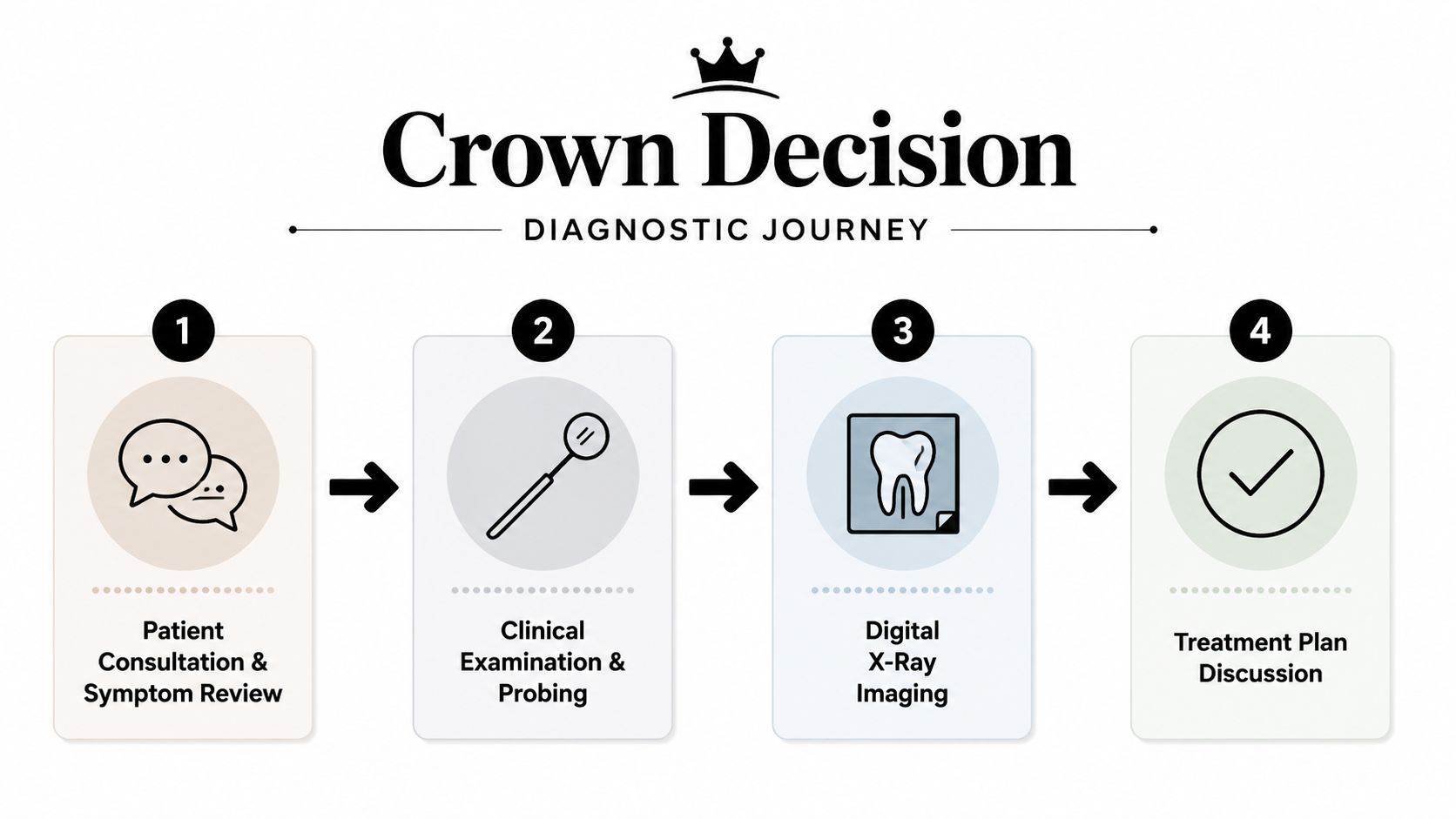
The diagnostic journey generally includes:
- Consultation: You describe when pain occurs, whether hot or cold triggers it, and how the tooth has changed.
- Clinical examination: The dentist checks tooth surfaces, gums, bite, restoration margins, and areas that flex or trap food.
- Dental x-rays: Imaging helps assess decay, bone support, root-canal treatment, and concerns hidden from a routine examination.
- Treatment discussion: You compare a crown with monitoring, a filling, an onlay, a veneer, or tooth replacement when appropriate.
Comparing Crowns to Alternative Dental Treatments
The most appropriate restoration depends on how much healthy tooth remains and what the tooth must withstand. A crown covers the tooth above the gumline, while other treatments preserve more surface structure or replace the tooth entirely.
| Treatment | Best For | Limitations |
|---|---|---|
| Crown | A cracked, heavily restored, extensively decayed, worn, or root-canal-treated tooth that needs broad structural support | Requires preparation of the tooth and isn't always the most conservative option |
| Filling | Small to moderate cavities with strong surrounding tooth structure | May not reinforce a tooth that has lost a large portion of its walls |
| Onlay | A tooth with damage concentrated in one or more cusps when healthy structure remains around it | Doesn't provide the same full external coverage as a crown |
| Veneer | A structurally sound front tooth with an appearance concern | Improves the visible surface but isn't designed to stabilize a severely weakened tooth |
| Extraction with dental implant | A tooth that can't be predictably restored or has a fracture extending too far | Requires removal of the tooth, healing, and replacement planning |
A filling is often sensible for a small cavity because it removes less healthy tooth. It becomes less convincing when the tooth has lost extensive structure, especially across multiple surfaces, because the remaining walls may continue to flex. In that situation, adding more filling material doesn't recreate the strength of intact tooth walls.
An onlay can occupy the middle ground. It may protect selected cusps while preserving more tooth than a crown, but the dentist must confirm that the remaining structure can support it. A veneer may improve the appearance of a discolored front tooth, yet it won't solve deep decay or a structural fracture. Patients comparing front tooth crowns with veneers can review this guide to the difference between a crown and veneer.
Extraction and an implant can replace a tooth that cannot be saved, but removing a restorable tooth just to avoid a crown isn't conservative care. A consultation should address whether preservation is predictable before discussing tooth extraction, dental implants near me, or other replacement options.
What to Expect During the Crown Procedure
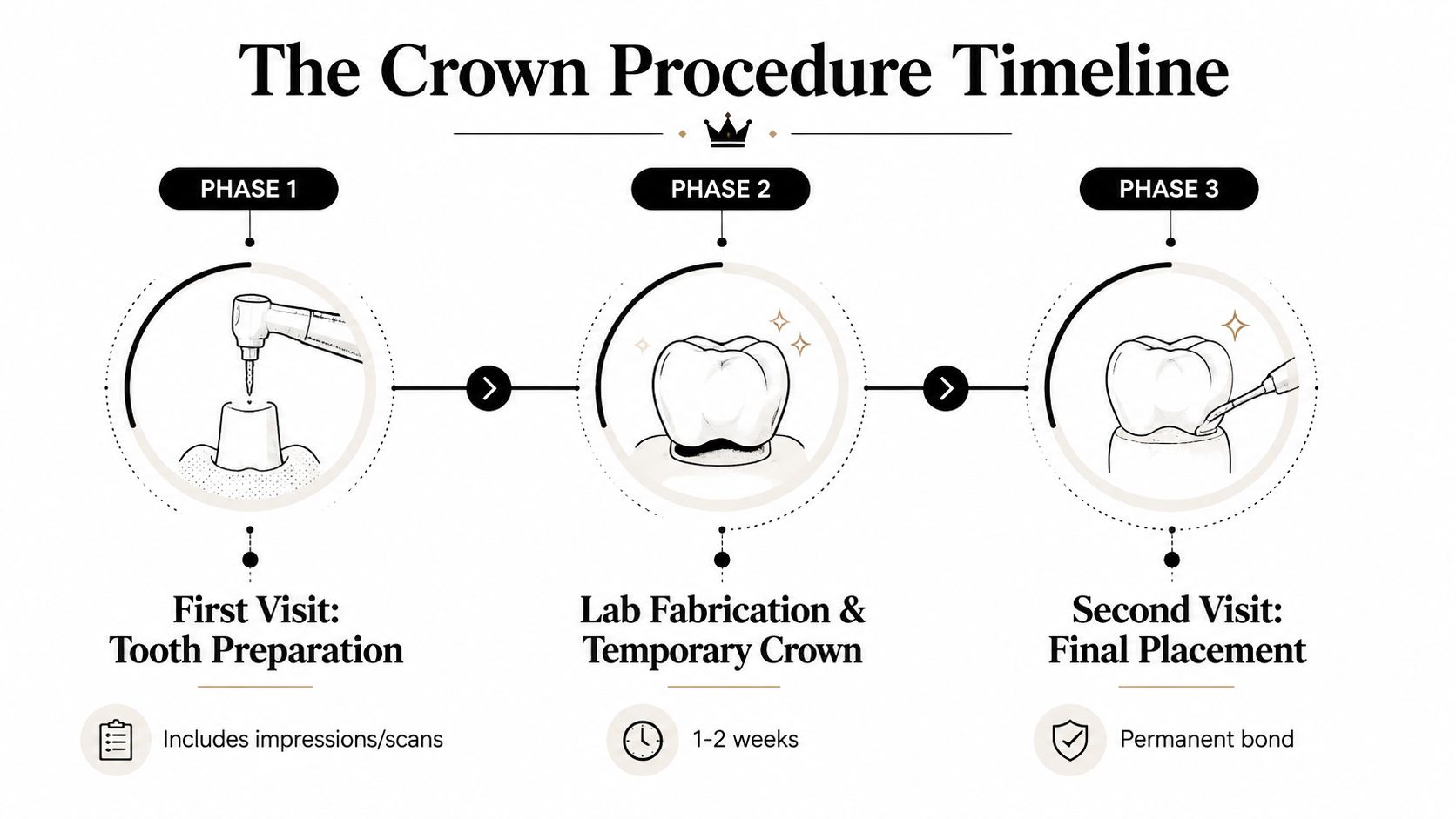
Crown treatment is usually planned around the condition of the tooth and the type of restoration selected. Many patients have two main visits, although a same-day digital workflow may be available for some cases.
The first visit
The dentist numbs the area, removes decay or compromised restoration material, and shapes the tooth so the crown can fit over it. If the tooth needs additional support, a core build-up or another foundation procedure may be discussed before the final restoration.
The office then records the prepared tooth with impressions or a digital scan. A temporary crown protects the tooth while the permanent crown is being made and helps you maintain ordinary function with some care.
Temporary crowns can feel different from natural teeth, especially around the gumline or when you bite. Avoid extremely hard or sticky foods that could loosen the temporary, and contact the office if it moves, feels high, or causes significant discomfort.
The waiting period is commonly about 2 to 3 weeks, although timing varies with the treatment plan and may be longer when extensive dental work or an implant is involved (temporary and permanent crown timing).
The second visit
At the final appointment, the temporary crown is removed and the permanent crown is tried in. The dentist checks the margins, appearance, contacts with neighboring teeth, and bite before cementing it in place. A minor bite adjustment can make a noticeable difference in comfort.
Digital dentistry is also changing the process. Coverage published in 2026 reported that 3D-printed zirconia crowns had been reduced from as much as 100 hours of processing to under 30 minutes (2026 coverage of 3D-printed zirconia crown workflow). That technology may suit selected cases, but speed doesn't replace diagnosis, proper fit, careful bonding, or a discussion of long-term maintenance.
Patients with dental anxiety can ask about comfort measures and sedation options when appropriate. Clear explanations, effective local anesthetic, and a paced appointment often make the procedure more manageable than patients expect.
Understanding Crown Costs and Insurance Coverage
The cost of a crown depends on the tooth, the material, the preparation, and the care needed beforehand. A tooth that only needs preparation has a different financial plan from one requiring a root canal, core build-up, post-and-core, gum treatment, or emergency care before restoration.
Material choices can include porcelain, zirconia, metal-ceramic, or other options selected for strength, appearance, and location in the mouth. A front tooth may place greater emphasis on shade and translucency, while a back molar may require a material and design suited to heavier chewing forces. The dentist should explain why a particular material fits your bite and clinical needs rather than presenting appearance as the only factor.
Dental insurance often treats crowns as restorative care when they're medically necessary, rather than as elective cosmetic dentistry. One independent insurance explainer says typical coverage is about 50% for a medically necessary crown, not a cosmetic crown (dental insurance coverage for crowns). Actual benefits vary, so confirm the details of your plan before treatment.
Ask the dental office and insurer:
- Benefit classification: Is the proposed crown considered restorative or cosmetic?
- Patient responsibility: What portion remains after the plan's benefit is applied?
- Additional treatment: Are the root canal, foundation, x-rays, or temporary restoration covered separately?
- Timing rules: Does the plan require a waiting period, preauthorization, or documentation of medical necessity?
A transparent consultation should connect the clinical recommendation with a written estimate. That lets you compare immediate protection with a conservative alternative without allowing cost uncertainty to decide a tooth's treatment by surprise.
Caring for Your Crown and Scheduling Your Visit
Treat a crowned tooth like an important part of your natural smile. Brush and floss around it normally, clean carefully along the gumline, and attend regular cleaning and exams so the crown, neighboring teeth, and gums can be checked together. Avoid using your teeth to open packages or chewing extremely hard objects, particularly if you have a history of grinding.
More detailed guidance is available in this resource on how to care for dental crowns. A crown can protect weakened structure, but it doesn't make the surrounding gums immune to inflammation or the tooth immune to decay at its margin.
Call a dentist promptly if the crown feels loose, pain persists, your bite suddenly feels different, or the tooth becomes sensitive in a new way. A cracked tooth with swelling or severe pain may require emergency dental services, while a routine concern may fit a new patient exam or restorative consultation.
Whether you're searching for a cosmetic dentist near me, planning dental implants near me, or looking for a Walnut Creek practice for crowns, root canals, tooth extraction, teeth whitening, and ongoing dental care, William M. Schneider, DDS serves Walnut Creek and the broader East Bay community with more than 25 years of experience. The practice offers personalized treatment planning, anxiety-friendly care, comfortable injections, and sedation options when appropriate.
Schedule a crown evaluation with William M. Schneider, DDS in Walnut Creek if you have pain when chewing, a cracked tooth, a large filling, or a recommendation you're unsure about. The practice can assess whether you need a crown now, can safely consider a more conservative restoration, or need urgent care to protect the tooth.