Clear aligners and braces often overlap in cost, with many Walnut Creek patients seeing either option fall somewhere between $3,000 and $8,500. The right choice usually depends more on your teeth, bite, and daily routine than on a big price gap.
A lot of people start this search because they want a straighter smile, but they also want clarity. The numbers online can feel contradictory, especially when one quote sounds like a bargain and another looks far higher once the treatment plan is personalized. In Walnut Creek, CA, that uncertainty is common, and it's exactly why a careful cost comparison matters before you commit to either clear aligners or braces.
| Feature | Clear Aligners | Traditional Braces |
|---|---|---|
| Typical U.S. price range | $3,000 to $8,500 | $3,000 to $7,500 |
| Common pricing pattern | Often overlaps braces, especially in moderate cases | Often overlaps aligners, especially when treatment is straightforward |
| Best-known strength | Discreet appearance and removability | Strong control for more complex tooth movement |
| Main trade-off | Requires consistent wear | Visible and less removable |
| Cost driver | Case complexity, system used, refinements | Case complexity, material choice, adjustment needs |
Your Guide to Orthodontic Costs in Walnut Creek CA
A Walnut Creek professional might want straighter teeth for confidence at work, or a parent may be comparing options for a teenager who's ready for treatment. The first question is usually cost, but the deeper question is value. You're not just buying an appliance, you're paying for a plan that has to fit your teeth, your lifestyle, and your follow-through.
At William M. Schneider, DDS, that conversation starts with the reality that there isn't one “cheap” option for everyone. In today's market, traditional braces and clear aligners often overlap in price rather than one being dramatically cheaper, which is why a simple label doesn't tell the full story (ConsumerAffairs average braces cost overview).
Why the same smile can carry different prices
Two people can both ask for straighter teeth and receive very different plans. One may need only mild spacing correction, while another needs bite correction and more complex tooth movement. That difference changes the number of visits, the amount of lab work, and the total treatment time.
Practical rule: the price you hear in the first conversation is a starting point, not the final answer.
That's why a Walnut Creek patient who gets one quote for aligners and another for braces shouldn't assume the lower number is automatically the better deal. The most useful question is which option gives the right result with the least friction for your life. For some people, convenience matters most. For others, predictability does.
What Determines Your Total Orthodontic Treatment Cost
Orthodontic pricing makes more sense once you break it into parts. The appliance itself matters, but it's only one piece of the total. What really changes the final number is how much work your teeth need and how long that work takes.
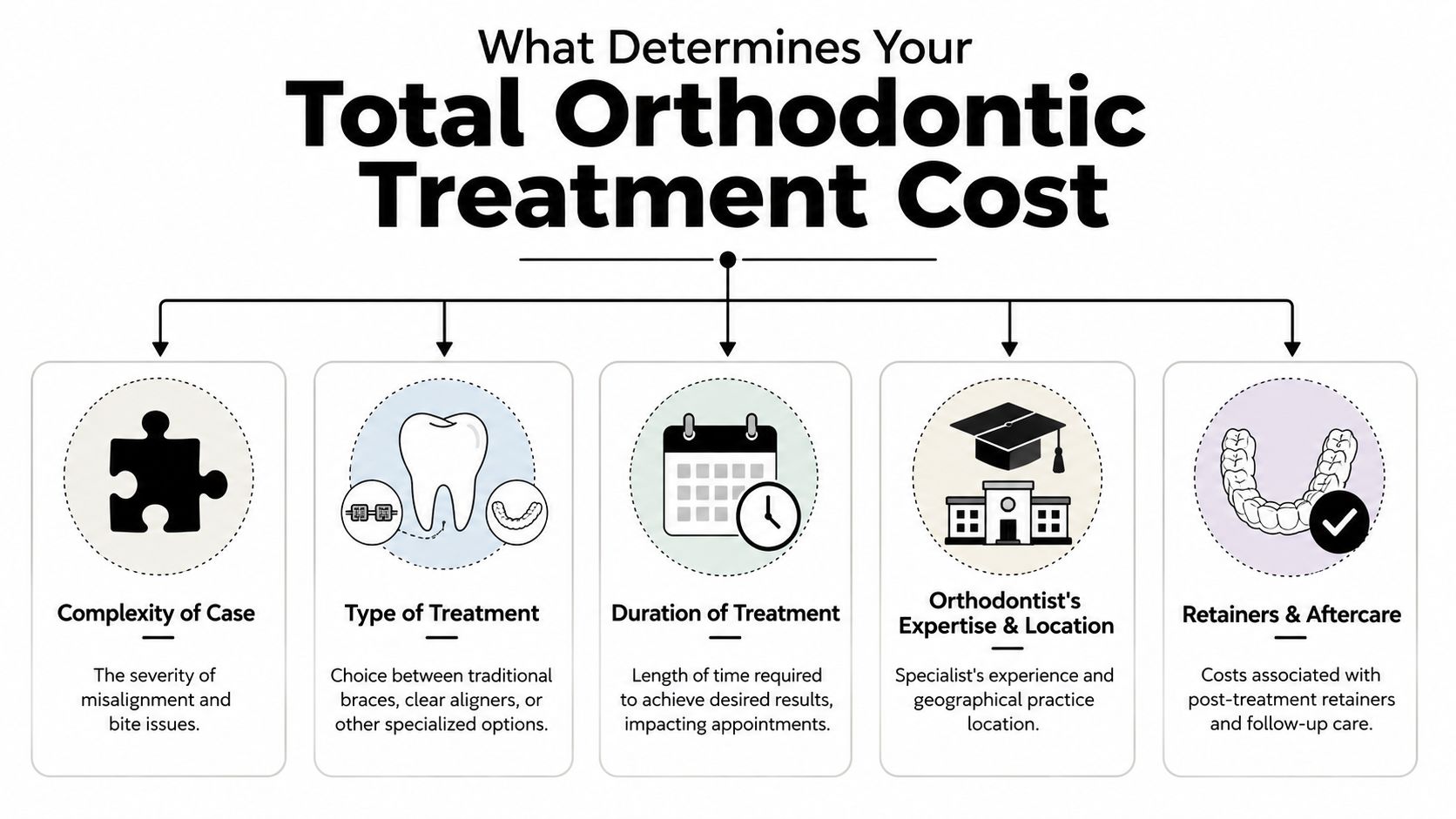
The main cost drivers
Complexity of the case is usually the biggest variable. Mild crowding and small spacing issues are different from severe bite corrections or extraction-based treatment. More complex movement usually means more appointments, more refinements, and a more customized plan.
Type of treatment also matters. A 2026 comparison reports that metal braces generally run $3,500 to $5,500, ceramic braces $4,500 to $6,500, and Invisalign clear aligners $4,500 to $8,500, which shows how system and material choices create overlapping price bands (cost by type comparison).
Duration of treatment affects value too. Longer treatment can mean more check-ins and more opportunities for refinements. That's one reason some aligner plans look affordable at first but become more expensive when the case is harder than it seems.
Expertise and location influence pricing because experienced care and local overhead are built into the fee. In a market like Walnut Creek and the broader East Bay, that's part of the normal pricing structure.
Retainers and aftercare matter because orthodontic treatment doesn't end the day the brackets come off or the last tray is worn. Retention protects the result, and that should be part of the budget from the start.
You can also use the practice's treatment planning resources, including how long Invisalign takes, to think through how time and cost often move together.
Clear Aligners vs Braces A Detailed Cost Comparison
A Walnut Creek patient comparing clear aligners vs braces cost usually finds that the primary distinction is not a single sticker price, but how the treatment performs once daily life starts. The quoted ranges often overlap, with traditional metal braces around $3,000 to $7,500 and clear aligners around $3,000 to $8,500. Many providers also cite a typical braces average of about $5,000 to $6,000, which shows how much the final fee depends on the case rather than the appliance alone.
| Cost and Feature Comparison: Clear Aligners vs. Traditional Braces | Clear Aligners | Traditional Braces |
|---|---|---|
| Typical cost range | Often $3,000 to $8,500 | Often $3,000 to $7,500 |
| Cost pattern | Can be lower in straightforward cases, but not always | Often competitive in both simple and complex cases |
| Aesthetic appearance | Nearly invisible in day-to-day conversation | Visible, with ceramic options being less noticeable |
| Daily use | Removed for eating and brushing | Fixed in place all day |
| Treatment control | Depends on consistent wear | Continuous force from bonded brackets and wires |
| Best use case | Mild to moderate crowding or spacing | Broad range of cases, especially more complex movement |
What the table means in real life
A lower starting quote for aligners can still become a higher final bill if the case needs refinements, extra trays, or a premium system. Braces may appear more expensive at the start, yet they often stay steadier when the treatment plan is simple and the mechanics are predictable.
That difference matters in practice. A patient who wants the lowest upfront number may be drawn to aligners, while someone who wants fewer decisions day to day may find braces easier to live with. In my office, I look at the cost of the appliance, the number of visits likely needed, and how much control the system gives us over the final result.
Worth keeping in mind: the least expensive treatment is the one that finishes well the first time.
For mild to moderate cases, a side-by-side orthodontic comparison reports 88 to 90% success rates for both Invisalign and traditional braces, while also noting that fixed appliances remain the clinical gold standard for severe bite correction and complex movement (side-by-side orthodontic comparison). That does not make one option universally better, but it does show why price has to be weighed against the type of movement your teeth need.
The Hidden Value Aesthetics Lifestyle and Long-Term Results
The lowest quote on paper is not always the best value in daily life. In Walnut Creek, some patients care most about how treatment looks during client meetings, school events, or photos. Others care more about not having to think about their appliance every day and want treatment to keep moving with as little attention as possible.

Lifestyle trade-offs that change the value
Clear aligners appeal to many adults because they are removable. Eating is simpler, brushing is easier, and the trays are less noticeable during meetings, dinners, and everyday conversations. The trade-off is consistency, because aligners only work well when they are worn as directed.
Braces offer a different kind of value. They stay in place, so you do not have to remember to put them back after every meal or snack. That fixed control can be a better fit when the bite is complex or when the treatment plan needs steady force throughout the day.
Treatment time also affects value. In some cases, aligners may take longer than braces, especially when extractions are part of the plan. In simpler cases, both options can move efficiently, but the exact timeline depends on how much tooth movement is needed and how well the patient follows the treatment plan.
What matters most to many patients
- Appearance: Clear aligners are less visible in conversation and photos.
- Convenience: Aligners come out for meals and brushing.
- Consistency: Braces keep working without daily reminders.
- Complexity: Braces are often the more reliable choice when movement becomes more involved.
The right investment is the one that fits your teeth and your routine. If you will wear aligners faithfully, they can be a very practical solution. If you already know compliance will be a challenge, braces may offer better value because they remove the guesswork.
For patients comparing a local estimate, this Invisalign treatment cost resource can help frame how appliance choice, treatment length, and overall fee work together.
Navigating Insurance and Financing in Walnut Creek
Orthodontic costs feel more manageable when you know how insurance usually works. Many dental plans treat Invisalign the same way they treat braces, and Invisalign's consumer guidance says orthodontic coverage may pay up to $3,000 toward treatment (Invisalign cost guidance). That means the appliance type often matters less to your insurer than the plan limits, your diagnosis, and the total treatment fee.
How to think about your out-of-pocket amount
The primary question is how much of the plan cost your insurance will absorb. A plan with a lifetime orthodontic maximum can reduce both braces and aligner bills in a similar way. In many cases, the difference you pay depends more on the total fee and benefit cap than on whether you choose trays or brackets.
That's why it helps to ask for a written estimate before starting. If you know the proposed fee, the insurance contribution, and any remaining balance, you can compare the options clearly instead of guessing. A useful local reference point is the cost of Invisalign treatment, which can help you think through how insurance and treatment type interact.
Ways Walnut Creek patients often make treatment fit the budget
- Dental insurance: Check whether orthodontic benefits apply to both braces and aligners.
- HSA or FSA funds: These can be used for eligible dental expenses.
- Monthly financing: Spreading payments out can make treatment easier to manage.
- Phased treatment planning: In some cases, care can be staged to match clinical needs and budget realities.
At William M. Schneider, DDS, financing and treatment planning are part of the conversation from the start. That matters because a well-planned case should feel understandable, not mysterious. If you're comparing the cost of a smile upgrade with other priorities in life, transparency makes the decision much easier.
Your Orthodontic Consultation at Our Walnut Creek Office
A first visit shouldn't feel like a sales pitch. It should feel like a clear, calm conversation about what your teeth need and what your budget can handle. In Walnut Creek, a good consultation gives you a direct answer, not a vague promise.
The appointment usually begins with a review of your goals, then a clinical exam and imaging so the treatment plan matches what's present in your mouth. Digital records, X-rays, and a careful look at your bite help show whether clear aligners, braces, or another approach makes the most sense.
Here's the kind of experience patients often appreciate most at a local office:
- Clear explanation: You hear what's going on in plain language.
- Personalized options: You see which treatment fits your case.
- Upfront cost discussion: You understand the likely financial range before deciding.
If you're also managing other dental needs, the same visit can help connect orthodontics with preventive care, cosmetic dentistry, or restorative planning. Some patients are focused on alignment, while others are also thinking ahead to teeth whitening, crowns, or future dental implants, and it helps when one practice can coordinate the big picture.
The consultation should leave you with a real plan and enough information to choose confidently. It's also the point where a trusted Walnut Creek office, like William M. Schneider, DDS, can help separate what's medically necessary from what's optional.
A short video can also help patients visualize the process before they book:
Making the Right Choice for Your Smile and Budget
There isn't a universal winner in the clear aligners vs braces cost conversation. Clear aligners can be a strong fit when you want discretion, easier eating, and a removable option that fits an active routine. Braces can be the better value when the bite is complex, the movement is harder, or you want a fixed system that doesn't rely on daily discipline.
The most important point is this, the price tag should never be considered without the result it buys. A treatment that looks cheaper today but takes longer, needs more refinements, or doesn't fit your habits can end up feeling more expensive in practice. A plan that looks less flashy may be the one that gives you the most predictable, lasting result.
If you're comparing options in Walnut Creek or anywhere in the East Bay, the smartest next move is a personalized consultation. You'll get a clearer diagnosis, a more accurate estimate, and a recommendation based on your teeth instead of a generic price list.
A CTA for William M. Schneider, DDS.