A missing tooth can change more than your smile. It can make chewing feel uneven, draw attention every time you laugh, and leave you wondering whether the replacement you choose will last.
That's why the numbers matter. Dental implants consistently demonstrate high short-to-mid-term success rates, with large-scale studies and systematic reviews reporting success rates between 94% and 98% at the five-year mark for single implants, according to research summarized here. For anxious patients in Walnut Creek, CA, that statistic reframes the conversation. The question usually isn't whether implants can work. The better question is how to give your implant the best chance to work well for many years.
That answer is never one-sided. Good implant outcomes come from a partnership. Your dentist handles diagnosis, planning, surgical technique, and restoration design. You handle healing, hygiene, and follow-up care. When both sides do their part, implants remain one of the most dependable options in restorative dentistry.
If you've been searching for a dentist near me, dental implants near me, or a dentist in Walnut Creek, CA because you're tired of hiding a gap in your smile, this is what you should know before moving forward.
Dental Implants Near Me in Walnut Creek for a Lasting Smile
More than 9 out of 10 single dental implants are still performing well at five years in large clinical reviews. For patients in Walnut Creek, that is a reassuring place to start, but it is not the whole story.
In practice, strong implant outcomes come from a partnership. My team handles diagnosis, 3D planning, precise placement, and restoration design. You help determine the long-term result by following healing instructions, keeping the area clean, and showing up for maintenance visits. That shared effort is what gives an implant the best chance to serve you for many years.
Patients usually ask a very reasonable question: will this last for me?
The answer depends on more than the implant itself. Bone quality, gum health, bite pressure, smoking, medical history, and daily home care all affect the outcome. A well-placed implant in a patient who keeps regular follow-ups tends to behave very differently from an implant placed without careful planning or left unmonitored after treatment.
Why replacing a missing tooth matters
A gap in your smile can create problems that build over time:
- Chewing can become uneven, which places extra force on nearby teeth
- Speech can change, especially if the missing tooth affects tongue position
- Bone in the area can shrink, because it no longer receives normal stimulation
- Confidence often drops, and many patients start smiling less or avoiding photos
I see this often after an extraction, a cracked tooth that could not be saved, or years of frustration with a partial denture. Some patients begin by searching for an emergency dentist, tooth extraction, or a cosmetic dentist near me. Then they realize they want a replacement that feels more stable and more natural in daily life.
Why staying local helps
Implant treatment is not a one-visit event. It includes planning, placement, healing, restoration, and years of maintenance. Keeping that care close to home in Walnut Creek makes follow-up easier, lets us catch small issues early, and keeps your implant care connected to your regular dental visits.
A lasting result comes from consistency.
If you are comparing options, it helps to review how long dental implants can last and what affects their lifespan. For many patients, that practical information lowers the anxiety. Implants have a strong record, and the best results usually come from careful planning on our side and steady care on yours.
Understanding Implant Success vs Survival Rates
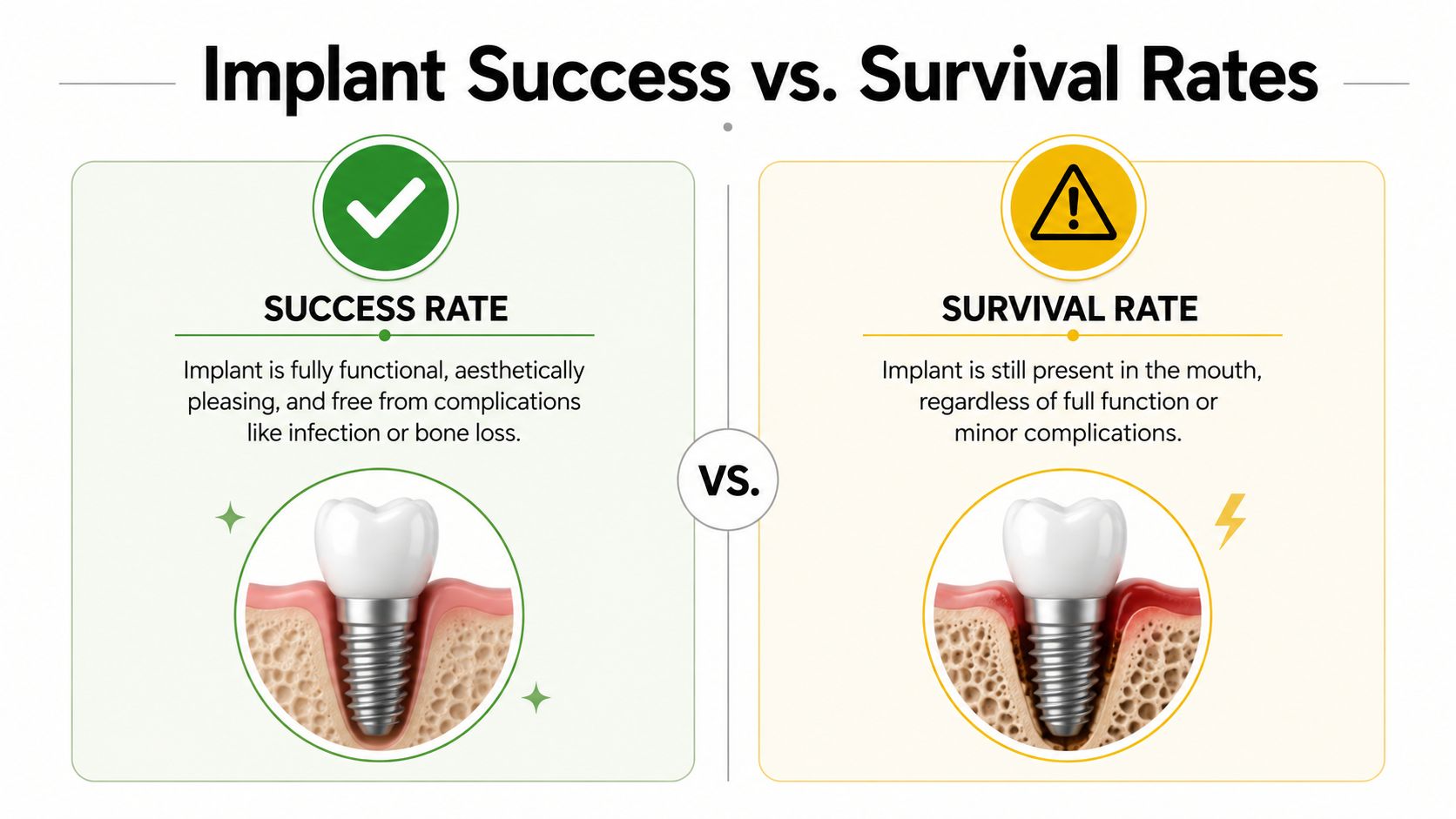
Many implant articles blur two very different ideas: survival and success. Patients deserve a clearer explanation because those words don't mean the same thing.
An easy analogy is a car. A car can still run, which means it survives. But if the engine light stays on, the brakes squeal, and it needs constant repairs, you wouldn't call that a success. Dental implants work the same way.
What survival means
An implant survives if it's still in the mouth. That's the broadest measurement. It tells you the implant wasn't removed.
Survival is useful, but it doesn't tell the whole story. An implant might still be present while needing treatment for inflammation, bone changes, or bite problems.
What success means
An implant succeeds when it does more than stay in place. It should feel comfortable, function normally, look natural, and remain free from major complications such as infection, mobility, or harmful bone loss.
That distinction matters over time. While implant-level survival is about 92% at 20 years, true success rates drop significantly when cases with peri-implantitis or pathologic bone loss are excluded. Peri-implantitis alone accounts for over 60% of late failures, according to this discussion of implant success versus survival.
Implant Survival vs True Success What You Need to Know
| Criteria | Implant Survival | Implant Success |
|---|---|---|
| Still present in the mouth | Yes | Yes |
| Comfortable to chew on | Not always | Yes |
| Stable without mobility | Not always clear from survival alone | Yes |
| Free from infection | Not required | Yes |
| Healthy surrounding bone and gums | Not required | Yes |
| Natural appearance and function | May be acceptable or compromised | Expected |
A surviving implant can still need treatment. A successful implant does its job quietly.
Why this changes patient decisions
When you read about dental implants success rates, ask what is being measured. If the number only refers to survival, it may sound more reassuring than your real day-to-day experience would be.
Good diagnosis and maintenance are therefore vital. A well-planned implant should be judged not only by whether it remains in place, but by whether it helps you eat comfortably, smile confidently, and avoid ongoing trouble. That's the standard worth aiming for when you're choosing restorative dentistry in Walnut Creek, whether you're replacing one tooth or planning a broader reconstruction after damage, decay, or extraction.
Key Factors That Influence Your Implant Outcome
About 1 in 5 implants can be affected by problems over very long follow-up periods if risk factors build up and maintenance slips. That is why I frame implant care as a partnership from the start.
My job is to place the implant in the right site, with the right plan, and with a restoration that can be cleaned and loaded properly. Your job is to protect that work with daily hygiene, regular maintenance visits, and quick follow-up if something changes. In Walnut Creek, the patients who do best usually are not the ones with perfect mouths. They are the ones who stay engaged.
The factors patients can influence most
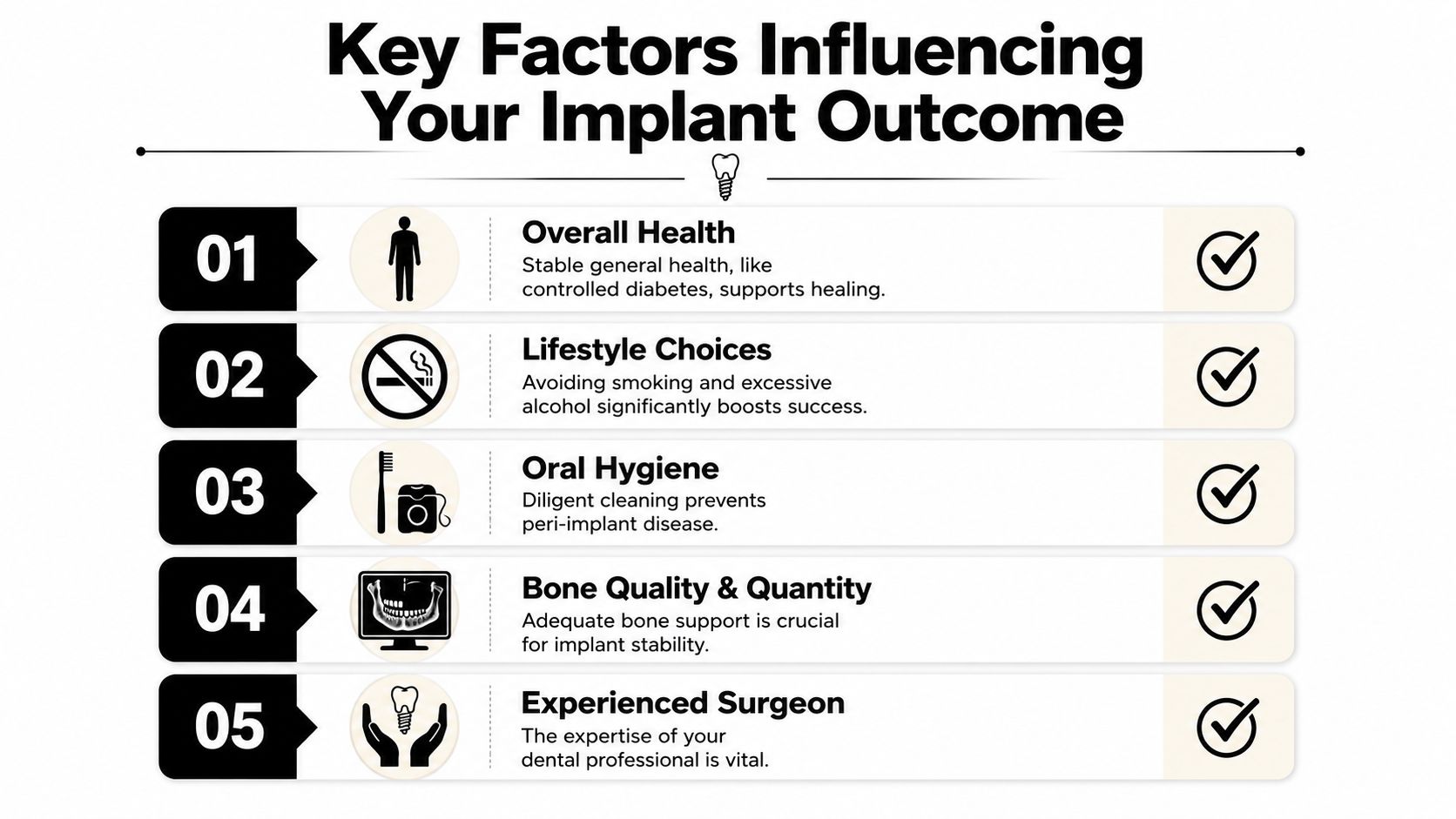
Some parts of implant treatment depend on bone shape, gum condition, and medical history. Several major factors are still in the patient's hands, and they make a real difference over the years.
- Smoking status affects circulation and healing. Smokers often heal more slowly and face a higher risk of inflammation around the implant.
- Home care habits matter every day. Plaque does not care whether it collects around a natural tooth or an implant crown.
- Follow-up attendance allows early treatment. Bleeding, irritation, or a bite issue is much easier to correct early than after bone loss has started.
- General health stability supports healing and long-term tissue health. Diabetes, immune conditions, and some medications may require closer coordination and a more careful schedule.
- Bite habits can shorten the life of excellent dentistry. Clenching and grinding place extra force on the implant, the crown, and the surrounding bone.
What good implant care looks like at home
Patients often ask whether an implant can get a cavity. It cannot. The gum and bone around it can still become inflamed, infected, or damaged if plaque stays in place.
A good routine is usually simple and consistent:
- Brush daily at the gumline, not just across the top of the crown
- Clean between teeth and implants with floss, picks, or other tools we recommend
- Keep recall visits and cleanings so we can check tissue health, bite forces, and bone support
- Call promptly about bleeding, soreness, or looseness instead of waiting to see if it passes
Small habits matter here.
I have seen beautifully placed implants fail because a patient disappeared for years after treatment. I have also seen patients with a history of gum disease keep implants healthy for a very long time because they were meticulous about home care and maintenance. That is the fundamental trade-off. The procedure gives you the opportunity. Your routine protects it.
The partnership that leads to better outcomes
Implant success is built over time. Surgery starts the process, but the long-term result depends on cooperation between the dental team and the patient.
Our team handles diagnosis, planning, implant selection, clean restorative design, and ongoing monitoring. You handle the daily care that no office visit can replace. Put those pieces together, and an implant can feel stable, look natural, and serve you well for many years.
How Surgical Technique and Implant Quality Affect Success
A well-made implant crown can still fail if the foundation under it is poorly planned or poorly placed. In my experience, long-term success usually comes from dozens of small clinical decisions that the patient never sees.
Planning before placement
Every implant starts with diagnosis. We study the bone, the gum tissue, the bite, the neighboring teeth, and the space available for the final restoration before we choose the implant position.
Standard dental x-rays often give us the first layer of information. If the case is more complex, CBCT imaging lets us examine bone width, height, contours, and nearby anatomy in three dimensions. That level of planning helps us place the implant where it can support a crown that looks natural, cleans well, and carries chewing force properly.
Patients sometimes focus on the day of surgery. I focus first on whether the site is fully ready.
Precision during surgery affects what happens years later
Bone integration depends on stability and positioning. If an implant is placed too shallow, too deep, too angled, or too close to another tooth, the result may still look acceptable at first while creating problems later.
Those problems are practical. Food may trap more easily. Flossing may become frustrating. The bite may hit too hard in one spot. Gum tissue may look uneven around the crown. In some cases, the implant itself remains in place, but the overall result is harder to maintain and less comfortable than it should be.
This is one of the clearest examples of partnership in implant care. Our job is to place the implant with control, protect the surrounding anatomy, and design a restoration that you can keep clean. Your job starts after that. Healing instructions, follow-up visits, and day-to-day plaque control protect the work we did in the operatory. If you want a better sense of how those stages unfold, our dental implant healing timeline explains what happens from placement through recovery.
Implant quality also matters
The implant itself is not a minor detail. Material quality, surface characteristics, connection design, and manufacturing consistency all affect how predictably an implant integrates and how well the final parts fit together over time.
Titanium remains the material used in the large majority of implant cases because it has a long clinical track record and integrates reliably with bone. Still, no material can overcome poor planning, excessive bite force, or missed maintenance. Good components improve predictability. They do not replace good technique or patient follow-through.
I tell patients in Walnut Creek the same thing every day. A dental implant is not just a product. It is a treatment sequence. We choose the case carefully, place it carefully, restore it carefully, and then monitor it over time. When both sides do their part, the result can feel stable, look natural, and serve you for many years.
Your Implant Timeline From Placement to Long-Term Success
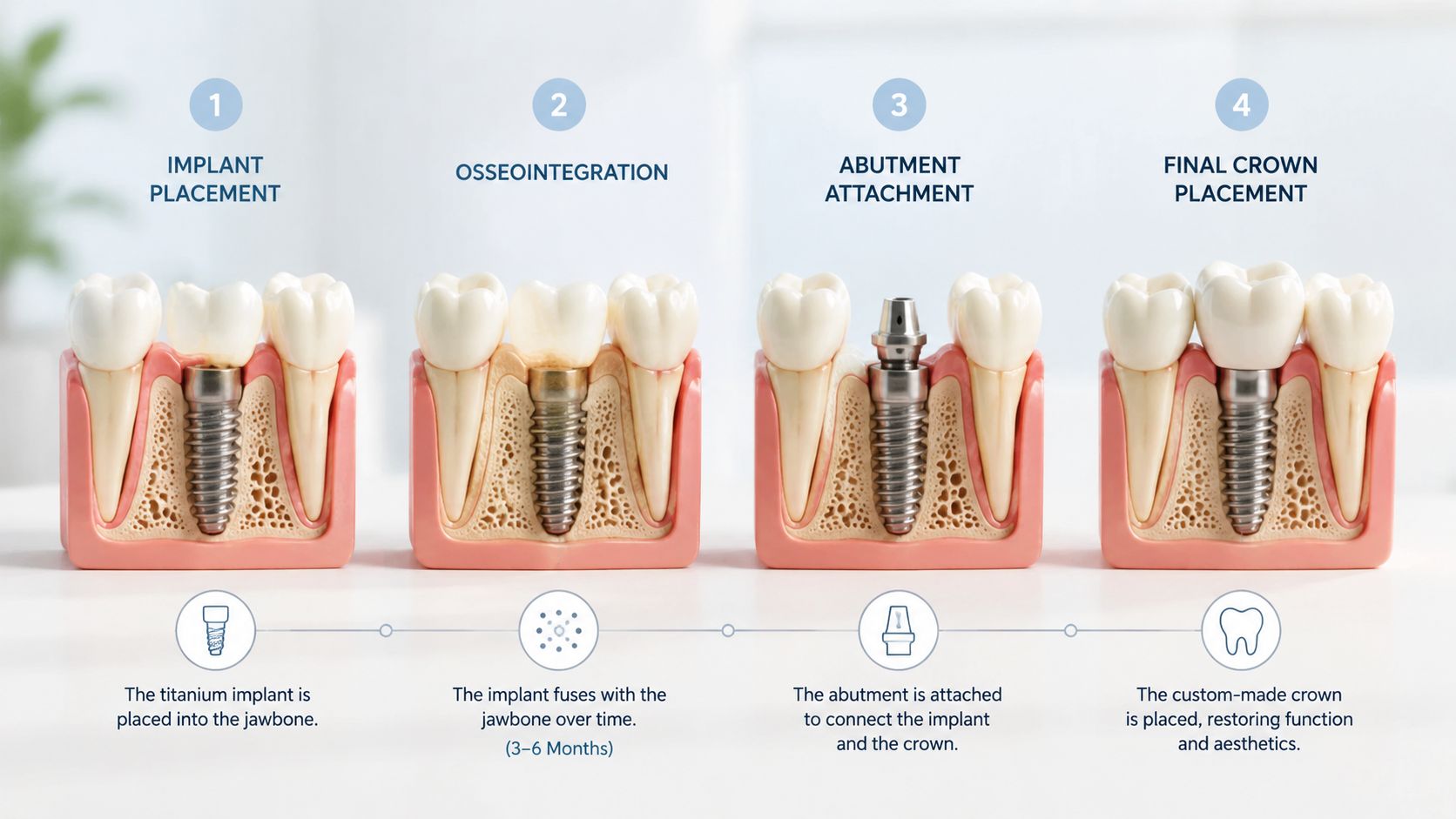
Implants don't become successful in one day. They become successful through stages. Knowing that timeline helps patients stay calm during healing and avoid expecting the final result too soon.
The early phase after placement
The first stage is placement of the implant post into the bone. After that, your body begins healing around it. During this period, the focus is protection. That means following food guidelines, cleaning instructions, and follow-up recommendations closely.
Some patients feel surprised that the visible tooth portion may not be completed immediately. That's often because the foundation needs time to stabilize before the final crown is attached. If you want a practical overview, this dental implant healing timeline explains how healing unfolds after placement.
The integration phase
Over the next several months, the implant and bone should integrate. This is the biological heart of the process. You may feel mostly normal during this time, but the area is still maturing.
That's why patience matters. Chewing habits, oral hygiene, and review visits all influence whether the final restoration is added under the right conditions.
Life with an implant over the long term
The encouraging part is what happens after healing goes well. Dental implants maintain strong long-term durability, with cumulative survival rates exceeding 90% over 10 years. Over a 20-year period, approximately 86% to 92% of dental implants remain functional, based on this long-term implant review.
Those figures are one reason implants remain a cornerstone of restorative dentistry. They're built for function. They're also built for routine life, which means eating, speaking, smiling, and cleaning them consistently.
A short visual explanation can make the sequence easier to picture:
What patients should expect emotionally
Most implant patients move through the same pattern. At first, they're worried about the procedure. Then they're impatient during healing. Later, they stop thinking about the implant much at all, which is usually a good sign.
That quiet, normal feeling is the goal. Whether you came in after a failed tooth, a planned extraction, or a cosmetic concern, long-term success usually looks uneventful. The implant becomes a natural part of your daily life.
Managing Complications and Ensuring Lasting Health
The most reassuring way to talk about complications is to be direct. They can happen. They're also easier to handle when they're caught early and when the original treatment is planned carefully.
Early problems and late problems are different
Some issues show up early, during the healing phase. Others appear later, after the implant has been functioning for years. Late problems often involve inflammation around the implant, difficulty cleaning the area, or changes in bite forces that place too much stress on the restoration.
Patients shouldn't interpret that as a reason to avoid treatment. They should see it as a reason to stay engaged with maintenance. Regular cleaning and exams, dental x-rays when needed, and prompt evaluation of bleeding or discomfort are what keep small concerns from turning into larger ones.
Why getting it right the first time matters
Replacement implants can still work well, but they don't perform exactly like first-time placements. Recent U.S. multi-university data shows cumulative survival drops from 98.6% for first-time implants to 96.1% for first replacements and further to 91.7% for second replacements, according to this review of replacement implant outcomes.
That's an important practical point for patients. It means careful diagnosis, site preparation, and maintenance from the start aren't small details. They matter because each additional round of treatment can become more complex.
If an implant area starts to bleed, feel sore, or trap food, don't “watch it” for months. Have it checked.
What helps protect implants over time
The most effective protection is usually simple and consistent:
- Routine professional cleanings and exams to monitor gum health and bone support
- Daily plaque control around the implant and neighboring teeth
- Bite evaluation if you clench, grind, or notice pressure changes
- Early treatment of inflammation before deeper tissue damage develops
Patients who treat their implant like a long-term health investment usually do better than patients who treat it like a one-time procedure. That mindset is often the difference between a restoration that merely stays in place and one that stays healthy, comfortable, and dependable.
Your Implant Consultation at Our Walnut Creek Dental Office
A consultation should leave you clearer, not more overwhelmed. If you're considering implants after tooth loss, a failed crown, advanced decay, or a recent tooth extraction, the first visit should answer practical questions about fit, timing, healing, and alternatives.
What happens at the first visit
A new patient implant consultation in Walnut Creek usually starts with a conversation, not a sales pitch. You'll discuss what happened to the tooth, what's bothering you now, and what you want your result to feel and look like. That may include comfort while chewing, cosmetic concerns, or the wish to avoid a removable replacement.
The clinical part often includes an exam, dental x-rays, and evaluation of the gums, bite, and bone support. If another issue needs attention first, such as gum disease or a damaged neighboring tooth, that should be addressed openly. Good treatment plans are built in the right order.

Questions worth asking
Patients searching for a dentist in Walnut Creek, CA often don't know what to ask at an implant consultation. These questions help:
- Am I a good implant candidate right now or do I need preparatory treatment first?
- What will healing involve and how do I care for the site at home?
- How will this affect nearby teeth and my bite?
- What maintenance will I need long term?
- If implants aren't ideal for me, what restorative dentistry alternatives should I consider?
Why the consultation matters even if you're unsure
You don't need to be fully decided before scheduling. A consultation is often where uncertainty becomes manageable. Some patients arrive thinking they need an emergency solution, then learn they have time to plan carefully. Others assume they aren't candidates and find out they have more options than expected.
That first conversation can also connect implants to your broader dental health. If you're due for cleaning and exams, new patient exams, or dental x-rays, those services often help create the full picture. For some patients, cosmetic goals such as teeth whitening or broader cosmetic dentistry become part of the discussion after function is restored.
If you live in Walnut Creek or nearby East Bay communities and want a clear, pressure-free assessment, the next step is simple. Schedule a consultation, get the facts about your mouth, and leave with a treatment plan that makes sense for your health, timeline, and goals.
If you're ready to replace a missing tooth with a plan built around long-term success, schedule a consultation with William M. Schneider, DDS. The office welcomes patients at 1855 San Miguel Dr., Suite 31 in Walnut Creek and provides thoughtful, personalized care for implant treatment, restorative dentistry, cosmetic concerns, routine dental care, and more.