If you've started noticing crowded teeth at home, a teen asking about Invisalign, or a bite that seems a little “off” at the dinner table, you're not alone. Those concerns usually show up first during routine cleanings and exams, not in an emergency, and a steady family dentist in Walnut Creek, CA can help sort out what's urgent, what's watchful, and what can wait until the next visit. At William M. Schneider, DDS, that conversation often starts with the whole household in mind, because braces, aligners, cleanings, and preventive care tend to work best when they're coordinated through one familiar dental home.
Orthodontic care has changed a lot. Roughly one-third of orthodontic patients are adults, up from about 20% in the early 2000s, and clear aligners now account for about 30% of new orthodontic case starts. The first clear aligners were introduced in 1999, and they'd been used to treat 17 million people by 2023, including 4.5 million teens. Those trend numbers matter in a family practice because braces and aligners aren't just for one stage of life anymore, they're part of long-term care for kids, teens, and adults in the same household.
When a Walnut Creek Family Starts Thinking About Braces
A child starts hiding a smile in photos. A teen asks whether a straighter bite is possible before sports pictures or graduation portraits. An adult has been putting off the aligner conversation and finally wants to understand the options. In Walnut Creek, those moments often surface between school drop-off, work calls, and routine dental check-ups, which is why a calm local dental home can make the decision easier to sort through.
William M. Schneider, DDS is set up for that kind of conversation. Instead of sending families straight into a separate specialty search, the office can look at whether the concern is mainly cosmetic, functional, or both, then talk through whether braces, clear aligners, or a referral makes sense. That first step lowers stress for parents who are balancing school schedules, sports, work, and because more than one person in the family may need care.
Why the first conversation often starts at a cleaning
Orthodontic questions rarely begin with an appliance. They usually begin when a dentist notices crowding, wear, gum irritation, or spaces that are changing over time. A family dentist can also tell whether the concern belongs in the “watch closely” group or the “start treatment now” group, which helps families avoid both overreacting and waiting too long.
Practical rule: if the concern shows up during a cleaning or exam, ask about braces then, not months later.
That approach helps parents who want one place for cleaning and exams, dental x-rays, and braces coordination. A local practice can keep the process more orderly because the same team that sees the child for prevention can also help plan the orthodontic next step. For families looking for a dentist near me who can support the whole household, that continuity matters.
Braces and Clear Aligners Explained in Plain Language
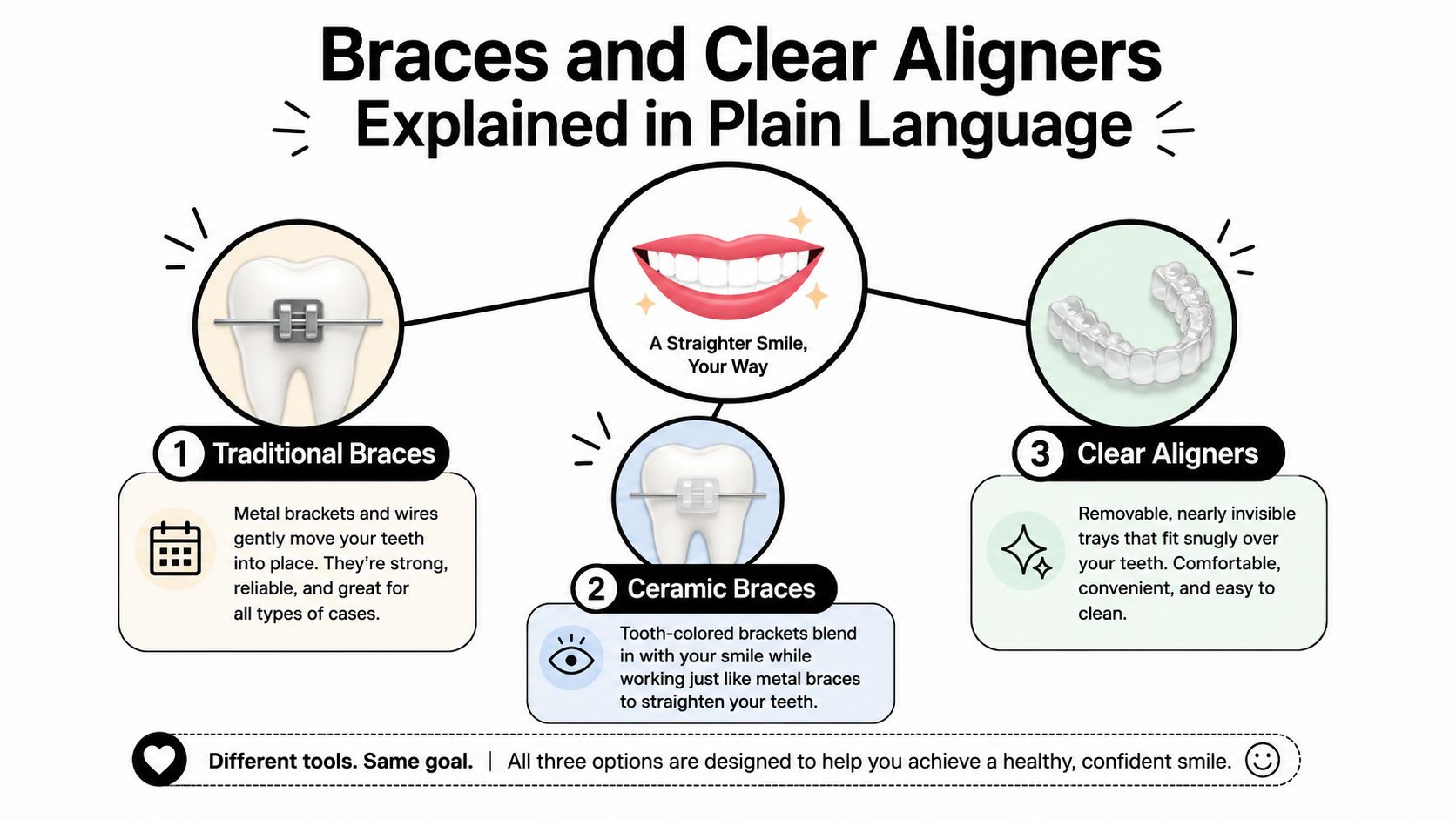
A child points to crowded front teeth at breakfast, a teen asks whether the metal will show in school photos, and a parent wonders if the bite problem will wait or needs attention now. Those are the moments when braces and clear aligners start to feel less like dental jargon and more like a family decision.
Traditional fixed braces move teeth by applying continuous, low-magnitude force through brackets and archwires. That pressure slowly reshapes the periodontal ligament and surrounding bone, which is why orthodontic movement takes patience instead of happening all at once. In many standard cases, active treatment often runs 18 to 24 months, and more complex crowding or bite discrepancies can extend to 30 months. EBSCO's dentistry overview explains the basic mechanism well enough for families to understand the “why” without getting buried in anatomy.
What changes between braces and aligners
The simplest comparison is how each option behaves in daily life.
- Traditional braces: Fixed to the teeth, so they stay on all day and do not rely on memory or compliance.
- Ceramic braces: Work like braces, but the brackets are more tooth-colored and less noticeable.
- Clear aligners: Removable trays that are swapped in sequence, often chosen by adults and teens who want something less visible.
The tradeoff is straightforward. Braces do the remembering for you, while aligners ask you to remember to wear them. That is why families usually talk through school routines, sports, snacks, and after-school activities before choosing one system over the other.
For Walnut Creek parents comparing options for a teen or for themselves, the better question is which tool fits the routine already in the home. A younger child may do better with fixed braces if keeping track of trays would be a struggle. An adult who wants a discreet option may prefer Invisalign, which is one reason aligners have become common in everyday family dentistry. You can also compare options in more detail through this local Invisalign versus braces guide.
Clear aligners are often easier to clean around, but they only work well when patients wear them consistently.
Family Dentist vs Orthodontist for Braces in Walnut Creek
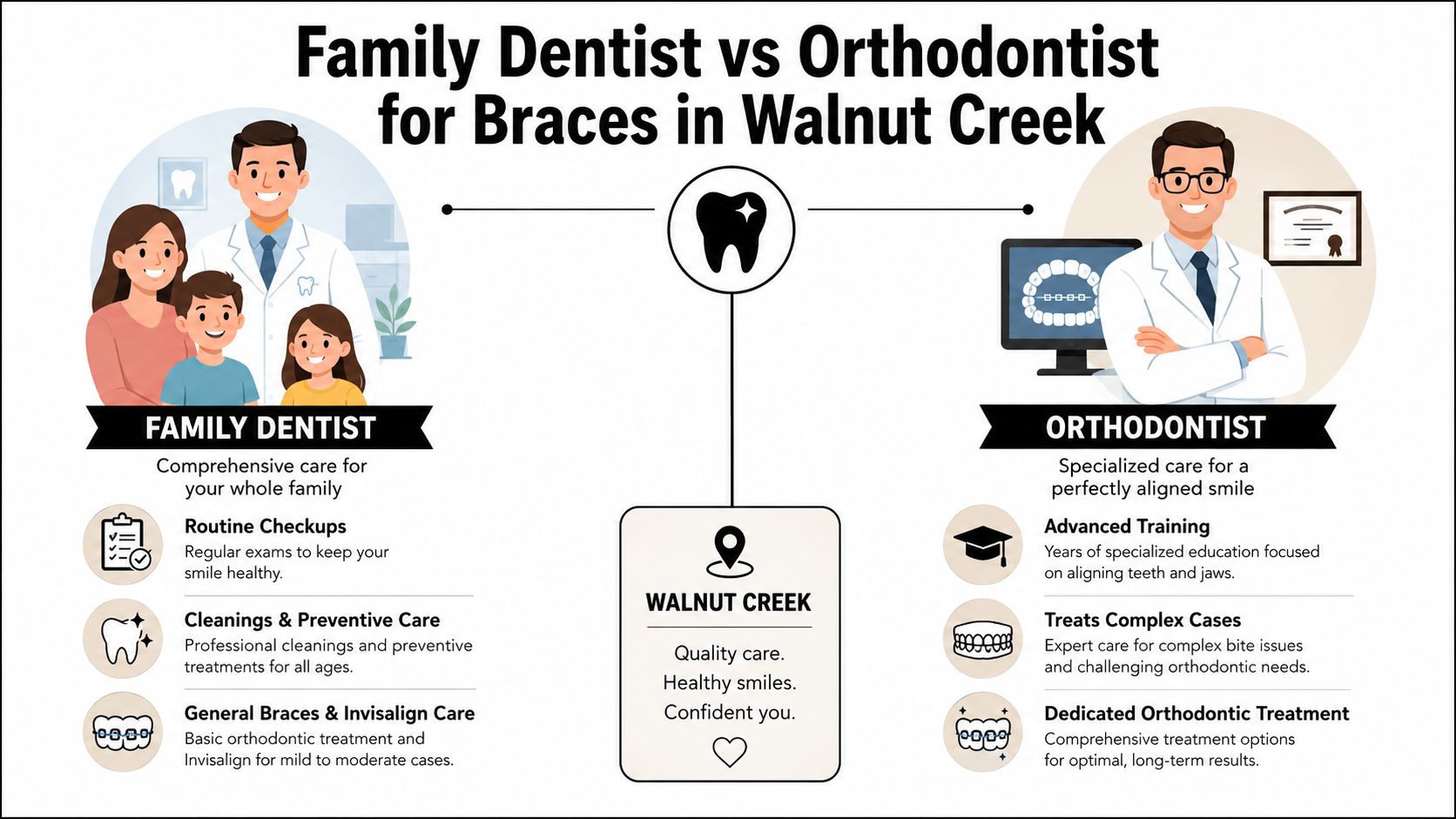
A Walnut Creek family may start with one simple question. Which office should guide braces, the regular dentist who already knows the household, or a specialist orthodontist who focuses on tooth movement and bite correction?
The answer depends on what the case needs and how much continuity the family wants. A family dentist can often screen for alignment concerns, manage mild cases, coordinate Invisalign or other aligner treatment, and keep preventive care moving in the same office. An orthodontist is usually the better fit for severe malocclusion, surgical planning, or jaw discrepancies that need more advanced movement planning.
For many parents, the appeal of a family dentist is practical. Cleanings, exams, and braces-related checks happen in one place, so the dental home stays familiar for children, teens, and adults. That can make it easier to keep up with appointments, handle small problems quickly, and fold orthodontic care into the rest of the family's oral health needs.
How the decision usually works in real life
A dentist-led plan often fits best when the teeth need modest correction and the family wants one office to coordinate care. The dentist can watch how the bite changes over time, keep an eye on gum health, and make sure routine preventive visits do not get pushed aside once treatment begins.
That matters because braces are not only about moving teeth. They also depend on regular cleanings, careful home care, and timely follow-up. A family dentist can keep those pieces connected, which is helpful for children who already come in for checkups, teens balancing school and activities, and adults trying to fit treatment into work and family schedules.
An orthodontist becomes the clearer choice when the bite is more complicated. Severe crowding, jaw-related differences, and cases that may eventually need surgery are better handled by a specialist who works with those problems every day. That is not a sign that family dentistry has failed. It is the right referral for the right level of complexity.
One way to sort the options is to ask where the care will be easiest to maintain:
- Family dentist care: screening, preventive visits, many straightforward aligner cases, and ongoing cleanings during treatment.
- Orthodontist care: more complex tooth movement, jaw-related planning, and difficult bite correction.
- Co-management: one office handles routine dental health while the specialist guides the advanced movement.
This shared approach can be especially useful in Walnut Creek, where parents often want a local dental home that can handle more than one stage of care. A child may need a braces check, a teen may need an aligner adjustment, and a parent may need a cleaning, all without turning dental care into a series of separate offices and extra drives. For more context on the broader family-care model, this Walnut Creek family dentist overview is a helpful starting point.
Who Is a Good Candidate by Age and Case Complexity
Age matters, but it doesn't tell the whole story. Children are still growing, so their jaws and tooth positions can be influenced earlier. Teens often want treatment that fits school and sports without drawing too much attention. Adults now make up a much larger share of orthodontic patients than they used to, and many of them prefer discreet options such as clear aligners.
The better question is not “How old is the patient?” It's “How complicated is the case?” Mild crowding, small spacing issues, and some bite problems may be appropriate for dentist-led treatment, especially if the patient can keep up with visits and hygiene. More severe crowding, jaw-related discrepancies, or cases that may eventually need surgery are more likely to need specialist care.
A simple fit check for families
If you're trying to sort out where someone in the family might land, this is a useful framework:
- Children: good candidates when early guidance or interceptive treatment can help direct growth.
- Teens: often good candidates for braces or aligners if they can manage appointments and daily care.
- Adults: often good candidates for Invisalign or braces when the bite issue is moderate and the plan is realistic for work and family life.
A community dental health study found that 81% of orthodontic referrals were initiated by the dentist, which supports the idea that the family dentist is often the first decision-maker in the process. The same study found 87% of patients were concerned about the appearance of their teeth, and 38% had experienced teasing related to dental appearance. That referral and motivation data fits what families say in real life, appearance and function are both part of the reason people ask about braces.
Adults don't miss the window for orthodontic care just because they didn't treat in middle school. They usually just need a plan that fits adult routines.
Timeline, Visits, Costs, and Sedation Options
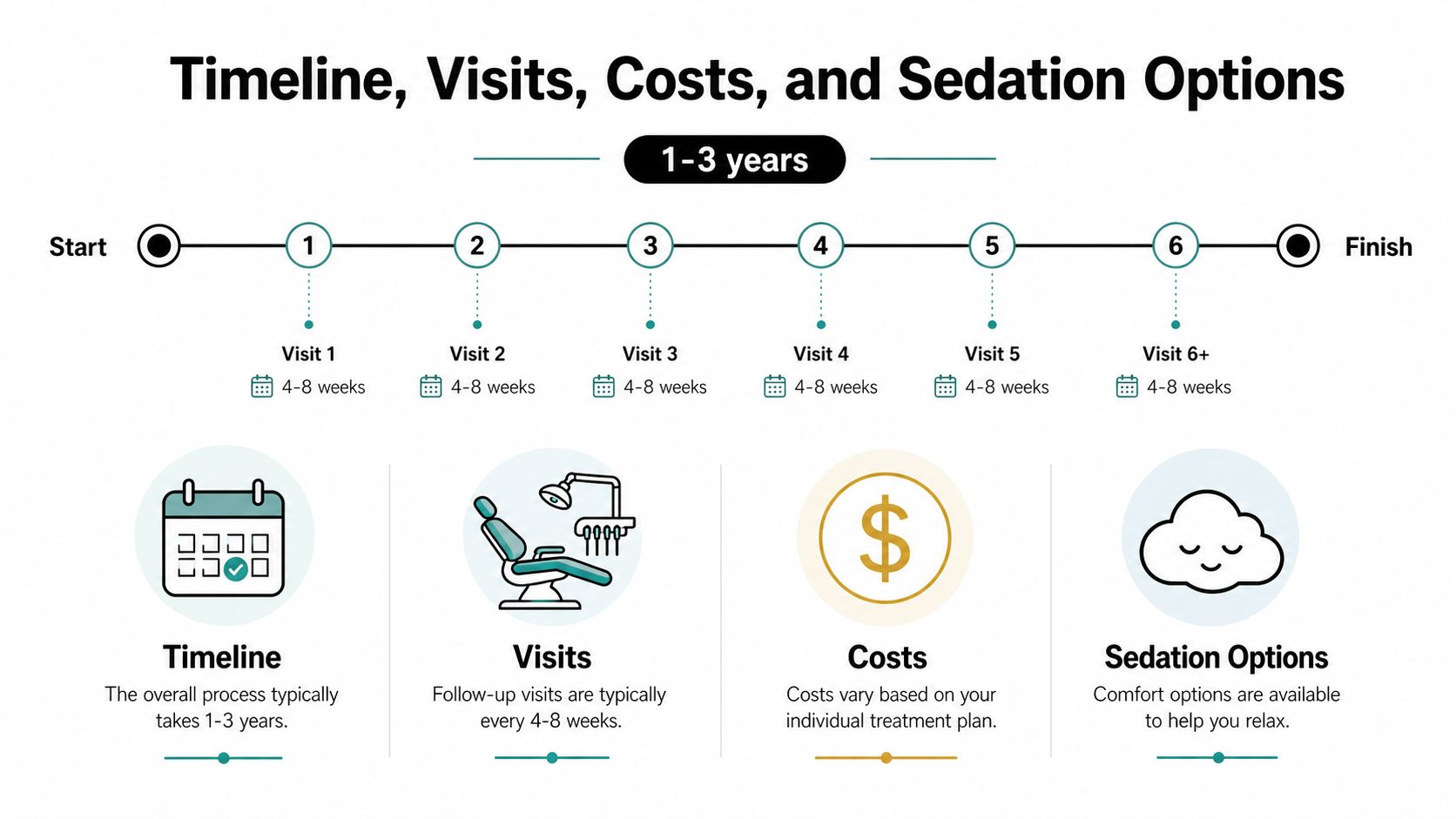
A braces plan is more like a long family project than a one-time repair. The teeth move slowly, the bite settles in stages, and the retainer phase keeps the result from drifting back. Healthdirect's brace and retainer guidance explains that braces are often worn for 1 to 3 years, then followed by retainers to hold the new position. Families who do well with treatment usually think beyond the active months and plan for the maintenance that comes after.
For Walnut Creek families, that long view works best when the dental home stays involved. A local family dentist in Walnut Creek can help coordinate braces or Invisalign-style care with cleanings, exams, and everyday questions from parents, so the plan feels connected instead of scattered across different offices.
What the schedule usually looks like
After braces go on, the check-ins are usually steady and predictable. Many patients return every 4 to 8 weeks so the wires can be adjusted and the teeth can keep moving in a controlled way. EBSCO's overview describes why those visits matter, because tooth movement depends on small, measured changes over time.
That rhythm is useful for families. It gives parents a chance to ask about soreness, broken brackets, hygiene, and whether the plan still fits school, sports, or work schedules. It also leaves room for same-day preventive care when a household already sees one dental team for regular cleanings and exams.
Costs depend on how complex the case is, how long treatment is expected to last, and whether the plan uses braces or clear aligners. In a family-dentist setting, the practical upside is often easier scheduling, fewer trips across town, and better coordination with routine visits for siblings and parents. That can matter just as much as the appliance itself, because orthodontic care is easier to keep up with when it fits into normal family life.
Anxiety can also shape how families experience treatment. William M. Schneider, DDS uses a calm, compassionate approach with painless injections and sedation options when appropriate, which can help nervous children and adults get through treatment planning or related procedures more comfortably. For a family thinking about braces alongside tooth extraction, restorative dentistry, or future dental implants near me searches, one office that already understands the whole mouth picture can make the plan feel less fragmented.
What families should ask at the consult
- Visit timing: how often will appointments happen, and can they be set around school or work?
- Retention: what kind of retainer plan follows active treatment, and how will it be checked?
- Anxiety care: what options are available if someone feels tense about dental work?
- Coordination: can cleanings, exams, and orthodontic monitoring happen in the same office?
Daily Care During Braces and Why Routine Cleanings Still Matter
Braces create more places for plaque to hide, so the home routine has to be more deliberate. The NHS recommends brushing with fluoride toothpaste in the morning, at night, and after meals, using an interdental brush every day to clean between teeth and under braces, and continuing regular dental check-ups while braces are on. NHS braces guidance is one of the clearest patient-facing summaries available.
The daily routine that actually works
Cleveland Clinic also recommends brushing at least twice a day, flossing once a day around braces, and avoiding hard, crunchy, or sticky foods that can damage appliances or enamel. Their brace care guidance gives families a practical baseline, and it's especially useful when parents need a routine that older kids can follow on their own.
A simple home routine looks like this:
- Brush carefully after meals: use fluoride toothpaste and work around brackets and wires.
- Clean between teeth daily: use floss tools or interdental brushes, not just a regular brush.
- Watch the food list: skip sticky candies, hard snacks, and anything likely to pop a bracket off.
Orthodontic treatment never replaces preventive dentistry. A patient with braces should still see a family dentist regularly for cavity check-ups, professional cleanings, sealants, fluoride varnish, and periodontal evaluations, based on individual risk. This preventive dentistry guidance supports a simple point families sometimes overlook, the braces are moving teeth, but the family dentist is still protecting the health of the teeth and gums around them.
Choosing a Walnut Creek Family Dentist for Braces
The best family dentist for braces is the one who can think in two directions at once, alignment and prevention. Look for experience with children and adults, clear aligner options, in-office imaging, transparent treatment discussions, accessibility, and a practice that can keep your cleanings and orthodontic follow-up in one place. In Walnut Creek, that matters because many families are juggling school commutes, work schedules, and care for more than one patient at once.
William M. Schneider, DDS fits that model with more than 25 years of experience, modern technology, and a team that offers Invisalign, preventive care, restorative dentistry, and a gentle approach for anxious patients. If you want a local office that can coordinate braces discussions with routine hygiene and long-term retention, start with a new-patient exam and ask which path makes sense for your household. The right office won't push you into treatment, it'll give you a clear plan.
If you're looking for a calm, experienced family dentist in Walnut Creek who can talk through braces, Invisalign, cleanings, and long-term retention without pressure, William M. Schneider, DDS is a strong place to start. Visit William M. Schneider, DDS to schedule a new-patient exam or braces consultation and get a practical plan for your family's smile.